- May 8, 2026
Sec 2 Math Topics: Complete Guide and Study Tips
Secondary 2 is widely regarded as one of the most pivotal years in a student’s academic journey in Singapore. The Sec 2 Math topics introduced at this level build directly on foundational concepts from Sec 1 while laying the groundwork for the more demanding O-Level Mathematics syllabus ahead. For many students, this is the year where gaps in understanding can quietly widen — and where the right support can make a transformative difference.
Whether your child is sailing through or starting to struggle, having a clear picture of what the Sec 2 Math syllabus covers — and how to approach it strategically — is invaluable. This guide breaks down every major topic in the Sec 2 Math curriculum, highlights the common pitfalls students encounter, and shares practical study tips that actually work. Read on to give your child the edge they need this year.
What Is Sec 2 Math and Why Does It Matter?
In Singapore’s education system, Sec 2 Mathematics sits at a critical junction. Students are still working within the Lower Secondary syllabus set by the Ministry of Education (MOE), but the concepts introduced in Sec 2 are noticeably more abstract and conceptually demanding than those in Sec 1. Topics like quadratic equations, indices, and coordinate geometry aren’t just examination requirements — they are the building blocks that students will rely on throughout their Upper Secondary years when preparing for the O-Level examinations.
Beyond examinations, Sec 2 Math develops critical thinking and problem-solving skills that students carry into everyday life and future academic pursuits. Students who develop a strong grasp of the Sec 2 syllabus tend to enter Sec 3 with far greater confidence, while those who let gaps accumulate often find the jump to O-Level topics especially steep. Early intervention and consistent practice during Sec 2 are therefore far more effective than last-minute cramming in Sec 3 or 4.
Core Sec 2 Math Topics You Need to Know
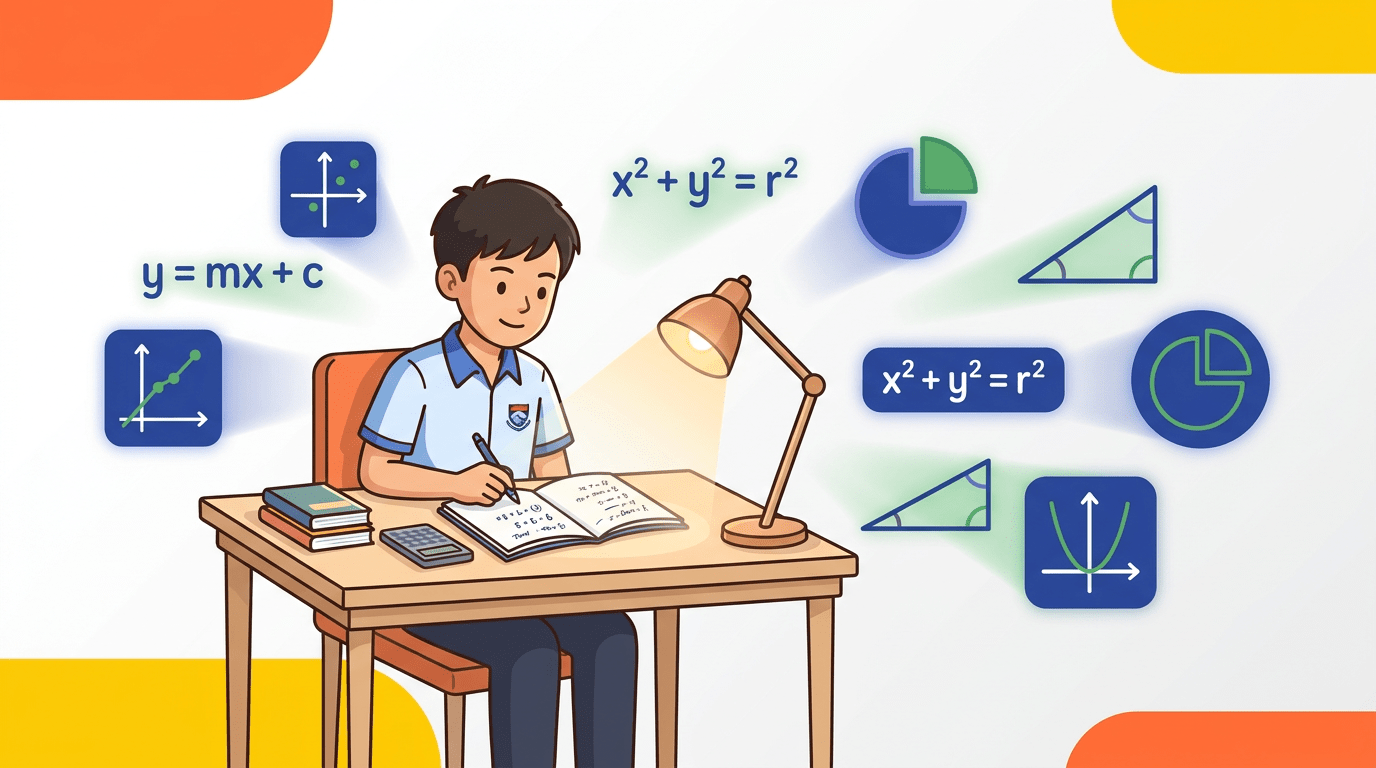
The Sec 2 Math syllabus covers a broad range of topics across algebra, geometry, and statistics. Here is a comprehensive breakdown of what students are expected to learn and master.
1. Algebra: Expansion and Factorisation
Algebra continues to be a central theme in Sec 2 Math. Students progress from basic algebraic manipulation to more complex skills such as expanding double brackets, factorising quadratic expressions, and applying algebraic identities. Key identities students must memorise and apply fluently include (a + b)² = a² + 2ab + b², (a − b)² = a² − 2ab + b², and (a + b)(a − b) = a² − b². These identities appear repeatedly across different question types, so mastery here pays dividends throughout the entire topic.
Factorisation takes expansion one step further by requiring students to work backwards — identifying common factors, using the cross method, and recognising special products. Many students find factorisation more challenging because it demands pattern recognition rather than a straightforward procedure. Regular practice with varied question types is the most effective way to build this skill.
2. Quadratic Equations
Closely linked to factorisation, quadratic equations represent one of the most significant new topics introduced in Sec 2. Students learn to solve equations of the form ax² + bx + c = 0 using factorisation, and they begin to appreciate how these equations connect to real-world problem-solving scenarios such as finding unknown dimensions or calculating time in motion problems. Understanding how to set up a quadratic equation from a word problem — not just solve one that is already written — is a skill that consistently separates stronger students from their peers.
3. Indices and Standard Form
Indices (also known as exponents or powers) form another cornerstone of the Sec 2 syllabus. Students are expected to apply the laws of indices fluently: the product rule, quotient rule, power rule, and the handling of zero and negative indices. Standard Form (scientific notation) is taught alongside indices, enabling students to work comfortably with very large or very small numbers in a concise and manageable format. These concepts frequently appear in combined questions, so understanding the relationship between them is important.
4. Graphs of Functions and Linear Graphs
Graphical representation is given significant attention in Sec 2. Students study linear graphs (y = mx + c) in greater depth, exploring gradient, y-intercept, and how to derive equations from graphs. They are also introduced to simple non-linear graphs such as quadratic curves (parabolas), which connect directly to their work on quadratic equations. Reading and interpreting graphs accurately — including finding the gradient from two points and understanding what different graph features represent — is an essential skill tested in examinations.
5. Geometry: Congruence, Similarity, and Pythagoras’ Theorem
The geometry strand in Sec 2 covers congruent and similar figures, requiring students to identify conditions for congruence (SSS, SAS, AAS, RHS) and apply the properties of similar triangles to solve for unknown lengths and angles. Pythagoras’ Theorem is also revisited and extended, including its application in three-dimensional contexts and problems involving the distance between two coordinate points. Many students underestimate this topic, but geometry questions can be among the most marks-heavy on the examination paper.
6. Mensuration
Mensuration in Sec 2 builds significantly on what students encountered in primary school. The focus shifts to calculating the volume and surface area of more complex three-dimensional solids including prisms, cylinders, pyramids, cones, and spheres. Students must memorise and apply the relevant formulae accurately, paying careful attention to units of measurement throughout their working. Composite solids — shapes formed by combining two or more basic solids — are a common examination favourite and require careful visualisation and problem-solving strategies.
7. Statistics and Probability
The statistics component in Sec 2 introduces students to data analysis skills including the construction and interpretation of various statistical diagrams: bar graphs, pie charts, histograms, and stem-and-leaf diagrams. Students learn to calculate and interpret measures of central tendency (mean, median, and mode) and understand their appropriate use in different contexts. Probability is also introduced, covering the basic concept of probability as a fraction and simple probability experiments. These topics may appear more straightforward than algebra or geometry, but students who skip practice here often drop marks unnecessarily in examinations.
Common Challenges Students Face in Sec 2 Math
Even diligent students encounter difficulty in Sec 2 Math, and understanding why can help both students and parents take more targeted action. One of the most common issues is careless errors in algebra — particularly with signs (positive and negative) during expansion and factorisation. These are not random mistakes; they usually indicate that the student has not fully internalised the underlying rules and is working on autopilot.
Another frequent challenge is difficulty transitioning between topics. Sec 2 Math questions increasingly require students to draw on multiple concepts at once — for example, using algebra to solve a geometry problem, or interpreting a statistical graph in the context of probability. Students who have studied each topic in isolation without connecting them often struggle with these integrated questions.
Finally, time management during examinations is a challenge many Sec 2 students have not yet developed strategies for. With paper formats testing a wide range of topics, students need to practise working efficiently under timed conditions — not just getting the right answer, but getting it within the available time. Consistent exam-style practice is the remedy here.
Proven Study Tips for Sec 2 Math
Scoring well in Sec 2 Math is less about innate talent and more about consistent, strategic effort. The following study strategies are tried and tested by students who make meaningful progress.
- Build a concept map: For each topic, create a one-page summary that connects the key rules, formulae, and worked examples. This visual reference reinforces understanding and is useful for last-minute revision.
- Focus on understanding, not memorisation: Memorising steps without understanding the reasoning leads to errors when questions are presented differently. Always ask “why” a method works, not just “how.”
- Practice with past-year papers: School examination papers and MOE-aligned practice papers expose students to the question styles and difficulty levels they will encounter. Aim to complete at least one timed paper per week as examinations approach.
- Review mistakes systematically: Keeping an error log — a notebook where wrong answers are corrected and annotated with an explanation of the mistake — is one of the most powerful revision tools available.
- Don’t skip “easy” topics: Topics like statistics and probability are often deprioritised in favour of more intimidating algebra content. However, consistent marks in these areas can meaningfully boost overall scores.
- Seek help early: If a concept is unclear, address it immediately rather than hoping it will make sense later. In mathematics, each topic builds on the previous one, and unresolved gaps compound quickly.
Consistency matters more than marathon study sessions. Short, focused daily practice sessions of 30 to 45 minutes are far more effective for mathematics than sporadic multi-hour cramming. Building this habit early in the year makes revision far less stressful as the end-of-year examinations approach.
How Tuition Can Make a Difference in Sec 2 Math
With a broad syllabus and the increasing complexity of topics in Sec 2, many students benefit greatly from additional support outside the classroom. In a typical school setting, teachers manage large classes and limited time, which means students who are slightly lost may not always receive the individualised attention they need. This is where structured tuition becomes a genuine game-changer.
At EduFirst Learning Centre’s Secondary Tuition programme, students receive targeted Sec 2 Math support in small group settings of just 4 to 8 students per class. This intimate format ensures that every student’s progress is closely monitored, misconceptions are identified and corrected promptly, and teaching is adapted to individual learning needs. Rather than sitting anonymously at the back of a large class, students at EduFirst are active participants in every lesson.
With 25 centres islandwide and over a decade of experience helping Singapore students succeed, EduFirst combines curriculum expertise with a warm, encouraging learning environment. Our experienced tutors don’t just teach to the examination — they help students develop the mathematical confidence and reasoning skills that serve them well beyond Sec 2. If your child is ready to strengthen their foundation and approach Sec 2 Math with greater confidence, explore our Secondary Tuition options today.
Final Thoughts
The Sec 2 Math syllabus is broad, progressive, and undeniably important. From algebraic manipulation and quadratic equations to geometry, mensuration, and statistics, each topic plays a role in shaping a student’s readiness for the O-Level journey ahead. The good news is that with a clear understanding of what to expect, consistent practice, and the right support system in place, any student can make meaningful progress — regardless of where they are starting from.
The key is not to wait. Whether your child is tackling a specific weak area or looking to consolidate their overall performance, taking early, targeted action during Sec 2 will pay dividends in the years ahead. Start by revisiting the core topics outlined in this guide, identify the areas that need the most attention, and build a realistic study plan that keeps mathematics a regular part of every week.
Give Your Child the Sec 2 Math Support They Deserve
EduFirst Learning Centre offers expert Secondary Maths tuition in small class sizes of just 4–8 students, ensuring your child gets the individual attention they need to excel. With 25 centres across Singapore, quality support is always close to home.