- May 8, 2026
Singapore Education System Explained: A Complete Parent’s Guide
If you are a parent in Singapore, few things feel as important — or as overwhelming — as understanding how your child’s education will unfold. The Singapore education system is internationally recognised for its rigour and outcomes, consistently ranking among the top in global assessments like PISA and TIMSS. But behind those impressive rankings lies a structured, multi-stage journey that every child takes from preschool through to post-secondary education, and understanding each step puts you in a far stronger position to guide and support your child along the way.
This complete parent’s guide walks you through every major stage of schooling in Singapore — from the early years right through to the critical PSLE and beyond into secondary school. Whether your child is just starting Primary 1 or you are preparing them for the leap to secondary school, you will find clear, practical information here to help you make confident decisions. We will also share honest advice on where additional academic support can make a meaningful difference, especially during key transition years.
Overview of the Singapore Education System
Singapore’s education system is built on a philosophy of developing every child to their full potential, regardless of background. Managed primarily by the Ministry of Education (MOE), the system is structured in clear stages: preschool, primary school, secondary school, and post-secondary education. Each stage feeds purposefully into the next, with national assessments helping to place students in environments best suited to their learning pace and strengths.
One of the most distinctive features of the system is its emphasis on both academic excellence and holistic development. Schools in Singapore are not just focused on exam results — they also cultivate values, character, and life skills through co-curricular activities (CCAs), national education programmes, and applied learning opportunities. For parents new to Singapore or those with children just entering the school system, understanding this broader framework makes the individual milestones far less daunting.
Preschool and Early Childhood Education
Formal education in Singapore typically begins between the ages of 18 months and 6 years, encompassing infant care, childcare, and kindergarten programmes. While preschool is not compulsory, it plays a foundational role in a child’s development, and the government has invested significantly in raising the quality of early childhood education across both private and government-supported providers.
Kindergarten (K1 and K2) is offered by providers such as PAP Community Foundation (PCF) Sparkletots, My First Skool, and MOE Kindergartens, among others. The curriculum at this stage focuses on language and literacy, numeracy, discovery of the world, motor skills, and social-emotional development. Children are introduced to both English and their Mother Tongue language, laying the groundwork for the bilingual education they will continue throughout their schooling.
For parents who want their young children to get a strong academic head start before Primary 1, enrolling them in a structured preschool programme is one of the most effective investments you can make. EduFirst’s preschool programme is designed to build early literacy and numeracy skills in a nurturing, small-class environment, helping children transition confidently into primary school.
Primary School Education (Primary 1 to 6)
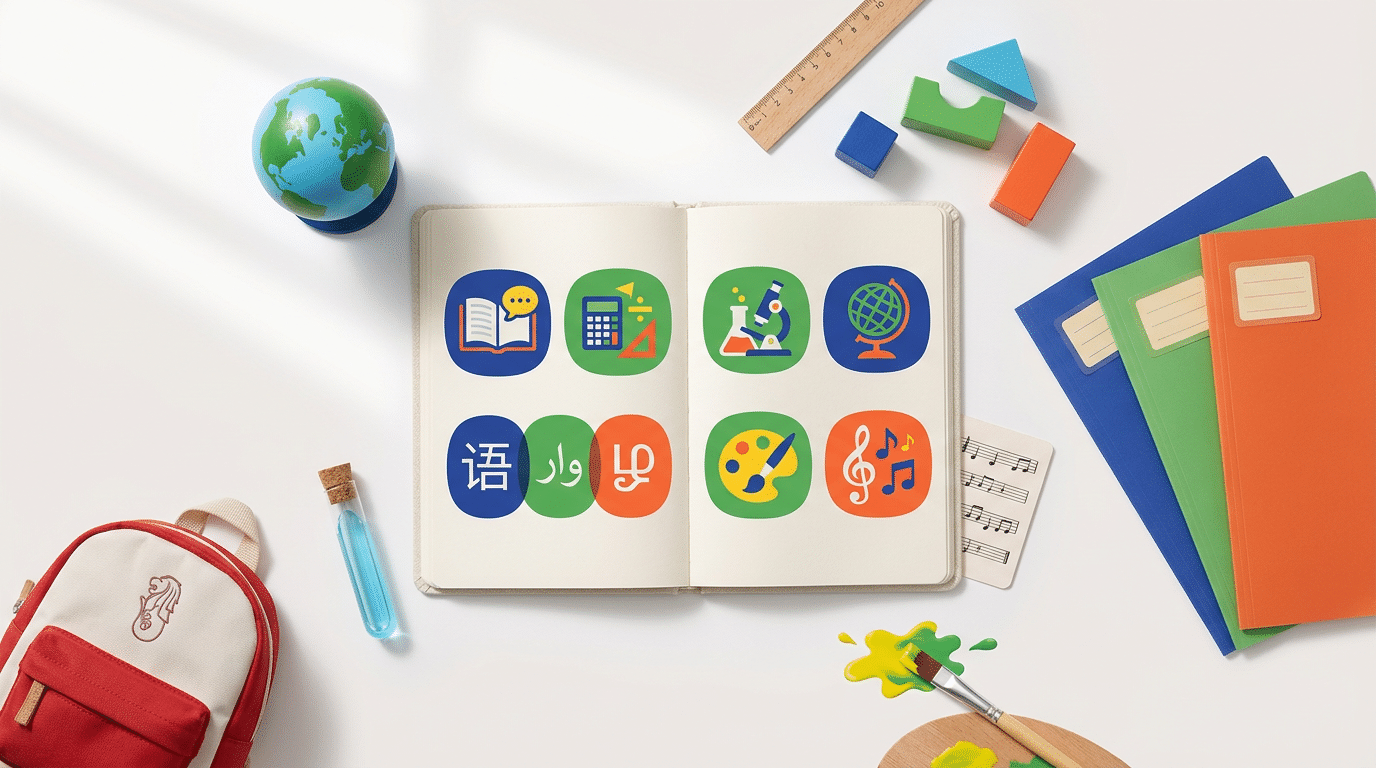
Primary school is where Singapore’s compulsory education begins. Children typically start Primary 1 at age 7 and progress through six years of schooling. The primary school curriculum covers English Language, Mother Tongue Language (Chinese, Malay, or Tamil), Mathematics, and Science (from Primary 3 onwards), along with Social Studies, Arts, Music, and Physical Education.
The lower primary years (P1 to P3) focus on building strong foundational skills. This is when children develop their reading and writing fluency in English, establish core mathematical concepts, and begin exploring the world around them through science and social studies. The upper primary years (P4 to P6) increase in complexity significantly, and it is during this phase that many parents begin to feel the academic pressure intensify.
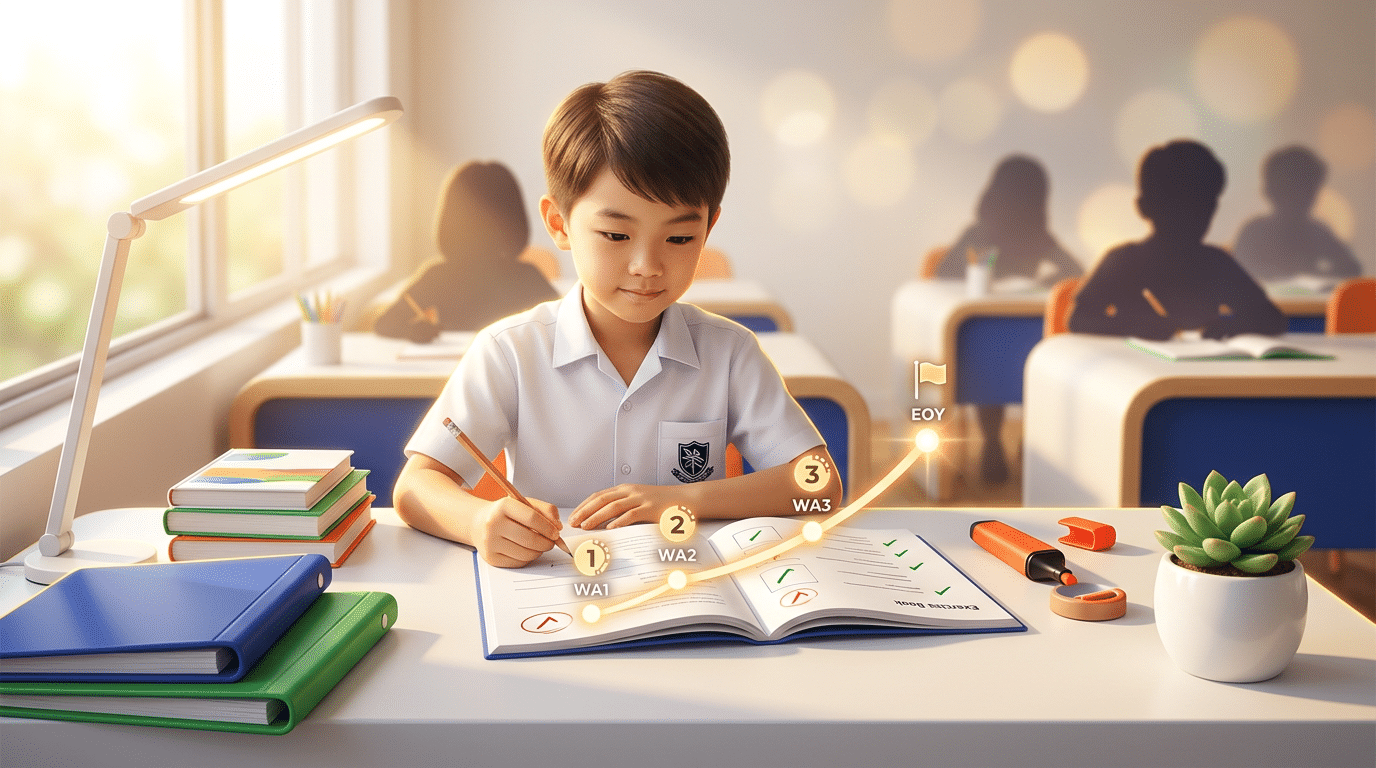
School-based assessments are now more holistic than they used to be — MOE removed high-stakes mid-year examinations for P1 to P3 students — but regular formative assessments, project work, and end-of-year examinations still form an important part of gauging student progress. Staying involved and informed during these years makes a real difference to how confidently a child approaches the PSLE in Primary 6.
For families looking for structured academic support during the primary years, EduFirst’s primary tuition programme covers English, Mathematics, Science, and Mother Tongue across all primary levels. With small classes of just 4 to 8 students, every child receives personalised attention and targeted feedback — something that can be difficult to achieve in a standard classroom setting.
The PSLE: What Parents Need to Know
The Primary School Leaving Examination (PSLE) is one of the most discussed milestones in any Singaporean child’s schooling journey. Taken at the end of Primary 6, the PSLE assesses students in English Language, Mother Tongue Language, Mathematics, and Science. The results determine which secondary school a child is eligible to attend and which academic track they will enter.
In 2021, MOE replaced the traditional T-score aggregate with the Achievement Level (AL) scoring system. Under this system, each subject is graded on a scale of AL1 (best) to AL8, and a student’s overall PSLE score is the sum of their four subject Achievement Levels. A lower total score is better, with the best possible score being 4 (AL1 in all four subjects). This change was intended to reduce excessive competition and focus on what each child can achieve individually, rather than ranking them against peers.
Secondary school posting is done through the Secondary 1 Posting Exercise, where students list their school choices in order of preference. Those with better PSLE scores have a wider range of options. Planning ahead — understanding which schools align with your child’s strengths and interests — is something families benefit from starting well before the P6 year.
Secondary School Education
Secondary school in Singapore spans four or five years, beginning at around age 13. The curriculum continues to cover English, Mother Tongue, Mathematics, and a range of elective subjects including the Humanities, Sciences, and Creative Arts. Students also participate in a Co-Curricular Activity (CCA), which contributes to their holistic development and is considered during certain post-secondary applications.
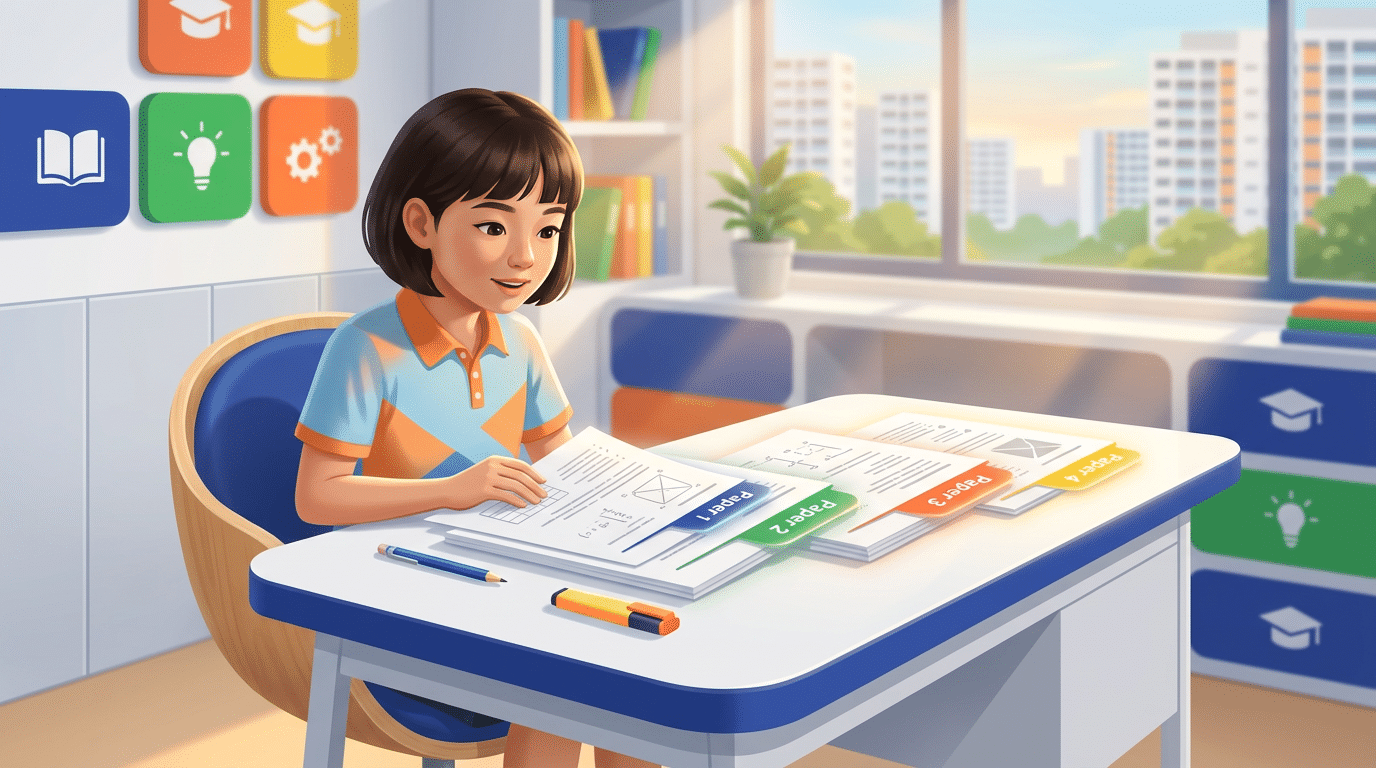
The national examination at the end of secondary school is the Singapore-Cambridge General Certificate of Education Ordinary Level (O-Level) for students on the Express and Normal (Academic) tracks, or the Normal (Technical) Nitec pathway for those on the Normal (Technical) track. O-Level results then determine eligibility for Junior College (JC), Millennia Institute, or Polytechnic entry.
Secondary school is academically demanding, and the subjects become far more specialised and conceptually challenging than anything encountered in primary school. This is when targeted academic support — particularly in subjects like Additional Mathematics, Combined Sciences, and Literature — can significantly impact a student’s final results. EduFirst’s secondary tuition programme is structured to help students master content, develop exam technique, and build the kind of academic confidence that translates into results when it counts most.
Subject-Based Banding: The New Streaming System
Singapore has moved away from the traditional three-stream system (Express, Normal Academic, Normal Technical) in secondary schools. Since 2024, the Full Subject-Based Banding (Full SBB) framework has been progressively implemented, allowing students to take subjects at different levels based on their individual strengths, rather than being placed wholesale into a single stream.
Under Full SBB, subjects are offered at G1, G2, and G3 levels (where G3 is the most demanding, aligning roughly with the former Express standard). A student might take Mathematics at G3 while taking English at G2, depending on where their abilities lie. This more flexible approach recognises that students rarely excel or struggle uniformly across all subjects, and it opens up more pathways for students to demonstrate their strengths.
For parents, this means the conversation around secondary school performance has shifted. Rather than focusing solely on which stream your child is in, the question becomes: Are they taking subjects at a level that reflects their true ability, and are they being supported to stretch as far as they can? Understanding this framework helps parents have more productive conversations with teachers and set realistic, encouraging goals for their children.
Beyond Secondary: JC, Polytechnic, and ITE
After secondary school, students in Singapore have several well-defined pathways to choose from, each suited to different learning styles, career interests, and academic profiles.
- Junior College (JC): A two-year pre-university programme culminating in the A-Level examinations. JC suits students who are academically strong and aiming for university entry through the traditional route.
- Millennia Institute (MI): A three-year pre-university programme offering more time for students to prepare for the A-Levels, suited to those who need additional time or performed at the Normal Academic level in secondary school.
- Polytechnic: A three-year diploma programme focused on applied learning across a wide range of disciplines including business, engineering, design, health sciences, and more. Polytechnic graduates can enter the workforce directly or pursue university education.
- Institute of Technical Education (ITE): Offers Nitec and Higher Nitec programmes emphasising hands-on technical and vocational skills, with clear pathways to polytechnic education for those who wish to continue.
All of these pathways lead to meaningful careers and further educational opportunities. Singapore’s education system has worked hard in recent years to challenge the perception that non-JC routes are lesser options — and many successful professionals today are proud polytechnic or ITE graduates.
How to Support Your Child at Every Stage
Understanding the education system is only the first part of the equation. The second — and arguably more important — part is knowing how to actively support your child through it. Every stage brings its own demands, and a child’s experience of school is deeply shaped by the support they receive at home and beyond the classroom.
Build Strong Foundations Early
The habits and attitudes your child develops in preschool and lower primary school will carry them through every subsequent stage. Encourage a love of reading, make numeracy fun through everyday activities, and help your child develop a growth mindset — the belief that effort and practice lead to improvement. Starting well is far easier than catching up later.
Stay Involved Without Hovering
Parental involvement has consistently been shown to improve student outcomes, but there is an important distinction between being engaged and being overbearing. Attend parent-teacher meetings, ask about your child’s day, review their work regularly, and communicate openly with their teachers. At the same time, give your child the space to develop independence and problem-solving skills — these are qualities that matter just as much as academic performance in the long run.
Seek the Right Academic Support When Needed
There is no shame in recognising when your child needs more support than a crowded classroom can provide. Many Singapore families turn to tuition — not to replace school learning, but to reinforce concepts, address gaps, and build confidence in subjects where a child is struggling. The key is choosing a programme that provides genuine, personalised attention rather than simply repeating what happens in school.
EduFirst Learning Centre has been helping primary and secondary students reach their potential since 2010, across 25 locations islandwide. With classes of just 4 to 8 students, their tutors can identify exactly where each child needs help and tailor lessons accordingly. Whether you are looking for primary tuition, secondary tuition, or even flexible e-lessons for families with busy schedules, EduFirst offers a structured, proven approach to academic support.
Take Care of Wellbeing, Not Just Results
Singapore’s education system is demanding, and it is easy for children to feel the weight of academic expectations from a young age. Make sure your child has time for rest, play, and activities they genuinely enjoy. Stress and burnout can affect learning far more severely than a missed revision session, so keeping your child’s mental and emotional wellbeing at the centre of all your educational decisions is not just good parenting — it is good strategy.
Final Thoughts
The Singapore education system is designed to give every child a pathway to success — but navigating it well requires parents to be informed, proactive, and realistic about their child’s individual needs. From the foundational preschool years to the demands of the PSLE and secondary school, each stage is an opportunity to build skills, develop character, and open doors to a wide range of futures.
No two children move through this system in exactly the same way, and that is perfectly fine. What matters most is that your child feels supported, understood, and encouraged to do their best — not someone else’s best. With the right information, the right expectations, and the right support around them, every child has the ability to thrive in Singapore’s schools and beyond.
Need Academic Support for Your Child?
EduFirst Learning Centre has been helping primary and secondary students succeed since 2010, with small classes of 4 to 8 students across 25 locations islandwide. Whether your child needs support in English, Mathematics, Science, or Mother Tongue — our experienced tutors are here to help.