- Aug 26, 2025 - 5 min read
The Bar Model Method: A Powerful Tool for Solving PSLE Questions
What is the Bar Model Method?
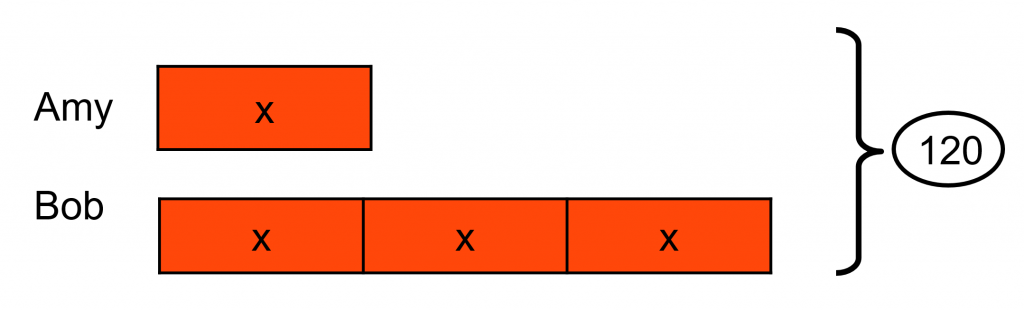
The Bar Model Method is a visual strategy where bars are drawn to represent quantities in a math problem. This technique is particularly useful for ratio problems, fractions, and whole-part relationships. Instead of diving straight into algebraic equations, the student can visualize the problem, making it easier to understand what needs to be calculated.
Example:
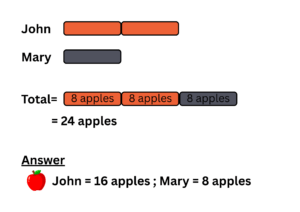
If John has twice as many apples as Mary, and together they have 24 apples, how many apples does each person have?
Using the bar model, we can draw:
-
2 equal bars for John
-
1 equal bar for Mary
-
Total = 3 bars = 24 apples → 1 bar = 8 apples
John = 16 apples, Mary = 8 apples.
Why is the Bar Model Method Important for PSLE Math?
The PSLE Math paper often includes non-routine word problems that require strong problem-solving skills. Many students struggle because they cannot translate the words into equations. The bar model acts as a bridge between understanding the question and finding the solution.
Benefits of Using the Bar Model Method:
✔ Improves comprehension of word problems
✔ Helps identify relationships between quantities
✔ Reduces careless mistakes
✔ Builds confidence in tackling complex questions
Common Types of PSLE Questions That Use the Bar Model Method
-
Whole-Part Problems
Example: A box contains 40 red and blue balls. There are twice as many red balls as blue balls. How many blue balls are there? -
Comparison Problems
Example: Peter has 3 times as many stamps as Sally. Together they have 96 stamps. How many stamps does Peter have? -
Fraction and Ratio Problems
Example: 3/5 of the students in a class are boys. If there are 18 girls, how many students are there in the class?
These types of questions appear frequently in PSLE Math Paper 2, making the Bar Model Method a crucial tool for scoring well.
Tips for Parents: How to Help Your Child Master the Bar Model
✔ Start Early – Introduce the bar model method from Primary 3 as it is part of the Singapore Math curriculum.
✔ Practice Different Question Types – Include fractions, ratios, and percentage problems in revision.
✔ Use Colour Coding – This helps children differentiate between different parts of the model easily.
✔ Work Through Past Year PSLE Papers – Identify questions that require bar model solutions.
Free Bar Model Practice Questions
To help your child get started, here are some practice questions:
-
A basket has 120 fruits. There are twice as many apples as oranges. How many apples are there?
-
A sum of money is shared between Alice and Bob in the ratio 3:5. If Bob receives $75 more than Alice, what is the total sum?
Conclusion
The Bar Model Method is not just a drawing technique; it’s a powerful problem-solving strategy that simplifies complex PSLE Math questions. By mastering this skill, your child will gain confidence and accuracy in tackling even the toughest PSLE Math problems.