- May 2, 2026
Polytechnic vs JC: Key Differences and How to Choose the Right Path
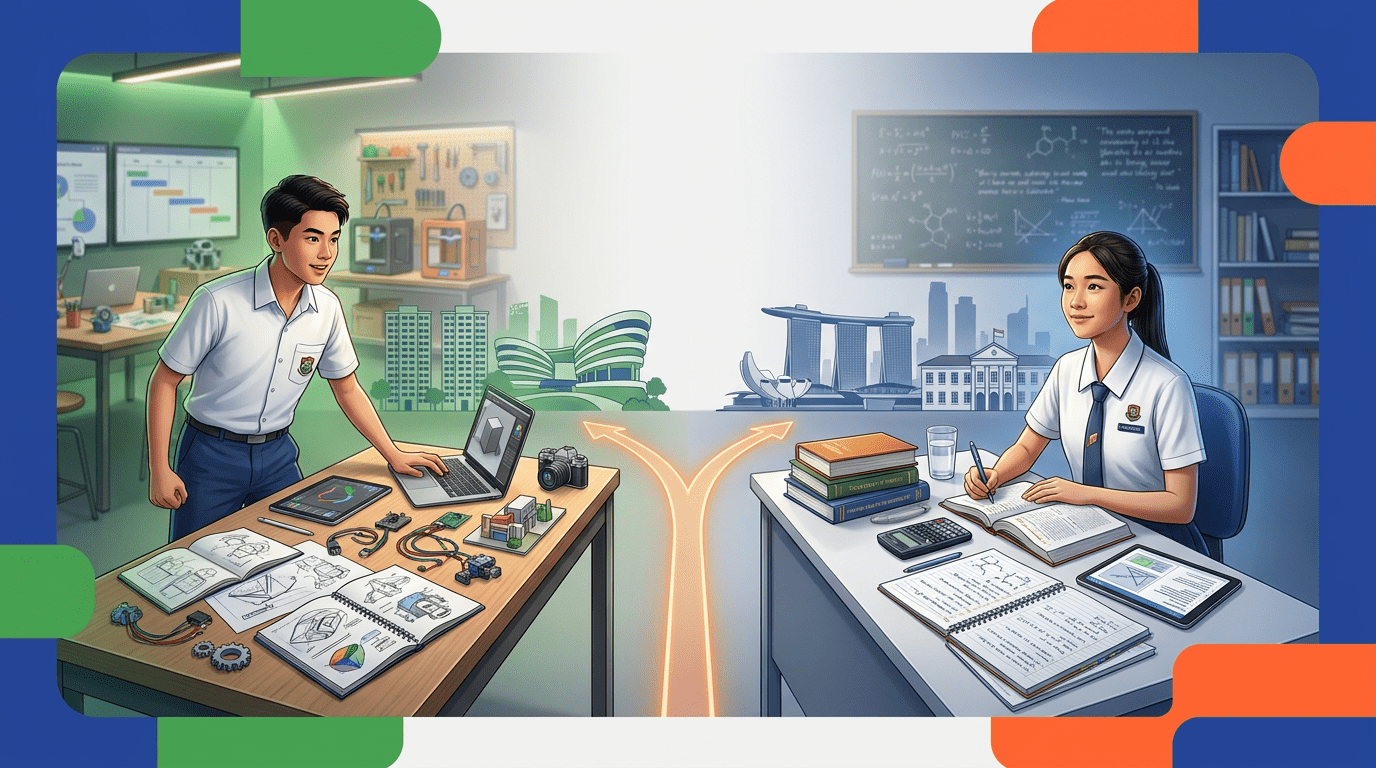
Every year, thousands of Secondary 4 students across Singapore sit with their O-Level results in hand and face one of the most consequential decisions of their young lives: Polytechnic or Junior College? It sounds straightforward, but the choice is anything but. Both pathways lead to meaningful futures, yet they are remarkably different in structure, culture, and the kind of learner they are designed to serve.
Parents often have strong opinions shaped by their own experiences, while students themselves may feel pulled in different directions by friends, teachers, or assumptions about prestige and career outcomes. The truth is there is no universally correct answer — only the right fit for each individual student. This guide breaks down the key differences between Polytechnic and JC in Singapore, explores what each pathway truly offers, and provides a practical framework to help students and parents make a confident, informed decision.
Understanding the Two Pathways
After the O-Level examinations, students in Singapore who qualify can choose to enroll in either a Junior College (JC) or a Polytechnic (Poly). Both are post-secondary institutions, but they operate on fundamentally different educational philosophies. JC is a two-year pre-university programme that prepares students for the A-Level examinations, which in turn serve as the primary gateway to local universities such as NUS, NTU, and SMU. Polytechnic, on the other hand, is a three-year diploma programme that combines academic knowledge with hands-on, industry-relevant skills across a wide range of fields.
Singapore has five polytechnics — Singapore Polytechnic, Nanyang Polytechnic, Ngee Ann Polytechnic, Temasek Polytechnic, and Republic Polytechnic — each offering hundreds of diploma courses. There are also six JCs under the Ministry of Education, including well-known institutions like Raffles Institution and Hwa Chong Institution, alongside newer merged colleges. Understanding what each institution is actually designed to do is the first step to making a sound choice.
Polytechnic vs JC: Key Differences at a Glance
Before diving into the nuances, it helps to understand the broad structural differences between the two pathways. These distinctions affect everything from daily routines to long-term career trajectories.
- Duration: JC takes 2 years; Polytechnic takes 3 years
- Primary Goal: JC prepares students for the A-Levels and university admission; Poly prepares students for industry with a vocational diploma
- Assessment Style: JC relies heavily on high-stakes written examinations; Poly uses a mix of projects, internships, presentations, and coursework
- Course Specialisation: JC students study a broad range of subjects; Poly students specialise in a chosen field from day one
- Class Size and Structure: JC classes are generally larger and more lecture-based; Poly uses a mix of lectures, tutorials, and project-based learning in smaller groups
- University Entry: JC students apply to local universities via A-Level results; Poly graduates can apply via GPA and may also pursue overseas universities or SIT/SUSS
These differences matter enormously depending on a student’s learning style, interests, and aspirations. Neither pathway is inherently superior — what matters is alignment with who the student is and what they want to achieve.
Curriculum and Learning Style
The JC Curriculum
Junior College follows a structured, subject-based curriculum that builds directly on the rigour of Secondary school academics. Students typically take three or four H2-level subjects alongside General Paper (GP), Project Work, and a contrasting subject. The pace is intense — many students describe the jump from Secondary school to JC as one of the steepest learning curves they have experienced. The entire two years culminates in the A-Level examinations, which determine university admission. For students who thrive in academically competitive environments and enjoy subjects like Mathematics, Sciences, Humanities, or Literature in depth, JC can be an intellectually stimulating experience.
However, the exam-heavy nature of JC means students who struggle with high-pressure, high-stakes testing may find the environment stressful. Strong foundation skills — particularly in subjects studied at the Secondary level — are critical for success. At EduFirst Learning Centre, our Secondary tuition programmes are designed to build exactly these foundations, helping students arrive at JC with the confidence and skills they need to handle the accelerated pace.
The Polytechnic Curriculum
Polytechnic education takes a very different approach. From the first semester, students immerse themselves in a chosen field — whether that is nursing, engineering, business, design, media, or any number of other disciplines. Learning is structured around real-world application: students work on industry projects, complete internships (known as Industrial Attachments), collaborate in teams, and present their work to panels. This applied, project-based model suits students who learn by doing rather than by reading and memorising. It also gives graduates a tangible portfolio of work and industry exposure that can be highly attractive to employers.
The Poly environment tends to be more autonomous and self-directed. Students manage their own timetables to a greater extent, which can be liberating for some and challenging for others. For students who have always been passionate about a specific field and are eager to gain practical skills, Poly can be an energising and purposeful experience.
University and Career Prospects
One of the most common concerns parents raise is whether choosing Polytechnic closes the door to university. The short answer is: it does not. In recent years, local universities have significantly expanded their intake of Polytechnic graduates, and the Poly-to-University pathway is well-established. NUS, NTU, SMU, SIT, SUSS, and SUTD all accept Poly graduates, and many courses actively value the practical experience and maturity Poly students bring. That said, the competition for popular courses via the Poly route can be stiff, and GPA requirements are demanding — typically above 3.5 for competitive programmes.
JC graduates who perform well in the A-Levels generally have a slightly more direct pathway to NUS and NTU for traditional degree programmes, particularly in fields like Medicine, Law, and the hard sciences where A-Level subject requirements are specific. However, it is important to note that not all JC students do well enough in the A-Levels to secure admission to their first-choice university — the examinations are challenging, and results are far from guaranteed. For career prospects without university, Poly graduates typically have a head start because of their industry experience and specialised skills, making them more immediately employable in their chosen fields.
Student Life and Environment
Beyond academics, the day-to-day experience of JC and Poly life differs considerably. JC students often describe a tight-knit school community with strong co-curricular activity (CCA) cultures, house events, and a shared sense of identity built around the two-year journey toward A-Levels. The school hours are generally fixed, and the structure resembles Secondary school in many ways — which can be reassuring for students who thrive in routine. Uniforms are worn, and the institutional culture tends to be more formal.
Polytechnic campuses, by contrast, feel closer to a university environment. Students do not wear uniforms, they navigate large campuses independently, and the social scene is broader and more diverse. CCAs exist but are less central to campus culture than in JC. The three-year timeline also allows for a more gradual settling-in period, which many students find less overwhelming. For students who are ready to exercise more independence and take ownership of their learning journey, this environment can be genuinely motivating.
How to Choose: Questions to Ask Yourself
Choosing between Poly and JC ultimately comes down to self-awareness. Encouraging students to reflect honestly on these questions can bring real clarity to the decision.
- How do you learn best? If you absorb knowledge through reading, discussion, and written examination, JC may suit you. If you learn better through doing, building, and problem-solving, Poly may be the better fit.
- Do you have a clear interest or passion? If you already know you want to work in hospitality, engineering, design, or healthcare, Poly lets you specialise early. If you are still exploring or want to keep all options open, JC gives you more time to decide.
- How do you handle academic pressure? JC demands consistent performance under high-stakes exam conditions. If you are resilient and motivated academically, JC can be rewarding. If sustained exam pressure tends to affect your wellbeing, Poly’s assessment style may allow you to shine.
- What are your university goals? If you have a specific degree pathway in mind — particularly in Medicine or Law — the JC-to-university route may be more straightforward. If you are open to different university options, both pathways work.
- Are you ready for independence? Poly requires more self-management. If you are a structured, guided learner, JC’s more supervised environment may help you stay on track.
Parents play an important role here too. Rather than projecting their own educational experiences onto their children, the most supportive thing parents can do is listen carefully to their child’s answers to these questions and help them reflect without judgment.
Does Your O-Level Score Decide for You?
To enter JC, students generally need a score of 20 or below (for a six-subject aggregate, with English included), though cut-off points vary by institution and subject combination. Polytechnic courses each have their own net ELR2B2 aggregate requirements, and popular courses such as Nursing, Business, and Mass Communication can be competitive. So while O-Level results do create a range of realistic options, they do not rigidly determine the outcome — students who fall just outside the JC cut-off may find Poly an excellent match for their abilities and interests anyway.
That said, performing well in the O-Levels always expands options and keeps more doors open. For students who are currently in Secondary school and want to maximise their choices, building strong foundations in every subject matters enormously. Our Secondary tuition at EduFirst Learning Centre, delivered in small classes of just 4 to 8 students, is specifically structured to help Secondary students achieve their best possible results — not just to meet cut-offs, but to truly understand the material and face their examinations with confidence.
For younger students still in primary school, it is never too early to build the habits and skills that will make these future decisions easier. Our Primary tuition programmes lay the groundwork for strong academic performance throughout a child’s schooling journey, from foundational literacy and numeracy all the way through to PSLE preparation.
Final Thoughts
The Polytechnic vs JC decision is one that feels enormous in the moment, but it is important to remember that both pathways lead to fulfilling, successful futures. JC offers academic depth, a structured community, and a clear route to university through the A-Levels. Polytechnic offers practical skills, industry exposure, and a learning environment that rewards curiosity and initiative. Neither is a fallback — both are legitimate, valuable choices that have launched countless successful careers in Singapore and beyond.
The best decision is the one made with honest self-reflection, good information, and an understanding that education is not a single race with one finish line. Students who choose the path that genuinely suits them — and who commit to making the most of it — will always be better positioned than those who choose based on external pressure or assumptions about prestige. Whatever path your child chooses, the right academic support along the way makes a real difference in outcomes and confidence.
Help Your Child Put Their Best Foot Forward
Whether your child is preparing for the O-Levels, navigating Secondary school, or still building foundations in Primary school, EduFirst Learning Centre is here to help. With small classes of 4 to 8 students across 25 locations islandwide, our experienced tutors provide the personalised attention that makes a genuine difference — in results, in confidence, and in the choices available after every major examination.
Explore our programmes or reach out to our friendly team today to find the right fit for your child.