- May 2, 2026
How Is Sec 1 Math Different from Primary Math?
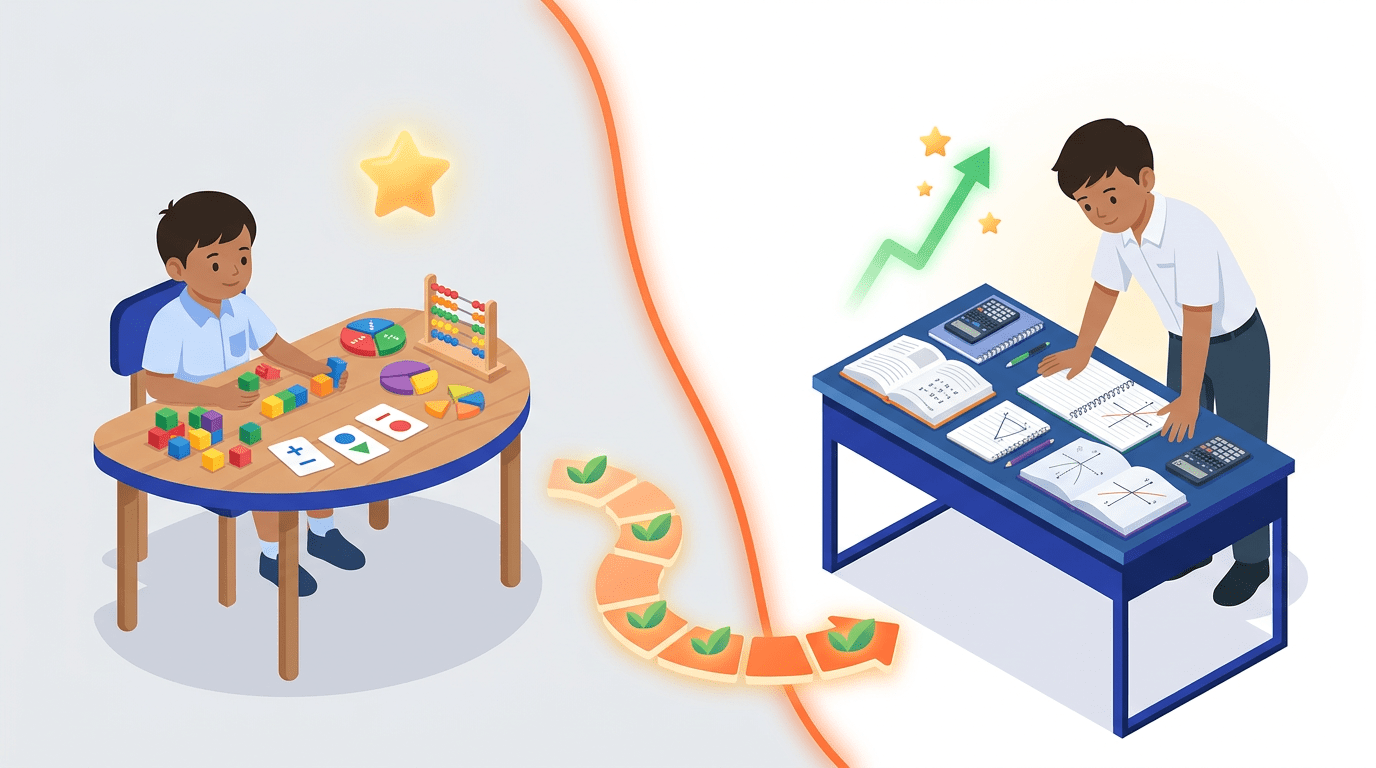
The jump from Primary 6 to Secondary 1 is one of the most significant academic transitions a student will face in Singapore. For many families, the subject that causes the most anxiety is Mathematics. Parents often ask: how different is Sec 1 Math from Primary Math, really? The honest answer is — quite different, and the shift can catch students off guard if they are not prepared.
It is not just about harder numbers or longer questions. Secondary 1 Mathematics introduces entirely new branches of the subject, demands a different style of reasoning, and expects students to work with greater independence and abstraction. Understanding these differences early gives your child a significant head start. This guide breaks down exactly what changes, what stays the same, and what you can do to help your child transition with confidence.
The Big Transition: What Changes When You Enter Sec 1
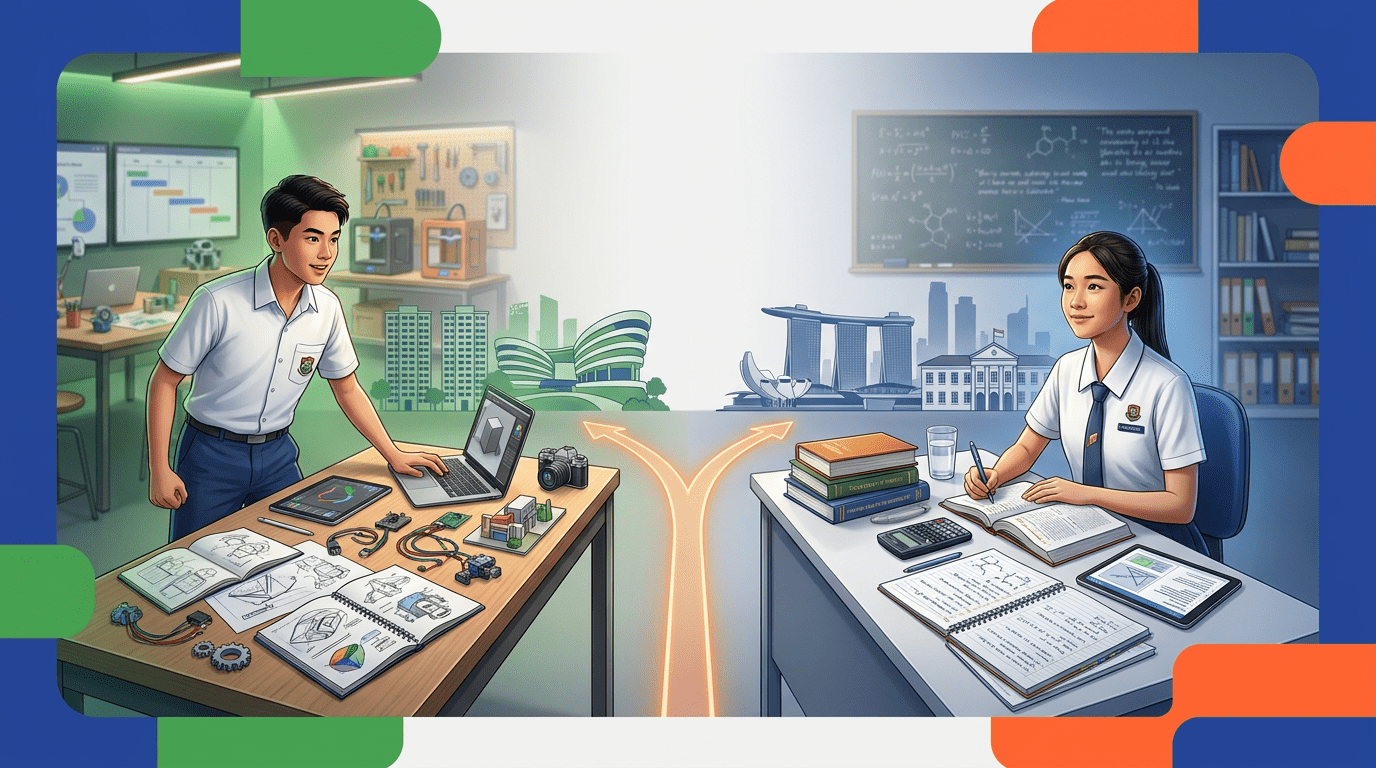
Primary school Mathematics in Singapore is built on a concrete-to-pictorial-to-abstract approach. Students learn to visualise problems using models, diagrams, and step-by-step methods that are closely guided by teachers. The focus is on building number sense, mastering the four operations, understanding fractions and percentages, and solving word problems using structured heuristics. By the time students complete PSLE, they are generally comfortable working within a familiar framework of problem types.
Secondary 1 Mathematics changes that framework significantly. The subject expands into multiple branches — including algebra, geometry, statistics, and number theory — and students are expected to handle more abstract concepts with less hand-holding. The pace is faster, the questions are more layered, and the ability to transfer knowledge across topics becomes essential. Students who relied heavily on memorising steps in primary school often find this transition the most challenging.
Curriculum Structure: Primary vs Secondary Math
In primary school, Mathematics is a single unified subject covering whole numbers, fractions, decimals, percentages, ratio, speed, geometry, and data analysis. The syllabus is designed to be progressive but relatively contained, with consistent exposure to familiar topic types across P1 to P6.
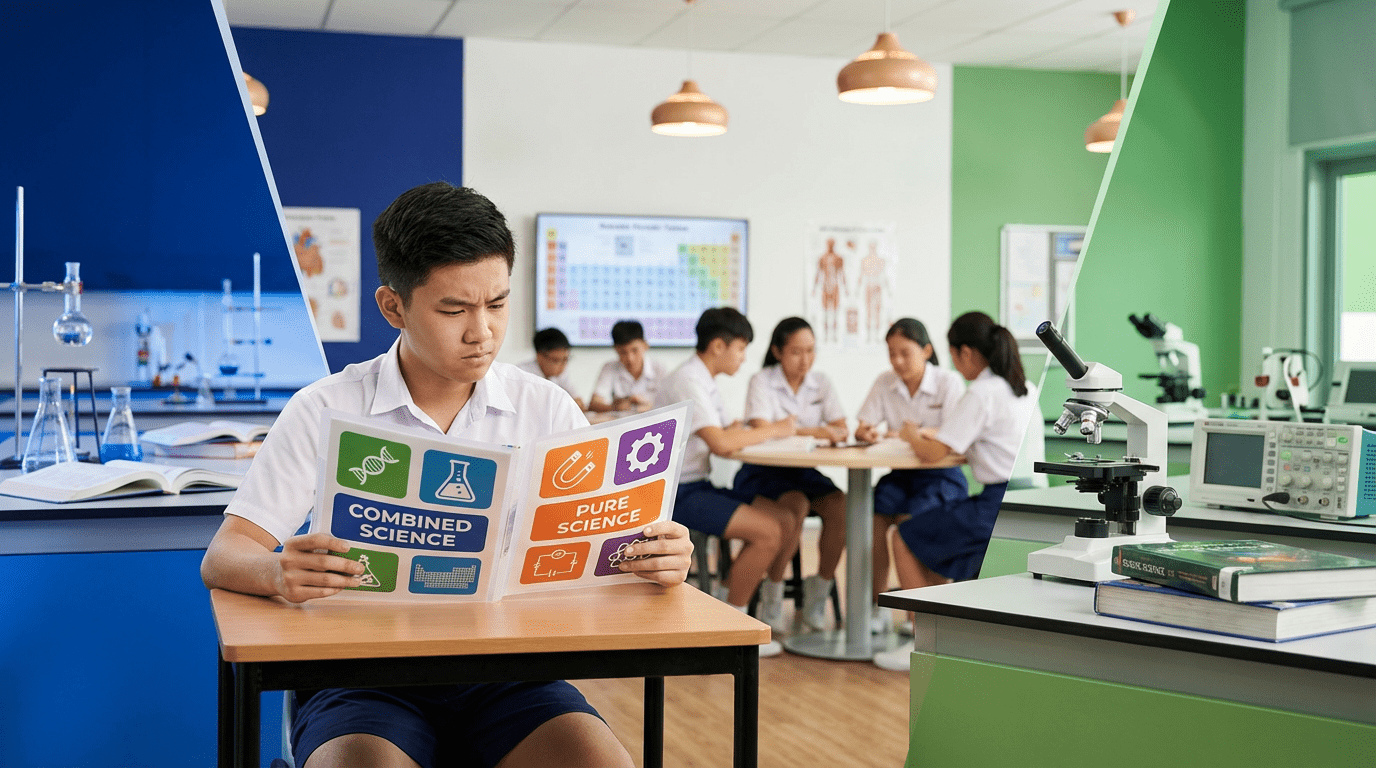
At the secondary level, Mathematics is still a core subject but the curriculum broadens considerably. In Singapore, Sec 1 students follow the MOE Lower Secondary Mathematics syllabus, which is divided into three main strands:
- Number and Algebra — integers, rational numbers, algebraic expressions, equations, and functions
- Geometry and Measurement — angles, triangles, polygons, congruence, and Pythagoras’ theorem
- Statistics and Probability — data representation, averages, and an introduction to probability
Each of these strands introduces concepts that are either entirely new or significantly more advanced than what was covered in primary school. The sheer breadth of content is one of the first things students notice — and it means there is far less time to dwell on any single topic before the class moves on.
New Topics Introduced in Sec 1 Math
While some topics like percentages and basic geometry carry over from primary school, a large portion of the Sec 1 syllabus is genuinely new. Here are the key areas students will encounter for the first time:
- Algebra — The formal introduction of algebraic notation, simplifying expressions, expanding brackets, and solving linear equations is one of the biggest shifts. Primary school uses letter notation occasionally in problem-solving, but Sec 1 formalises this into a full topic that underpins everything else.
- Negative Numbers and Integers — Primary Math deals only with whole numbers and positive values. In Sec 1, students work with negative numbers, directed numbers, and operations involving the number line in both directions.
- Linear Equations and Inequalities — Solving for unknowns using formal algebraic methods is a new skill that requires students to think logically and apply rules consistently.
- Ratio, Rate, and Speed (extended) — While ratio and speed are covered in primary school, secondary level treatment is more abstract and connects these ideas to algebraic reasoning.
- Basic Geometry Proofs — Students begin learning how to construct logical arguments to prove geometric properties, rather than simply identifying shapes and calculating angles.
- Introduction to Statistics — Topics like mean, median, mode, and data interpretation become more rigorous and require students to analyse and draw conclusions from data sets.
These topics are not just harder versions of what came before — they require students to develop entirely new mental models for thinking about Mathematics.
A Shift in Mathematical Thinking
Perhaps the most overlooked difference between Primary and Secondary Math is not the content itself but the type of thinking required. Primary school Mathematics emphasises concrete problem-solving: you are given a scenario, you identify the method, and you apply it. The bar model method is a perfect example — it is a visual, structured tool that guides students through multi-step problems in a systematic way.
Secondary Mathematics expects students to think more abstractly and flexibly. A Sec 1 student needs to recognise when to apply algebra versus arithmetic, how to work backwards from an answer, and how to connect ideas across different topics in a single question. The questions also become more multi-layered — a single exam problem might require knowledge of geometry, algebra, and ratios all at once.
This shift from structured, model-based thinking to abstract, flexible reasoning is where many students struggle most. It is not because they are not capable — it is because they have never been asked to think this way before. Building this skill takes deliberate practice and guided exposure, which is why structured support during this transition period is so valuable. Our secondary tuition programmes at EduFirst are specifically designed to help students develop this kind of mathematical reasoning from the moment they enter Sec 1.
Common Struggles Students Face in Sec 1 Math
Knowing what to expect helps parents and students prepare more effectively. These are the most common challenges that arise during the primary-to-secondary transition in Mathematics:
- Algebra anxiety — Many students find the introduction of letters representing unknown values confusing at first, especially when they are used to working with concrete numbers.
- Gaps from Primary 6 — Students who found PSLE Math challenging may carry foundational gaps into Sec 1, and these tend to widen quickly when new content is built on shaky foundations.
- Faster pace — Secondary school moves through topics more quickly than primary school. If a student misses a concept, it is harder to catch up before the next topic builds on it.
- More independent studying — Secondary students are expected to revise more independently and manage their own study schedules, which is a new skill in itself.
- Exam format differences — Secondary Math exams use different question formats, including structured working, show-that questions, and multi-part problems that require clear presentation of working steps.
Recognising these challenges early — rather than waiting for a poor result to signal a problem — gives your child far more time to build confidence and competency before high-stakes assessments arrive.
How to Prepare Your Child for Sec 1 Math
The good news is that the transition to Sec 1 Math does not need to be overwhelming. With the right preparation and mindset, most students can adapt well within the first semester. Here are practical steps that make a real difference:
- Strengthen primary school fundamentals before Sec 1 begins — Make sure your child is confident with fractions, decimals, percentages, ratios, and basic algebra. These are the building blocks for almost everything in Sec 1.
- Introduce algebraic thinking early — Even before school starts, practising simple equations like solving for x builds familiarity so algebra feels less foreign in class.
- Develop good working habits — Sec 1 teachers expect to see full working shown clearly. Help your child get into the habit of writing out every step rather than trying to solve problems mentally.
- Encourage regular revision, not just pre-exam cramming — Mathematics builds cumulatively, so revisiting topics weekly keeps concepts fresh and prevents knowledge gaps from forming.
- Seek support early if your child is struggling — Do not wait for a failing test grade. If your child seems confused by a concept in week two, addressing it promptly prevents a snowball effect.
If you are looking to build your child’s foundation before they start secondary school, exploring our primary tuition programmes is a great starting point. A strong P6 foundation makes the Sec 1 leap far more manageable.
How Tuition Support Can Make the Difference
For many students, the classroom pace in secondary school simply does not allow enough time to consolidate every new concept before moving on. This is where structured tuition plays a crucial role — not just in catching up, but in building genuine understanding that prevents problems from developing in the first place.
At EduFirst Learning Centre, we have been supporting students through the Primary-to-Secondary transition since 2010. Our Sec 1 Math classes are kept deliberately small, with just 4 to 8 students per group, so every student receives the personalised attention they need. Our experienced tutors know exactly where students typically stumble — from algebra basics to geometry proofs — and they structure lessons to address these pain points proactively.
Whether your child needs to fill gaps from primary school, get ahead on new Sec 1 topics, or simply build confidence in their mathematical thinking, our secondary tuition programme is tailored to meet them where they are. With 25 locations islandwide and flexible scheduling options including e-lessons, quality support has never been more accessible.
Final Thoughts
The difference between Sec 1 Math and Primary Math goes well beyond content — it represents a fundamental shift in how students are expected to think, reason, and approach problems. New topics like algebra, negative numbers, and formal geometry, combined with a faster pace and greater independence, can feel like a steep hill at first. But with the right preparation, consistent practice, and targeted support, your child can not only keep up — they can thrive.
The earlier you start preparing, the smoother the transition will be. Whether your child is still in primary school building their foundations or has just entered Sec 1 and is finding the adjustment tough, there is always an effective path forward. The key is not to wait and hope the difficulty resolves itself — it is to take action early and give your child the support and skills they need to succeed.
Help Your Child Conquer Sec 1 Math with Confidence
At EduFirst Learning Centre, our experienced tutors guide Secondary 1 students through every new concept in small classes of just 4–8 students — so no one gets left behind. With 25 centres islandwide and flexible e-learning options, expert support is always within reach.