- Oct 23, 2025 - 5 min read
Fun Ways to Learn About Magnets
What Are Magnets?
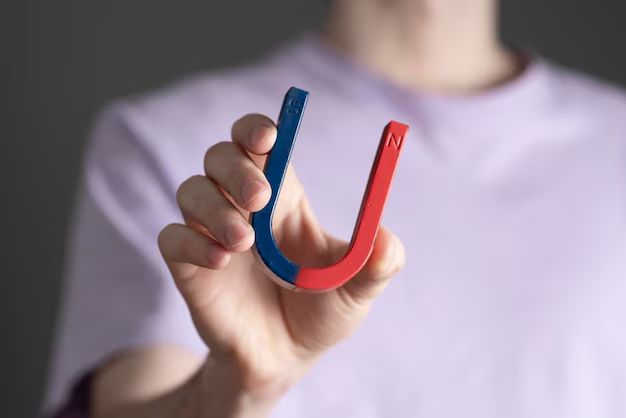
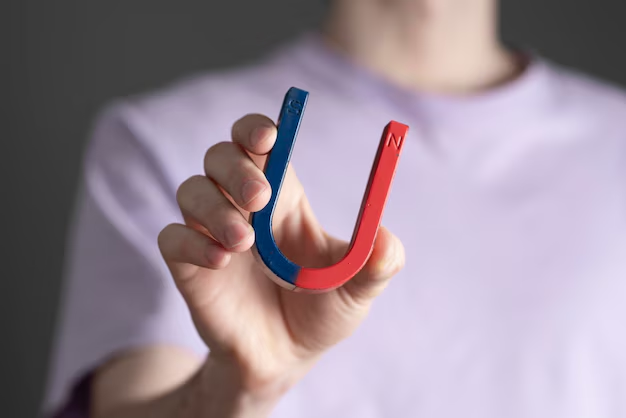
Magnets are objects that can attract or repel certain materials, such as iron, steel, cobalt, and nickel. The ends of a magnet are called poles — one is the North Pole (N) and the other is the South Pole (S).
When you place two magnets together:
- Like poles repel (N–N or S–S)
- Unlike poles attract (N–S)
This simple concept helps students understand the basic principles of magnetism, an important foundation in Primary Science.
Fun and Easy Magnet Experiments at Home
Here are a few simple experiments your child can try — safe, fun, and educational!
1. Magnetic Treasure Hunt
What you’ll need: A small magnet, paper clips, coins, plastic toys, and wooden blocks.
👉 Let your child test which items are magnetic!
This helps them learn to differentiate magnetic and non-magnetic materials — a key learning objective in the Primary 3 Science syllabus.
2. Magnet Fishing Game
Cut out fish shapes from paper clips and paper, then use a magnet tied to a string as a “fishing rod.”
🎣 This activity teaches children about magnetic attraction while keeping it playful and engaging.
3. Magnetic Maze Challenge
Draw a simple maze on cardboard, place a paper clip on top, and move it using a magnet from below the board.
✨ Kids will be amazed to see how the magnetic force can act through materials!
4. DIY Compass
Rub a steel needle with a magnet in one direction about 30–40 times. Float the needle on water using a small piece of cork.
🧭 Watch it align itself north–south — a simple demonstration of Earth’s magnetic field!
Why Learning About Magnets Is Important
Understanding magnets helps children:
- Build a foundation for Physics concepts they’ll learn in Secondary School Science.
- Develop critical thinking through hands-on exploration.
- See science in real life — from fridge doors to electric motors!
Magnetism also encourages inquiry-based learning, where students observe, test, and make conclusions — just like real scientists.
Common Misconceptions About Magnets
Even some adults get these wrong!
Here are a few points to clarify for your child:
- ❌ Not all metals are magnetic (e.g. aluminium and copper are not magnetic).
- ❌ Magnets do not “stick” to all shiny objects.
- ✅ Magnetic forces can act through non-metallic materials like paper and plastic.
How EduFirst Learning Centre Can Help
At EduFirst Learning Centre, our experienced Science tutors make learning interactive and engaging.
We don’t just teach theory — we bring concepts like magnetism to life through visual aids, real experiments, and hands-on learning.
Our Primary Science tuition classes in Singapore are designed to:
- Reinforce key concepts from the MOE syllabus
- Improve exam skills and understanding
- Build curiosity and confidence in Science
📍 Locations: Choa Chu Kang, Hougang, Yew Tee, Bukit Panjang, and more!
📅 Join our Primary Science classes today! Slots are filling fast!