- Oct 5, 2025
Secondary-School Algebra Tuition: Bridging the Gap from Primary Fractions
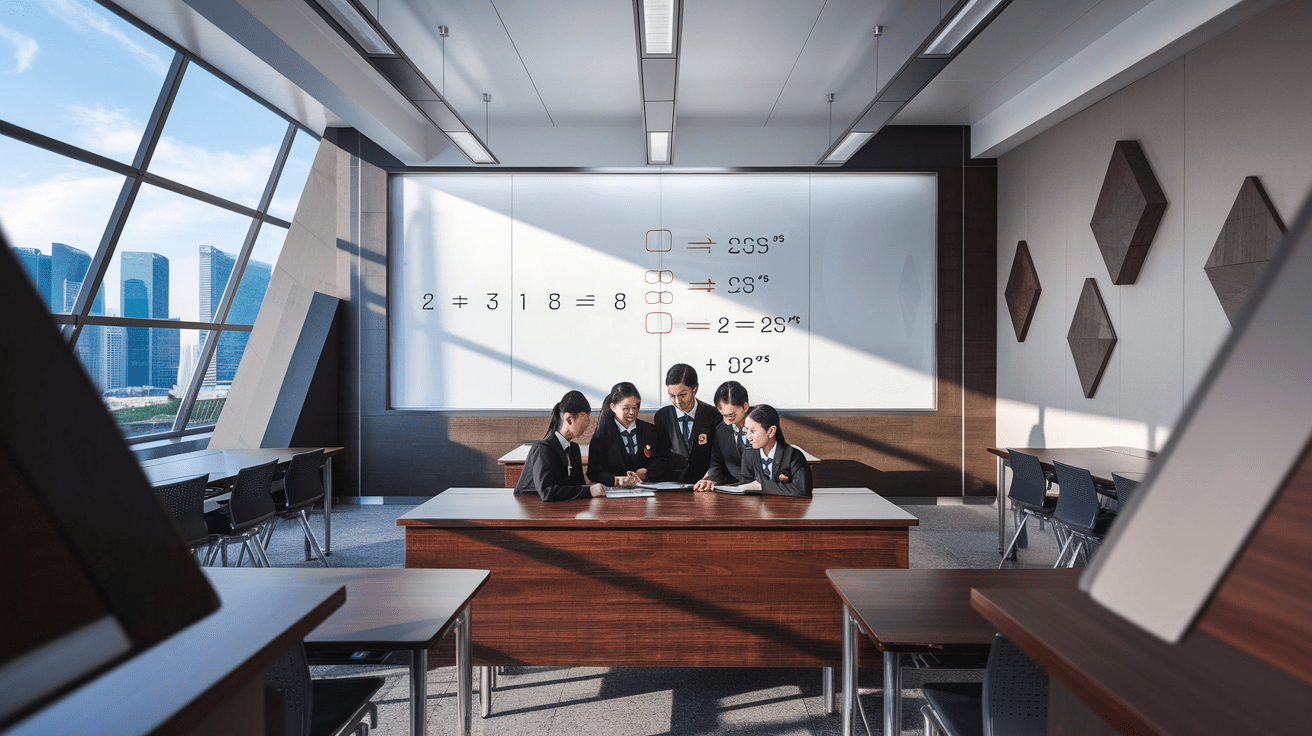
Table Of Contents
- The Critical Transition: From Primary Mathematics to Secondary Algebra
- Key Challenges Students Face When Transitioning to Algebra
- Essential Mathematical Foundations for Algebra Success
- Effective Bridging Strategies for Algebra Mastery
- The Importance of Personalized Tuition Approaches
- What to Look for in Secondary School Algebra Tuition
- How EduFirst Bridges the Primary-Secondary Mathematics Gap
- Conclusion: Building Mathematical Confidence for Long-term Success
The transition from primary to secondary school mathematics represents one of the most significant academic challenges in a student’s educational journey. While primary mathematics focuses largely on concrete concepts and basic operations with numbers, secondary mathematics introduces algebra – an abstract system that uses symbols and letters to represent quantities and relationships.
Many students who performed well in primary school mathematics suddenly find themselves struggling with algebraic concepts, leading to frustration and a potential long-term aversion to the subject. This transition period is critical, as algebra forms the foundation for higher-level mathematics and many STEM-related fields.
In this comprehensive guide, we’ll explore how specialized secondary-school algebra tuition can effectively bridge the gap from primary mathematics, particularly fractions, to algebraic thinking. We’ll examine the specific challenges students face, essential foundations needed for success, and how personalized tuition approaches can make all the difference in a student’s mathematical journey.
The Critical Transition: From Primary Mathematics to Secondary Algebra
The leap from primary to secondary mathematics isn’t just about learning new content – it represents a fundamental shift in mathematical thinking. In primary school, students primarily work with concrete numbers and straightforward operations. They learn to add, subtract, multiply and divide, and they work with fractions, decimals, and percentages in relatively straightforward ways.
Secondary school introduces algebra, which requires students to think in terms of variables, expressions, and equations. This abstraction – using letters to represent unknown quantities – is a cognitive leap that many students find challenging. Suddenly, they’re not just solving 5 + 3 = 8, but dealing with expressions like 5x + 3y = 8, where x and y can represent different values.
Research has shown that this transition period is where many students begin to develop negative attitudes toward mathematics. A study by the National Institute of Education found that nearly 40% of Singapore students experience difficulty during this transition, with algebra being identified as a particularly challenging area.
Key Challenges Students Face When Transitioning to Algebra
Understanding the specific obstacles students encounter can help parents and educators provide targeted support during this critical transition period.
The Abstraction Challenge
The most fundamental challenge is moving from concrete to abstract thinking. In primary school, mathematics deals primarily with specific numbers and quantities students can visualize. Algebra introduces variables – letters that can represent any number – requiring students to manipulate symbols without knowing their specific values.
The Language of Algebra
Algebra introduces a new mathematical language with its own syntax and rules. Students must learn to interpret expressions like 2(x + 3) and understand concepts such as coefficients, variables, and constants. This mathematical language barrier often compounds the difficulty of learning the underlying concepts.
The Fraction-Algebra Connection
One of the most direct connections between primary mathematics and algebra comes through fractions. In primary school, students learn to manipulate fractions through operations like addition, subtraction, multiplication, and division. In algebra, these same operations apply to algebraic fractions like (x+2)/(x-3), but with added layers of complexity.
Students who struggle with basic fraction operations in primary school often find algebraic fractions particularly challenging. Their difficulties with fundamental fraction concepts become magnified when variables are introduced.
Shift in Problem-Solving Approaches
The nature of problem-solving changes significantly with algebra. Primary mathematics often involves direct calculation, while algebraic problem-solving requires students to translate word problems into equations, a skill that combines mathematical understanding with language comprehension.
Essential Mathematical Foundations for Algebra Success
Certain primary school mathematics concepts serve as critical building blocks for algebraic understanding. Mastery of these foundations significantly improves a student’s ability to transition smoothly to algebra.
Fraction Operations and Number Sense
Proficiency with fractions serves as perhaps the strongest predictor of future algebra success. Students need to understand fractions conceptually – not just as procedures to follow. This includes visualizing fractions, understanding equivalent fractions, and performing operations with unlike denominators.
Number sense – the intuitive understanding of how numbers relate to each other – also plays a crucial role in algebraic thinking. Students who can mentally manipulate numbers and understand properties like distributivity will find algebraic manipulations more intuitive.
Order of Operations and Algebraic Expressions
The order of operations (PEMDAS/BODMAS) is critical for correctly evaluating both numerical and algebraic expressions. Students who understand why this order matters, rather than simply memorizing the sequence, will find it easier to work with complex algebraic expressions.
Understanding Equality and Equations
Many students develop misconceptions about the equals sign, viewing it as a signal to “do something” rather than as a symbol of balance between two expressions. This misunderstanding becomes problematic when solving equations in algebra, where the equals sign represents a relationship that must be preserved through equivalent operations on both sides.
Effective Bridging Strategies for Algebra Mastery
The transition to algebraic thinking can be smoothed through targeted strategies that build on primary school knowledge while gradually introducing algebraic concepts.
From Concrete to Abstract: The Graduated Approach
Effective algebra tuition often employs a graduated approach, moving from concrete examples to abstract concepts. For instance, introducing variables first through concrete scenarios (e.g., “If one apple costs x dollars, how much do 5 apples cost?”) before moving to more abstract algebraic expressions.
Visual representations serve as valuable intermediate steps between concrete and abstract thinking. Algebra tiles, for example, provide a visual and tactile way to represent variables and operations, making concepts like “combining like terms” more intuitive.
Connecting Fractions to Algebraic Fractions
One powerful bridging strategy involves explicitly connecting fraction operations to their algebraic counterparts. For example, showing students how finding the least common denominator works the same way whether adding 2/3 + 1/4 or (2x)/(x+1) + 1/(x-2).
This connection helps students see algebra not as an entirely new subject but as an extension of concepts they already understand, building confidence and conceptual understanding simultaneously.
The Importance of Personalized Tuition Approaches
Students transition to algebraic thinking at different rates and face unique challenges based on their prior mathematical experiences. Personalized tuition approaches recognize these individual differences and tailor instruction accordingly.
Identifying Individual Gaps Through Diagnostic Assessment
Before effective tuition can begin, it’s essential to identify each student’s specific strengths and weaknesses. Comprehensive diagnostic assessments can pinpoint gaps in prerequisite knowledge, such as fraction operations or the order of operations, that might hinder algebraic understanding.
These assessments should go beyond simply identifying incorrect answers to uncover the thinking processes and misconceptions behind those errors. This diagnostic approach allows tutors to address root causes rather than symptoms of algebraic struggles.
Targeted Intervention and Scaffolded Learning
Based on diagnostic findings, personalized tuition provides targeted interventions that address specific gaps while building on existing strengths. This might involve revisiting primary school concepts like fractions but with an eye toward their algebraic applications.
Scaffolded learning – providing appropriate support that gradually decreases as student proficiency increases – is particularly effective for algebra. This might include working with formulas and substituting values before moving to solving for unknowns, or using guided practice before independent work.
What to Look for in Secondary School Algebra Tuition
Not all tuition approaches are equally effective for bridging the primary-secondary mathematics gap. Parents should consider several key factors when selecting algebra tuition for their children.
The Advantage of Small Group Settings
While one-on-one tuition offers maximum personalization, small group settings (4-8 students) provide an optimal balance of individualized attention and collaborative learning. These environments allow tutors to observe each student’s work closely while enabling peer learning and discussion.
In algebra particularly, hearing multiple approaches to the same problem helps students develop flexible thinking and recognize that there are often several valid paths to a solution.
Tutor Expertise and Teaching Methodology
Effective algebra tutors need more than just mathematical knowledge – they need a deep understanding of how mathematical thinking develops and common stumbling blocks students encounter. Look for tutors with specific training or experience in mathematics education, particularly in the primary-secondary transition.
The teaching methodology should emphasize conceptual understanding alongside procedural fluency. Students need to understand why algebraic procedures work, not just how to apply them mechanically.
How EduFirst Bridges the Primary-Secondary Mathematics Gap
At EduFirst Learning Centre, the transition from primary mathematics to secondary algebra receives special attention through a structured approach designed to build mathematical confidence and competence.
Small Class Advantage for Algebraic Learning
EduFirst’s commitment to small class sizes (4-8 students) creates an ideal environment for algebraic learning. This setting allows tutors to identify specific misconceptions quickly and provide immediate feedback, preventing minor misunderstandings from developing into major obstacles.
The intimate learning environment also encourages students to ask questions and verbalize their thinking process – a crucial component of developing algebraic reasoning skills.
Curriculum Bridge: Connecting Primary Foundations to Secondary Applications
EduFirst’s secondary mathematics program specifically addresses the primary-secondary transition through a curriculum that explicitly connects primary school concepts to their algebraic extensions. This includes dedicated review sessions focusing on fraction operations and their algebraic applications.
The curriculum systematically builds algebraic thinking by starting with concrete examples and gradually introducing abstraction, with frequent reinforcement of connections to previously learned concepts.
Building Mathematical Confidence Through Mastery
Mathematical anxiety often peaks during the transition to algebra. EduFirst’s approach emphasizes building confidence through mastery of foundational skills before advancing to more complex concepts. Regular successes with progressively challenging material help students develop a positive mathematical identity.
This confidence-building approach includes celebration of small victories, normalization of productive struggle, and fostering a growth mindset toward mathematical abilities.
Conclusion: Building Mathematical Confidence for Long-term Success
The transition from primary mathematics to secondary algebra represents a pivotal moment in a student’s mathematical journey. How students navigate this transition often shapes their mathematical confidence and capabilities for years to come.
Effective bridging between primary concepts, particularly fractions, and algebraic thinking requires more than just additional practice – it demands a thoughtful, structured approach that connects concrete understanding to abstract reasoning. Small group tuition environments that provide personalized attention can make this transition significantly smoother.
By addressing foundational gaps, explicitly connecting primary mathematics concepts to algebraic applications, and building mathematical confidence, students can develop not just the skills to pass examinations, but the deep understanding that leads to long-term mathematical success.
The right support during this critical transition period doesn’t just improve secondary school mathematics performance – it opens doors to advanced studies in mathematics, sciences, engineering, and technology, giving students more options for their academic and professional futures.
Is your child struggling with the transition to secondary school algebra? EduFirst Learning Centre’s specialized small-group tuition programs can help bridge the gap from primary mathematics and build the strong algebraic foundation needed for long-term success.
Contact us today to learn more about our Secondary Mathematics programs and how we can support your child’s mathematical journey.