- Apr 17, 2026
Signs Your Child Is Struggling Silently in School
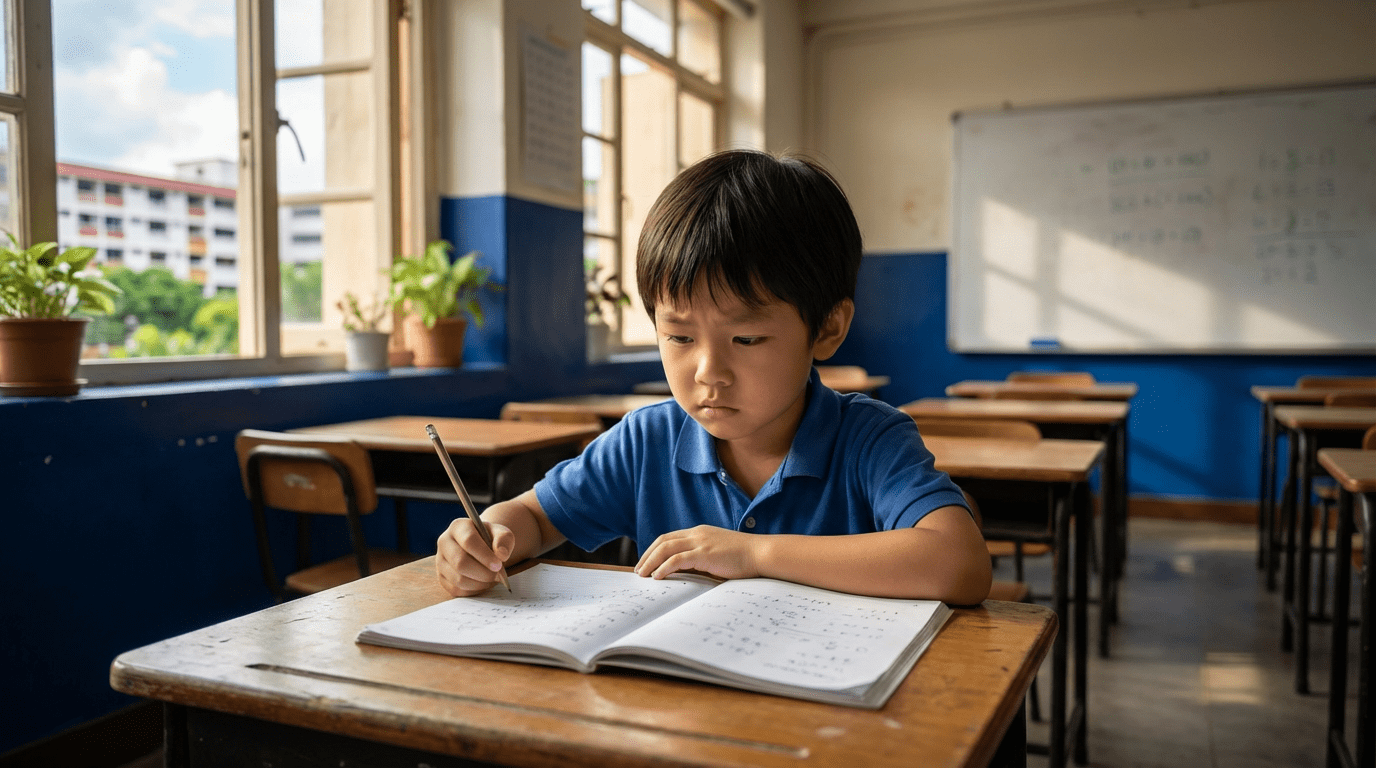
Most parents assume that if something were seriously wrong at school, their child would simply say so. But the reality is often far more complicated. Many children — especially in Singapore’s academically demanding environment — learn to mask their difficulties long before the situation becomes visible in their report cards. By the time poor grades appear, weeks or even months of quiet struggle may have already passed.
Recognising the signs your child is struggling silently in school is one of the most valuable skills a parent can develop. Silent struggles don’t announce themselves. They hide behind “I’m fine,” in a sudden reluctance to open a school bag, or in the child who used to love reading but now avoids books entirely. This article walks you through the key behavioral, academic, and emotional warning signs — and more importantly, what you can do about them before things escalate.
Why Children Struggle Silently
Understanding why children keep their struggles hidden is the first step toward helping them. For many kids, admitting they don’t understand something feels deeply uncomfortable. They worry about disappointing their parents, being perceived as less capable than their peers, or simply not having the words to explain what’s going wrong. In a high-achieving school culture like Singapore’s, this pressure can be especially pronounced — children sometimes feel that struggling is something to be ashamed of rather than something normal and fixable.
Younger children, particularly those in primary school, may not even fully recognize that they’re falling behind. They simply feel confused, anxious, or tired more often than usual, without the self-awareness to connect those feelings to their schoolwork. Older students in secondary school may be more aware of their difficulties but choose to hide them to protect their independence or avoid conflict at home. In both cases, the silence isn’t defiance — it’s usually a coping mechanism.
Behavioral Signs to Watch For at Home
Changes in behavior at home are often the earliest and most overlooked indicators that a child is struggling academically. Because children spend much of their emotional energy managing stress at school, they frequently “hold it together” in the classroom and then unravel at home where they feel safe. This can look like irritability, withdrawal, or sudden personality shifts that seem to come from nowhere.
Pay close attention to how your child behaves around homework time. A child who previously completed assignments with minimal fuss but now stalls, throws tantrums, or consistently claims to have “no homework” may be avoiding tasks they find overwhelming. Similarly, a noticeable drop in enthusiasm for school — once an exciting place now described as boring or pointless — can signal deeper frustration rather than a passing mood.
Other behavioral warning signs include:
- Frequently “forgetting” to bring home textbooks or worksheets
- Spending an unusually long time on homework without producing much output
- Becoming easily frustrated or tearful when asked about schoolwork
- Avoiding conversations about school altogether
- Complaints of stomachaches or headaches, especially on school mornings
- Increased screen time or other escapist behaviors in the evenings
Physical complaints deserve special mention. Research consistently shows that academic stress in children can manifest as genuine physical symptoms. If your child frequently feels unwell before school but recovers quickly on weekends or holidays, it’s worth investigating whether school-related anxiety is the underlying cause.
Academic Red Flags You Might Be Missing
Some academic warning signs are obvious — a failing grade, a note from a teacher, a test paper stuffed to the bottom of a school bag. But many signs are far subtler, particularly in the early stages of a child’s struggle. In fact, some children maintain passable grades through sheer memorization and hard work, masking a genuine lack of understanding that will eventually catch up with them.
Watch for inconsistency in performance. A child who scores well on some topics but consistently struggles with others may have specific conceptual gaps rather than a general lack of effort. For example, a student in primary school who understands addition and multiplication but consistently loses marks on word problems may be struggling with reading comprehension or mathematical reasoning — not the arithmetic itself. Identifying these gaps early can make a significant difference in how quickly they’re resolved.
Other academic red flags to look for include:
- A steady decline in grades over one or two terms rather than a sudden drop
- Difficulty completing assignments within a reasonable time frame
- Avoidance of reading or reluctance to write, even for enjoyment
- Teachers noting that your child seems distracted or disengaged in class
- Inability to explain concepts they claim to have learned
- Consistent careless mistakes that go beyond normal errors
It’s also worth reviewing how your child performs under exam conditions specifically. Some students understand the material when discussing it at home but fall apart during timed tests due to exam anxiety — a distinct issue that requires its own form of support and is especially relevant as students transition into secondary school, where the academic stakes rise considerably.
Emotional and Social Warning Signs
Academic struggles rarely stay neatly contained to the classroom. Over time, a child who feels consistently lost or behind their peers will begin to experience emotional and social effects that ripple into other areas of their life. One of the most telling signs is a shift in how your child talks about themselves — or stops talking about themselves. A child who used to share stories about their school day now giving one-word answers may be protecting themselves from a conversation they dread having.
Self-esteem is particularly vulnerable during the school years. When children repeatedly experience failure or confusion in a subject, they begin to form negative beliefs about their own intelligence. Phrases like “I’m just bad at maths” or “I’ll never be as smart as my classmates” are not just venting — they’re early signs of academic self-doubt that, left unaddressed, can become deeply ingrained. This is especially common in subjects like Mathematics and the sciences, where concepts build directly on prior knowledge and a gap at one level creates compounding confusion at the next.
Socially, struggling students may begin to withdraw from group activities, lose interest in school events, or express reluctance to attend school camps or excursions. In some cases, they may begin comparing themselves unfavorably to friends or siblings, or become unusually sensitive to discussions about academic performance. These are not just emotional quirks — they are signals that your child’s relationship with learning has become fraught and stressful.
What Parents Can Do to Help
When you suspect your child is struggling silently, the single most important thing you can do is create a space where they feel safe to be honest. This means approaching conversations with curiosity rather than concern, and listening without immediately launching into problem-solving mode. Children are far more likely to open up when they sense they won’t be met with panic or disappointment. A simple “I’ve noticed you seem a bit tired lately — how are things going at school?” can open doors that a more direct “Why are your grades dropping?” would close.
Beyond conversation, there are practical steps that make a meaningful difference:
- Check in with teachers regularly — don’t wait for parent-teacher meetings. A quick email or message to the class teacher can give you a clearer picture of how your child is performing day-to-day.
- Review their work together — not to correct every error, but to understand where confusion begins. Look for patterns rather than isolated mistakes.
- Build consistent study routines — structure reduces anxiety. A predictable homework time and study environment gives children a sense of control over their learning.
- Celebrate effort, not just results — children who fear failure are more likely to hide struggles. Reinforcing the value of trying hard, even when things are difficult, builds the psychological safety they need to ask for help.
- Limit comparisons — especially to siblings or classmates. Every child’s learning journey is different, and comparison often deepens shame rather than motivating improvement.
It’s also worth taking a closer look at your child’s study habits and environment. Many students who appear disengaged or forgetful are actually dealing with poor study strategies rather than a lack of capability. Teaching simple techniques like active recall, spaced repetition, and breaking revision into manageable sessions can dramatically improve how effectively your child retains information.
When It’s Time to Seek Extra Academic Support
There comes a point where parental support at home, however loving and consistent, isn’t enough to bridge the gap. If your child has been struggling for more than a few weeks, shows persistent signs of academic anxiety, or is falling behind in ways that are beginning to affect their confidence and enjoyment of learning, it may be time to consider structured academic support outside of school.
This is not a sign of failure — it is a proactive decision that many Singapore families make to give their children the individualized attention that large classroom settings simply cannot provide. Whether your child is in primary school and needs help building foundational skills, or is navigating the more complex demands of secondary school subjects, targeted tuition in a small group environment can make an enormous difference to both their understanding and their confidence.
For younger learners who are just beginning their academic journey, early intervention is particularly powerful. If you have concerns about how your child is developing before formal schooling begins, exploring structured pre-school programmes can help build the foundational literacy and numeracy skills that set children up for long-term success. And for families who prefer flexibility in how their children access support, online e-lessons offer a convenient and effective alternative to in-person classes without sacrificing quality of instruction.
The key is not to wait until the situation becomes a crisis. Silent struggles, by their very nature, are easy to miss — but they are also far easier to address when caught early. If any of the signs in this article resonate with what you’re observing in your child, trust your instincts. A conversation with an experienced educator may be all it takes to uncover what’s really going on and chart a clear path forward.
Helping Your Child Before the Struggle Becomes a Crisis
Children rarely struggle in isolation — their difficulties at school almost always show up somewhere, whether in their behavior at home, their emotional wellbeing, or their growing reluctance to engage with learning. The challenge for parents is learning to read the quieter signals before they become louder problems. By staying observant, keeping communication open, and taking early action when something feels off, you give your child the best possible chance of getting back on track before confidence takes a serious hit.
At EduFirst Learning Centre, we understand that every child’s learning journey is different. With over a decade of experience supporting primary and secondary students across Singapore, and small class sizes of just 4 to 8 students, our educators are trained to identify gaps quickly and provide the kind of personalized attention that helps children not only catch up — but genuinely thrive. If you’ve been wondering whether your child might benefit from some extra support, we’re here to help you find out.
Is your child showing signs of silent struggle?
Don’t wait for report card day to find out. Reach out to our team at EduFirst Learning Centre and let us help you understand your child’s needs — and how we can support them. With 25 locations islandwide and small, focused classes designed for real learning, we make it easy to get started.