- Jun 21, 2025
Top Strategies to Master Memory Techniques Before the PSLE

Table of Contents
- Understanding How Memory Works for PSLE Students
- Spaced Repetition: The Science of Remembering
- Active Recall: Beyond Passive Reading
- Mind Mapping for Visual Learners
- Mnemonic Devices for Complex Information
- Chunking Information for Better Retention
- Optimizing the Physical Environment for Memory
- The Importance of Consistency and Routine
- Nutrition, Sleep and Physical Activity
- Managing Stress and Anxiety for Better Memory
- Conclusion: Building Confidence Through Memory Mastery
As the PSLE approaches, students across Singapore face the challenge of remembering vast amounts of information across multiple subjects. For many children and parents, the question isn’t just about studying harder—it’s about studying smarter. Memory techniques are powerful tools that can transform a student’s ability to retain and recall information during these critical examinations.
At EduFirst Learning Centre, we’ve witnessed countless students dramatically improve their PSLE performance by mastering effective memory strategies. These techniques aren’t merely exam tricks; they’re lifelong skills that build confidence and create stronger learners. The good news is that memory can be trained and improved with the right approaches.
This comprehensive guide explores proven memory enhancement strategies specifically tailored for PSLE preparation. From understanding the science behind memory formation to practical techniques you can implement today, we’ll cover everything parents and students need to know about optimizing memory function during this crucial academic period.
Understanding How Memory Works for PSLE Students
Before diving into specific techniques, it’s important to understand the fundamentals of how memory works, especially in children of PSLE age (11-12 years old). The brain processes and stores information through three main stages: encoding (receiving and processing information), storage (creating a permanent record), and retrieval (recalling stored information).
For primary school students, several factors influence these memory processes:
- Their brain development is still ongoing, particularly in the prefrontal cortex which handles working memory and attention
- They typically respond better to multi-sensory learning approaches than adults
- Their emotional state significantly impacts memory formation
- They may not naturally know how to organize information efficiently
- Their memory strategies tend to be less sophisticated without proper guidance
With targeted memory techniques, students can significantly enhance their natural abilities. The key is finding approaches that align with your child’s learning style while developing versatility across different methods.
Spaced Repetition: The Science of Remembering
Spaced repetition is perhaps the most scientifically-validated memory technique available. Rather than cramming all studying into one session, this approach spreads reviews over increasing intervals. For PSLE students, this translates to reviewing material not just once after learning it, but multiple times according to a strategic schedule.
How to Implement Spaced Repetition
First exposure to material should be followed by reviews at carefully timed intervals:
For instance, after learning a new Science concept or Chinese vocabulary list:
– First review: Same day (within 24 hours)
– Second review: 2-3 days later
– Third review: 1 week later
– Fourth review: 2 weeks later
– Final reviews: Monthly until the exam
This approach works by triggering the brain’s memory consolidation processes right before forgetting occurs. At EduFirst Learning Centre, our tutors incorporate spaced repetition into lesson plans, ensuring students revisit key concepts at optimal intervals for maximum retention.
Consider using digital tools like flashcard apps that automatically implement spaced repetition algorithms, or create a simple calendar-based system to track review schedules for different subjects.
Active Recall: Beyond Passive Reading
Many students spend hours re-reading textbooks or notes, believing this is effective studying. However, research consistently shows that active recall—testing yourself on material rather than passively reviewing it—produces far superior results for long-term memory.
Implementing Active Recall for PSLE Preparation
For Mathematics: Instead of reviewing worked examples, try solving problems without looking at solutions. Check your answers afterward and focus on understanding mistakes.
For English: After reading comprehension passages, close the book and summarize the main points. Compare your summary with the text to identify any missed information.
For Science: Create question sets based on each topic. After studying a concept, write questions that test your understanding, then answer them without referring to notes.
For Mother Tongue: Practice recalling vocabulary and grammar rules by writing sentences from memory, then checking for accuracy.
Active recall creates stronger neural connections by forcing the brain to retrieve information without cues. This mirrors the exam environment where students must independently access stored knowledge. Our small class sizes at EduFirst allow instructors to regularly incorporate active recall exercises, giving students valuable practice with this powerful technique.
Mind Mapping for Visual Learners
Mind mapping is particularly effective for PSLE students who process information visually. This technique creates a graphic organization of information with a central concept branching out to related ideas, creating visual associations that enhance recall.
Creating Effective Mind Maps
Start with a central topic or concept in the middle of a blank page. For example, “Photosynthesis” for Science or “Types of Compositions” for English composition writing.
From this central theme, draw branches for major subtopics or categories. For photosynthesis, branches might include “Requirements,” “Process,” “Products,” and “Importance.”
Add smaller branches from each subtopic with specific details, using color coding to organize information. For instance, under “Requirements,” branches could include sunlight, water, and carbon dioxide, each in different colors.
Incorporate simple drawings or symbols where possible. Visual elements significantly enhance memory by creating additional neural pathways for recall.
Mind maps work particularly well for subjects with hierarchical information or complex relationships between concepts. They allow students to see the big picture while also capturing important details, making this technique especially valuable for subjects like Science and Social Studies.
Mnemonic Devices for Complex Information
Mnemonics are memory aids that help students remember complex information through associations, acronyms, or visualization. These techniques are especially useful for PSLE students who need to recall lists, sequences, or abstract concepts.
Types of Mnemonics for PSLE Students
Acronyms: Creating a word from the first letters of a list. For example, to remember the colors of the rainbow (Red, Orange, Yellow, Green, Blue, Indigo, Violet), students can use the name “ROY G. BIV.”
Acrostics: Forming a sentence where each word starts with the letter you need to remember. For instance, to recall the order of mathematical operations (Brackets, Orders, Division, Multiplication, Addition, Subtraction), students might use “Please Excuse My Dear Aunt Sally.”
Method of Loci: This advanced technique involves associating information with specific locations in a familiar place, like your home. While walking through this mental space, students can “pick up” the information they’ve placed there. For example, to remember steps in a Science experiment, imagine each step occurring in a different room of your house.
These memory devices work by creating meaningful connections and using parts of the brain typically not engaged in rote memorization. At EduFirst, we teach students to develop their own personalized mnemonics, making them more memorable and effective.
Chunking Information for Better Retention
Chunking is a technique that helps overcome the limitations of working memory by grouping individual pieces of information into meaningful units. This approach is particularly helpful for PSLE students facing dense material across multiple subjects.
How to Apply Chunking Effectively
For Mathematics: Instead of memorizing a long list of formulas individually, group them by concepts such as area/perimeter formulas, volume formulas, or algebraic expressions.
For English vocabulary: Organize new words by themes (weather-related words, emotion words) or by word families with similar roots.
For Chinese characters: Group characters with similar radicals or those used in common contexts rather than learning them in isolation.
For Science: Organize biological systems by their functions (respiratory system, digestive system) or group chemical elements by their properties.
The effectiveness of chunking comes from our brain’s ability to process and recall groups more efficiently than individual items. When information is meaningfully organized, students can retrieve entire chunks by recalling just one element within the group.
Optimizing the Physical Environment for Memory
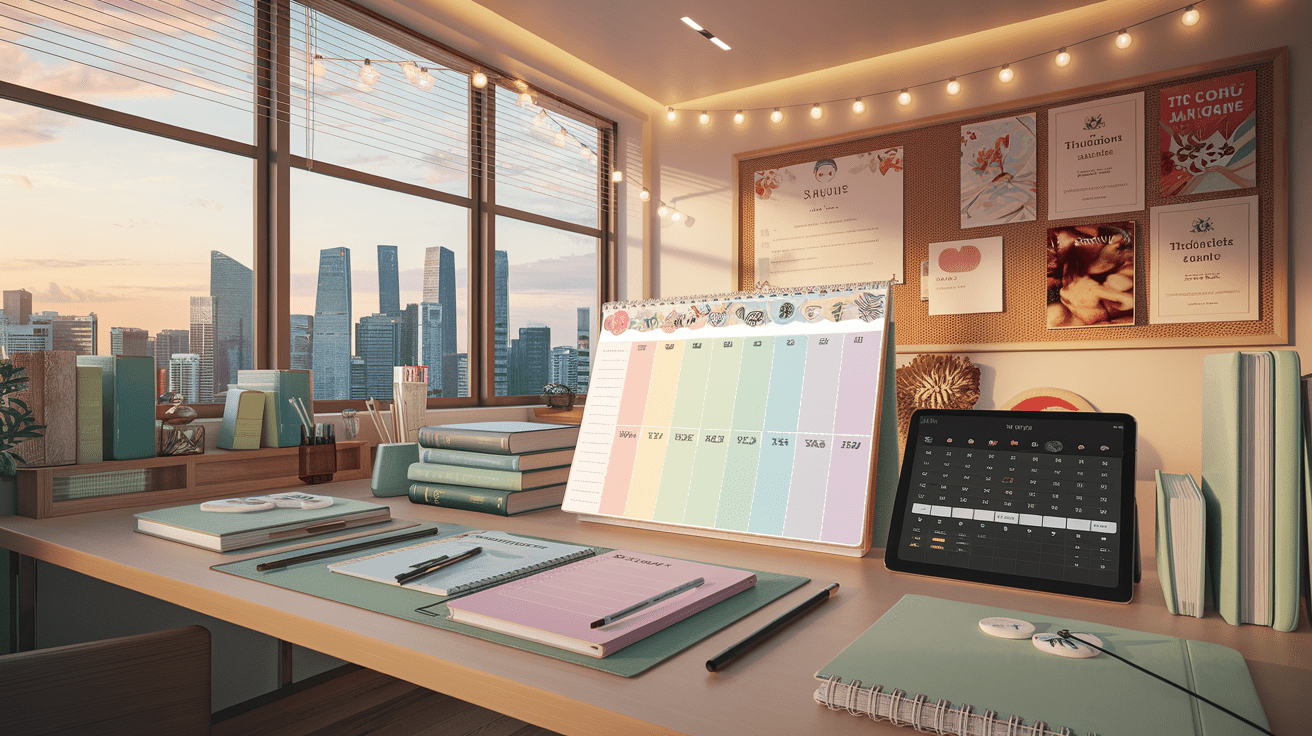
The physical environment plays a crucial role in memory formation and recall. Creating optimal study conditions can significantly enhance a student’s ability to remember information for the PSLE.
Creating Memory-Enhancing Study Spaces
Consistent location: Studying in the same place regularly helps the brain associate that environment with learning, triggering a study mindset more quickly.
Minimize distractions: Reduce noise, clear visual clutter, and keep electronic devices out of sight unless needed for studying. Research shows that even having a smartphone visible (even when turned off) can reduce cognitive capacity.
Proper lighting: Natural light is ideal, but if unavailable, use daylight-simulating bulbs rather than harsh fluorescent lighting which can cause eyestrain and reduce focus.
Temperature control: Studies suggest that the optimal temperature for cognitive function is between 20-23°C. Temperatures that are too warm can induce sleepiness and reduce alertness.
Learning tools: Stock the study area with all necessary materials (highlighters, sticky notes, flashcards) to prevent interruptions when studying.
At EduFirst Learning Centre, we carefully design our classroom environments to optimize focus and memory retention. Parents can apply these same principles when creating home study spaces for PSLE preparation.
The Importance of Consistency and Routine
Consistency is a powerful but often overlooked aspect of memory enhancement. Establishing regular study routines helps prime the brain for learning and improves information processing efficiency.
Building Effective Study Routines
Fixed study times: Schedule study sessions at the same times each day. This helps establish a biological rhythm where the brain becomes naturally more alert during these periods.
Start with difficult subjects: Begin study sessions with the most challenging or least preferred subjects when mental energy is highest.
Interleaving: Rather than studying one subject for extended periods (blocking), alternate between related topics. For example, switch between different math concepts or between similar science topics. This approach improves discrimination between similar concepts and strengthens memory connections.
Pre-study rituals: Develop simple routines that signal to the brain it’s time to focus, such as clearing the desk, filling a water bottle, or a brief 2-minute mindfulness exercise.
Break timing: Implement the Pomodoro technique (25 minutes of focused study followed by a 5-minute break) or find a similar rhythm that works for your child.
Consistency builds cognitive habits that make memory techniques more effective over time. Our structured approach at EduFirst Learning Centre helps students develop these productive routines that they can continue at home.
Nutrition, Sleep and Physical Activity
Memory function is profoundly influenced by physiological factors. Ensuring proper nutrition, adequate sleep, and regular physical activity can dramatically improve a student’s ability to form and retrieve memories during PSLE preparation.
Supporting Memory Through Physical Wellbeing
Sleep optimization: Students aged 11-12 typically need 9-12 hours of sleep daily. During sleep, the brain consolidates memories through processes that cannot occur while awake. Ensure your child maintains consistent sleep and wake times, even on weekends.
Brain-boosting nutrition: Incorporate these memory-enhancing foods into your child’s diet:
- Fatty fish rich in omega-3s (salmon, sardines)
- Berries containing antioxidants (blueberries, strawberries)
- Eggs for choline, which supports memory function
- Leafy greens for vitamin K and folate
- Nuts and seeds for vitamin E and healthy fats
Hydration: Even mild dehydration can impair cognitive function and memory. Ensure your child drinks water regularly throughout the day, especially during study sessions.
Physical activity: Regular aerobic exercise increases blood flow to the brain and stimulates the growth of new neurons in the hippocampus, a region critical for memory formation. Encourage at least 60 minutes of physical activity daily, which can be broken into shorter sessions.
These physiological factors create the foundation upon which all memory techniques can work more effectively. At EduFirst, we educate both students and parents about these critical lifestyle factors that support optimal learning.
Managing Stress and Anxiety for Better Memory
The PSLE period can be stressful for many students, and high anxiety levels directly interfere with memory formation and recall. Stress triggers cortisol release, which impairs hippocampal function and reduces access to stored information—essentially blocking memory retrieval during critical moments.
Stress-Reduction Techniques for PSLE Students
Mindfulness practices: Simple breathing exercises or brief meditation sessions can significantly reduce stress and improve focus. Even 5 minutes of mindfulness before studying can enhance information retention.
Positive visualization: Guide your child to visualize successfully remembering information and performing well on exams. This technique reduces anxiety and builds confidence in memory abilities.
Reframing techniques: Help students see exams as opportunities to demonstrate what they know rather than tests of their worth. This cognitive reframing reduces the threat response that blocks memory retrieval.
Practice under exam conditions: Regular practice tests in exam-like environments help students become comfortable with test conditions, reducing anxiety during actual exams and improving memory recall.
Normalize mistakes: Create a learning environment where errors are seen as part of the learning process rather than failures. This reduces the fear response that interferes with memory function.
At EduFirst Learning Centre, our small class sizes allow teachers to provide the emotional support needed to manage exam anxiety effectively. We work with students to develop personalized stress management techniques that enhance their memory performance during high-pressure situations.
Conclusion: Building Confidence Through Memory Mastery
Mastering memory techniques isn’t just about achieving higher PSLE scores—it’s about building learning confidence that will serve students throughout their educational journey and beyond. The strategies outlined in this guide work synergistically, creating a comprehensive approach to memory enhancement that addresses both cognitive and emotional aspects of learning.
Remember that different techniques work better for different students and subjects. Encourage your child to experiment with various approaches to discover their optimal memory strategy mix. With consistent practice, these techniques become second nature, transforming how students interact with information.
At EduFirst Learning Centre, we integrate these evidence-based memory techniques into our curriculum across all subjects. Our experienced teachers guide students in applying these strategies specifically to PSLE content, ensuring they develop both subject knowledge and the meta-learning skills needed for academic success.
By implementing these memory techniques early in the PSLE preparation process, students can approach their examinations with confidence, knowing they have the tools to effectively remember and apply everything they’ve learned. This confidence itself becomes a powerful memory enhancer, creating a positive cycle that leads to optimal performance when it matters most.
Need Personalized Guidance for PSLE Success?
At EduFirst Learning Centre, our experienced teachers work directly with students in small groups (4-8 students) to implement these memory techniques while mastering PSLE content. With 25 locations across Singapore, we provide convenient, personalized learning experiences that build both knowledge and confidence.
Contact us today to discover how our proven approach can help your child excel in the PSLE examinations!