- Aug 28, 2025
Essential Science Topics in Primary School MOE Syllabus: What Parents Need to Know
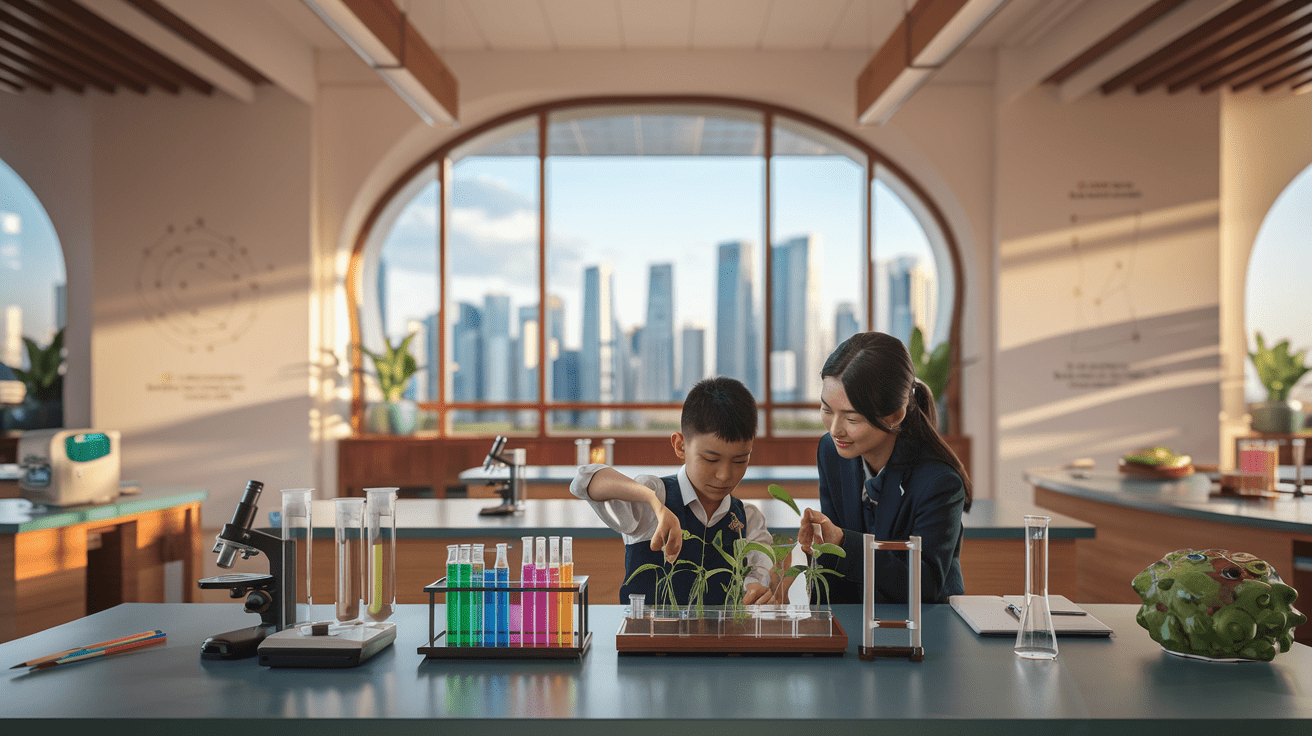
Table Of Contents
- Understanding Singapore’s Primary Science Curriculum
- Key Science Topics for Lower Primary (P3-P4)
- Key Science Topics for Upper Primary (P5-P6)
- Recent Changes to the Science Syllabus
- Practical Assessments and Experiments
- Common Challenges Students Face in Primary Science
- Effective Ways to Prepare for Science Examinations
- How EduFirst Helps Students Master Primary Science
As a parent of a primary school student in Singapore, you’re likely aware of how crucial Science education is in laying the foundation for your child’s academic journey. With the Ministry of Education (MOE) continuously refining the Science curriculum to meet the evolving educational landscape, staying informed about what your child will be tested on is more important than ever.
The Primary Science syllabus in Singapore is designed to nurture students’ curiosity about the world around them while developing critical thinking and inquiry skills. As we look ahead to 2026, understanding the key topics and assessment methods will help you better support your child’s learning journey.
In this comprehensive guide, we’ll explore the essential Science topics in the MOE primary school curriculum, recent changes to the syllabus, and how specialized tuition programs like those offered at EduFirst Learning Centre can help your child build a strong foundation in Science.
Understanding Singapore’s Primary Science Curriculum
The Singapore Primary Science curriculum follows a spiral approach, where concepts are revisited with increasing complexity as students progress through their primary education. Science as a formal subject begins in Primary 3, building upon the foundation laid during the formative years of Primary 1 and 2.
The curriculum is organized around five main themes:
- Diversity
- Cycles
- Systems
- Energy
- Interactions
These themes are explored through various topics related to Physical Sciences, Life Sciences, and Material Sciences. The MOE syllabus emphasizes both content knowledge and process skills, ensuring students not only learn scientific facts but also develop the ability to think and work scientifically.
Key Science Topics for Lower Primary (P3-P4)
In lower primary, the Science curriculum introduces fundamental concepts through engaging, hands-on activities. These topics form the building blocks for more complex concepts in later years.
Primary 3 Focus Areas
The Primary 3 Science syllabus concentrates on developing basic observational skills and understanding simple scientific concepts. Key topics include:
Diversity of Living and Non-living Things – Students learn to classify objects as living or non-living based on observable characteristics. They explore the diversity of plants and animals, learning about their basic needs and habitats.
Materials and Their Properties – This unit introduces students to different materials and their physical properties such as hardness, transparency, and whether they float or sink in water. Students learn how these properties make materials suitable for specific purposes.
Light and Shadows – Students discover the basic properties of light, including how shadows form when light is blocked by opaque objects. They learn about transparent, translucent, and opaque materials.
Primary 4 Focus Areas
Primary 4 builds upon the foundation established in P3, introducing more complex scientific concepts:
Matter: States and Properties – Students explore the three states of matter (solid, liquid, gas) and their properties. They learn about the water cycle and how matter can change from one state to another.
Living Things and Their Environment – This unit expands on plant and animal adaptations, focusing on how living things are suited to their habitats. Students learn about simple food chains and the interdependence of living things.
Heat and Temperature – Students learn about heat sources, the effects of heat on materials, and how heat travels. They explore the concept of temperature and how it’s measured.
Magnets – This topic introduces magnetic attraction and repulsion, magnetic materials, and the uses of magnets in everyday life.
Key Science Topics for Upper Primary (P5-P6)
The upper primary Science curriculum delves deeper into scientific concepts, requiring students to apply their knowledge to solve problems and explain natural phenomena.
Primary 5 Focus Areas
In Primary 5, students tackle more complex scientific concepts that require higher-order thinking:
Plant and Animal Cell Structures – Students learn about the basic structure of plant and animal cells, including the functions of key cell components like the nucleus, cytoplasm, and cell membrane.
Plant Transport Systems – This topic covers how water and nutrients are transported in plants, including the roles of roots, stems, and leaves.
Respiratory and Circulatory Systems – Students explore the human respiratory and circulatory systems, learning how they work together to transport oxygen and nutrients throughout the body.
Water Cycle and the Environment – Building on earlier knowledge, students study the water cycle in greater depth, exploring issues related to water conservation and pollution.
Electrical Systems – Students learn about electrical circuits, conductors, insulators, and how electrical energy is converted to other forms of energy.
Primary 6 Focus Areas
Primary 6 represents the culmination of primary Science education, with topics that prepare students for secondary-level Science:
Energy Conversion – Students explore different forms of energy (potential, kinetic, electrical, light, heat) and how energy can be converted from one form to another.
Forces – This unit covers different types of forces (gravitational, frictional, magnetic) and their effects on objects, including concepts like balanced and unbalanced forces.
Food Chains and Food Webs – Students examine the transfer of energy in ecosystems through food chains and food webs, learning about producers, consumers, and decomposers.
Reproduction in Plants and Humans – This sensitive topic introduces students to the basic concepts of reproduction, including plant pollination and seed dispersal, as well as an age-appropriate overview of human reproduction.
Adaptations and Natural Selection – Students learn how plants and animals adapt to their environments over time, touching on basic concepts of natural selection and evolution.
Recent Changes to the Science Syllabus
The MOE regularly reviews and updates the Science curriculum to ensure it remains relevant and prepares students for future challenges. Recent and anticipated changes to the Primary Science syllabus include:
Greater Emphasis on STEM Integration – The revised curriculum increasingly emphasizes connections between Science, Technology, Engineering, and Mathematics (STEM), encouraging students to apply knowledge across disciplines.
Environmental Education – In response to growing environmental concerns, topics related to sustainability, climate change, and conservation have gained more prominence in the curriculum.
Enhanced Focus on Scientific Inquiry – The new syllabus places greater emphasis on the development of scientific inquiry skills, encouraging students to ask questions, design investigations, and draw evidence-based conclusions.
Digital Literacy – As technology becomes more integrated into science education, students are increasingly expected to use digital tools for data collection, analysis, and presentation.
At EduFirst Learning Centre, our curriculum specialists continuously monitor these changes to ensure our tuition programs align with the latest MOE requirements, giving your child a competitive edge in their examinations.
Practical Assessments and Experiments
A distinctive feature of Singapore’s Science education is its emphasis on practical work. Students are not only expected to understand scientific concepts but also to apply them through hands-on experiments and investigations.
By 2026, the MOE is expected to place even greater emphasis on practical skills assessment. Key experimental skills that students need to develop include:
Observation – Making accurate observations using all senses appropriate to the situation.
Using Apparatus – Correctly handling scientific equipment such as thermometers, measuring cylinders, and spring balances.
Following Procedures – Following experimental procedures systematically and safely.
Recording Data – Organizing and recording experimental data in appropriate formats, including tables and graphs.
Analysis and Interpretation – Drawing logical conclusions from experimental results and identifying patterns in data.
At EduFirst, we recognize the importance of these practical skills. Our Science tuition programs include regular hands-on activities and experiments in small class settings (4-8 students), ensuring each student receives guidance and develops confidence in their practical abilities.
Common Challenges Students Face in Primary Science
Despite the engaging nature of Science as a subject, many primary students encounter challenges that can affect their performance and confidence:
Misconceptions – Children often develop misconceptions about scientific concepts based on everyday experiences or intuition. These misconceptions can be difficult to correct if not addressed early.
Language and Terminology – Science introduces many new technical terms that students must understand and use correctly. This vocabulary can be particularly challenging for students who are not strong in language skills.
Application Questions – The MOE Science examinations increasingly include questions that require students to apply concepts to unfamiliar contexts. Many students struggle with these higher-order thinking questions.
Open-ended Questions – Students often find it difficult to articulate scientific explanations clearly and concisely in open-ended questions, which form a significant portion of the examination.
Connecting Concepts – Science topics are interconnected, and students are expected to make links between different concepts. Many students tend to compartmentalize their knowledge, treating each topic in isolation.
Effective Ways to Prepare for Science Examinations
Preparing effectively for primary Science examinations requires a strategic approach that goes beyond mere memorization:
Regular Revision – Science builds on previously learned concepts. Regular revision helps reinforce understanding and identifies areas that need additional attention.
Concept Mapping – Creating visual representations of scientific concepts and their relationships helps students see the bigger picture and make connections between different topics.
Practice Data-based Questions – Working with graphs, tables, and diagrams helps students develop the skills needed to interpret and analyze scientific data.
Everyday Applications – Relating scientific concepts to everyday experiences makes the learning more meaningful and enhances retention.
Exam Techniques – Learning specific strategies for tackling different question types, particularly open-ended questions, improves examination performance.
Structured Study Schedule – Creating a balanced study schedule that allocates sufficient time to each topic helps prevent last-minute cramming and reduces exam anxiety.
How EduFirst Helps Students Master Primary Science
At EduFirst Learning Centre, we have developed a comprehensive approach to Science tuition that addresses the challenges primary students face while preparing them for the rigors of the MOE Science curriculum:
Small Group Setting – Our small class sizes of 4-8 students ensure personalized attention, allowing our teachers to identify and address individual learning needs.
Qualified and Experienced Teachers – Our Science tutors are not only subject experts but also experienced in the Singapore education system, familiar with the latest MOE syllabus and examination requirements.
Engaging Teaching Methods – We employ a variety of teaching methods, including demonstrations, experiments, visual aids, and interactive discussions to cater to different learning styles.
Comprehensive Materials – Our carefully developed worksheets and resources cover all syllabus topics and include various question types to build familiarity with examination formats.
Regular Assessments – We conduct regular assessments to monitor progress and identify areas for improvement, providing detailed feedback to both students and parents.
Exam-Smart Strategies – We teach specific strategies for approaching different question types, helping students maximize their marks in examinations.
Concept Reinforcement – Our curriculum emphasizes the connections between different Science topics, helping students develop an integrated understanding of scientific concepts.
With 25 locations islandwide, EduFirst offers convenient access to quality Science tuition, helping primary students build a solid foundation in Science that will serve them well beyond their PSLE examinations.
As we look ahead to 2026, the Primary Science curriculum in Singapore continues to evolve, emphasizing not just content knowledge but also critical thinking, inquiry skills, and practical application. The key topics across the primary levels—from diversity of living things to energy conversion and forces—form a comprehensive foundation that prepares students for more advanced scientific study in secondary school.
Understanding these topics and the MOE’s assessment approach is crucial for parents who want to support their children’s Science education effectively. The challenges students face—from misconceptions to application questions—can be addressed through structured learning and targeted support.
At EduFirst Learning Centre, we remain committed to helping primary students navigate the Science curriculum with confidence. Our small-group tuition approach ensures that each child receives the attention they need to understand complex concepts, develop practical skills, and excel in their examinations.
By partnering with experienced educators who understand the nuances of the MOE Science syllabus, you can help your child build not just the knowledge but also the scientific thinking skills that will benefit them throughout their academic journey and beyond.
Want to help your child excel in Primary Science?
Contact EduFirst Learning Centre today to learn more about our specialized Science tuition programs designed to meet the latest MOE requirements. With 25 locations islandwide and small class sizes of 4-8 students, we provide personalized attention that makes a difference.