- May 10, 2026
Express vs Normal Academic vs Normal Technical: The Key Differences Explained
Every year, as PSLE results are released, thousands of Singapore parents find themselves facing one of the most emotionally charged decisions in their child’s academic journey: which secondary school stream is their child going into, and what does it really mean for their future? The terms Express, Normal Academic (NA), and Normal Technical (NT) are ones nearly every parent in Singapore has heard, but understanding the actual differences between these streams — and what doors each one opens or closes — is far less clear-cut than most people assume.
Whether your child has just received their PSLE results or you are planning ahead and want to understand how the system works, this guide breaks down everything you need to know. We will look at the curriculum differences, the subject offerings, the assessment formats, and — most importantly — the future pathways available to students in each stream. By the end, you will have a much clearer picture of what each stream involves and how to support your child through whichever path they take.
What Is Secondary School Streaming in Singapore?
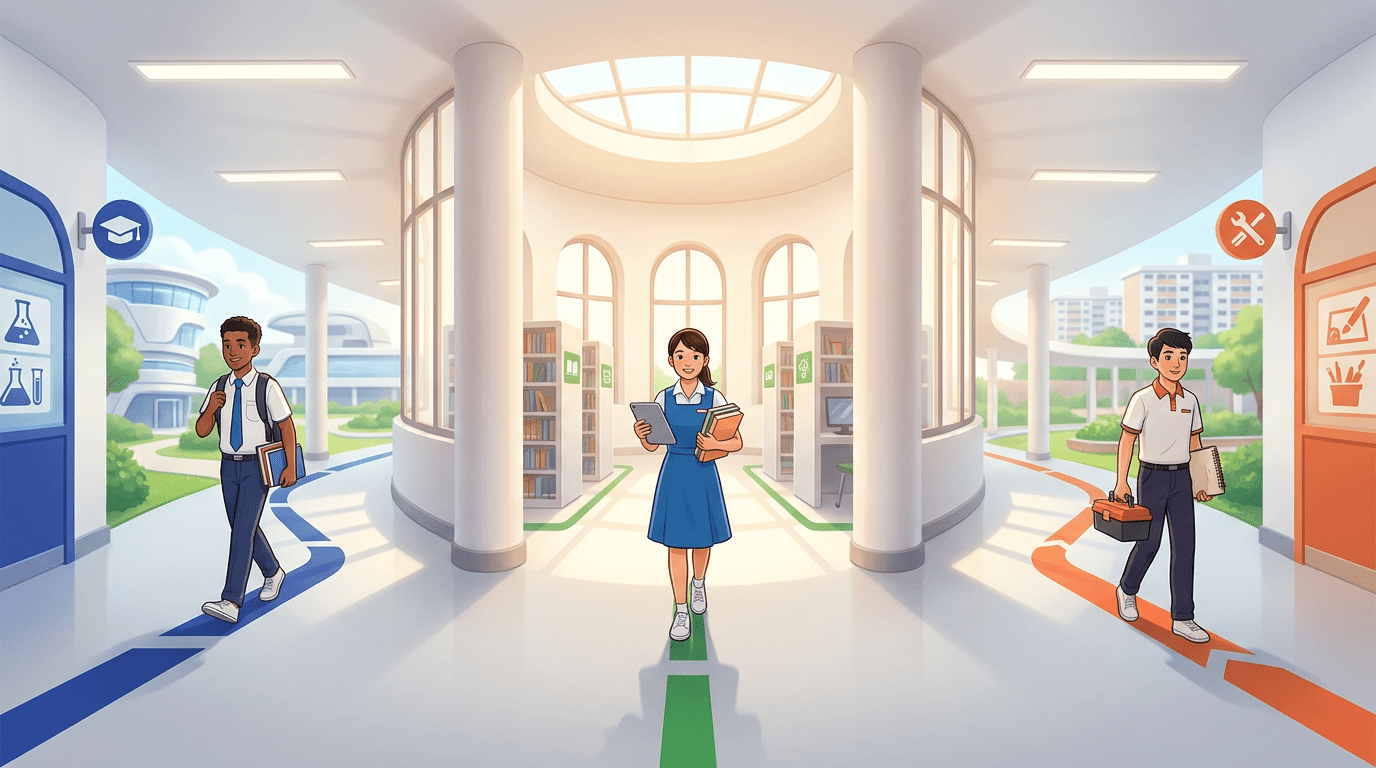
Secondary school streaming in Singapore has traditionally been the process by which students are placed into different academic tracks based on their PSLE (Primary School Leaving Examination) results. The three main streams are the Express stream, the Normal Academic (NA) stream, and the Normal Technical (NT) stream. Each stream follows a distinct curriculum and leads to different national examinations at the end of secondary school.
The rationale behind streaming has always been to allow each student to learn at a pace and in a mode that suits their strengths and learning style. A student who excels in abstract reasoning and academic writing may thrive in Express, while a student who is more hands-on and practically inclined might find the NT stream a better fit. That said, it is important for parents to understand that no stream is a dead end — all three pathways offer routes to further education and fulfilling careers, though the timelines and routes do differ.
It is also worth noting that Singapore is actively reforming its streaming system through Full Subject-Based Banding (FSBB), which is being rolled out across secondary schools. We will cover this in more detail later, but understanding the traditional three-stream model remains essential because most students currently in secondary school are still navigating it.
What Is the Express Stream?
The Express stream is the most academically rigorous of the three tracks. Students in this stream complete their secondary education over four years and sit for the GCE O-Level examinations at the end of Secondary 4. The PSLE score required to qualify for the Express stream is generally higher than for the other two streams, and students placed here are expected to handle a more demanding academic workload.
In the Express stream, students take a combination of core and elective subjects. Core subjects typically include English Language, Mother Tongue Language, Mathematics, and one or more humanities. Beyond these, students choose from a range of elective subjects such as Additional Mathematics, the sciences, literature, geography, and history. The curriculum is designed to build strong analytical, writing, and problem-solving skills — qualities that are well-suited to students aiming for junior college and eventually university.
Upon completing their O-Levels, Express students commonly move on to:
- Junior College (JC) for the GCE A-Level programme
- Polytechnic diploma courses
- Institute of Technical Education (ITE) programmes
The Express stream is a strong fit for students who are comfortable with a high volume of academic content, enjoy theoretical learning, and are motivated by examination performance. If your child is in primary school and aiming for the Express stream, early preparation through structured tuition can make a significant difference. EduFirst’s Primary Tuition programme is designed to build exactly the foundational skills — in English, Maths, and Science — that give students a competitive edge heading into PSLE.
What Is the Normal Academic Stream?
The Normal Academic stream is designed for students who are academically capable but may need more time to consolidate their learning before tackling the full O-Level syllabus. Students in the NA stream spend four to five years in secondary school. At the end of Secondary 4, they sit for the GCE N(A)-Level examinations. Students who perform well in their N(A)-Levels may then proceed to Secondary 5, where they sit for the GCE O-Level examinations — giving them an additional year to strengthen their foundation before attempting the same qualification as Express students.
The NA curriculum shares many similarities with the Express curriculum but is delivered at a slightly slower pace with a greater emphasis on reinforcing understanding before moving forward. Students in NA take subjects including English Language, Mother Tongue Language, Mathematics, and a selection of humanities and sciences. The key difference from the Express stream is the N(A)-Level examinations at the end of Secondary 4, which assess broadly similar content to O-Levels but within a framework calibrated for the NA learner’s progression.
For students in the NA stream, the pathway options after Secondary 4 or 5 include:
- Progression to Secondary 5 and then O-Levels (for strong N(A)-Level performers)
- Polytechnic Foundation Programme (PFP), a one-year bridging programme leading to polytechnic diplomas
- ITE programmes, which lead to the Nitec qualification
The NA stream suits students who benefit from a slightly more measured academic pace but are still pursuing university or polytechnic education as a long-term goal. Targeted tuition support can be particularly valuable here, helping NA students keep pace with the curriculum and position themselves well for the N(A)-Level results that determine which post-secondary pathway they can access. EduFirst’s Secondary Tuition programme supports students across all streams in achieving their academic potential.
What Is the Normal Technical Stream?
The Normal Technical stream is tailored for students who are more hands-on, practical learners. This stream places a greater emphasis on applied and technical subjects rather than purely academic ones, and students complete their secondary education over four years, sitting for the GCE N(T)-Level examinations at the end of Secondary 4.
Core subjects in the NT stream include English Language, Mother Tongue Language, Mathematics (which is a more applied version compared to Express or NA), and a subject called Computer Applications. NT students also have access to a range of elective modules, many of which are vocationally oriented. The curriculum is intentionally designed to connect classroom learning with real-world, practical skills — making it a better fit for students who learn by doing rather than by reading and writing.
After completing the NT stream, students typically progress to:
- ITE, where they can pursue a Nitec or Higher Nitec qualification in a trade or technical field
- The Direct-Entry-Scheme to Polytechnic Programme (DPP), a two-year programme that leads directly into a polytechnic diploma
It would be a mistake to view the NT stream as a lesser path. Many students who go through NT and ITE go on to build highly skilled, well-paying careers in engineering, technology, culinary arts, healthcare support, and more. ITE graduates can also progress to polytechnics, and from polytechnics, students can gain admission to local universities. The route is longer, but the destination can be the same.
Key Differences: Express vs Normal Academic vs Normal Technical
To make the distinctions concrete, here is a side-by-side comparison of the three streams across the most important dimensions:
Duration of Secondary Education
- Express: 4 years (Secondary 1 to 4)
- Normal Academic: 4 to 5 years (Secondary 1 to 4, with an optional Secondary 5)
- Normal Technical: 4 years (Secondary 1 to 4)
National Examinations
- Express: GCE O-Level at end of Secondary 4
- Normal Academic: GCE N(A)-Level at end of Secondary 4; option to sit O-Level after Secondary 5
- Normal Technical: GCE N(T)-Level at end of Secondary 4
Curriculum Focus
- Express: Academically rigorous; broad range of humanities, sciences, and languages
- Normal Academic: Academically oriented but paced more gradually; similar subject range to Express
- Normal Technical: Practical and applied focus; includes technical and vocational electives
Post-Secondary Pathways
- Express: Junior College, Polytechnic, ITE
- Normal Academic: Secondary 5 then O-Levels, Polytechnic Foundation Programme, ITE
- Normal Technical: ITE (Nitec/Higher Nitec), Direct-Entry-Scheme to Polytechnic Programme
Future Pathways After Each Stream
One of the most important things parents need to know is that Singapore’s education system is deliberately designed with multiple entry and transfer points. This means that a student who starts in NT can, through hard work and strong results, progress all the way to a university degree. The timeline may be longer compared to a student who went through the Express route and directly into Junior College, but the endpoint is achievable.
For students who end up in NA or NT and feel motivated to pursue higher education, the system offers structured bridging pathways. The Polytechnic Foundation Programme (PFP) for strong NA students, and the Direct-Entry-Scheme to Polytechnic Programme (DPP) for NT students, are both meaningful routes that acknowledge a student’s growth beyond what a single PSLE score captured. Universities in Singapore also accept applications from polytechnic graduates, recognising the depth and applied nature of diploma-level study.
What this means practically is that the stream your child enters at age 12 is a starting point, not a final verdict. With the right support, motivation, and consistent effort — particularly in subjects like English and Mathematics which are central to every stream — students can progress further than their initial placement might suggest.
How Full Subject-Based Banding (FSBB) Is Changing Things
Singapore’s Ministry of Education has been progressively rolling out Full Subject-Based Banding (FSBB), which represents a significant shift away from the traditional three-stream model. Under FSBB, the fixed labels of Express, NA, and NT are phased out. Instead, students take individual subjects at different levels — G1 (roughly equivalent to NT), G2 (equivalent to NA), and G3 (equivalent to Express) — based on their aptitude in each specific subject.
This means a student might study Mathematics at G3 level while taking English at G2, reflecting their actual strengths in each subject rather than being placed in a single overarching stream. The system is designed to reduce stigma, allow students to be stretched in their areas of strength, and ensure that no student is held back across the board by a single aggregate score. All students under FSBB will sit for a common national examination at the end of Secondary 4, creating a more unified and equitable educational experience.
FSBB is currently being implemented progressively, and many schools have already transitioned. Parents of current primary school students should expect their children to enter a secondary school environment that looks quite different from the stream-based model described above. That said, the G1, G2, and G3 levels still broadly correspond to the NT, NA, and Express standards — so understanding the traditional streams remains a useful reference point.
For younger children still in primary school, building a strong foundation now positions them to take more subjects at the G3 level when they enter secondary school. EduFirst’s Primary Tuition programme is specifically designed to strengthen this foundation in key subjects, giving your child the best possible starting position under the evolving FSBB landscape.
Supporting Your Child Regardless of Stream
Perhaps the most important thing parents can do when their child is placed into a particular stream is to reframe the conversation around growth rather than limitation. Students are incredibly perceptive — if they sense that their parents view their stream placement as a failure, that perception can become a self-fulfilling prophecy. On the other hand, children who feel supported and believe in their own capacity to grow tend to perform consistently better over time.
Practically speaking, support looks like ensuring your child has access to consistent, quality academic guidance. In small class settings, students receive more individualised attention and can ask questions without hesitation — something that makes a measurable difference in learning outcomes. EduFirst has delivered this kind of personalised support to primary and secondary students since 2010, with class sizes of just 4 to 8 students that allow tutors to really understand each child’s learning gaps and address them directly. Whether your child is in the Express stream managing a demanding O-Level syllabus or in the NA stream working towards their N-Levels and beyond, structured support helps them stay on track and build real confidence.
Beyond tuition, parents can support their children by maintaining open conversations about their interests and strengths, encouraging a growth mindset, and helping them identify which post-secondary pathway genuinely excites them. A student who is passionate about the culinary industry or engineering may find that the NT-to-ITE-to-polytechnic pathway is not a consolation prize but actually the most direct and fulfilling route to where they want to go.
For students who are interested in flexible, accessible learning options, EduFirst also offers E-Lessons — a convenient way to access quality tuition from home, ensuring that geography or scheduling constraints never get in the way of academic progress.
Final Thoughts
The differences between the Express, Normal Academic, and Normal Technical streams go beyond just exam names and subject lists. They represent different learning paces, different strengths, and different pathways — all of which can lead to meaningful and successful futures. Understanding these differences clearly allows parents to set realistic expectations, have more productive conversations with their children, and make more informed decisions about where and how to seek support.
With Singapore actively transitioning towards Full Subject-Based Banding, the rigid labels of the past are gradually giving way to a more nuanced, student-centred model. But in the meantime, what matters most is ensuring that every child — regardless of which stream or level they are in — has the support they need to reach their full potential. That is something EduFirst has been committed to since 2010, and it remains at the heart of everything the centre does.
Want Personalised Guidance for Your Child?
Whether your child is preparing for PSLE, navigating secondary school, or working towards their N or O-Level examinations, EduFirst’s experienced tutors are here to help. With small class sizes of 4 to 8 students across 25 locations islandwide, we provide the focused, individualised attention every student deserves.