- May 20, 2026
Moving to Singapore with Kids: A Complete Guide to School Options

Moving to Singapore with children is an exciting milestone, but for most families it comes with one very immediate question: where will my child go to school? Singapore consistently ranks among the world’s top-performing education systems, which is reassuring — but the landscape of school types, admission requirements, and fee structures can feel genuinely overwhelming when you are also juggling a new home, a new job, and a new country.
The good news is that Singapore’s education ecosystem is well-organised, well-documented, and genuinely designed with outcomes in mind. Whether your child is two or thirteen, whether you are staying for two years or planning to put down roots, there is a pathway that fits your family. This guide walks you through the key decisions: the difference between local government schools and international schools, how the admissions process works for foreign children, what you can realistically expect to pay, and how tuition support can make the transition significantly smoother once your child is in class.
Understanding Singapore’s Education System
Singapore’s formal education structure follows a path that will feel broadly familiar to parents from most countries, even if the pace and rigour can come as a surprise. Children typically begin with preschool (ages 18 months to 6 years), move into primary school (Primary 1 to 6, ages 6 to 12), then secondary school (Secondary 1 to 4 or 5, ages 13 to 16 or 17), followed by post-secondary pathways including junior colleges, polytechnics, or the Institute of Technical Education. The Ministry of Education (MOE) oversees all government and government-aided schools, while international and private institutions are regulated separately.
What sets Singapore apart is how seriously academic achievement is taken from the very earliest years. The Primary School Leaving Examination (PSLE), taken at the end of Primary 6, is a nationally standardised milestone that determines secondary school placement. For a child arriving mid-way through this journey, that context matters enormously. Understanding not just which school to enter, but where your child sits relative to the local curriculum, is one of the most important things an expat parent can get right early on.
Local (MOE) Schools vs. International Schools: Which Is Right for Your Child?
This is the central question every family faces, and there is no single correct answer. The right choice depends on how long you plan to stay in Singapore, your child’s current academic foundation, your family’s language background, and your longer-term education goals. Both pathways are genuinely excellent; they simply serve different needs.
Local government schools follow the MOE curriculum, are taught primarily in English, and place a strong emphasis on Mother Tongue languages (Mandarin, Malay, or Tamil). They offer a deeply immersive experience in Singaporean culture and the chance to build lasting friendships with local peers. Fees for international students are considerably more affordable than international school alternatives, though the academic demands are high and the curriculum moves at a fast pace. A child entering Primary 3 without familiarity with Singapore-style Mathematics, for example, may find the adjustment genuinely challenging in those first months.
International schools cater explicitly to globally mobile families. Most offer internationally recognised programmes such as the International Baccalaureate (IB), British A-Levels and IGCSEs, or the American K-12 diploma pathway. They typically have more flexible admission timelines, dedicated English as an Additional Language (EAL) support, and pastoral teams experienced with relocation challenges. The trade-off is cost: annual fees commonly range from S$18,000 to over S$50,000, with premium campuses exceeding that figure.
As a general guide, families planning a stay of fewer than three years often prefer international schools for curriculum continuity — your child can step back into a familiar academic framework when you relocate again. Families on longer postings, or those considering permanent residency, sometimes choose local MOE schools to give their children the full Singapore experience and a stronger footing for local university admissions. Many families also find that combining a local school placement with targeted after-school tuition support gives their children the best of both worlds.
How Expat Children Get Into MOE Schools: The AEIS Explained
Foreign children who wish to attend a government primary or secondary school must go through a centralised admissions process called the Admissions Exercise for International Students (AEIS). This is an MOE-administered test that assesses English and Mathematics, and it is the standard route for international students applying for places in the following academic year.
Here is how the process works in practice:
- Register via the MOE Candidates Portal — The application period for the main AEIS typically opens in July each year. You will need to create an account for your child and submit the required documents online.
- Sit the AEIS tests — Tests are conducted in Singapore, usually in September. The AEIS covers English and Mathematics and is designed to assess whether your child has the academic readiness for mainstream schooling at the level applied for.
- Receive the outcome — Results are released within weeks of the tests. If successful, placement is based on available vacancies and your declared residential area where possible.
- Accept the offer promptly — There is a defined reporting window; places offered to successful applicants can be withdrawn if families do not respond within the stated period.
- Complete enrolment — Successful applicants start school in January of the following year.
If you missed the main AEIS window, there is also the Supplementary AEIS (S-AEIS), which runs from January and has tests in February or March. The S-AEIS covers admission to Primary 2 to 4 and Secondary 1 to 2 for the same academic year, with successful applicants typically starting school in April or May. One important note: admission through either exercise is not guaranteed and is subject to your child’s test performance and school vacancy availability.
Primary school applicants should also be aware that a valid Cambridge English Qualifications (CEQ) test result is required as part of the application. It is worth planning ahead for this requirement well before the registration period opens.
International Schools in Singapore: Curricula and What to Expect
Singapore has a well-developed international school sector with more than 80 registered schools serving families from virtually every nationality. The most prominent institutions are spread across districts such as Buona Vista, Holland Village, Novena, Pasir Ris, and Woodlands, though most are accessible from across the island via dedicated school bus services.
When evaluating which curriculum suits your child, consider not only your current country of residence but also where your family is likely to live next. The main curriculum options are:
- International Baccalaureate (IB): Offered at three levels — Primary Years Programme (PYP), Middle Years Programme (MYP), and the Diploma Programme (DP). Globally respected and strong preparation for universities worldwide.
- British curriculum (IGCSE / A-Levels): Familiar to families from the UK, Commonwealth countries, and much of Asia. Several long-established British schools operate in Singapore.
- American curriculum: A K-12 structure leading to an American High School Diploma with SAT preparation built in. A good fit for families targeting US universities.
- Australian and other national curricula: Singapore also hosts French, German, and Japanese national schools catering to their respective expatriate communities.
Beyond curriculum, look carefully at class sizes, teacher-to-student ratios, support services for learning differences, co-curricular activity offerings, and the school’s university placement track record. Many schools hold open houses throughout the year; attending one before committing is strongly recommended. Keep in mind that most international schools have their own application fees, registration deposits, and capital levies on top of tuition, so the true first-year cost is typically 15 to 25 percent higher than the headline tuition figure alone.
Preschool for Younger Children: Starting on the Right Foot
For families with children under six, the preschool decision is often the first education challenge after arrival. Singapore’s early childhood sector is diverse, ranging from government-affiliated childcare centres (such as NTUC First Campus and PCF Sparkletots) to private Montessori schools and the early childhood programmes of international schools. Foreign children are welcome at virtually all private and international preschools, and most anchor operators accept non-citizen children too, though subsidy eligibility differs based on citizenship status.
One consideration worth flagging early: the best preschools in Singapore, particularly those with IB-aligned or bilingual curricula, can carry waiting lists of six months to a year or more. If you know which neighbourhood you will be settling in, begin researching and applying as soon as possible — ideally before you arrive. Monthly fees for quality private preschools typically range from around S$800 to S$3,000 or more at the premium end, and that figure covers tuition only; additional charges for meals, transport, and enrichment activities are common.
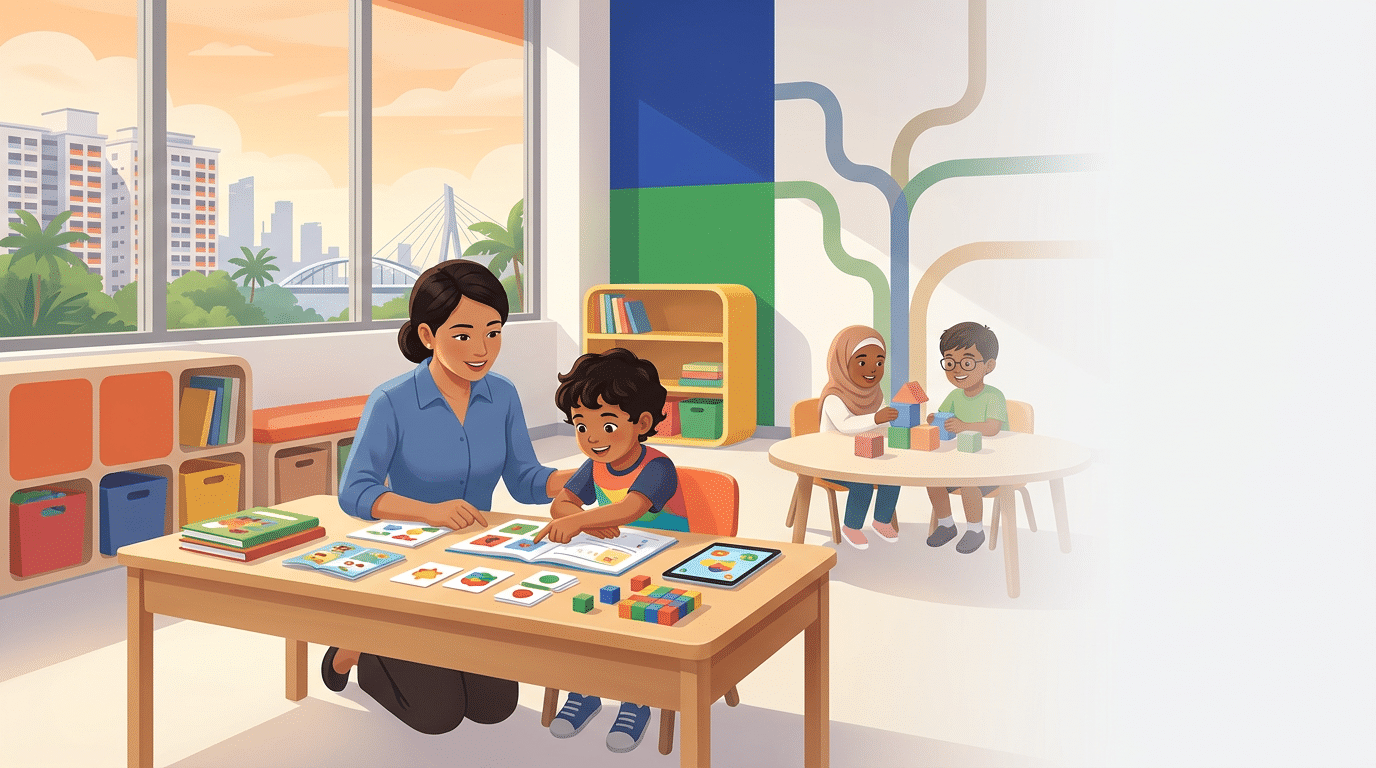
For children approaching primary school entry, EduFirst Learning Centre offers a dedicated preschool programme designed to give children a strong academic foundation before they enter Primary 1. With small classes of just four to eight students, children receive genuine individualised attention during one of the most formative transitions in their education journey.
School Fees at a Glance: What to Budget For
Education costs in Singapore vary enormously depending on the school type, and the headline tuition figure is rarely the whole story. Here is a broad overview to help you plan:
- MOE primary schools (international students): Approximately S$465 to S$750 per month in school fees (inclusive of GST), with additional miscellaneous fees on top. The exact amount depends on nationality and school tier — MOE’s online fees checker gives precise figures.
- MOE secondary schools (international students): Monthly fees are higher than primary level. Use the MOE fees checker for the most current rates, as fees are reviewed annually and have been increasing by S$25 to S$140 per year for international students as part of MOE’s 2024 to 2026 fee review cycle.
- International schools: Annual tuition typically ranges from S$18,000 to over S$55,000 depending on the school, curriculum, and year group. More affordable international school options exist closer to the S$20,000 to S$25,000 range for families working within a tighter budget.
- Private preschools: Monthly fees vary widely, from around S$800 for standard programmes to S$3,000 or more for premium international preschools.
- Ancillary costs: School bus services can add S$4,000 to S$8,000 annually. Registration fees, development levies, uniforms, technology fees, and school lunch programmes can push first-year costs well above the tuition figure alone.
If your employer provides an education allowance as part of a relocation package, read the terms carefully. Clarify whether the allowance covers tuition only or also ancillary costs, whether it is capped, and what happens if you need to switch schools mid-year. Many multinational companies offer these allowances, but the details vary considerably between packages.
Bridging the Academic Gap: Why Tuition Support Matters for Expat Children
One aspect of Singapore’s education culture that surprises many newcomers is how central supplementary learning is to daily student life. After-school tuition, enrichment classes, coding, arts, and sports coaching are all woven into the fabric of childhood here, for both local and expat families. For children joining an MOE school in particular, this support is not just cultural — it can be academically essential.
The Singapore Mathematics curriculum, for example, uses a distinct problem-solving approach that differs significantly from most overseas programmes. A child entering Primary 4 from a British or American school may be very capable academically but still find themselves several steps behind their classmates in the specific methods and formats the local syllabus demands. This is not a reflection of intelligence; it is simply a curriculum mismatch, and targeted tuition addresses it directly and efficiently.
At EduFirst Learning Centre, we have been supporting primary and secondary students across Singapore since 2010, and we understand exactly what an incoming student needs to find their footing quickly. Our primary tuition programmes are built around small class sizes of four to eight students, which means your child receives genuine individual attention rather than being one face in a large group. Tutors can quickly identify which parts of the MOE syllabus your child needs to build up, and lessons are tailored accordingly rather than following a one-size-fits-all schedule.
For older students joining secondary school, the same principle applies. The jump from an international curriculum to Singapore’s O-Level pathway — or even the transition between international curricula — can be more demanding than families expect. Our secondary tuition programmes cover core subjects including English, Mathematics, the sciences, and Humanities, all aligned to the MOE syllabus and designed to build both understanding and exam confidence. With 25 locations islandwide, there is very likely a centre conveniently near your home or your child’s school.
For families who prefer the flexibility of learning from home, especially in those first unsettled months after a move, EduFirst also offers e-lessons that deliver the same quality instruction and small-group format through an online platform. This option works particularly well for children who are still settling into a new routine or whose school schedule makes travelling to a centre difficult during the week.
Registering Your Child: A Practical Step-by-Step Guide
The registration process differs between local and international schools, but the following steps apply broadly to most situations expat families encounter. Working through this list methodically will reduce stress and help you avoid missed deadlines.
- Confirm your child’s year group — Singapore follows a January-to-December academic year. This may differ from your home country’s school calendar, so confirm the correct year level with the school before applying rather than assuming it maps directly.
- Build a realistic shortlist — Use the MOE SchoolFinder and international school directories to shortlist schools based on curriculum, location, and budget. Attend open houses wherever possible before committing.
- Prepare your documents — Standard requirements include your child’s birth certificate (with an English translation if necessary), passport with at least six months’ validity, immunisation records, recent school reports, and proof of Singapore residence such as a tenancy agreement. Some schools also require recommendation letters or conduct entry assessments.
- Register for AEIS if applying to an MOE school — Create an account in the MOE Candidates Portal, submit your application during the July registration window, and ensure your child sits the tests in Singapore in September. Primary school applicants will also need to have valid Cambridge English Qualifications results ready.
- Accept the offer and complete enrolment — Once a place is offered, act promptly. There is typically a short window to accept, pay any deposits, and complete paperwork. Delays can result in the place being offered to another applicant.
- Sort the practical details — School uniforms, bus passes, textbooks, and canteen cards all need to be arranged before the first day. Schools provide checklists, but starting early reduces last-minute stress considerably.
Tips for a Smooth School Transition in Singapore
The paperwork and fees are manageable once you understand the system. The human side of transition, however, deserves equal attention. Children who move internationally go through a genuine period of cultural, social, and academic adjustment, and acknowledging this openly tends to lead to better outcomes than expecting an immediate, seamless fit.
- Visit the school before the first day if the school permits it. Familiarity with the physical environment and, where possible, meeting a teacher in advance can significantly reduce first-day anxiety.
- Connect with expat parent communities. School parent-teacher associations, Facebook groups such as the Singapore Expat Schooling Forum, and platforms like InterNations are excellent sources of practical, on-the-ground advice from parents who have navigated the same journey.
- Give your child time before adding enrichment. Singapore’s after-school culture is rich and varied, but resist the impulse to fill every afternoon slot immediately. Allow at least a month for your child to settle into the school routine before adding tuition or activities. Once the basics are established, supplementary support becomes genuinely useful rather than an additional burden.
- Monitor language adjustment. If your child is entering a local school, be prepared for the initial encounter with Singlish and the code-switching between English and Mother Tongue languages that is normal in Singaporean classrooms. This settles with time, and patience in the early weeks pays dividends later.
- Build a relationship with teachers early. Singapore’s teaching workforce is rigorously trained and professionally proud. Communicating your family’s context early — particularly if your child is joining mid-year or comes from a very different academic system — helps teachers provide more targeted support from the outset.
- Start tuition support before the academic pressure peaks. If you know your child will need help bridging a curriculum gap, beginning tuition in the first month rather than waiting until exam season approaches gives both the tutor and your child time to build rapport and work methodically through the material.
Singapore is, in many respects, one of the most welcoming countries in the world for expat families navigating education. The infrastructure is excellent, the schools are safe, and the academic outcomes are world-class. With the right preparation, the right school choice, and the right support in place, finding the best fit for your child is genuinely achievable.
Making the Right Choice for Your Child’s Singapore Education
Choosing where your child goes to school in Singapore is one of the most consequential decisions you will make during your time here. Whether you opt for the cultural immersion and rigour of an MOE school or the curriculum continuity of an international school, the foundations you lay in those first months matter greatly. Take the time to visit schools, speak honestly with other expat parents, and understand not just where your child will learn but how they will be supported as they settle in.
For many expat families, the school decision is only the beginning. The next step is making sure your child thrives once they are in the classroom. If your child is joining an MOE school and needs help getting up to speed with the local curriculum, or if they simply need a structured, supportive environment to build confidence after a big move, EduFirst Learning Centre is here to help. With small class sizes, experienced educators, and 25 centres across Singapore, we make it easy to find the right academic support close to wherever you call home.
Ready to Give Your Child the Best Start in Singapore?
Whether your child is preparing for primary school, navigating the MOE curriculum for the first time, or catching up at the secondary level, EduFirst Learning Centre’s small-group tuition programmes are designed to help every student find their footing and move forward with confidence.
With 25 locations islandwide, class sizes of just 4 to 8 students, and flexible e-lesson options, there has never been a better time to get started.