- Sep 20, 2026
Sec 1 Science: Full Topic List and the Study Habits That Set Up Upper Secondary
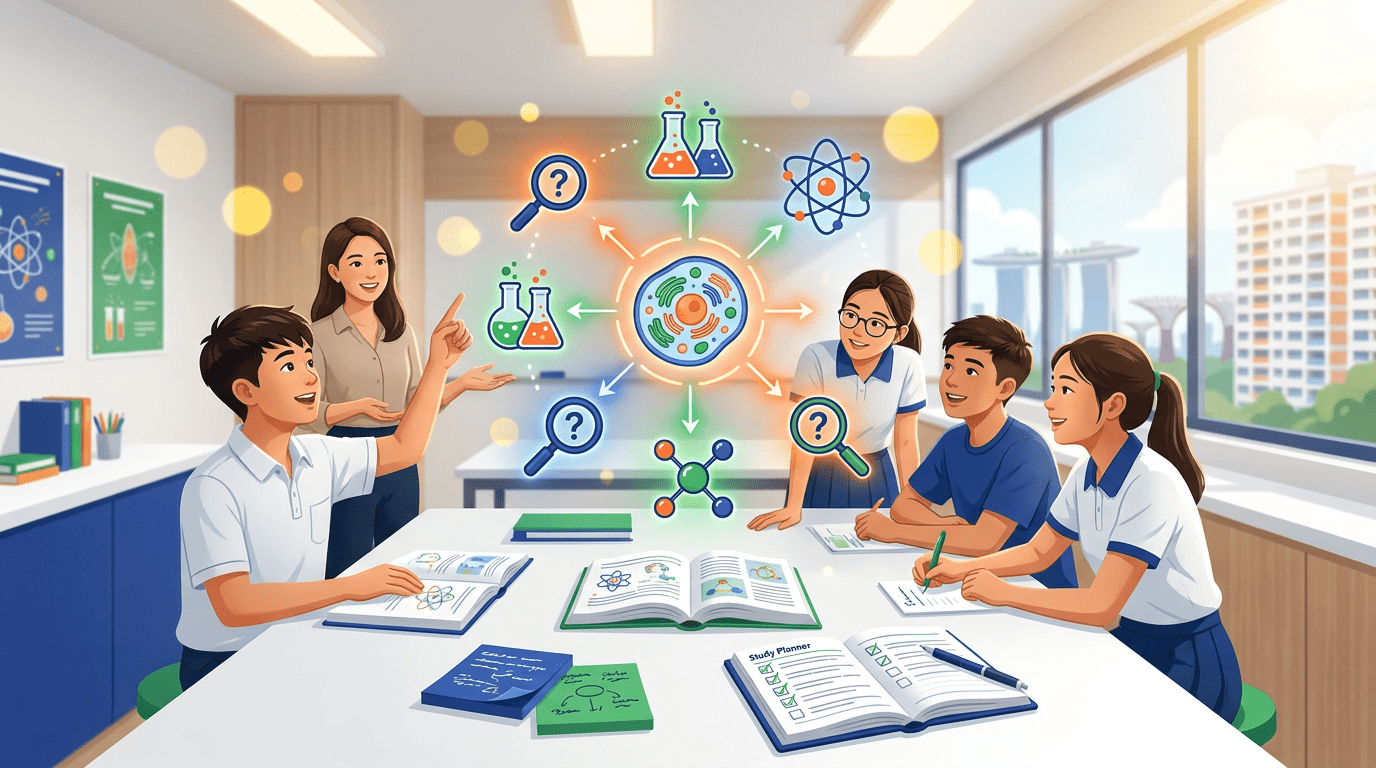
Secondary 1 is a year of firsts: first school uniform, first CCA sign-up, first time science notes fill three separate folders instead of one. For many students, the jump in content volume and thinking depth is the biggest academic shift they have experienced so far. For parents, it can feel just as unfamiliar.
What makes this year genuinely high-stakes is not just the content itself, but the habits formed around it. The Sec 1 Science topic list covers Biology, Chemistry, and Physics concepts simultaneously — and how your child learns to handle that breadth in Year One directly shapes how ready they are when subject banding arrives at the end of Sec 2. Whether they go on to Pure Sciences or Combined Science, the foundation is built right here.
This guide gives you a clear, complete breakdown of the Sec 1 Science topics your child will study, explains why each theme matters for upper secondary, and walks through the specific study habits that distinguish students who thrive in Sec 3 and Sec 4 from those who struggle to catch up. If your child has just started secondary school, or is about to, this is the article to read first.
Why Sec 1 Science Is More Important Than It Looks
At first glance, Sec 1 Science can seem manageable. There is no national examination at this level, and many students coast through the first term on the momentum built from primary school. But the subject is doing something more significant beneath the surface: it is introducing the thinking frameworks, vocabulary, and investigative habits that Pure Physics, Pure Chemistry, and Pure Biology will assume students already have by Sec 3.
End-of-Sec-2 results determine whether a student takes Pure Sciences or Combined Science, and that choice has a long reach — affecting junior college subject options and university pathways years later. At the same time, students in the current Sec 1 cohort will sit the new Singapore-Cambridge Secondary Education Certificate (SEC) rather than the legacy O-Level examination, which makes building strong conceptual habits early an even more durable strategy than paper-format cramming.
The other reason Sec 1 Science deserves serious attention is that it runs as a single timetabled subject covering three distinct scientific disciplines, each with different thinking styles, vocabulary demands, and problem-solving approaches. Even students who performed well in PSLE Science can find themselves caught off guard by the pace and complexity, particularly if they continue relying on the memorisation habits that served them at primary level. Building the right approach now prevents small misunderstandings from quietly compounding over two years.
How the Sec 1 Science Syllabus Is Structured
Under the MOE 2021 Lower Secondary Science syllabus, students at the G2 and G3 levels follow a curriculum organised around five overarching themes: Scientific Endeavour, Diversity, Models, Systems, and Interactions. These themes are deliberately designed to bridge primary school science and the disciplinary sciences of upper secondary. The G1 stream follows a different, more contextualised set of modules (Machines Around Us, Our Environment, Our Body and Health), while G2 and G3 students share the thematic syllabus described in this guide.
It is worth noting that not all five themes are covered equally in Sec 1. The Scientific Endeavour, Diversity, and Models themes form the core of Year One, while Systems is introduced towards the end of Sec 1 and extended through Sec 2. Interactions, the most demanding theme, is primarily a Sec 2 topic and serves as the main bridge into upper secondary sciences. The sequence is intentional: it moves students from classifying and observing, to modelling and explaining, and finally to understanding cause-and-effect relationships in complex systems.
The Sec 1 Science Topic List: A Theme-by-Theme Breakdown
Theme 1: The Scientific Endeavour
This is typically the first chapter of the year and sets up everything that follows. Students learn how science is practised as a discipline — how to ask researchable questions, plan and carry out fair tests, make accurate measurements, record data systematically, and communicate findings with clarity. Practical skills covered include the safe and correct use of laboratory equipment such as measuring cylinders, thermometers, and electronic balances, as well as an introduction to standard SI units.
Many students underestimate this theme because it does not feel like “real science” compared to cells or chemicals. In practice, it is where crucial marks are won or lost. Reading a measuring cylinder at eye level rather than from above, remembering to tare a balance before weighing, and expressing results in correct units with the right significant figures — these small procedural habits accumulate into consistent marks on practical assessments and data-response questions throughout the year.
Theme 2: Diversity
The Diversity theme is the largest and most content-rich part of Sec 1 for G2 and G3 students. It covers three interconnected areas that span both Chemistry and Biology concepts.
Physical Properties of Matter: Students learn to classify matter according to measurable properties such as state (solid, liquid, gas), density, solubility, melting point, and boiling point. They explore how solids maintain a fixed shape, liquids take the shape of their container, and gases expand to fill available space — connecting observable behaviour to the idea that matter is made of particles arranged differently in each state.
Chemical Composition: This section introduces the distinction between elements, compounds, and mixtures. Elements are pure substances made of one type of atom (for example, oxygen or gold), compounds are formed when two or more elements combine chemically (such as water, H₂O), and mixtures contain two or more substances combined physically — meaning they can be separated without a chemical reaction. This is an area where misconceptions are common: students often misclassify saltwater as a compound rather than a mixture, or mistake a gas like helium for a compound.
Separation Techniques: Students also study the practical methods used to separate mixtures, including filtration, evaporation, distillation, and chromatography. Understanding which technique applies to which type of mixture requires students to link their knowledge of physical properties (like solubility and boiling point) to real-world problem-solving — exactly the kind of application-based thinking that features heavily in school assessments.
Theme 3: Models
The Models theme introduces students to one of the most important ideas in scientific thinking: that scientists use simplified representations to explain things that cannot be directly observed. There are three main models covered in Sec 1.
The Particle Model of Matter: This builds on the states of matter covered in the Diversity theme by explaining the behaviour of matter in terms of the arrangement and movement of particles. Students use this model to explain diffusion, changes of state, and the properties of solids, liquids, and gases at a microscopic level. A common stumbling block is the tendency to take particle diagrams too literally — assuming they are drawn to scale, for example, or that the spaces between particles represent empty space in a meaningful physical sense.
The Ray Model of Light: Students learn that light travels in straight lines, and use this model to explain how shadows are formed, how reflection off flat and curved mirrors works, and how refraction causes light to bend when it moves between materials of different optical densities. Ray diagrams are a key skill here, and students often struggle initially with the distinction between a ray (a mathematical representation of direction) and an actual beam of light. Accurate diagram technique, including correct use of arrows and labelling, is assessed throughout Sec 1 and beyond.
The Cell Model: This section introduces cells as the basic units of living things. Students study the structure and function of animal and plant cells, learning to identify and describe organelles such as the nucleus, cell membrane, cell wall, chloroplasts, and vacuole. Drawing and accurately labelling cell diagrams from memory — rather than tracing from a textbook — is a skill that pays off repeatedly in Biology-based questions throughout lower and upper secondary.
Theme 4: Systems (Introduced in Sec 1, Extended in Sec 2)
The Systems theme focuses on how components work together within living and non-living environments. In Sec 1, the primary system studied is the human digestive system — covering the organs involved, the processes of mechanical and chemical digestion, and how nutrients are absorbed into the bloodstream. Students also begin to explore the concept of electrical systems, including basic circuit components, current, voltage, and Ohm’s Law. These topics form the bridge into the more complex Systems and Interactions content of Sec 2, and they introduce the quantitative problem-solving (calculations with correct units) that becomes increasingly important in upper secondary Physics and Chemistry.
Science Process Skills: The Hidden Marks Your Child Needs
Alongside topic knowledge, the MOE syllabus places significant emphasis on scientific process skills. These are the practical and analytical abilities that allow students to conduct investigations, interpret data, and communicate findings accurately. They are not tested separately — they are embedded in practical tasks, structured questions, and open-ended responses throughout the year. Students who develop these skills early gain a consistent advantage not just in Sec 1, but across all subsequent science subjects.
The core process skills taught at this level include:
- Observing — Using senses and instruments to gather accurate information
- Classifying — Grouping objects or events based on shared characteristics
- Comparing — Identifying meaningful similarities and differences
- Inferring — Drawing evidence-based conclusions that go beyond what is directly observed
- Predicting — Making reasoned forecasts based on patterns or prior knowledge
- Analysing and Interpreting — Reading tables, graphs, and experimental results to identify trends
- Communicating — Presenting findings using correct scientific terminology, diagrams, and structured written responses
- Evaluating — Assessing whether an experiment is fair, reliable, and accurate, and suggesting improvements
- Formulating hypotheses — Proposing testable explanations for observed phenomena
A particularly important shift from primary school is the language standard expected in written answers. Secondary Science answers require precise vocabulary — “particles gain kinetic energy” rather than “the particles move faster” — and students who build this precision early find that it transfers naturally into their upper secondary work.
Where Sec 1 Students Typically Struggle
Understanding the most common difficulty areas helps parents and students address them before they become entrenched habits. The transition from primary to secondary science involves a genuine shift in what is expected: students move from describing observable phenomena to explaining abstract concepts using models, calculations, and precise scientific language.
The most frequently seen challenges include confusing classification criteria (for example, mistaking a mixture for a compound, or assuming all cells look exactly like textbook diagrams), misreading scientific equipment due to poor technique (reading a measuring cylinder from above eye level rather than at the meniscus), and struggling with density calculations when units are inconsistent. There is also a common gap between being able to recognise a correct answer and being able to construct one independently — students may understand a concept when it is explained to them but freeze when asked to write an explanation in their own words using the right keywords.
The other challenge is structural: because Sec 1 Science covers three disciplines taught by different specialist teachers, students sometimes treat it as three separate mini-subjects and miss the conceptual connections between them. In reality, the particle model supports both Chemistry and Physics understanding, and cell biology links directly to the digestive system covered in the Systems theme. Students who actively build these cross-topic connections develop a deeper, more flexible understanding that proves invaluable when upper secondary exams require the application of integrated knowledge.
The Study Habits That Pay Off in Upper Secondary
Study skills are significantly easier to develop in Sec 1 and Sec 2, before the demands of subject specialisation and high-stakes examinations set in. Students who build reliable habits at this stage do not just perform better in their Sec 1 year-end exams — they arrive at Sec 3 with the systems already in place to handle a much heavier workload. Here are the habits that genuinely make a difference.
1. Review notes on the day they are taught — Science concepts in Sec 1 build sequentially. The particle model supports the understanding of diffusion and changes of state; cell structure supports the understanding of digestion. A brief 10–15 minute review after each lesson, while the content is still fresh, prevents the kind of accumulated confusion that is very difficult to untangle under exam pressure weeks later.
2. Draw and label diagrams from memory — For topics like cells, ray diagrams, and digestive system organs, the ability to reproduce accurate diagrams without referring to notes is both a revision technique and a directly testable skill. Students who practise drawing from memory, rather than copying from textbooks, build the kind of recall that holds up in exam conditions.
3. Build a science vocabulary habit — Every new term learned in Sec 1 — density, refraction, nucleus, osmosis, element — should be practised in sentences, not just defined in a list. The examiner rewards answers that use keywords precisely and in context. A simple weekly vocabulary review, using flashcards or written self-testing, builds this precision gradually without requiring large study blocks.
4. Correct mistakes before moving on — Many students complete marked work, note the score, and file the paper away. Students who go back and work out where they lost marks — not just which questions, but which specific misconception or missing keyword caused the error — improve far more consistently. This habit is especially important for structured questions where partial credit is available.
5. Use realistic schedules that account for CCA life — CCAs, tuition, and longer commutes are all part of secondary school life in Singapore. Study schedules that do not account for these realities are abandoned quickly. Short, focused blocks of 20–30 minutes spread across the week are more sustainable than marathon sessions the night before a test — and more effective for the kind of conceptual retention that Science requires.
6. Practise answering open-ended questions aloud or in writing — One of the hardest shifts in secondary Science is the move from choosing the right answer to constructing a complete, independently worded explanation. Regular practice with structured questions — even informally, explaining concepts to a parent or sibling — builds the verbal fluency that makes written answers come more naturally under timed conditions.
Students who develop strong Science study habits in Sec 1 — drawing accurate diagrams, showing working clearly, using precise terminology — carry those habits into upper secondary where they become even more critical. Equally, students who relied on last-minute memorisation in lower secondary find that approach unsustainable when the content load of Pure Sciences arrives.
How Sec 1 Science Is Assessed at School
There is no national examination for Sec 1 Science — all assessment is school-based and varies slightly between schools. The typical structure includes Weighted Assessments (WAs) spread across the year, which together account for roughly 50–60% of the final grade, and an End-of-Year Examination (EYE) making up the remaining 40–50%. WAs may include written tests, scenario-based questions, short open-book tasks, and practical assessments where students are graded on their experimental technique and lab report writing. The EYE generally features Multiple-Choice Questions (MCQs), structured questions requiring reasoned explanations, and open-ended questions that test the ability to design or evaluate investigations.
Some schools also include performance-based tasks and group project work, particularly for assessing collaboration, scientific communication, and the application of Science to real-world problems. Understanding the format of your child’s school assessments early — and ensuring revision covers both content knowledge and process skills — makes the assessment experience far less stressful and far more effective.
How Sec 1 Connects to the Sec 3 Subject Banding Decision
One of the most important things parents can understand about Sec 1 Science is where it leads. Under Full Subject-Based Banding (Full SBB), a student’s performance through lower secondary influences their eligibility to take subjects at different G-levels, and it is the end of Sec 2 results that determine whether a student proceeds to Pure Science subjects (Pure Physics, Pure Chemistry, Pure Biology) or Combined Science. That decision, in turn, has implications for Junior College subject combinations and university course eligibility years down the line.
A strong start in Sec 1 prepares students for subject banding in Sec 3, where they will be placed based on academic performance and interests. By mastering the Sec 1 topic list and developing genuine conceptual understanding — rather than surface memorisation — students become more adaptable and more confident when they eventually choose between Pure and Combined Science pathways. Pure Physics in Sec 3, for example, assumes fluency with forces, energy, and measurement from Sec 1 and 2. Pure Chemistry assumes confident use of the periodic table, chemical formulae, and separation techniques. These are not review topics in upper secondary — they are assumed starting points.
Interest and confidence also compound early. Students who genuinely engage with lower secondary Science and feel capable tend to make bolder, more aspirational subject choices. The reverse is equally true: a student who loses confidence in Sec 1 because abstract concepts were not properly anchored is less likely to choose a demanding Science pathway even if they have the intellectual ability to succeed in it. Investing in a solid lower secondary Science foundation is, in this sense, an investment in keeping more doors open.
How EduFirst Supports Sec 1 Science Students
At EduFirst Learning Centre, we have been supporting Singapore students since 2010 — and we know that Sec 1 is one of the most pivotal academic transitions a child will make. Our Secondary Tuition programme is designed specifically for the Singapore curriculum, with experienced tutors who understand not just the syllabus content but the thinking and answering skills that turn understanding into marks.
What makes our approach different is scale. With small class sizes of just 4 to 8 students across our 25 locations islandwide, every student receives the kind of individual attention that simply is not possible in a larger classroom setting. Tutors can identify misconceptions early, give specific feedback on structured answers, and adjust the pace of explanation to match each student’s level of understanding. For Sec 1 Science — where the habits formed in this year carry forward into upper secondary — that personalised attention is not a luxury. It is the difference between a student who builds a genuine foundation and one who papers over gaps until they become harder to fix.
Whether your child needs support with the Diversity topics, is struggling to write complete explanations for open-ended questions, or simply needs a structured environment that makes consistent revision a reality, EduFirst is here to help. Our E-Lessons are also available for families who prefer flexible, online learning options without compromising on quality or personalised feedback.
Getting Sec 1 Science Right: A Foundation Worth Building
The Sec 1 Science topic list covers a lot of ground — from classifying matter and separating mixtures, to drawing ray diagrams, understanding cell structure, and exploring the human digestive system. But the content itself is only part of the picture. The students who go on to thrive in upper secondary are not necessarily the ones who found Sec 1 easy. They are the ones who developed the right habits early: reviewing notes regularly, practising precise language, correcting mistakes thoroughly, and building the kind of conceptual understanding that holds up when exam questions appear in unfamiliar forms.
Sec 1 is genuinely the year to get this right. The topics are manageable, the stakes of individual assessments are lower than they will be in Sec 3 and Sec 4, and the habits — once formed — carry forward automatically. A child who learns to write a complete scientific explanation in Year One will find that skill waiting for them in every science exam they sit for the rest of their secondary education.
Give Your Child a Strong Start in Secondary Science
EduFirst Learning Centre offers personalised Secondary Tuition in small classes of 4–8 students across 25 locations in Singapore. Our experienced tutors help Sec 1 students build the topic knowledge, process skills, and study habits that set them up for upper secondary success.
Have questions about our Sec 1 Science programme or want to find the nearest centre? Send us an enquiry today and a member of our team will be in touch to help you find the right fit for your child.