- Oct 1, 2026
Secondary 1 Posting: How Places Are Allocated After PSLE
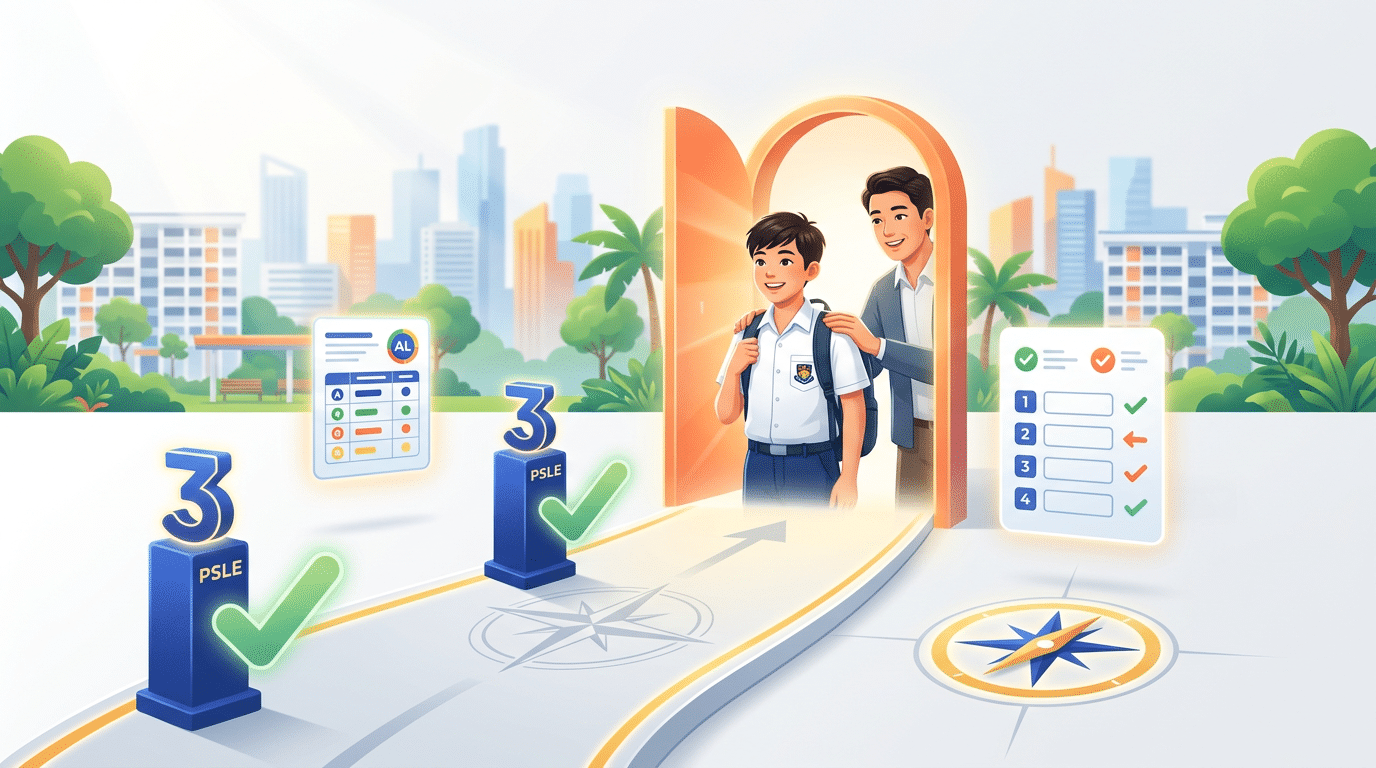
Every November, Primary 6 students across Singapore receive their PSLE results — and for many families, the very next question is: which secondary school will my child attend? The answer comes through the Secondary 1 (S1) Posting Exercise, a centrally managed process run by the Ministry of Education (MOE) that determines where each student will spend the next four or five years of their education. Understanding exactly how this process works — from PSLE scores to Posting Groups, from school choice submission to tie-breakers — can make a significant difference in how confidently you and your child approach this important transition.
This guide walks you through every stage of the S1 Posting Exercise in plain language. You will learn how PSLE scores translate into Posting Groups, what the new G1, G2 and G3 subject levels mean in practice, how tie-breakers are applied, and what role DSA-Sec and school affiliation play. Whether your child is in Primary 4 and you are planning ahead, or in Primary 6 preparing to submit school choices right now, this article gives you the full picture.
What Is the Secondary 1 Posting Exercise?
The Secondary 1 Posting Exercise is the official process by which Primary 6 students in Singapore are allocated places in secondary schools after receiving their PSLE results. It is centrally managed by MOE and is the main pathway through which most students enter secondary school each year. The entire exercise — from the release of PSLE results to the announcement of posting outcomes — takes place across a focused window of a few weeks in November and December.
It is worth noting that not every student goes through this process in the same way. Students who secured a place through Direct School Admission (DSA-Sec) receive their school allocation together with their PSLE results and do not need to submit school choices through the standard posting route. For everyone else, the S1 Posting Exercise is how secondary school placement is decided — and understanding its mechanics puts your family in a much stronger position.
How Your Child’s PSLE Score Determines Their Posting
Academic merit, measured by the PSLE Score, remains the primary criterion for Secondary 1 posting. The PSLE Score is the sum of the four Achievement Levels (ALs) your child earns in English Language, Mother Tongue Language, Mathematics and Science. Because each AL runs from 1 (strongest) to 8 (weakest), the overall score ranges from a best possible 4 to a maximum of 32, with lower scores being more competitive.
Students with stronger (lower) PSLE Scores are considered first for vacancies in their chosen schools. Each secondary school has a PSLE Score range based on the previous year’s intake, with the Cut-Off Point (COP) representing the score of the last student admitted. These ranges are published on MOE’s SchoolFinder tool and serve as a useful reference — but it is important to understand that they reflect a past cohort’s results and choices, not a fixed entry requirement. A school’s COP can shift from year to year depending on how many students apply and what scores the cohort achieves in that particular cycle.
Understanding Posting Groups: PG1, PG2 and PG3
One of the most significant changes in recent years is the introduction of Posting Groups, which replaced the old Express, Normal (Academic) and Normal (Technical) stream labels from the 2024 Secondary 1 cohort onwards. Rather than streaming students into separate tracks for their entire secondary education, MOE now posts students through one of three Posting Groups — PG1, PG2 or PG3 — based on their overall PSLE Score. This shift reflects a broader educational philosophy: that a student’s PSLE Score should guide their starting point, not define a fixed ceiling for the next four years.
The Posting Group your child is assigned to guides the initial subject levels they take at the start of Secondary 1, but it is not a permanent label. Here is how the PSLE Score bands map to Posting Groups:
- Posting Group 3 (PG3): PSLE Score of 4 to 20 — students generally start most subjects at the G3 level (formerly Express-equivalent)
- Posting Group 2 (PG2): PSLE Scores of 21 to 24 — students generally start most subjects at the G2 level, with the option to take some subjects at G3
- Posting Group 1 (PG1): PSLE Score of 25 to 30 (with AL7 or better in English Language and Mathematics) — students generally start most subjects at the G1 level, with options to move up in specific subjects where they performed well
The scores 21, 22, 25 and certain borderline ranges allow for a choice of Posting Group in cases where a student’s performance in individual subjects qualifies them. This flexibility is intentional — the system is designed to ensure that schools admit a diverse profile of students while giving each individual access to subject levels that suit their abilities.
What Posting Groups Mean for Subject Levels (G1, G2, G3)
Under Full Subject-Based Banding (Full SBB), which was fully implemented across Singapore secondary schools from the 2024 S1 cohort, students no longer follow a single stream for every subject. Instead, core academic subjects — English Language, Mother Tongue Language, Mathematics and Science — are taught at one of three levels, known as G1, G2 and G3, where the “G” stands for General. This means a student can study Mathematics at G3 and English at G2 in the same year, taking each subject at the level that best reflects their individual ability and pace.
The three G-levels map to the standards of the former streams as follows:
- G3 is equivalent to the former Express level — the most academically demanding, designed to prepare students for the Singapore-Cambridge Secondary Education Certificate (SEC) at the highest level
- G2 is equivalent to the former Normal (Academic) level — an intermediate standard with a balanced curriculum
- G1 is equivalent to the former Normal (Technical) level — a foundational standard with greater scaffolding and practical application
One key benefit of this new approach is that secondary school form classes are now mixed, meaning students from different Posting Groups learn together for a number of common curriculum subjects such as Art, Music, Physical Education, and Character and Citizenship Education. This promotes greater social interaction across different academic profiles — something the old streaming system made very difficult. For subjects taught at G-levels, students attend classes with peers at the same subject level, not necessarily from the same Posting Group. If your child is preparing for this transition and could use additional support to hit the ground running, EduFirst’s Secondary Tuition programme is structured to help students at every G-level build confidence and consistency from their very first term.
The S1 Posting Process Step by Step
Knowing the sequence of events helps families stay organised and avoid missing critical windows. Here is how the posting process unfolds after PSLE results day:
- PSLE Results Are Released — Typically in late November, students collect their results from their primary schools. Along with the result slip, families receive information about the S1 Posting Exercise and the school option form process.
- Access the S1 Portal via Singpass — Parents log in to the MOE S1 Portal using Singpass to view their child’s eligible Posting Group and begin the school selection process. Keeping your Singpass credentials ready and your registered home address updated with the primary school before end of October each year is important.
- Submit Up to Six School Choices — Families can list up to six secondary school preferences, ranked in order of priority. The order matters greatly, as choice order is used as a tie-breaker if two students share the same score.
- MOE Runs the Posting Algorithm — MOE processes all applications, allocating each student to their highest-ranked school that has remaining vacancies and matches their PSLE Score and Posting Group eligibility.
- Posting Results Are Announced — Results are typically released in mid-to-late December. Students find out which school they have been posted to through the S1 Portal.
- Students Who Are Not Posted to Any Choice School — If a student cannot be placed in any of their chosen schools, MOE will post them to a school with remaining vacancies based on their PSLE Score and registered home address. This is one reason it is so important to keep home address details current.
What Happens When Scores Are Tied?
Because the PSLE scoring system uses AL bands rather than precise raw marks, more students share the same overall PSLE Score than was the case under the old T-score system. This means ties at the borderline of popular schools are more common. MOE applies a clear sequence of tie-breakers whenever two or more students with the same score are vying for the last available places in a school.
The tie-breakers are applied strictly in this order:
- Citizenship Status — Singapore Citizens are given priority over Permanent Residents, who are in turn given priority over International Students.
- Order of School Choice — Between students with the same score and citizenship status, the student who ranked that school higher on their own list of choices is placed first. This is precisely why careful, strategic ordering of school choices is so important.
- Computerised Balloting — Only used as a final resort when score, citizenship and choice order are all identical. Each student is given an equal opportunity through a random computerised draw.
There is also a specific posting advantage for students applying to Special Assistance Plan (SAP) schools. Students who achieved a PSLE Score of 14 or better and received a Distinction, Merit or Pass in Higher Chinese Language (HCL) are eligible for posting priority at SAP schools. If multiple students with the same PSLE Score apply to the same SAP school, those with better HCL grades are allocated places ahead of other applicants — and this advantage is applied before the standard tie-breakers come into effect.
DSA-Sec and Affiliation Priority: Other Ways Into a School
The S1 Posting Exercise is not the only route into secondary school. Two other pathways — Direct School Admission (DSA-Sec) and affiliation priority — can shape where a student ends up, and parents should understand how each works.
Direct School Admission (DSA-Sec)
Introduced in 2004, DSA-Sec allows Primary 6 students to apply for admission to selected secondary schools before sitting the PSLE, based on their talents and strengths in specific areas. These include sports, performing arts, debate and public speaking, science and mathematics, languages, uniformed groups and leadership. Students who receive and accept a confirmed DSA-Sec offer are guaranteed a place in that school, provided their PSLE result meets the minimum Posting Group requirement, and they do not need to go through the standard S1 Posting process for school allocation. The key trade-off is that DSA-Sec students must commit to the school they are admitted to for the duration of the programme. This is an important consideration for families weighing up this option, especially when a child’s PSLE results might have qualified them for other schools.
Affiliation Priority
Many primary schools in Singapore are affiliated with a secondary school, and students from those primary schools can benefit from affiliation priority during the S1 Posting Exercise. However, this advantage is not unlimited. From the 2019 S1 Posting Exercise, MOE required affiliated secondary schools to reserve at least 20% of places in each Posting Group for non-affiliated students — meaning affiliation priority is capped at 80% of a school’s available places per group. Affiliation also does not override the need to meet the school’s minimum PSLE Score requirement; it simply improves a student’s chances when competing for places against other applicants with similar scores.
Choosing Schools Wisely: What to Look Beyond the Cut-Off Point
Cut-off points receive a lot of attention during the school selection period, but they are best understood as a starting reference rather than the defining factor in your decision. A school’s COP reflects the score of the last student admitted in the previous year’s posting exercise — it can shift meaningfully from year to year depending on how that cohort’s scores were distributed and which schools proved most popular. Meeting last year’s COP does not guarantee a place this year if demand increases; equally, a school with a slightly higher COP one year may ease the next.
When shortlisting schools, consider the following alongside the PSLE Score range:
- Distinctive programmes and subject offerings — Does the school offer subjects or enrichment programmes aligned with your child’s interests or strengths?
- CCA options — Co-Curricular Activities are a core part of secondary school life and significantly influence a student’s overall development and future applications.
- School culture and ethos — The values a school emphasises and the community it builds matter as much as academic outcomes over four years.
- Proximity to home — A manageable commute helps your child arrive at school rested and leave time for study, activities and rest after a full school day.
- Support for different learners — If your child benefits from structured support or enrichment at specific G-levels, knowing what academic support the school offers is valuable.
The S1 option form allows up to six choices, and making thoughtful use of all six — rather than only listing reach schools — gives your child the best possible outcome from the posting process. A good rule of thumb is to include schools you would genuinely be happy for your child to attend across the realistic range of their score.
Preparing Your Child for Secondary School Success
The S1 Posting Exercise marks the end of one chapter and the start of another. Whether your child is in Primary 5 and still building toward their PSLE Score, or has already received their posting and is preparing for their first day of secondary school, the fundamentals that drive long-term success remain the same: strong subject foundations, consistent study habits, and the confidence that comes from understanding the material rather than just memorising it.
For families with children still in primary school, the most effective thing you can do right now is address any weak subjects early. Because the PSLE Score adds together four subject ALs, one underperforming subject can raise the total significantly — and it is almost always more efficient to lift a weaker subject than to squeeze extra marks from an already strong one. EduFirst’s Primary Tuition programme offers small classes of just 4 to 8 students, ensuring every child gets the individual attention they need to close gaps and build genuine understanding across all four PSLE subjects. With 25 locations islandwide and e-lessons available for added flexibility, support is always accessible regardless of where you are in Singapore.
For students who have already been posted and are about to begin Secondary 1, the transition to G-level subjects can feel like a significant gear shift — new expectations, new teachers and a new environment all at once. Getting off to a strong start in Secondary 1 helps establish good learning habits that pay dividends all the way through to the SEC examination. EduFirst’s Secondary Tuition programme is tailored to the Full SBB curriculum at all G-levels, helping students consolidate their understanding and stay ahead as subject content increases in depth and complexity. If your child also attends EduFirst’s student care service, the continuity of familiar teachers and a structured after-school environment makes the adjustment smoother still.
The Bottom Line for Parents
The Secondary 1 Posting Exercise is a well-structured process once you understand how its different parts connect. Your child’s PSLE Score determines their eligible Posting Group, which in turn guides their starting subject levels under Full SBB. School choices are submitted through the S1 Portal, and places are allocated by academic merit first, with citizenship, choice order and balloting serving as sequential tie-breakers when scores are identical. DSA-Sec and affiliation priority offer additional pathways for students with specific talents or primary-secondary school links.
The most empowering thing you can do as a parent is to start early — understanding the system, supporting your child’s learning in the years leading up to PSLE, and helping them build the subject-level confidence they need to thrive wherever they are posted. The school a student attends sets the environment; the foundations they bring in determine how far they can go within it.
Give Your Child the Best Start — Before and After PSLE
Whether your child is working toward a stronger PSLE Score or preparing to hit the ground running in Secondary 1, EduFirst Learning Centre offers personalised tuition in small classes of 4 to 8 students across 25 locations islandwide. Our experienced tutors follow the latest MOE syllabus and are available for Primary Tuition, Secondary Tuition, Pre-School programmes and E-Lessons for maximum flexibility.