- Oct 15, 2026
P3 Science: How the Syllabus Begins and What Themes Are Covered
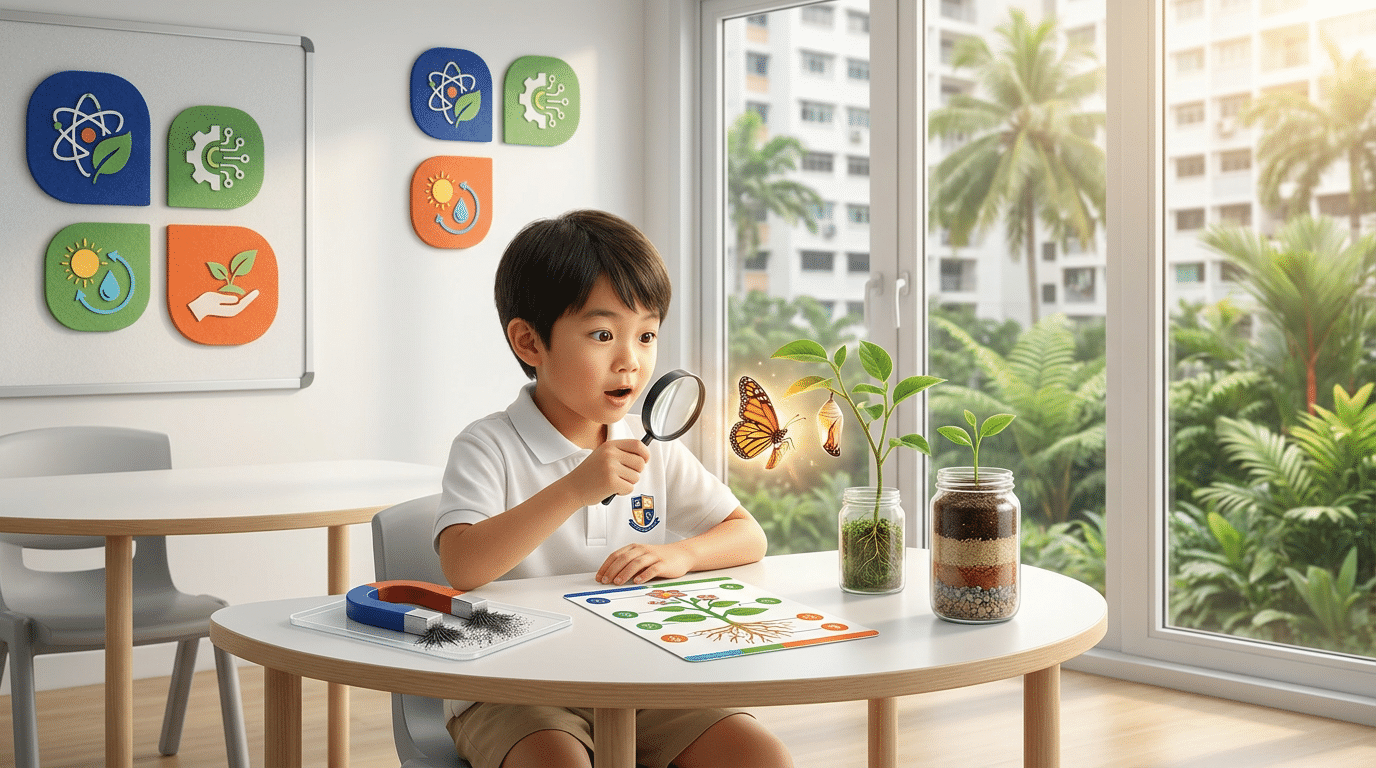
Primary 3 Science is the only time a completely new examinable subject enters the Singapore primary school curriculum. Before P3, your child explored the natural world informally through General Studies in P1 and P2. From P3 onwards, Science becomes a structured, assessed subject with its own vocabulary, answering conventions, and thinking skills. That shift is bigger than most parents anticipate.
The good news is that the P3 Science syllabus is genuinely interesting. Your child will classify living things, investigate materials, trace the life cycles of butterflies and frogs, and discover how magnets attract and repel. What makes P3 critical, however, is not just the content itself. The observation habits, scientific vocabulary, and explanation structures that children build in P3 are the very foundations that P5 and P6 exam questions quietly assume. Getting those foundations right from the start saves an enormous amount of remediation later.
This guide walks through everything covered in the P3 Science syllabus — the themes, the topic clusters, the process skills, and the connections to upper primary — so you know exactly what your child is learning and how to support them along the way.
Why P3 Science Is More Important Than It Looks
Many parents treat P3 Science as gentle background learning, something to ease into before the real work begins. That is an understandable view, but it underestimates what is actually happening. P3 is when children learn not just what science says, but how to think and communicate scientifically. The classification skills, comparison sentence structures, and scientific vocabulary introduced in P3 are assumed — silently and consistently — in every subsequent year of primary Science.
A child who arrives in P5 without a firm grasp of how to classify living things, or who has never been trained to write a cause-and-effect explanation, does not simply have a content gap. They have a foundational gap in how to answer Science questions altogether, which is considerably harder to close. Treating P3 Science seriously is therefore not about pressure. It is about building the right habits at the right time, when they are cheapest to build and most durable.
How the P3 Science Syllabus Is Structured
The MOE Primary Science syllabus is organised around five overarching themes — Diversity, Cycles, Systems, Interactions, and Energy — that spiral across P3 to P6. Not all five themes appear at every level. At P3, the themes covered are Diversity, Cycles, and Interactions. Systems and Energy topics begin from P4 onwards, deepening steadily through P5 and P6.
This structure is deliberate. Diversity and Cycles are the most observation-driven themes, making them a natural starting point for children who are new to formal scientific thinking. Interactions, through the topic of magnets, adds a layer of hands-on reasoning that teaches children to move beyond describing what they see toward explaining why something happens. Together, the three P3 themes produce a coherent first year of Science that emphasises careful looking, accurate classifying, and simple but precise explanation.
| P3 Theme | Topic Cluster | Core Learning Goal |
|---|---|---|
| Diversity | Living and non-living things; Classification of animals, plants, fungi, and bacteria; Diversity of materials | Classify accurately using observable evidence |
| Cycles | Life cycles of animals; Life cycles of plants | Identify and compare stages; understand that living things change |
| Interactions | Magnets | Explain attraction, repulsion, poles, and magnetic materials |
Theme 1: Diversity — Living Things, Non-Living Things, and Materials
Diversity is the largest theme in P3 and occupies most of the first two school terms. It covers two distinct areas: the diversity of living things and the diversity of materials. Both areas share a common intellectual goal — teaching children to observe carefully, identify distinguishing features, and use those features to sort and classify accurately.
Living and Non-Living Things
The first topic asks children to define what makes something alive. Living things carry out seven life processes, often remembered through the acronym MRS GREN: Movement, Respiration, Sensitivity, Growth, Reproduction, Excretion, and Nutrition. Students also learn to distinguish between things that are currently living, things that are non-living, and things that were once alive — a three-way distinction that trips up many children who assume the category is simply living versus not.
From there, the classification of living things expands into four groups: animals, plants, fungi, and bacteria. This is a point worth reinforcing at home. Children who learn only two groups, animals and plants, carry a misconception that causes genuine problems from P5 onwards when fungi and bacteria feature prominently in food chains and decomposition questions. Getting all four groups correct from the start is worth the effort.
Within the animals group, students classify vertebrates (mammals, birds, reptiles, amphibians, and fish) and key invertebrate groups using observable features such as body covering, number of limbs, and method of breathing. Within plants, they distinguish between flowering and non-flowering varieties. The classifying principle throughout is the same: a useful property must actually vary across the group being sorted. If every organism in a set shares the same feature, that feature cannot be used to split them into sub-groups.
Diversity of Materials
The second Diversity topic shifts from biology to everyday physics. Students examine common materials — wood, metal, ceramic, rubber, glass, plastic, and fabric — and investigate their properties: strength, flexibility, whether they float or sink in water, transparency, and waterproofness. The learning goal is not simply to list properties but to match materials to suitable uses. A child asked why a waterproof jacket uses nylon rather than cotton should be able to explain the property that makes nylon the better choice for that purpose.
This topic develops the habit of evidence-based reasoning that is central to Science at every level. Rather than saying something is “good” or “better,” students learn to name a specific property and link it to a specific function — a skill that pays dividends in the open-ended questions of upper primary.
Theme 2: Cycles — Life Cycles of Plants and Animals
The Cycles theme teaches children that living things do not simply grow and stop. They pass through distinct stages, and those stages form a repeating pattern across generations. At P3, the focus is on correctly identifying and sequencing these stages. The deeper biology behind reproduction and pollination is reserved for P5, so parents should not worry if those details do not appear in P3 notes.
Life Cycles of Animals
Students learn to distinguish between two types of animal life cycles. A three-stage life cycle follows the pattern of egg, young, and adult — seen in animals such as chickens, frogs at a simplified level, and grasshoppers. A four-stage life cycle (complete metamorphosis) follows the pattern of egg, larva, pupa, and adult — seen in butterflies, beetles, and mosquitoes. The key examination skill is being able to identify which type of cycle an animal undergoes, name the stage shown in a diagram, and state what comes immediately before or after it. Drawing these cycles from memory, including the direction of the arrows, is one of the most effective revision habits at this level.
A common misconception is that all young animals look like small versions of their parents. Complete metamorphosis demonstrates clearly that this is not always true — a caterpillar and a butterfly are the same organism at different stages, even though they look completely different. Helping children engage with this genuinely surprising idea, rather than just memorising the diagram, tends to produce far more durable understanding.
Life Cycles of Plants
The plant life cycle at P3 traces the journey from seed to germination, growth into an adult plant, production of flowers and fruit, and then the dispersal of new seeds to begin the cycle again. Students learn what a seed needs to germinate — water, oxygen, and warmth (sometimes taught as the W.O.W. mnemonic) — and are expected to explain what happens when one of those conditions is removed. This same trio of conditions also answers questions about food spoilage and mould growth, making it one of the most reusable ideas in the lower primary syllabus.
Theme 3: Interactions — Magnets
The Magnets topic sits under the Interactions theme and introduces P3 students to their first taste of forces. It is also where children make the transition from simply classifying what they observe to explaining relationships and causes. That shift in thinking is what makes this topic particularly important as a foundation skill, even though its content is relatively compact.
Students learn that magnets attract objects made of iron, steel, nickel, and cobalt. One of the most persistently tested misconceptions at this level is the belief that all metals are magnetic. Copper, aluminium, gold, and silver are all metals but are not attracted to magnets. Children who have this misconception corrected early avoid a recurring source of avoidable errors right through to PSLE. Students also study magnetic poles — every magnet has a North pole and a South pole — and learn that like poles repel while unlike poles attract. The repulsion test is particularly important: attraction alone cannot confirm that an object is a magnet, because any magnetic material will be attracted to a magnet. Only repulsion between two objects confirms that both are magnets.
Finally, students discover that magnetic force can act through some non-magnetic materials, such as paper, plastic, and certain liquids. This concept introduces the idea of a non-contact force, preparing the groundwork for more complex force topics in upper primary. Hands-on exploration with household items — testing which objects stick to a fridge magnet, testing whether a magnet works through a sheet of cardboard — is one of the most effective ways to consolidate understanding of this topic at home.
Science Process Skills: The Half of P3 That Parents Often Miss
The MOE Science syllabus is built around two equally weighted pillars: content knowledge and Science Process Skills. Most parents focus almost entirely on content topics, which means the second pillar often goes underdeveloped until exam marks reveal the gap. Process skills are tested in every Science paper, frequently in questions that look like content questions on the surface but actually require a child to observe, infer, classify, or predict rather than recall a definition.
At P3, the key process skills being developed include:
- Observing: Using the five senses systematically to gather accurate information about objects and events, going beyond the obvious to notice relevant details.
- Comparing: Identifying similarities and differences between two or more things, using precise language. This is the skill behind every comparison question — and why writing “Animal A has wings while Animal B does not” scores marks that “Animal A has wings. Animal B does not” can miss.
- Classifying: Grouping objects or organisms based on shared properties, and understanding that a useful classifying property must actually vary across the group.
- Inferring: Drawing a logical conclusion from observations, even when the answer is not directly visible. For example, a child who sees a dry seed and a germinated seed in two jars is expected to infer that water caused the difference, not simply describe what they see.
- Predicting: Using known patterns to forecast what will happen in a new situation, and giving a reason for the prediction.
- Communicating: Expressing observations, comparisons, and explanations clearly in complete sentences using correct scientific vocabulary.
The most effective way to build process skills at home is to ask “why” and “how” questions rather than “what” questions. Instead of asking “What are the stages of a butterfly’s life cycle?” try asking “Why do you think the pupa stage is important?” or “How would you sort these five materials into two groups?” That shift in questioning style, over many weeks, develops the reasoning habit that science exams actually test.
Common Mistakes P3 Students Make
Understanding where children typically go wrong in P3 Science allows both parents and teachers to address problems early, before they become entrenched habits. The following mistakes appear regularly across assessments at this level.
- Writing comparisons without comparison words. On compare questions, both facts must appear in the same sentence, connected by a comparison word such as “while,” “whereas,” or “but.” Simply writing two separate observations about two organisms is not a comparison. This is one of the highest-value habits to build early because it affects marks across every year of primary Science.
- Classifying living things into only two groups. Children who learn animals and plants as the only groups of living things will need to unlearn this misconception before fungi and bacteria become central topics in P5.
- Assuming all metals are magnetic. This misconception is extremely common and consistently tested. Copper, aluminium, gold, and silver are non-magnetic metals, and children who have not explicitly learned this will lose marks on questions involving those materials.
- Confusing a magnet with a magnetic material. A magnetic material is attracted to a magnet but does not itself attract or repel other objects. A magnet has poles and can both attract and repel. The difference between the two is a direct exam target.
- Using everyday language instead of scientific terms. Writing “the thing goes around” instead of “the life cycle” or “it sticks” instead of “it is attracted” costs marks because Science answers are assessed on correct vocabulary, not just correct thinking.
- Memorising answers without understanding context. A child who has memorised “living things need air, water, and food” may write that phrase as their answer to a question that specifically asks about germination conditions, which requires a different but related answer. Understanding when to apply each concept matters as much as knowing the concept itself.
How P3 Science Links to P4, P5, and PSLE
One of the most useful things parents can understand about the primary Science syllabus is that it is deliberately cumulative. Topics do not exist in isolation — each level builds on the language, concepts, and thinking skills introduced at the level before. P3 Diversity lays the groundwork for P5 food chains, habitats, and adaptation topics, all of which assume that children can classify organisms quickly and accurately using observable features. P3 life cycles form the foundation for P5 reproduction, which extends the same diagrams into the mechanisms of pollination, fertilisation, and seed dispersal.
The process skills introduced at P3 — observing, comparing, classifying, inferring — are not replaced by harder skills in upper primary. They are built upon. A P6 open-ended question about an unfamiliar organism in a new habitat is still asking a child to observe, classify, and infer. The content context is more complex, but the underlying thinking skill is the same one introduced in P3. This is why Singapore primary school teachers often stress keeping all Science materials from P3 onwards — the concepts and the thinking patterns introduced early remain relevant all the way to PSLE.
For a broader view of how Science topics progress from P3 through to secondary level, our Primary Tuition programme covers the full primary Science curriculum in a structured, sequential way that ensures no foundational gap is left unaddressed.
How to Support Your Child at Home
Supporting your P3 child in Science does not require re-teaching content or sitting with textbooks every evening. The most effective home support comes from building thinking and communication habits through everyday conversation and simple activities. Here are approaches that work well at this level.
- Ask comparison questions, not just recall questions. Instead of “What is a mammal?”, try “How is a mammal different from a reptile?” This trains the comparison language that earns marks.
- Test the magnet rule with household objects. Gather a coin, a paper clip, an aluminium foil strip, and a steel spoon, then test each one with a fridge magnet. Ask your child to explain which ones are attracted and, more importantly, why each one either is or is not attracted. This builds the reasoning habit far more effectively than reading a definition.
- Ask about life cycle stages in sequence. Show your child a picture of a caterpillar and ask what comes before it and after it. Ask them to draw the full cycle with arrows showing the direction. P3 exam questions frequently give one stage and ask for the adjacent stages.
- Ask for full-sentence answers, always. When your child answers a Science question, gently encourage them to write or say it in a complete sentence using the correct scientific word. “It’s magnetic” becomes “The paper clip is attracted to the magnet because it is made of steel, which is a magnetic material.” That habit, built consistently at P3, becomes automatic by P5.
- Notice the W.O.W. trio in everyday life. When bread goes mouldy, ask what three things the mould needed. When a seed pot on the windowsill does not sprout, ask which of the three germination conditions might be missing. Linking the science to real situations is the fastest route to genuine understanding.
Frequently Asked Questions
When does Science start as a formal subject in Singapore?
Science begins as a formally assessed subject in Primary 3. In P1 and P2, students may have some science-related activities through General Studies, but there is no dedicated Science examination at those levels. P3 is the first year where Science has its own subject, its own syllabus, and its own assessments.
What are the main topics covered in P3 Science?
The P3 Science syllabus covers four main topic areas across three themes. Under Diversity: the classification of living and non-living things (including animals, plants, fungi, and bacteria) and the properties of materials. Under Cycles: the life cycles of animals (three-stage and four-stage) and the life cycle of plants (seed germination through to seed dispersal). Under Interactions: magnets, including magnetic materials, poles, attraction, repulsion, and magnetic force acting through materials.
Is P3 Science heavily assessed?
At P3, assessment is typically through topic-based tests rather than a high-stakes end-of-year exam. The assessments at this stage are primarily designed to build familiarity with Science question formats — MCQ identification questions, matching exercises, and short explanation answers — rather than to rank students. However, the habits formed in these tests, particularly around comparison answers and scientific vocabulary, carry directly into the more significant assessments from P5 onwards.
What is the difference between a magnet and a magnetic material?
A magnetic material is a material, such as iron or steel, that is attracted to a magnet but does not itself have poles or attract other objects. A magnet has a North pole and a South pole and can both attract magnetic materials and attract or repel other magnets depending on which poles face each other. This distinction is directly tested in P3 assessments and continues to be important through to PSLE.
Does P3 Science cover seed dispersal and pollination?
At P3, the life cycle of plants is covered at the stage level: seed, germination, growth, flowering, fruit, and new seeds. The mechanisms of pollination, fertilisation, and the detailed processes of seed dispersal are P5 content. P3 students should know that seeds need water, oxygen, and warmth to germinate, and that seeds are eventually dispersed to continue the cycle, but they are not yet expected to explain how pollination occurs biologically.
How can I tell if my child’s P3 Science foundation is strong?
Three quick checks give a reliable picture. First, ask your child to name the four groups of living things — if they name only animals and plants, that is a gap worth closing now. Second, ask them to compare two animals using a sentence with a comparison word such as “while” or “whereas” — if they write two separate sentences instead, the comparison habit needs practice. Third, ask what a seed needs to germinate — if they can name water, oxygen, and warmth without prompting, the Cycles foundation is solid.
The Foundation That Everything Else Builds On
P3 Science covers more ground than many parents expect, and it does so in a way that is genuinely cumulative. The four groups of living things, the comparison sentence structure, the W.O.W. germination mnemonic, the distinction between a magnet and a magnetic material — none of these are trivia. They are the building blocks that P5 and P6 Science quietly assumes every student already has. A child who arrives in upper primary with those foundations intact does not just know more content. They think about Science differently, and that difference shows up in marks.
The most valuable investment at P3 is not cramming facts. It is building the habits of careful observation, precise comparison, and evidence-based explanation that the MOE syllabus is designed around. Start those habits early, reinforce them consistently through everyday conversation and simple activities, and your child will enter the upper primary years with genuine confidence rather than a fragile collection of memorised answers.
If you would like structured support in building those foundations, EduFirst’s Primary Tuition programme is designed to do exactly that — developing both content knowledge and Science process skills in small classes of four to eight students, where every child receives the individual attention needed to build the right habits from the very beginning.
Give Your Child the Right Start in Primary Science
At EduFirst Learning Centre, our P3 Science classes are kept deliberately small — just 4 to 8 students — so that every child gets the individual attention they need to build strong foundations, not just cover content. Our experienced tutors work ahead of the school curriculum and address the process skills and answering techniques that make the difference at every level, from P3 right through to PSLE.
With 25 convenient locations islandwide and flexible e-lesson options, quality Science tuition is never far away.