- Oct 23, 2026
Primary School Subjects in Singapore: What Is Taught at Every Level
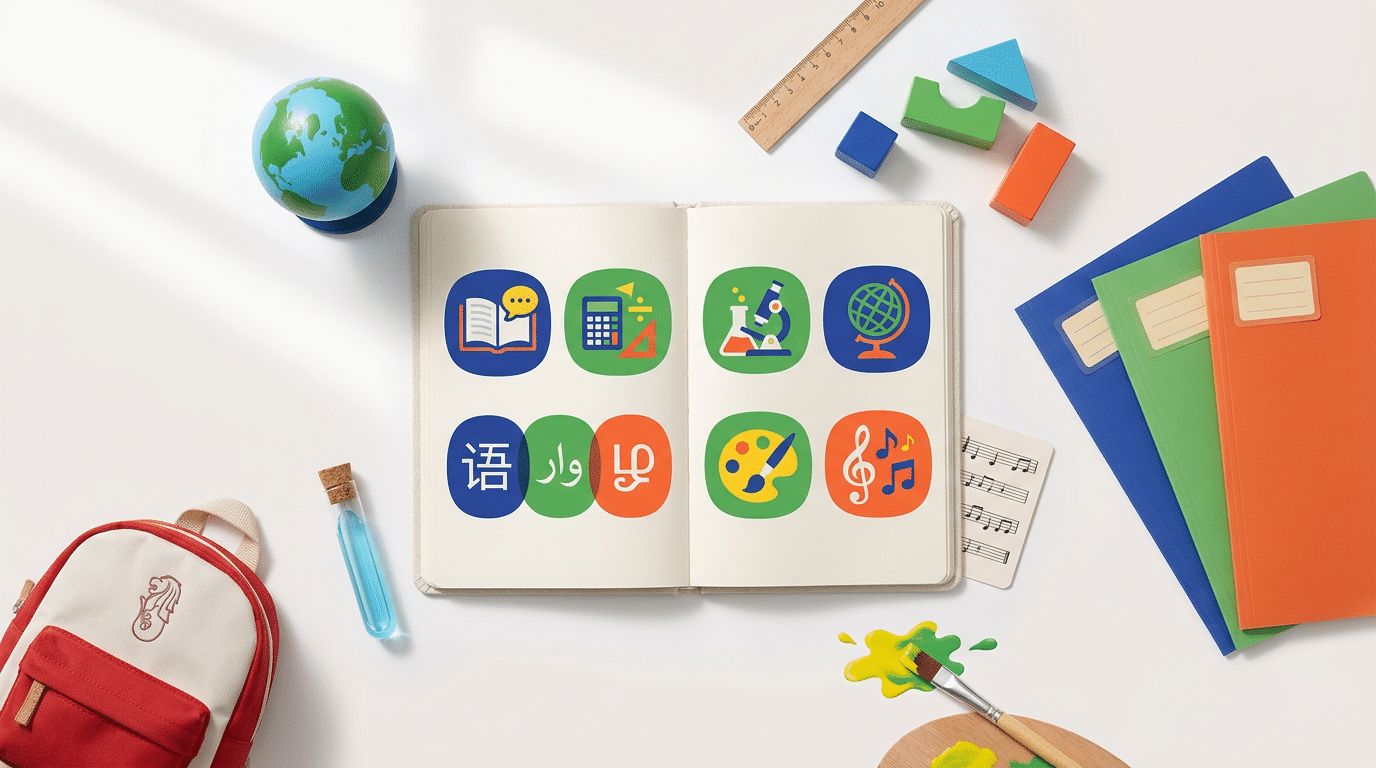
If you have a child starting primary school — or already partway through — you have probably asked yourself: what exactly are they learning each year, and when does it get harder? Singapore’s primary school curriculum is carefully structured to build academic skills progressively from Primary 1 all the way to the Primary School Leaving Examination (PSLE) in Primary 6. But the curriculum covers far more ground than most parents initially realise.
While the PSLE spotlight tends to fall on just four examinable subjects, the full primary school experience spans nine learning areas — from English and Mathematics to Art, Music, and Character and Citizenship Education. Understanding what is taught at every level helps you track your child’s progress, identify areas where they might need extra support, and plan ahead with confidence. This guide walks you through every subject, every stage, and every key milestone across the six years of primary school in Singapore.
Overview of the Singapore Primary School Curriculum
Singapore’s national primary school curriculum is designed and overseen by the Ministry of Education (MOE). It spans six years — Primary 1 through Primary 6 — covering children from the age of 7 to 12. The curriculum’s core philosophy is progressive skill-building: concepts introduced at a simpler level in the early years are revisited with greater depth and complexity as students move up each grade. This “spiral” approach means your child isn’t just accumulating new information; they are continuously deepening their understanding of what they have already learned.
The primary school curriculum focuses on three interconnected pillars. The first is subject-based learning, which develops academic knowledge across languages, mathematics, science, arts, and social studies. The second is the development of knowledge skills through subject learning and project work. The third is character development, which takes place through everyday classroom interactions, Character and Citizenship Education lessons, and co-curricular activities. Together, these three strands are designed to produce not just academically capable students, but well-rounded young people ready for secondary school and beyond.
The Full List of Primary School Subjects
Many parents are surprised to learn that the primary school curriculum extends well beyond the four subjects tested at the PSLE. According to the MOE, primary school students study the following subjects across their six years:
- English Language
- Mother Tongue Language (MTL) — Chinese, Malay, or Tamil
- Mathematics
- Science (introduced from Primary 3)
- Art
- Music
- Physical Education (PE)
- Social Studies
- Character and Citizenship Education (CCE)
The four subjects examined at the PSLE are English Language, Mother Tongue Language, Mathematics, and Science. The remaining subjects — Art, Music, PE, Social Studies, and CCE — are part of every child’s schooling experience even though they do not contribute to the PSLE score. As one education resource puts it, “not examined at PSLE” does not mean “not taught” or “not important.” These subjects play a genuine role in building your child’s creativity, physical fitness, national identity, and values.
Lower Primary (P1–P2): Building the Foundations
The first two years of primary school are devoted to laying the groundwork for everything that follows. In P1 and P2, the emphasis is squarely on literacy and numeracy, and there are no weighted examinations — MOE removed high-stakes assessments for P1 and P2 students to allow more space for foundational learning without early exam pressure. This is a period for exploration, habit-building, and confidence-building in the core subjects.
English Language (P1–P2)
The English syllabus in lower primary follows the MOE’s STELLAR (Strategies for English Language Learning and Reading) programme, which integrates reading, writing, listening, and speaking through shared reading experiences and structured language activities. In Primary 1, students learn to read using phonics — developing letter-sound relationships, blending, and segmenting as the basis for both decoding and spelling. Grammar instruction at this stage covers basic sentence structures, subject-verb agreement, simple tenses, and punctuation. By Primary 2, these skills are consolidated and extended, with students reading longer passages, writing short compositions, and beginning to engage with more varied vocabulary.
Mathematics (P1–P2)
The Primary 1 Mathematics syllabus is organised across three broad strands: Numbers and Algebra, Measurement and Geometry, and Statistics. Students start with counting and simple number operations before moving into addition, subtraction, multiplication, and division. For measurement and geometry, P1 students explore shapes, length, time, and money. By Primary 2, the curriculum introduces numbers up to 1,000, expands multiplication tables (covering 2, 3, 4, 5, and 10), and introduces fractions and volume for the first time. The bar model method — a visual problem-solving strategy that will serve students all the way to PSLE — is introduced from P1 onwards.
Mother Tongue Language (P1–P2)
Every primary school student studies a Mother Tongue Language — Chinese, Malay, or Tamil — alongside English from Primary 1. In the lower primary years, the focus is on oral communication, basic reading, and writing in the student’s MTL, alongside developing an appreciation of the associated culture and heritage. The MTL syllabus mirrors the progressive structure of the English syllabus, building vocabulary, grammar, and comprehension skills incrementally across each year.
Middle Primary (P3–P4): Expanding the Curriculum
Primary 3 marks a significant transition point in a child’s schooling journey. Two new examinable subjects are added — Science and Social Studies — and formal assessments begin. The academic workload increases meaningfully, and the skills developed in P1 and P2 are now tested in a more structured way. For many families, P3 is the year when extra academic support first becomes a consideration.
Science (Introduced at P3)
Science is formally introduced at Primary 3, and its content is organised around five major themes: Diversity, Cycles, Systems, Interactions, and Energy. In P3, students begin with the diversity of living and non-living things, explore materials, study life cycles in plants and animals, and learn about magnets. P4 advances into plant and human body systems, the digestive system, cycles in matter and water, light, and heat. The P3 and P4 years are about careful observation, classification, and building the conceptual vocabulary that will support more complex scientific inquiry later on.
Mathematics (P3–P4)
By Primary 3, the Mathematics curriculum introduces numbers up to 10,000, full multiplication tables (including 6, 7, 8, and 9), angles, perpendicular and parallel lines, and area and perimeter. Primary 4 extends further into numbers up to 100,000, factors and multiples, fractions at a higher level of complexity, decimals, and data representation using tables and line graphs. Problem-solving heuristics — structured strategies for approaching unfamiliar questions — are progressively introduced throughout this stage, including “guess and check” and “work backwards.”
English Language (P3–P4)
The English syllabus in middle primary shifts from building basic literacy to applying it more independently. Composition writing becomes more structured, comprehension passages grow longer and include inferential questions, and grammar accuracy becomes increasingly important. Listening Comprehension is formally assessed from Primary 3. By Primary 4, students are writing compositions of 100–150 words, answering both literal and inferential comprehension questions, and developing the vocabulary range needed for more demanding reading.
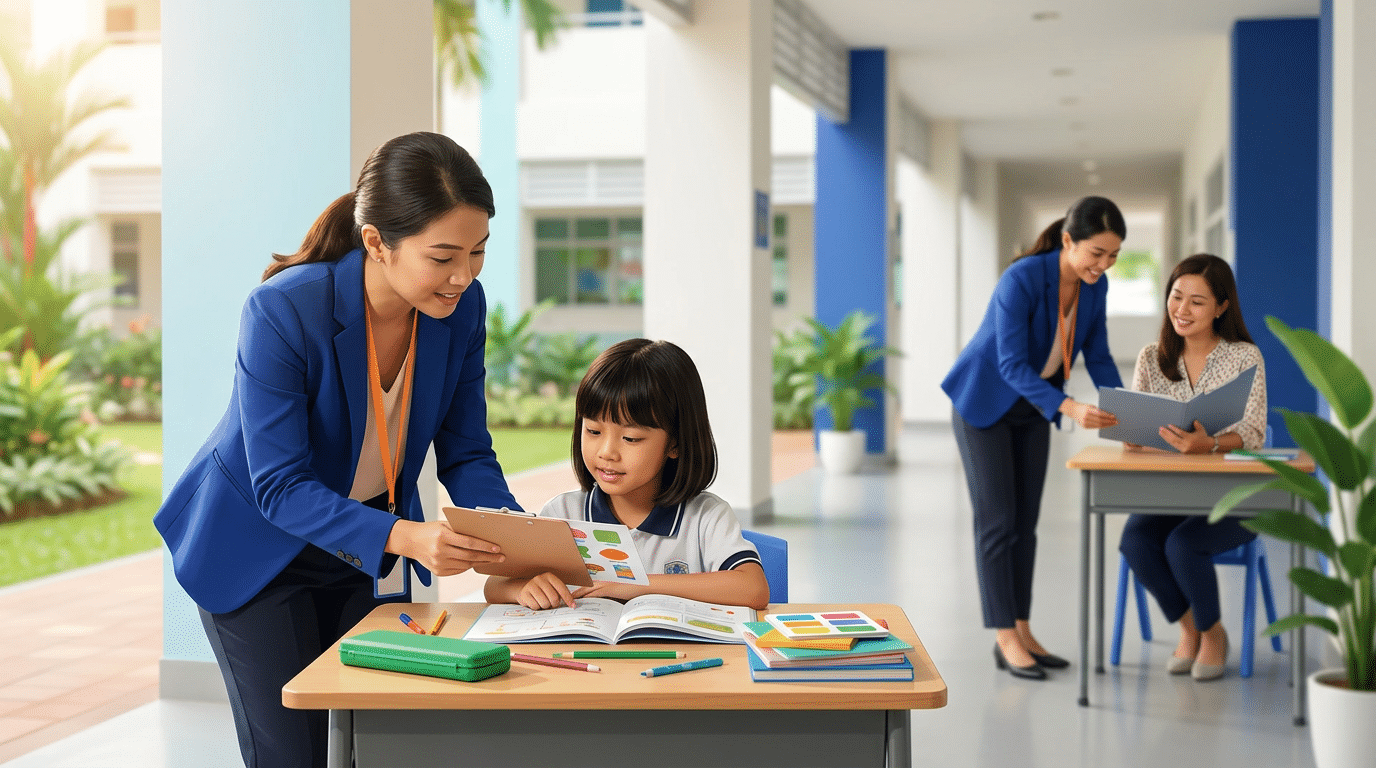
If your child needs extra reinforcement in English or Maths during this critical stage, EduFirst’s Primary Tuition programme provides structured, level-appropriate support in small classes of 4 to 8 students — ensuring every child gets the individual attention they need to keep pace with the expanding curriculum.
Upper Primary (P5–P6): PSLE Preparation and Subject-Based Banding
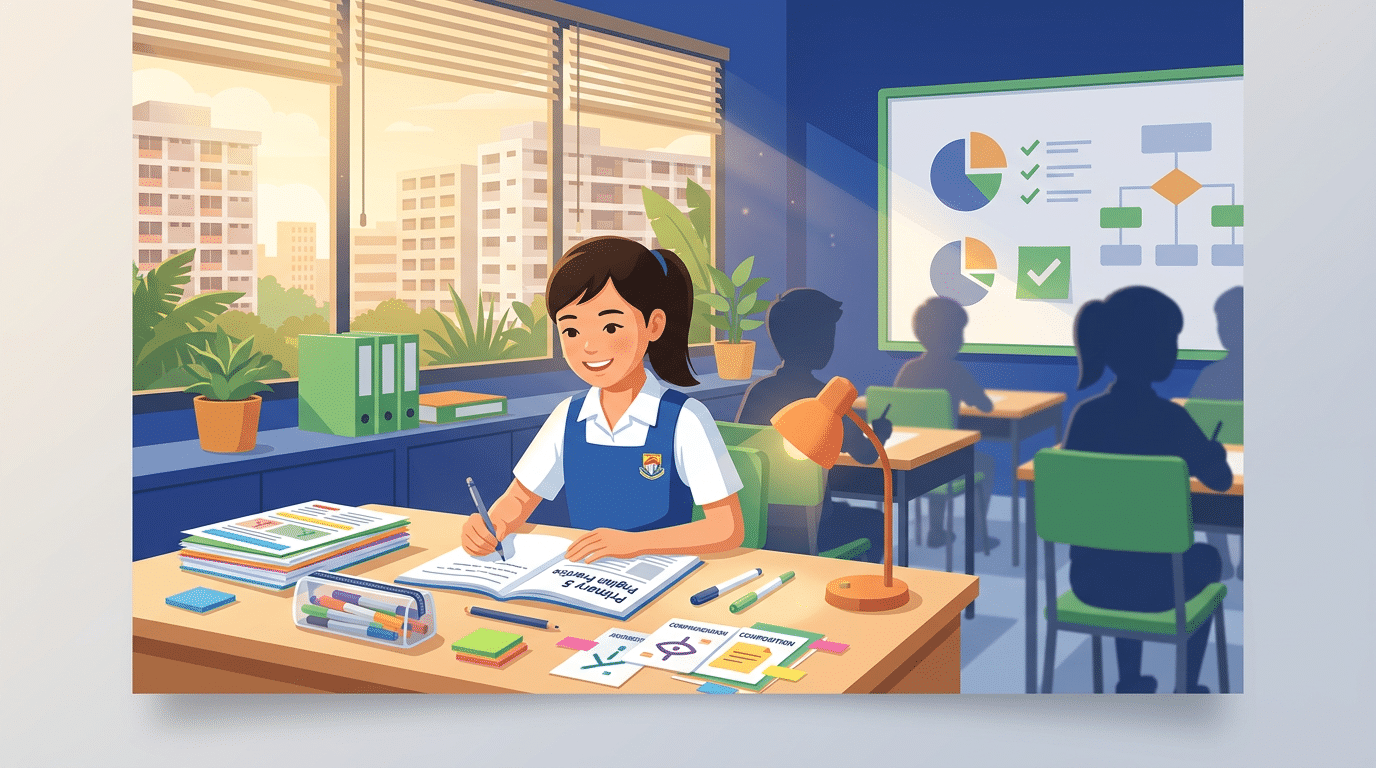
Primary 5 and 6 represent the most demanding phase of primary school. Students carry the full subject load across all examinable subjects, and the academic complexity is at its highest. PSLE preparation becomes an active part of classroom teaching, and both students and parents feel the increased stakes. At the same time, the subjects themselves reach their most sophisticated level of content.
Science (P5–P6)
Upper primary Science becomes notably more demanding. Primary 5 students study reproduction in plants and animals, the water cycle, plant transport systems, the respiratory and circulatory systems, and electrical systems — a broad set of topics that requires students to connect systems and explain experimental observations. Primary 6 then focuses on photosynthesis, energy conversion, forces (including frictional, gravitational, and elastic spring forces), and interactions within the environment. The PSLE Science paper places heavy emphasis on open-ended questions that require students to apply knowledge from multiple topic areas at once.
Mathematics (P5–P6)
The upper primary Mathematics syllabus introduces ratio, percentage, speed, algebra, circles, and advanced heuristics. The P5–P6 Standard Mathematics syllabus continues the development of the P1–P4 syllabus, while the Foundation Mathematics syllabus revisits key concepts from earlier years at a slightly lower complexity level. Problem-solving in P5 and P6 draws on all the heuristics introduced across the primary years, including the assumption method and before-after models, which are typically applied in higher-order word problems.
English Language (P5–P6)
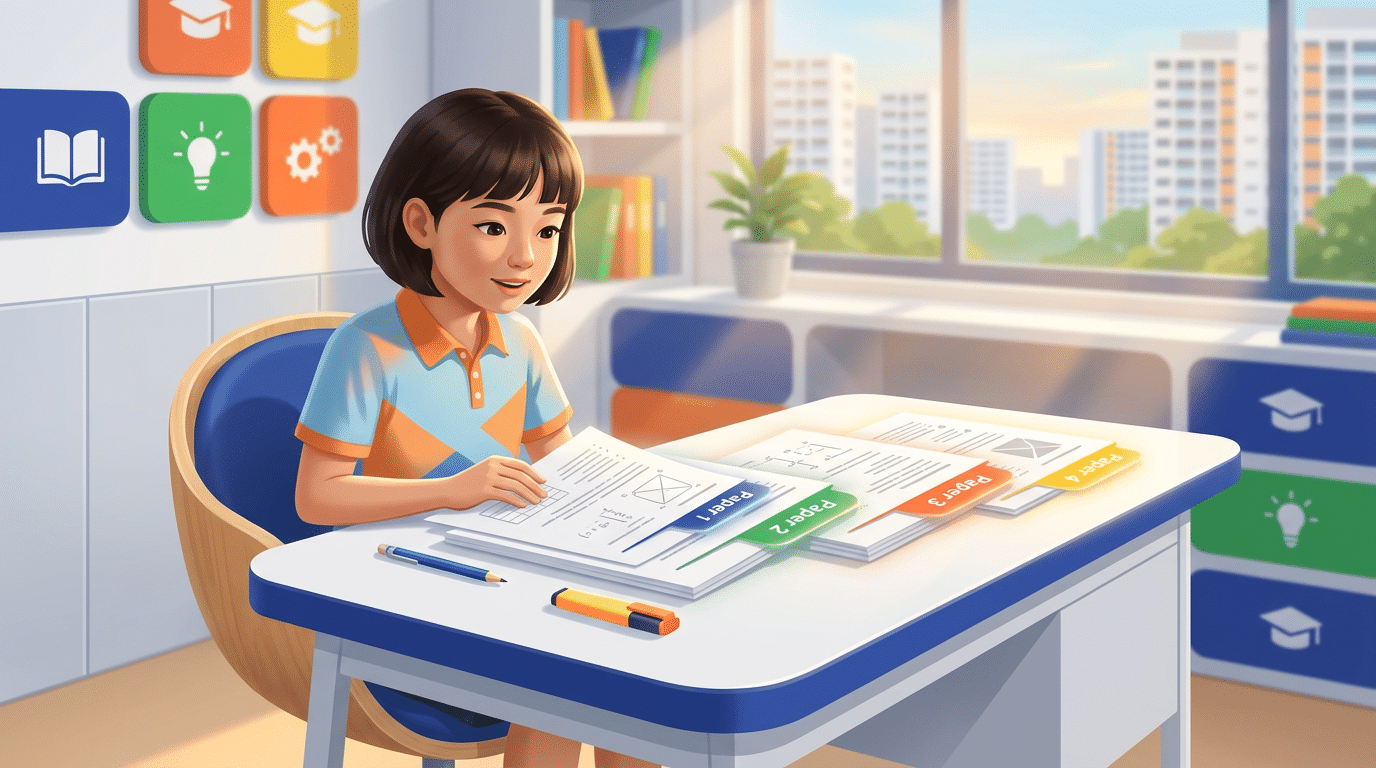
By upper primary, the English curriculum demands independent, sophisticated language use. Students tackle argumentative and situational writing, complex inferential comprehension, summary writing, and structured oral responses. The PSLE English examination consists of four papers: Writing (Paper 1), Language Use and Comprehension (Paper 2), Listening Comprehension, and Oral Communication — totalling 200 marks. Each of these papers calls on a distinct set of skills that have been built progressively since Primary 1.
Beyond the PSLE: Non-Examinable Subjects That Still Matter
It is easy for parents to focus exclusively on the PSLE subjects as the pressure of Primary 6 approaches, but the non-examinable subjects contribute meaningfully to a child’s overall development throughout all six years.
- Physical Education (PE): PE covers six core components — physical fitness, games and sports, gymnastics, dance, outdoor education, and movement concepts. Primary 4 and 5 students also participate in the compulsory National Physical Fitness Award (NAPFA) test.
- Art: Art develops visual thinking, creativity, and aesthetic sensibility. Students engage with both making and appreciating art, connecting their personal expression to broader cultural and social contexts.
- Music: The Music curriculum nurtures listening skills, vocal and instrumental expression, and an appreciation of musical heritage across different cultures.
- Social Studies: Social Studies focuses on Singapore’s identity, history, and its place in the wider world, helping students develop a sense of civic belonging and global awareness.
- Character and Citizenship Education (CCE): The CCE curriculum is built around three big ideas — Identity, Relationships, and Choices. In addition to values and citizenship, CCE covers mental health awareness, cyber-wellness, and the social-emotional competencies students need to navigate daily life responsibly.
These subjects are taught throughout P1 to P6, not as afterthoughts to the core academic programme, but as integral components of a holistic education. They also provide natural opportunities for students to practise communication, collaboration, and critical thinking in real-world contexts.
Understanding Subject-Based Banding (SBB)
One of the most important structural features of the upper primary curriculum is Subject-Based Banding (SBB). Based on your child’s Primary 4 school examination results, they will be offered English Language, Mother Tongue Language, Mathematics, and Science at either the Standard or Foundation level in Primary 5 and 6. The Standard level covers the full curriculum and allows students access to the complete range of PSLE Achievement Levels, while the Foundation level provides a simplified version of the content and caps the PSLE Achievement Level at 8.
It is important to understand that SBB is not a rigid track — students can be offered different levels for different subjects depending on their individual strengths. A child might take Standard Mathematics and Foundation English, for example, or any other combination that reflects their actual academic profile. The goal is to ensure every student is learning at a level that challenges them appropriately without creating unnecessary discouragement. Parents who receive the P4 SBB recommendations should discuss their child’s subject combination carefully with their school’s teachers before finalising the decision for P5.
Students placed at Foundation level who work hard and show strong progress can also be considered for a subject level change, so SBB is not the final word on a child’s academic trajectory. If your child is approaching the P4 assessment year and you want to give them the best possible preparation for SBB subject decisions, EduFirst’s Primary Tuition programme helps students strengthen the specific subject areas where they need the most development.
How to Support Your Child at Every Stage
Understanding the curriculum is the first step; supporting your child through it is the ongoing work of parenthood. At the lower primary stage (P1–P2), the priority is building reading habits, practising phonics at home, and reinforcing number sense through everyday activities — counting change, telling the time, and playing games that involve simple arithmetic. This early engagement makes a genuine difference when formal assessments begin in P3.
In the middle primary years (P3–P4), many families find it helpful to supplement school learning with structured tuition as new subjects like Science are introduced and the workload broadens. Keeping close tabs on your child’s school assessments at this stage — particularly their P4 end-of-year results, which inform the SBB recommendation — gives you the information you need to make good decisions about support going into P5. In upper primary (P5–P6), the focus shifts to exam technique, time management, and targeted revision across all four PSLE subjects.
Whatever the level, personalised support makes a meaningful difference. At EduFirst Learning Centre, primary students benefit from small class sizes of just 4 to 8 students, ensuring every child receives individual attention rather than being lost in a large classroom setting. With 25 locations islandwide and programmes designed to match the MOE curriculum at every level, EduFirst is built around the way Singapore children actually learn.
Singapore’s primary school curriculum is a thoughtfully structured six-year journey that goes far beyond what most parents see on a PSLE results slip. From the phonics and number sense of Primary 1, through the introduction of Science and Social Studies in Primary 3, to the complex analytical demands of Primary 5 and 6, every stage has its own challenges and its own milestones. Knowing what your child is learning — and when — puts you in a much stronger position to support them at the right time and in the right way.
Whether your child is just starting Primary 1 or gearing up for the PSLE, understanding the full picture of what is being taught at every level is one of the most valuable things a parent can do. The curriculum is designed to build confidence and capability progressively, and with the right support at each stage, every child can approach their primary school years — and the PSLE — with genuine readiness.
Give Your Child the Support They Deserve
EduFirst Learning Centre has been helping primary school students across Singapore reach their full potential since 2010. With small class sizes of 4 to 8 students and 25 centres islandwide, we provide personalised tuition that moves at your child’s pace — not the class average.