- Apr 20, 2026
10 Fun Science Experiments That Reinforce PSLE Concepts at Home
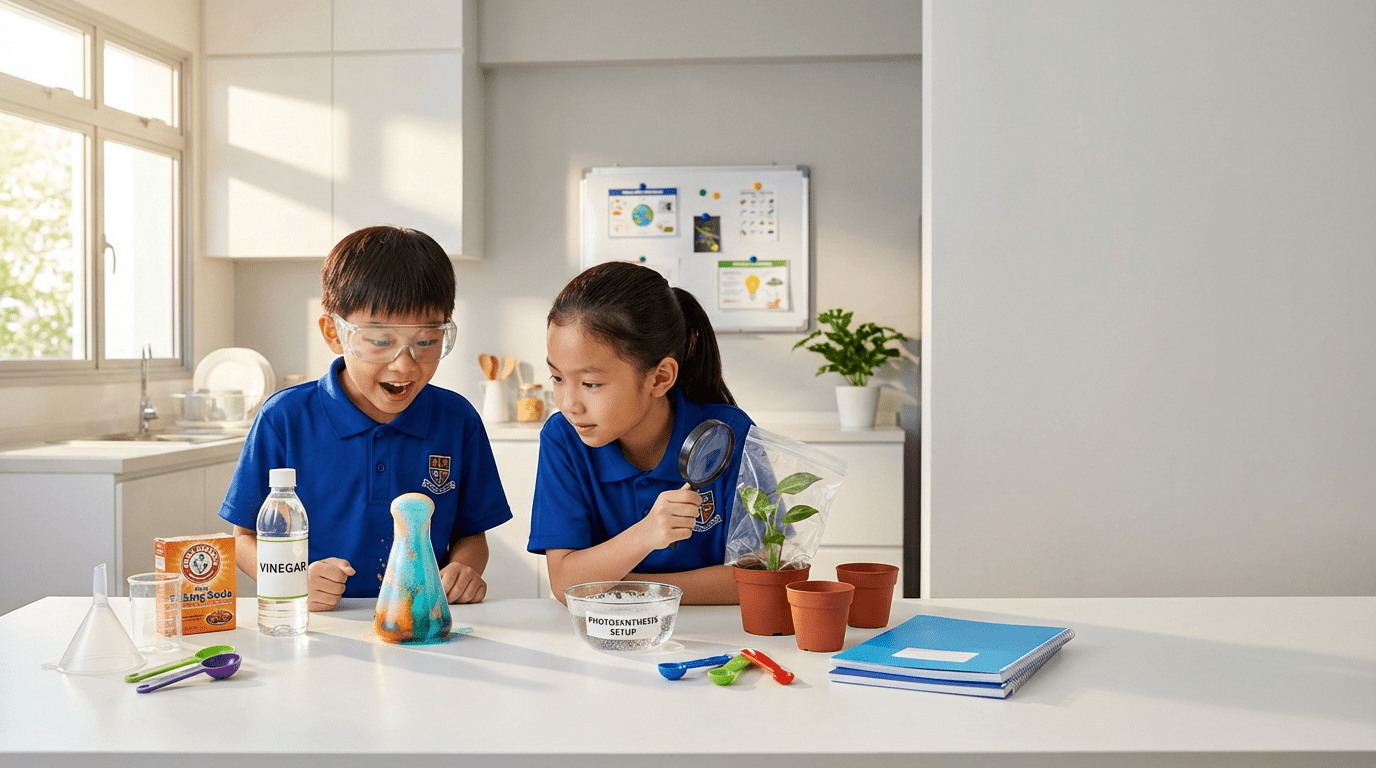
When your child is preparing for the PSLE Science paper, textbook revision alone can only go so far. The Singapore PSLE Science syllabus is designed to test not just memory, but conceptual understanding and application — which is exactly why hands-on experiments can make such a powerful difference. When a child sees a concept come to life right in front of them, it sticks in a way that reading a paragraph never quite manages.
The good news is that you don’t need a laboratory to make this happen. Many of the core PSLE Science topics — from plant systems and light to forces and matter — can be explored with simple materials you already have at home. In this guide, EduFirst Learning Centre brings you 10 fun, curriculum-aligned science experiments that parents and children can do together, along with clear explanations of the PSLE concept each one reinforces. Whether your child is a hands-on learner or simply needs a fresh way to approach revision, these activities are designed to build genuine understanding and spark curiosity.
Why Hands-On Learning Matters for PSLE Science
The PSLE Science examination expects students to explain, predict, and analyse — not just recall. When children conduct experiments, they engage with scientific processes firsthand: forming hypotheses, making observations, and drawing conclusions. This mirrors the exact thinking skills that open-ended and structured PSLE questions demand. Research in education consistently shows that experiential learning deepens conceptual retention, and for primary school children especially, the physical act of doing something creates a stronger memory trace than passive reading.
Beyond academic benefits, science experiments at home send an important message to your child: science is relevant, accessible, and genuinely interesting. That sense of curiosity and confidence can translate directly into better performance on exam day. Now, let’s get into the experiments.
1. Dancing Raisins – Understanding Density and Buoyancy
PSLE Concept: Properties of matter, density, and forces.
What You’ll Need:
- A clear glass of sparkling water or soda
- A small handful of raisins
Drop the raisins into the fizzy water and watch them sink, then rise, then sink again in a rhythmic “dance.” The carbon dioxide bubbles cling to the raisins’ wrinkled surface, increasing their buoyancy until they reach the top. At the surface, the bubbles pop and the raisins sink again. This is a vivid, repeatable demonstration of how buoyant force and density interact — a key topic in the PSLE Science syllabus. Ask your child: What happens if we use flat water instead? Why do the raisins stop dancing eventually?
2. Homemade Volcano – Acids, Bases, and Chemical Reactions
PSLE Concept: Interactions and reactions between substances.
What You’ll Need:
- Baking soda (sodium bicarbonate)
- White vinegar
- A small container or moulded “volcano” shape made from clay or paper
- Food colouring (optional)
Place baking soda inside the container, add a few drops of food colouring, then pour vinegar in and step back. The fizzing overflow is caused by a chemical reaction that produces carbon dioxide gas. While the PSLE syllabus doesn’t go into acid-base chemistry at a molecular level, this experiment illustrates the observable signs of a reaction: bubbling, fizzing, and a change in the mixture. It also opens up a great discussion about gases and their properties.
3. Celery and Food Colouring – The Water Transport System in Plants
PSLE Concept: Plant systems — transport of water and nutrients.
What You’ll Need:
- A stalk of celery with leaves
- A glass of water
- Blue or red food colouring
Trim the base of the celery stalk and place it in coloured water. Leave it overnight and check back the next day — the leaves will have taken on the colour of the water. This demonstrates how plants draw water upward through their stems via a process called transpiration and capillary action. For PSLE students, this is a direct and memorable illustration of how the transport system in plants works, making a commonly tested concept far easier to explain in their own words during an exam.
4. Static Electricity Butterfly – Electrical Charges
PSLE Concept: Electricity and static charge.
What You’ll Need:
- Tissue paper
- A plastic ruler or balloon
- Scissors
Cut out a simple butterfly shape from tissue paper. Rub the plastic ruler or an inflated balloon vigorously against your hair or a wool surface, then hold it close to the tissue butterfly without touching it. The butterfly will lift and seem to “flutter” toward the ruler. This experiment introduces the concept of static electricity in a magical, memorable way. Children can see for themselves that unlike charges attract, reinforcing what is often a confusing abstract topic in the PSLE Science paper.
5. Shadow Tracing – Light and Shadows
PSLE Concept: Light travels in straight lines; shadow formation.
What You’ll Need:
- A torch or desk lamp
- Various objects of different shapes
- A white wall or large sheet of paper
Shine the torch at an object in a darkened room and observe the shadow it casts. Experiment by moving the light source closer, further away, and at different angles, then ask your child to predict what the shadow will look like before you move the torch. This hands-on activity reinforces the principle that light travels in straight lines and that shadows form on the opposite side of an object from the light source. Varying the angle of the light shows how shadow length and direction change, which is a detail that comes up in PSLE questions.
6. DIY Periscope – Reflection of Light
PSLE Concept: Reflection of light using mirrors.
What You’ll Need:
- A long cardboard tube or two short cardboard boxes taped together
- Two small mirrors
- Tape and scissors
Build a simple periscope by positioning two mirrors at 45-degree angles inside a tube — one near the top opening and one near the bottom. When your child looks through the bottom, they can see over obstacles, just as submarines and soldiers once did. This experiment makes the law of reflection tangible: light hits the first mirror at an angle, bounces to the second, and reaches the eye. It’s a brilliant way to visualise a concept that PSLE students often find difficult to draw correctly in diagrams.
7. Egg in a Bottle – Air Pressure
PSLE Concept: Air pressure and properties of gases.
What You’ll Need:
- A hard-boiled egg (peeled)
- A glass bottle with a neck slightly smaller than the egg
- Strips of paper and a lighter (adult supervision required)
Drop lit strips of paper into the bottle, then quickly place the peeled egg on the bottle’s mouth. As the flame uses up the oxygen inside and cools the air, the air pressure inside drops. The higher external air pressure then pushes the egg into the bottle. This is a dramatic, visually striking way to demonstrate that air has pressure and exerts force on objects. Given that this is a concept tested in the PSLE Science open-ended section, seeing it in action helps children articulate their answers with genuine understanding rather than memorised phrases.
8. Germination Jar – Life Cycles and Plant Growth
PSLE Concept: Life cycles; conditions needed for germination.
What You’ll Need:
- Bean seeds (e.g., mung beans)
- A clear glass jar
- Damp cotton wool or paper towels
Press the bean seeds against the inner wall of the jar using damp cotton wool so you can observe the roots and shoot emerging over several days. Set up two jars as a simple experiment — one in sunlight, one in a dark cupboard — and compare results after a week. This long-form experiment teaches children about the conditions required for germination (water, warmth, air) and allows them to observe plant growth firsthand. It also introduces the concept of fair testing, which is part of the PSLE Science investigation framework.
9. Homemade Compass – Magnets and Forces
PSLE Concept: Magnets, magnetic force, and the Earth’s magnetic field.
What You’ll Need:
- A sewing needle
- A bar magnet or strong refrigerator magnet
- A small piece of cork or foam
- A bowl of water
Stroke the needle in one direction with the magnet approximately 30 to 40 times to magnetise it. Place the needle on the cork and float it in the bowl of water. It will rotate and point north-south, just like a compass. This experiment demonstrates that magnets have poles, that magnetism can be induced, and that the Earth itself behaves like a giant magnet. These are key ideas in the PSLE magnetism topic, and children who build their own compass rarely forget how a compass works or why it points north.
10. Melting Ice Investigation – Heat and Temperature
PSLE Concept: Heat transfer; effects of heat on matter.
What You’ll Need:
- Several ice cubes
- Different materials: a metal tray, a wooden board, a cloth, a plastic container
- A timer
Place an ice cube on each different surface at the same time and observe which melts fastest. Metal conducts heat much more efficiently than wood or cloth, so the ice on the metal tray melts first. This is a simple but powerful way to explore the concept of thermal conductors and insulators without any specialist equipment. Children can record their observations, make predictions, and draw conclusions — practising the exact process that structured open-ended PSLE Science questions require them to demonstrate.
Tips for Making Science Experiments Count at Home
Doing the experiment is only the first step. To truly maximise the learning value, encourage your child to narrate what they observe as it happens, then explain why they think it is happening. This mirrors the PSLE answer structure, which typically requires students to state an observation, identify the cause, and explain the link between the two.
A few habits that make home experiments more effective:
- Keep a simple science journal. Ask your child to write down their prediction, what they observed, and what conclusion they can draw. This builds the habit of systematic thinking.
- Connect it back to the textbook. After each experiment, open the PSLE Science textbook together and find the matching topic. Reading it again after a hands-on activity dramatically improves retention.
- Ask “what if” questions. Change one variable and ask your child to predict the new outcome. This develops higher-order thinking that is essential for scoring in the open-ended section.
- Celebrate curiosity, not just correct answers. The confidence to attempt an answer — even an imperfect one — is a skill that takes practice to build.
If your child needs more structured and consistent support to master the full PSLE Science syllabus, it may be worth exploring professional tuition. At EduFirst Learning Centre, our Primary Tuition programme is designed with small class sizes of just 4 to 8 students, ensuring that every child gets the individual attention they need to understand concepts thoroughly and apply them confidently — not just memorise them. For students moving beyond PSLE, our Secondary Tuition programme continues building on these strong scientific foundations.
Conclusion
Science doesn’t have to feel like a chore, even during PSLE preparation. These 10 home experiments show that the concepts in your child’s syllabus are all around them — in a glass of fizzy water, a celery stalk, or a bowl of floating cork. When children experience science rather than just read about it, they build the kind of deep, flexible understanding that lets them answer unfamiliar exam questions with genuine confidence.
The best approach to PSLE Science combines hands-on exploration at home with consistent, expert-guided revision in the classroom. Both reinforce each other beautifully. Start with one or two experiments this weekend, and watch how your child’s attitude toward science — and their readiness for the exam — begins to shift.
Give Your Child the Edge in PSLE Science
EduFirst Learning Centre has been helping Singapore primary students achieve their best since 2010. With small classes of 4–8 students across 25 locations island-wide, our experienced tutors provide the personalised attention your child deserves — combining conceptual teaching with exam-smart strategies.