- Sep 29, 2026
Choosing Among Singapore’s Top Secondary Schools: A Fit-First Approach
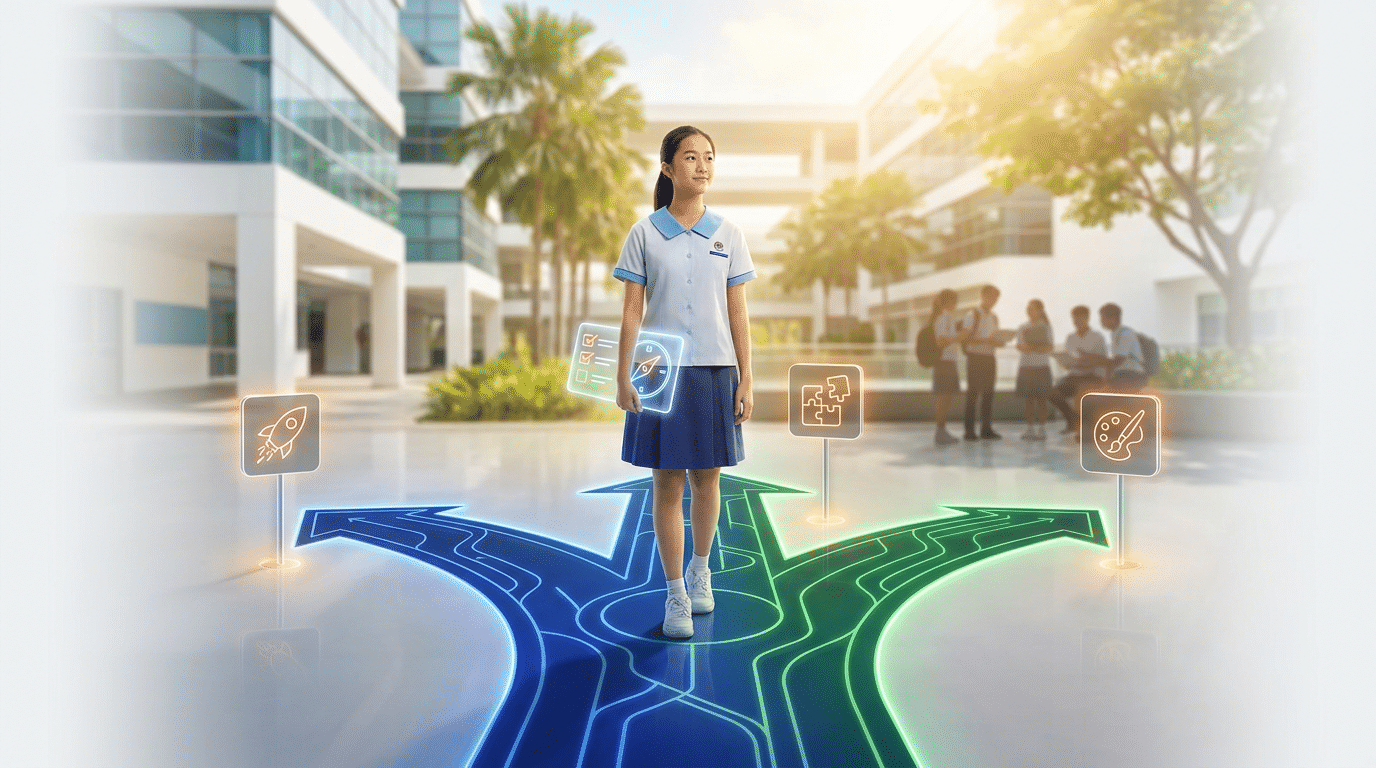
Every November, thousands of Singapore families hold their breath as PSLE results arrive — not just to see the score, but to begin answering the question that follows immediately: which secondary school is right for my child? With over 130 secondary schools across the island, each shaped by a distinct culture, academic track, and co-curricular identity, the choice can feel both consequential and overwhelming.
The mistake many parents make is treating this decision as a purely numerical exercise — comparing cut-off points, ranking schools by prestige, and aiming for the highest-scoring institution their child can technically access. But Singapore’s top educators, and the Ministry of Education’s own reforms, are pointing toward a more nuanced approach: choosing for fit. The right school is not necessarily the most competitive one available; it is the one where your child will thrive academically, discover their strengths, and grow as a person.
This guide is designed to help you make that distinction. We’ll walk through Singapore’s school landscape, explain the latest changes to secondary education, highlight key considerations beyond cut-off points, and give you a clear framework for making a confident, informed choice — one that puts your child’s needs first.
Understanding Singapore’s Secondary School Landscape
Before comparing individual schools, it helps to understand the three broad categories under which all secondary schools in Singapore operate. Each carries a different balance of curriculum flexibility, fees, and admissions criteria — and understanding these distinctions makes the school selection process far less confusing.
Government and Government-aided schools form the backbone of secondary education in Singapore. They follow the national curriculum set by the Ministry of Education (MOE) and benefit from subsidised fees, making quality education accessible across all housing estates. Government-aided schools are often affiliated with religious or community organisations and may incorporate values-based education into their programmes. These schools consistently deliver strong academic results and should never be overlooked in favour of more prestigious institutions simply on the basis of perception.
Autonomous schools sit a step above in terms of flexibility. They retain the national curriculum framework but enjoy greater latitude to design niche programmes, introduce specialist tracks, and allocate resources to enriched co-curricular activities. This autonomy allows them to develop distinctive learning cultures — some may emphasise the arts, others applied STEM or leadership development. Fees are slightly higher than standard government schools, but not dramatically so.
Independent schools have the most autonomy of all, setting their own curriculum, fees, and admissions criteria. Many offer the Integrated Programme (IP), which allows students to bypass the O-Level examinations and proceed directly to A-Levels or the International Baccalaureate. This continuity can deepen learning, but it also means students make an early commitment to a six-year academic pathway. Fees are significantly higher than government schools, though bursaries and financial assistance are available for eligible families.
The New Era of Secondary Education: Full Subject-Based Banding
One of the most significant shifts in Singapore’s secondary education system in recent years is the introduction of Full Subject-Based Banding (Full SBB). Starting from the 2024 Secondary 1 cohort, the familiar Express, Normal (Academic), and Normal (Technical) streams have been removed. In their place, students are posted to secondary schools through Posting Groups 1, 2, and 3 — and critically, they now have the flexibility to take individual subjects at different levels based on their strengths, rather than being locked into a single academic track across every subject.
What this means in practice is that a student who excels in English but needs more time with Mathematics is no longer penalised by being assigned to a lower-tier stream across the board. Instead, they can take English at a more demanding level while building confidence in Mathematics at a pace that suits them. This approach better reflects how students actually learn — rarely uniformly across all subjects — and it reduces the social stigma that came with stream labels.
For parents choosing a secondary school today, Full SBB shifts the conversation away from “which stream will my child be in?” and towards “which school’s culture, support systems, and subject offerings will serve my child’s individual profile best?” That is a meaningful and positive change, and it reinforces why a fit-first approach to school selection matters more than ever.
It is worth noting that IP schools — which run their own six-year integrated curriculum — operate outside the Full SBB framework. If your child is considering an IP school, the pathway and its implications remain as they were: a single continuous track from secondary school through to pre-university, without an O-Level checkpoint.
A Snapshot of Top Schools by Category
Rather than presenting an exhaustive ranking, the most useful way to think about Singapore’s top secondary schools is by the type of environment and pathway they offer. Within each category, the “best” school is genuinely the one that fits your child — not the one with the lowest cut-off point.
Integrated Programme (IP) Schools
IP schools are among Singapore’s most sought-after institutions. Schools like Raffles Institution, Hwa Chong Institution, Nanyang Girls’ High School, and Anglo-Chinese School (Independent) offer the six-year integrated pathway that bypasses O-Levels. These schools are well-suited to students who are self-directed learners, academically confident, and ready to commit to a continuous six-year curriculum. They tend to have highly competitive cut-off points, strong alumni networks, and rich co-curricular ecosystems. However, the absence of an O-Level checkpoint is a double-edged sword — students who might benefit from a mid-journey reassessment do not get that natural pause point.
Strong Autonomous and Government Schools
Many of Singapore’s finest secondary schools sit in the autonomous or government-aided category, and they offer genuinely excellent education without the pressure or fees of independent schools. Victoria School, CHIJ St. Nicholas Girls’ School, Dunman High School, and Cedar Girls’ Secondary School are well-regarded examples — schools where academic programmes are robust, CCA offerings are wide, and pastoral care is a genuine priority. For students who would benefit from a structured, milestone-based pathway with the option to reassess after O-Levels, these schools often represent the stronger fit, even if their cut-off points are lower than IP institutions.
Specialised Schools
For students with a clear, demonstrable passion, Singapore’s specialised schools offer pathways that mainstream institutions simply cannot replicate. The School of the Arts (SOTA) admits students based on audition and portfolio rather than PSLE scores alone, offering a six-year programme that integrates arts training with academic study. The School of Science and Technology (SST) uses applied learning and real-world problem-solving as its pedagogical core, making it ideal for curious, self-directed students with a STEM orientation. The Singapore Sports School supports student-athletes with flexible academics and professional coaching, catering to those with national-level athletic potential. These schools are not for everyone — but for the right student, they are transformative.
Understanding PSLE AL Scores and Cut-Off Points
Since 2021, Singapore’s PSLE has used the Achievement Level (AL) scoring system, replacing the old T-score model. Under this system, each of the four subjects — English, Mother Tongue, Mathematics, and Science — is graded from AL1 (strongest) to AL8, and the four scores are added together to produce a total PSLE score. A lower total score is better: a child scoring AL2 in every subject would have a total of 8, which is highly competitive. The best possible total is 4, and the highest (weakest) is 32.
When schools publish “cut-off points,” they are referring to the PSLE score range of students admitted in the previous year — specifically the score of the last student who received a place. These figures shift slightly from year to year depending on the cohort’s overall score distribution and school vacancy levels. This means you should look at recent trends across multiple years rather than treating a single year’s figure as definitive. Importantly, if you are comparing cut-off data from before 2021, it will be based on the old T-score system and is not directly applicable today.
A useful strategic note: affiliated students (those from primary schools affiliated to a particular secondary school) generally benefit from lower cut-off thresholds. If your child attends a primary school with a secondary school affiliation, factor this into your planning as early as possible — it can meaningfully expand your options.
5 Factors for a Fit-First School Decision
Once you have a realistic sense of which schools fall within your child’s PSLE score range, the real work of school selection begins. Here are five factors that should guide your thinking beyond the numbers.
1. Academic pathway and pace. Consider whether your child would thrive in the IP’s continuous six-year track or would benefit from the structure and flexibility that O-Levels provide. Some students flourish when they are given a mid-journey milestone to work toward; others find IP’s freedom to explore deeply more motivating. Be honest about your child’s self-directedness and academic confidence, not just their score.
2. School culture and values. Every school has a personality, and it matters. Some schools are highly competitive environments where academic rankings are part of daily life; others cultivate collaborative, exploratory learning cultures. Some are steeped in religious tradition; others are secular and values-neutral. Visit open houses, walk the corridors, and pay attention to how students interact with teachers and each other. Your child’s gut reaction to a school visit often tells you more than any prospectus can.
3. Co-curricular activities (CCAs). CCAs are compulsory in Singapore secondary schools and are formally recognised through the LEAPS 2.0 framework, which evaluates students on leadership, enrichment, achievement, participation, and service. Beyond their role in formal assessment, CCAs are where friendships deepen, character builds, and passions develop. If your child is serious about a particular sport, art form, or interest group, research which schools have genuinely strong, active programmes — not just a CCA that exists in name only.
4. Support systems and teaching approach. Consider what level of academic and emotional support your child is likely to need. Some schools prioritise independent, inquiry-based learning; others provide more structured guidance and closer teacher-student relationships. If your child struggles with motivation or benefits from smaller class environments, investigate how the school structures pastoral care, remedial support, and learning assistance. This is especially relevant as Full SBB allows for subject-level movement — a school that actively supports students in moving between levels will serve your child better than one that sets subject levels in stone.
5. Location and daily commute. A school that takes 90 minutes to reach each way is not just inconvenient — it meaningfully erodes your child’s time for rest, homework, and family life. Calculate realistic peak-hour journey times, not just distance, and consider how the commute will interact with CCA schedules that often run until 6 or 7pm. That said, if a school is a genuinely exceptional fit in every other dimension, a longer commute may be worthwhile — particularly as your child grows into a more independent traveller.
Navigating the S1 Posting Process Strategically
After PSLE results are released in late November, parents submit their child’s secondary school choices through MOE’s online S1 portal using Singpass. Students can rank up to six schools in order of preference, and the posting algorithm allocates places based on PSLE score, choice order, citizenship status, and available vacancies. A student with a lower total AL score is processed first; where scores are equal, Singapore Citizens take priority over Permanent Residents, who in turn take priority over International Students. Choice order also matters significantly — a student who lists a school first has an advantage over a student with the same score who lists it third.
The practical implication is that you should list your six choices in genuine order of preference, not in an attempt to game the system. Because the algorithm always considers a student’s higher-ranked choices first, there is no disadvantage to placing an aspirational school at the top of your list. Structure your six choices to span a range of cut-off competitiveness: one or two aspirational choices near the edge of your child’s score, two to three realistic choices where your child comfortably meets recent cut-offs, and one or two safe choices where admission is highly likely based on historical data.
Families should also be aware of the Direct School Admission (DSA) pathway, which allows Primary 6 students to secure a place at a secondary school based on talents — in areas such as sports, performing arts, leadership, or STEM — before PSLE results are released. DSA applications typically open in May and June, with offers confirmed by September. Accepting a DSA offer means your child is committed to that school and cannot participate in the regular S1 posting exercise, so the decision deserves careful consideration. Crucially, even a DSA-confirmed student must still sit the PSLE and meet the school’s minimum PSLE score requirement for the relevant course.
After posting results are released in late December, an appeals window opens for families who did not receive their preferred placement. Appeals are considered based on available vacancies and generally require meeting that year’s cut-off point. Success is not guaranteed, so while it is worth attempting if your child feels strongly about a particular school, the more important preparation is to make thoughtful, well-researched choices in the first place.
Bridging the Gap: How Tuition Support Sets Your Child Up for Success
Choosing the right secondary school is only the beginning of the journey. Once your child settles in, the academic demands of secondary school — whether in a competitive IP environment or a rigorous O-Level programme — require a strong foundation and consistent effort across all subjects. Many students benefit from targeted academic support during this transition, particularly in the early secondary years when the step up in difficulty from primary school can feel significant.
At EduFirst Learning Centre, we offer dedicated secondary school tuition designed to complement and reinforce what your child is learning in school. Our small class sizes of just 4 to 8 students ensure that every lesson is genuinely personalised — our tutors can identify exactly where each student is struggling and address those gaps directly, rather than teaching to the middle of the class. This level of individual attention is especially valuable during the secondary years, when subjects branch into more complex concepts and personalised feedback makes a real difference.
For students still building their foundation at the primary level — whether preparing for PSLE or catching up on key concepts — our primary school tuition programmes provide structured, progressive support that helps students approach PSLE with confidence. We also offer e-lessons for families who prefer flexible, online learning options, and preschool programmes for younger children beginning their learning journey. With 25 locations across Singapore, EduFirst makes it easy for families to find quality tuition support close to home — or close to school.
Choosing among Singapore’s top secondary schools is not a race to the highest possible cut-off point. It is a thoughtful process of matching your child’s learning style, interests, values, and goals to the school environment most likely to help them flourish — academically, socially, and personally. With Full Subject-Based Banding reshaping how students move through secondary school, that alignment matters more than ever before.
Take time to visit schools during open houses, involve your child in the conversation, and look beyond rankings to the culture, people, and programmes that make a school a community. The right school is out there — and with the right preparation and support behind your child, it will be a place where they genuinely love to learn.
Ready to Give Your Child the Best Start in Secondary School?
Whether your child is preparing for PSLE or transitioning into secondary school, EduFirst’s personalised tuition programmes — with small class sizes of just 4 to 8 students across 25 locations islandwide — are designed to help every student reach their potential.