- Oct 4, 2026
Education and Career Guidance in Schools: What an ECG Counsellor Does
Picture this: your child is in Secondary 3, and you ask them what they want to do after school. They shrug. Maybe they say “doctor” because it sounds impressive, or “engineer” because you mentioned it once. For many Singapore families, this uncertainty is completely normal — but it doesn’t have to stay that way.
That is exactly where Education and Career Guidance (ECG) and the school-based ECG counsellor step in. As Singapore’s education landscape grows more diverse — with multiple pathways through polytechnics, ITEs, junior colleges, and beyond — students need more than good grades. They need clarity about who they are, what they value, and where they want to go. This article breaks down what ECG is, what an ECG counsellor actually does in schools, how the guidance evolves across secondary school levels, and how parents can play a meaningful role in supporting their child’s journey.
What Is Education and Career Guidance (ECG)?
Education and Career Guidance (ECG) is a structured programme embedded within Singapore’s school curriculum. It is part of Character and Citizenship Education (CCE) and is designed to help students develop a strong sense of self-identity alongside the ability to make sound education and career choices. The goal is not simply to match a student with a career title — it is to equip young people with the knowledge, skills, and values to navigate transitions confidently at every stage of their schooling.
ECG is not a one-time event or a single career quiz. It is a developmental process that begins as early as Primary 5 and continues through post-secondary education. At each stage, the emphasis shifts to meet the student’s growing maturity and the decisions they face. For secondary school students specifically, ECG focuses on self-exploration, understanding available pathways, and learning to make well-informed choices that align with their interests and strengths rather than external pressure or popular opinion.
What Does an ECG Counsellor Do in School?
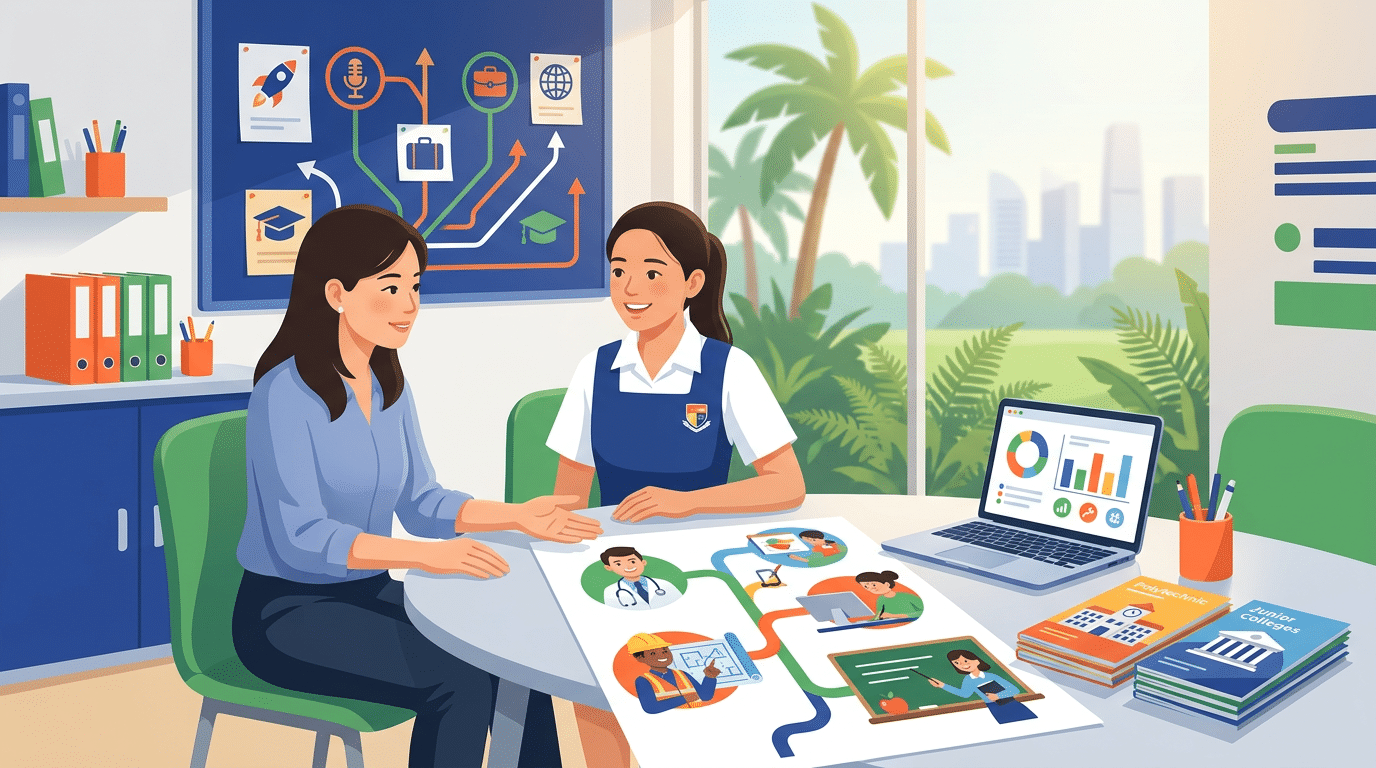
An ECG counsellor is a professionally trained specialist deployed to Singapore’s secondary schools, junior colleges, polytechnics, and ITEs. Unlike a subject teacher or form teacher, the ECG counsellor is dedicated entirely to guiding students through their education and career planning. They are distinct from school counsellors who primarily handle emotional well-being — while there is compassion in their work, their focus is on empowering students to make forward-looking decisions.
The ECG counsellor’s responsibilities span several dimensions. On an institutional level, they design and deliver programmes across the school year, from workshops and seminars to career fairs and industry engagement events. On an individual level, they meet with students one-on-one or in small groups to explore personal strengths, interests, and career aspirations. They also act as a bridge between students and the wider world — working with teachers, parents, industry partners, and alumni to bring the realities of working life into the school environment.
Key responsibilities of a school ECG counsellor include:
- Providing individual and group counselling sessions to help students explore their strengths, interests, and career aspirations
- Conducting ECG workshops and co-delivering ECG lessons as part of the CCE curriculum
- Organising career talks, ECG fairs, and learning journeys to post-secondary institutions and industries
- Supporting students with subject combination choices, post-secondary applications, and admissions processes
- Building partnerships with industry organisations, alumni, and education institutions to create meaningful experiences for students
- Working alongside teachers and parents to align ECG efforts and identify students who need additional support
It is worth noting that MOE deploys ECG counsellors so that every junior college has one dedicated counsellor, while every two secondary schools share one. This means students benefit from a specialist who understands both the school’s context and the broader education and employment landscape in Singapore.
The ECG Journey: From Secondary 1 to Post-Secondary
One of the most important things to understand about ECG is that it is developmental — it evolves deliberately as students progress through school. The ECG Developmental Model is built around three progressive stages: Awareness, Exploration, and Planning. Here is how it typically unfolds across the secondary school years:
Secondary 1: Who Am I?
The ECG journey begins with self-discovery. Secondary 1 students are encouraged to explore their values, interests, personality, and strengths — sometimes abbreviated as V.I.P.S. The central question at this stage is simply: Who am I? Students start to develop self-awareness and a positive work ethic, with activities designed to introduce them to the broad world of occupations and industries. This is not about making decisions yet — it is about building the self-knowledge that will inform every decision to come.
Secondary 2: Where Am I Going?
By Secondary 2, the focus shifts to early exploration. This is a pivotal year because students will soon face one of their first consequential academic choices: their subject combinations. ECG counsellors and teachers help students understand how the subjects they choose can open or limit their post-secondary options. Students begin exploring career personality types, using profiling tools to identify what kinds of work environments and roles suit them best. Making an informed subject combination choice at this stage — rather than just following peers — can have long-lasting effects on a student’s educational path.
Secondary 3 to 4/5: How Do I Get There?
Upper secondary is where ECG takes on a sharper, more practical focus. Students are actively exploring post-secondary pathways — comparing junior colleges, polytechnics, and ITEs — and understanding the admissions exercises available to them, such as the Early Admissions Exercise (EAE) and Direct School Admission (DSA). From Secondary 3 onwards, students are encouraged to attend polytechnic and industry tours, participate in work attachments, and engage with career fairs. The question shifts from self-awareness to active planning: How do I get there?
Tools and Resources ECG Counsellors Use
ECG counsellors draw on a range of structured tools and resources to facilitate meaningful conversations and self-discovery exercises. Far from being abstract career quizzes, these are research-backed instruments designed to help students gain clarity in a structured way.
The most widely used resource is the MySkillsFuture Student Portal, a government-developed one-stop digital platform that helps students explore their career interests, work values, skills confidence, and learning styles. Available to students from Primary 5 through to pre-university level, the portal includes a world-of-work database, education pathway guides, and self-assessment tools that generate personalised career interest profiles. Students can build and maintain an education and career e-portfolio over time, tracking their interests and achievements as they grow.
Beyond the portal, ECG counsellors also use hands-on conversation tools such as Challenge Cards — structured prompts that invite students to reflect on the challenges they face, the resources they have, and the goals they are working towards. These conversation starters serve a dual purpose: they build trust between the counsellor and the student while kickstarting genuine self-reflection. For students who are reluctant to open up or who feel uncertain about their direction, these tools offer a non-threatening starting point. The counsellor’s role is to listen without bias and guide without prescribing — the student must ultimately arrive at their own informed conclusions.
Year-Round Programmes: Fairs, Workshops, and Work Attachments
ECG is not limited to individual counselling sessions. A significant part of an ECG counsellor’s work involves curating and facilitating school-wide experiences that bring career exploration to life. These programmes run throughout the school year and are tailored to each year level’s developmental stage.
Common ECG programmes in Singapore secondary schools and junior colleges include:
- ECG Fairs: Annual events where students can meet representatives from post-secondary institutions, industry partners, and alumni. These fairs give students a chance to ask real questions and hear first-hand accounts of different career paths.
- Career Talks and Dialogue Sessions: Guest speakers — including mid-career professionals and industry veterans — share their journeys, helping students understand that career paths are rarely linear and that adaptability is a key skill for the future.
- Learning Journeys: Visits to polytechnics, ITEs, junior colleges, and industry workplaces give students a direct taste of different educational environments and work cultures before they have to make a decision.
- Work Attachments and Internships: Especially common at the junior college level, these structured stints in real workplaces allow students to experience day-to-day professional life in industries such as healthcare, engineering, early childhood education, and more.
- Subject Combination Briefings and EAE/DSA Workshops: Targeted workshops help students understand the implications of their academic choices and prepare them for competitive admissions processes.
What makes these programmes genuinely impactful is the exposure to diverse perspectives. When a student meets a mid-career professional who switched from finance to social work — or from engineering to education — it powerfully illustrates that skills can be transferable and that a single career title does not define a life. Students who enter these events with fixed, narrow ideas about what they want to do often come away with a broader and more honest understanding of what different careers actually involve.
One-to-One Counselling: Personalised Support When It Matters
While group programmes cast a wide net, individual counselling is where the most meaningful breakthroughs often happen. Students who are uncertain, anxious, or conflicted about their futures can book an appointment with their school’s ECG counsellor for a private session. These sessions are especially valuable for students who have not yet identified their interests, are struggling to reconcile their grades with their aspirations, or need help understanding their post-secondary options in detail.
In these sessions, ECG counsellors might conduct career profiling, explore the student’s values and personality type, walk through subject and pathway options, or simply provide a space for honest conversation. Importantly, good ECG counselling is not directive — the counsellor does not tell a student what to become. Instead, they use structured tools and questions to help students arrive at clarity themselves. This distinction matters enormously, because a student who understands why a choice aligns with their own values and interests is far more likely to stay motivated and resilient when challenges arise.
For students at critical crossroads — such as choosing a subject combination in Secondary 2, selecting post-secondary institutions in Secondary 4, or deciding between a JC and a polytechnic — a timely conversation with an ECG counsellor can make a significant difference. Parents who sense that their child is feeling lost or overwhelmed about future decisions should not hesitate to encourage them to make an appointment.
Additionally, the ECG Centre @ MOE provides ECG counselling services during the release of GCE N-Level, O-Level, and A-Level examination results — some of the most stressful and decisive moments in a student’s academic journey. Students can access online or phone counselling during these periods to get timely, expert guidance as they navigate their options.
How Parents Can Support Their Child’s ECG Journey
Parents play a uniquely important role in their child’s ECG journey — and yet it is easy to inadvertently narrow their options by projecting familiar career expectations or steering them towards “safe” choices. The most supportive thing a parent can do is foster open, curious conversations about interests, values, and the world of work, rather than focusing exclusively on grades and university rankings.
Practical ways parents can support ECG at home include:
- Exploring the MySkillsFuture portal together — each student has a personal account and can use it to discover their career interests and explore education pathways
- Introducing your child to a variety of occupations and sharing the work experiences of people in your own network
- Attending school-organised ECG fairs or parent briefings where you can learn about the latest post-secondary options alongside your child
- Encouraging your child to make an appointment with their school ECG counsellor, especially if they seem uncertain or stressed about future decisions
- Resisting the urge to compare your child’s pathway to peers — every student’s strengths and aspirations are different
It is also worth remembering that ECG is not a process that happens only once. A child’s interests and understanding of themselves will evolve significantly between Secondary 1 and graduation. Ongoing conversations at home, combined with professional ECG support at school, create the richest foundation for confident, well-informed decision-making.
Why a Strong Academic Foundation Matters for ECG
ECG and academic performance are more connected than many families realise. A student’s subject results directly influence which post-secondary pathways are available to them. Strong grades in the relevant subjects can keep more doors open, while weaker performance — especially in core subjects — can inadvertently limit options before a student has even had the chance to fully discover what they want. This is why building a solid academic foundation in primary and secondary school is not just about exam results: it is about preserving the freedom to pursue the pathways that genuinely match a student’s interests and aspirations.
At EduFirst Learning Centre’s Primary Tuition programme, students receive personalised attention in small classes of just 4 to 8 students, ensuring that foundational skills are built early and thoroughly. For students navigating the increasingly consequential choices of secondary school, our Secondary Tuition programme is designed to strengthen subject mastery and exam readiness — so that when the time comes to make subject combination choices or apply for post-secondary pathways, students and families can focus on what is the right fit, not just what is available to them. We also offer E-Lessons for flexible learning, and our Pre-School programme lays the groundwork for a confident learning journey from the very beginning.
Conclusion
An ECG counsellor is far more than a careers adviser. They are a trained guide who helps students build self-awareness, explore the world of work, and make thoughtful decisions about their future — at every stage of secondary school and beyond. From the self-discovery exercises of Secondary 1 to the hands-on work attachments of junior college, ECG is a structured, ongoing process designed to give every Singapore student a clearer sense of direction.
For parents, understanding what ECG counsellors do — and how to support the process at home and academically — can make a genuine difference in how confidently your child approaches the major decisions ahead. And for students, the most important step is simply to start the conversation: with your school ECG counsellor, with your parents, and with yourself.
Help Your Child Build the Foundation for a Brighter Future
At EduFirst Learning Centre, we believe that academic confidence and career readiness go hand in hand. With small class sizes of 4–8 students across 25 locations islandwide, our experienced tutors provide the personalised support your child needs to stay on track — from primary school right through to secondary. Give your child the academic edge that keeps every pathway open.