- Oct 5, 2026
Vectors in O-Level Maths: Notation, Operations and Geometry Proofs Explained
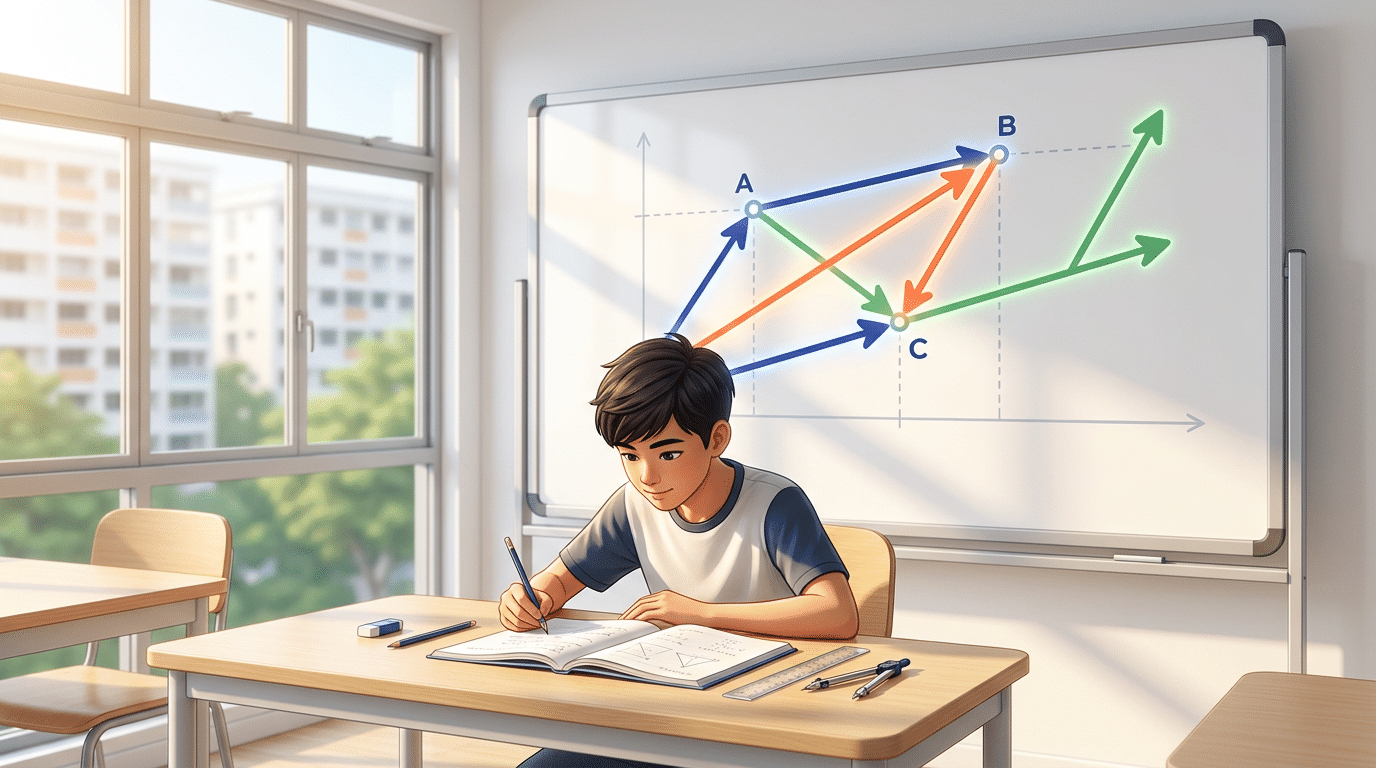
Vectors is one of those topics that many Secondary 4 students in Singapore dread the moment it appears on the syllabus. It sits within the Geometry and Measurement strand of the O-Level Mathematics (E-Maths) paper, and it combines algebra, geometry and logical reasoning in ways that can feel overwhelming at first. Yet here is the truth: once you truly understand what a vector is and how the rules of notation and operations fit together, vectors become one of the most rewarding topics to score marks in.
This guide breaks down everything you need to know about vectors in O-Level Maths — from the notation used in the Singapore syllabus, to vector addition and scalar multiplication, to the geometry proof questions that tend to separate A1 students from the rest. Whether you are just starting out or looking to tighten up your exam technique, read on for a clear, step-by-step walkthrough of every key concept.
What Is a Vector? Understanding the Basics
Before diving into notation or operations, it helps to understand what makes a vector different from other quantities you have already encountered in Maths. A vector is a quantity that has both magnitude and direction. This is what sets it apart from a scalar, which has magnitude only. Speed, distance, time and mass are all scalars — they tell you how much, but not which way. Velocity, displacement, acceleration and force, on the other hand, are vectors, because the direction is just as important as the size.
In O-Level E-Maths, you work exclusively with vectors in two dimensions. Geometrically, a vector is represented as a directed line segment — essentially an arrow drawn on a diagram. The length of the arrow represents the magnitude (how big the vector is), and the arrowhead shows the direction it points. This visual representation is worth keeping in mind as you work through the rest of this guide, because every algebraic rule about vectors has a geometric meaning behind it.
Vector Notation in O-Level Maths
The Singapore O-Level syllabus requires you to be comfortable with specific notations, and using the wrong one in an exam can cost you marks even if your working is correct. There are two main ways to denote a vector in E-Maths.
The first is using two capital letters with an arrow, such as AB (written with an arrow above it). This notation represents the vector that travels from point A to point B. The order of the letters matters enormously: AB (A to B) is the exact opposite of BA (B to A), so BA = −AB. Many students lose marks by forgetting this direction rule mid-proof.
The second is using a single bold lowercase letter, such as a or b. In printed materials and textbooks, this letter appears in bold. When writing by hand in your exam, you underline the letter instead (e.g., a) to indicate it is a vector, not a scalar variable. The column vector form is the third representation you must master: a vector is written as a column with its horizontal (x) component on top and its vertical (y) component below. For example, a vector that moves 3 units to the right and 2 units upward is written as the column with 3 on top and 2 on the bottom. Moving right and up uses positive values, while moving left and down uses negative values.
Core Vector Operations: Addition, Subtraction and Scalar Multiplication
Once you are comfortable with notation, the next step is learning how to combine and scale vectors. There are three fundamental operations tested in the O-Level exam.
Vector Addition
Adding two vectors produces a new vector called the resultant. Geometrically, you place the tail of the second vector at the head of the first vector; the resultant runs from the tail of the first to the head of the second. This is often called the triangle law of vector addition. Algebraically, you simply add the corresponding components: the x-components add together, and the y-components add together. So if vector a = (column: 3, 1) and vector b = (column: 2, −4), then a + b = (column: 5, −3).
The vector pathway is a technique that uses addition to express any vector in terms of known ones. For example, to find AC, you might write it as AO + OC, travelling from A to the origin O and then from O to C. This chain rule approach is the backbone of almost every geometry proof question in the O-Level exam, so practising it until it becomes second nature is essential.
Vector Subtraction
Subtracting one vector from another is equivalent to adding the negative version of the second vector. Reversing a vector flips its direction while keeping the same magnitude, which is why AO = −OA. Algebraically, you subtract the corresponding components. When using the vector pathway approach, subtraction naturally appears whenever you need to reverse a direction along your path — for instance, going from B back to A gives you BA = −AB = −a.
Scalar Multiplication
Multiplying a vector by a scalar (an ordinary number) changes its magnitude but not its direction — provided the scalar is positive. If the scalar is greater than 1, the vector stretches; if it is between 0 and 1, the vector shrinks. A negative scalar flips the direction of the vector entirely, as well as scaling its size. Algebraically, you multiply every component of the column vector by the scalar. So 3a where a = (column: 2, −1) gives (column: 6, −3). This property is directly connected to the concept of parallel vectors, which plays a starring role in geometry proofs.
Calculating the Magnitude of a Vector
The magnitude of a vector is its length — a scalar quantity. For a column vector with horizontal component x and vertical component y, the magnitude is found using Pythagoras’ Theorem: |a| = √(x² + y²). This makes intuitive sense because the vector forms the hypotenuse of a right-angled triangle with legs of length x and y.
Magnitude questions in the O-Level exam are usually straightforward, but a common slip is forgetting the square root or incorrectly squaring a negative component. Remember that squaring a negative number always gives a positive result, so both positive and negative components contribute positively under the square root. For example, a vector (column: −4, 3) has magnitude √(16 + 9) = √25 = 5. Always give your final answer to the appropriate number of significant figures if the result is not a whole number.
Position Vectors and How to Use Them
A position vector locates a point relative to a fixed origin O. The position vector of a point P is written as OP (with an arrow), and it simply tells you how to travel from the origin to reach P. If P has coordinates (a, b), then its position vector is the column vector with a on top and b below. Every point in the plane has a unique position vector, making this a precise and powerful way to describe locations algebraically.
Position vectors become especially useful when you need to find the vector between two arbitrary points. For any two points P and Q, the vector PQ can be expressed as PO + OQ, which equals −OP + OQ, or simply OQ − OP. In plain language: to go from P to Q, reverse the journey from O to P, then make the journey from O to Q. This formula is used constantly in proof questions, so write it out and memorise it thoroughly before your exam.
Geometry Proofs: Parallel Vectors and Collinear Points
Geometry proof questions are typically the highest-difficulty questions in the vectors section of the O-Level paper. They usually involve a triangle or quadrilateral, where two sides are defined as base vectors a and b, and you are asked to prove that certain lines are parallel or that certain points are collinear. Mastering these proofs is what tends to separate students who score an A1 from those who achieve a B.
Proving Two Vectors Are Parallel
Two vectors are parallel if and only if one is a scalar multiple of the other. In notation: if XY = k × PQ for some non-zero scalar k, then XY is parallel to PQ. To prove two lines are parallel in an exam question, express both vectors in terms of the base vectors a and b, then show that one expression equals a scalar multiple of the other. Do not forget to write a clear concluding statement — examiners expect you to explicitly state that the vectors are parallel and why.
Proving Three Points Are Collinear
Three points are described as collinear when they all lie on the same straight line. Proving collinearity requires two conditions, and you must state both in your answer to earn full marks:
- Show that two vectors sharing one of the points are parallel — i.e., one is a scalar multiple of the other.
- State the common point — explicitly identify which point the two vectors share.
Only establishing parallelism is not enough. Two parallel vectors could sit on two entirely separate parallel lines. It is the shared point that confirms all three points lie on the same single line. For example, to prove A, B, and C are collinear: find AB and AC in terms of a and b, show that AC = k × AB, and then conclude: “Since AC is a scalar multiple of AB and they share the common point A, the points A, B, and C are collinear.”
The Midpoint Theorem Revisited Through Vectors
One classic geometry proof that comes up repeatedly involves the midpoints of triangle sides. If M and N are the midpoints of two sides of a triangle OAB, you can use vectors to prove that the line joining M and N is both parallel to the third side and half its length. This is the Midpoint Theorem, and its vector proof is a model of how elegant and convincing a well-structured vector argument can be. Practise this proof until you can write it fluently under exam conditions.
Common Mistakes Students Make in Vectors
Understanding where marks are most commonly lost helps you avoid the same pitfalls in your own exam. Here are the most frequent errors seen in O-Level vectors questions:
- Reversing the direction of a vector: Remember that AO = −OA. Getting this wrong invalidates an entire proof. Always check your arrow direction before writing a vector expression.
- Incomplete collinearity proofs: Showing two vectors are parallel is necessary but not sufficient. You must also identify and state the common point, or the proof is incomplete.
- Skipping the conclusion sentence: After all the algebra, always write a final statement that directly answers what the question asked. This concluding sentence often carries its own mark.
- Rushing the algebra: Careless arithmetic when combining vector components — especially with negative signs — is a leading cause of dropped marks. Write each step clearly and check your signs twice.
- Not underlining vectors in handwritten work: In a typed textbook, vectors appear in bold. In your handwritten exam answers, you must underline vector letters to distinguish them from scalar variables.
- Overcomplicating the vector pathway: Some students introduce unnecessary variables or take unnecessarily long routes between points. Identify the simplest path and stick to it.
Exam Tips for Scoring Well on Vector Questions
With the right exam strategy, vectors can be one of your most reliable sources of marks in the O-Level Maths paper. Here are the approaches that make the biggest difference:
- Draw a quick sketch first. Even if the question provides a diagram, redraw or annotate it with the known vector letters. Visualising the pathway before writing algebra significantly reduces direction errors.
- Label your base vectors consistently. Once you assign a to a particular side of the diagram, keep that assignment throughout the entire question. Switching labels midway is a common source of confusion.
- Write out every step of the pathway. Do not skip from the question to the final expression in one jump. Showing intermediate steps earns method marks even if your final expression contains a slip.
- Memorise the two-condition proof for collinearity. Parallel + common point. Write both conditions every single time, even when it feels repetitive — because examiners will look for both.
- Check significant figures. Magnitude answers that are not exact should be rounded to 3 significant figures unless the question specifies otherwise.
Consistent practice with past exam papers is the single most effective way to build fluency with vectors. The more varied the diagram setups you work through — triangles, parallelograms, trapeziums — the more quickly you will recognise the right pathway in an unseen question. At EduFirst’s Secondary Tuition programme, our tutors guide students through exactly this kind of structured, targeted practice in small groups of just 4 to 8 students, ensuring every learner gets the attention they need to master tricky topics like vectors.
Putting It All Together
Vectors in O-Level Maths is a topic that rewards students who take the time to understand its logic rather than just memorise its formulas. The core ideas — that vectors carry both direction and magnitude, that notation must be precise, that operations follow consistent algebraic rules, and that geometry proofs require both a calculation and a conclusion — build on one another in a coherent, learnable way.
Start by becoming completely confident with notation and direction, then move on to operations and magnitude, and finally tackle geometry proof questions using the structured approach outlined above. With enough practice and the right guidance, vectors will shift from being one of the most feared topics on the O-Level paper to one of the most manageable. If you would like personalised support as you work through the O-Level Maths syllabus, EduFirst Learning Centre has experienced tutors ready to help — in small, focused classes designed to get results.
Ready to Ace Your O-Level Maths?
At EduFirst Learning Centre, our experienced tutors work with students in small groups of just 4–8 to ensure every student gets the individual attention they deserve. Whether your child needs help with vectors, algebra, or any other topic in the O-Level Maths syllabus, we are here to help at any of our 25 locations across Singapore.
Explore our programmes:
- Secondary Tuition — Comprehensive O-Level E-Maths and A-Maths support for Secondary 1 to 4/5
- Primary Tuition — Building strong mathematical foundations early
- E-Lessons — Flexible online learning options for every schedule