- May 4, 2026
O-Level Biology Practical: What to Expect and Mistakes to Avoid
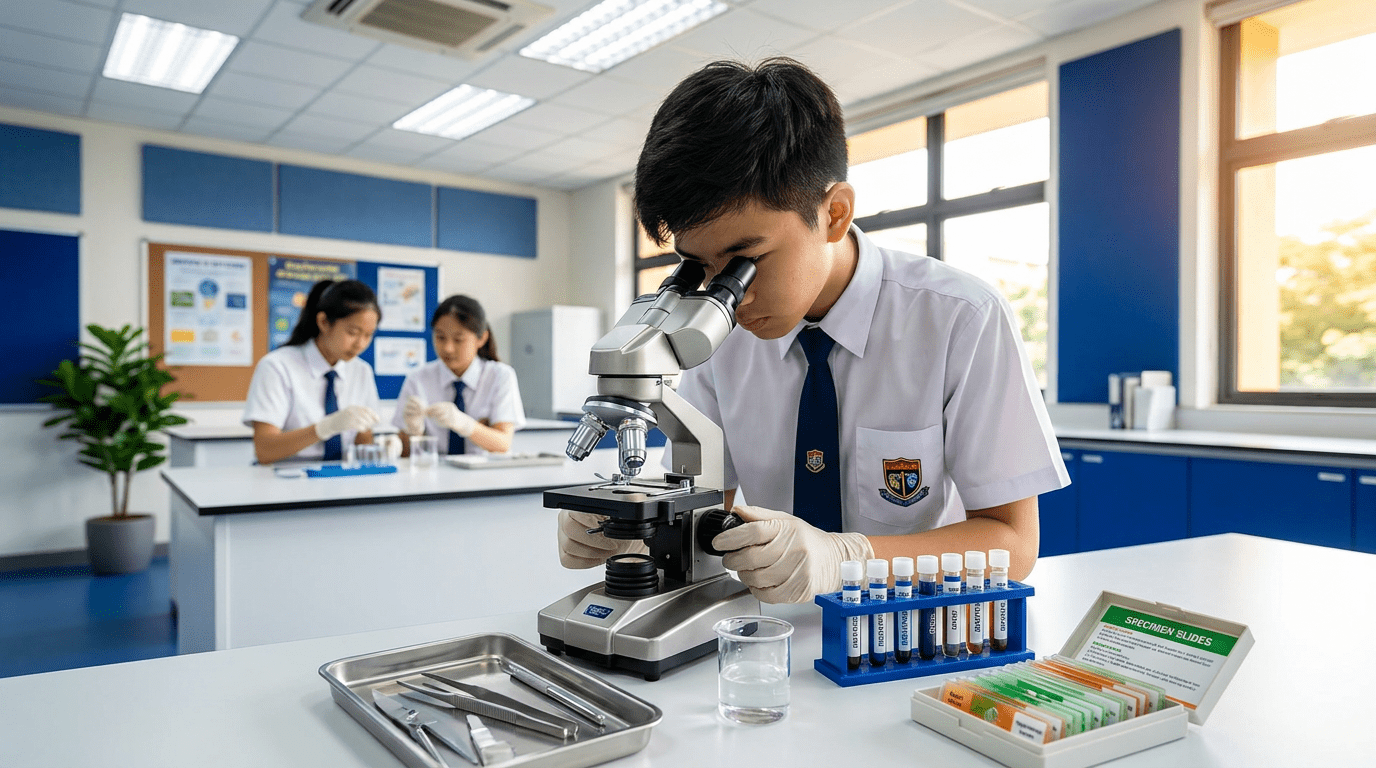
For many Secondary 4 students, the O-Level Biology practical exam is the part of the syllabus that feels the most unpredictable. Unlike written papers where you can study notes and practise past questions at home, the practical component puts you in front of actual specimens, equipment, and experiments — and expects you to think on your feet. If you’ve ever walked out of a school lab session feeling unsure whether you did things correctly, you’re not alone. The good news is that with the right preparation and awareness of what examiners are actually looking for, the Biology practical is very manageable — and even enjoyable. This guide walks you through exactly what to expect in the O-Level Biology practical, the most common mistakes that cost students marks, and the strategies that help students perform confidently on exam day.
What Is the O-Level Biology Practical?
The O-Level Biology practical examination is a compulsory component of the Singapore-Cambridge General Certificate of Education (Ordinary Level) Biology syllabus, administered by the Singapore Examinations and Assessment Board (SEAB). It contributes to your overall grade and assesses skills that cannot be tested through written papers alone, including your ability to handle laboratory equipment, carry out experimental procedures, record observations accurately, and draw conclusions from data.
The practical exam is designed to evaluate three broad areas: planning, data collection and processing, and analysis and evaluation. Students are expected not just to follow instructions, but to demonstrate genuine scientific thinking — explaining why steps are taken, identifying sources of error, and suggesting improvements to experimental designs. This is what separates students who score well from those who merely complete the tasks.
Format and Structure of the Practical Exam
The O-Level Biology practical exam (Paper 3) is typically 1 hour and 50 minutes long and carries 30 marks, accounting for approximately 20% of the total Biology grade. Students work individually at a lab bench and are given a set of instructions, biological specimens or materials, and laboratory apparatus to complete a series of tasks. The exam usually consists of two to three questions covering different areas of the Biology syllabus.
It is important to note that the practical exam is conducted under examination conditions — you cannot consult your notes, ask classmates, or repeat a procedure if something goes wrong. Time management is therefore critical. Each question has a recommended time allocation, and pacing yourself properly ensures you have enough time to complete observations, draw diagrams, and answer analytical questions thoroughly.
What to Expect on Exam Day
Walking into the exam hall prepared means knowing the kinds of tasks you are likely to encounter. While the specific experiments vary from year to year, O-Level Biology practicals tend to draw from a consistent pool of topics and skills. You can generally expect to encounter one or more of the following types of activities:
- Examining biological specimens (e.g., leaves, seeds, food samples) and recording observations
- Using a light microscope to view prepared slides and drawing biological diagrams
- Carrying out food tests (e.g., testing for starch, reducing sugars, proteins, or fats)
- Performing enzyme experiments and observing how variables like temperature or pH affect enzyme activity
- Interpreting data presented in tables or graphs and drawing scientific conclusions
- Planning or evaluating an experiment based on a given hypothesis
Being familiar with these task types in advance removes a lot of the anxiety on exam day. Students who have practised these tasks in a structured setting — such as through secondary tuition programmes that include practical skills training — tend to feel far more composed during the actual examination.
Common Types of Practical Questions
Understanding the types of questions asked helps you approach each section strategically rather than reactively. The practical paper typically tests a mix of procedural and analytical skills.
Observation and Recording Questions
These questions ask you to describe what you see — colour changes in food tests, the appearance of a specimen, or the behaviour of a reaction over time. Examiners reward precise, scientific language. Writing “the solution turned blue-black” is correct; writing “it changed colour” is not enough. Training yourself to describe observations in specific, measurable terms is one of the most valuable habits you can build.
Biological Drawing Questions
If you are asked to draw a biological specimen or what you observe under a microscope, the drawing must be clear, accurate, and properly labelled. Lines should be drawn with a sharp pencil, labels should use a ruler for pointer lines, and the drawing should accurately reflect proportions. Many students lose marks here not because their biology knowledge is wrong, but because their drawing technique does not meet the marking criteria.
Analysis and Evaluation Questions
These require you to interpret results, explain trends in data, identify variables, suggest sources of error, or propose improvements to an experiment. These questions reward students who understand the underlying biology — not just those who can follow a protocol. Practising past-year practical papers is essential for building this kind of scientific reasoning.
Common Mistakes Students Make (and How to Avoid Them)
Even well-prepared students can lose marks in the Biology practical due to avoidable errors. Being aware of these pitfalls in advance is a significant advantage.
1. Rushing Through Observations Without Recording Enough Detail
One of the most frequent mistakes is completing a procedure quickly and then writing a superficial observation. Examiners are looking for specific, accurate descriptions. If a food test is positive, describe the colour change precisely. If you are observing a leaf, note its shape, venation, texture, and any visible structures. Taking an extra minute to write a thorough observation can be worth several marks.
2. Ignoring the Question’s Command Words
Biology practical questions use specific command words such as “state,” “describe,” “explain,” and “suggest.” Each requires a different type of response. “State” requires a brief factual answer, while “explain” requires you to give a reason using biological knowledge. Many students answer the wrong type of question because they do not read the command word carefully. Always underline the command word before answering.
3. Messy or Inaccurate Biological Diagrams
Biological drawings lose marks when they are shaded (shading is not permitted — use stippling if needed), when label lines cross one another, or when proportions are clearly inaccurate. Practise drawing common structures such as cells, dicot roots, insect body plans, and any other frequently tested specimens so that neat, accurate diagrams become second nature before exam day.
4. Not Managing Time Properly
The 1 hour 50 minutes allocated to the practical exam passes quickly. Students who spend too long on one section often find themselves rushing through analysis questions, which carry significant marks. Before starting, briefly read through all the questions and mentally allocate time to each section. If an observation or procedure takes longer than expected, make note of what you intended to do and move on.
5. Failing to Control Variables in Planning Questions
When asked to plan an experiment, students must clearly identify the independent variable, dependent variable, and controlled variables. A common mistake is listing only one or two controlled variables when several are relevant, or failing to describe how a controlled variable will actually be kept constant. Examiners want to see methodical scientific thinking, so your plan should read like a logically sound protocol that another person could follow.
6. Writing Vague Improvements or Limitations
When asked to identify limitations of an experiment or suggest improvements, vague answers like “use more accurate equipment” or “repeat the experiment” rarely earn full credit on their own. You need to be specific: name the equipment (e.g., “use a colorimeter instead of visual observation to reduce subjectivity”), explain why the current method is limited, and clarify how the improvement addresses that specific limitation.
How to Prepare Effectively for Your Biology Practical
Solid preparation for the O-Level Biology practical goes beyond reading your textbook. The following strategies will help you build the hands-on confidence and scientific reasoning skills that the exam demands.
- Practise food tests at home or in school: Know the reagents, procedures, and expected results for all food tests on the syllabus — Benedict’s test, iodine solution, Biuret test, and ethanol emulsion test for lipids.
- Work through past-year practical papers: SEAB releases past papers that reflect the style and difficulty of the actual exam. Time yourself and write full answers rather than just reading through model answers.
- Refine your biological drawing technique: Set aside time specifically to practise drawings. Use a sharp HB pencil, avoid shading, and always label with ruled lines.
- Review the theory behind each practical topic: Understanding why an experiment works helps you answer analysis and evaluation questions confidently. Don’t treat practicals as just mechanical tasks.
- Get familiar with common lab equipment: Know how to use a light microscope, measure with a ruler on scale diagrams, and handle test tubes and pipettes safely.
- Ask for feedback on your written answers: Have a teacher or tutor review your practical answers so you can see where your responses are too vague or missing key scientific terms.
Consistent, structured revision is far more effective than cramming in the weeks before the exam. Students who build practical skills steadily over Secondary 3 and 4 consistently outperform those who treat the practical component as an afterthought.
How EduFirst Can Help You Excel in O-Level Biology
At EduFirst Learning Centre, we understand that every student learns differently — and that some find the practical component of O-Level Biology especially challenging because it requires a very different set of skills from written exams. Our secondary tuition programmes are designed to bridge exactly that gap. With small class sizes of just 4 to 8 students, our tutors are able to give each student the individual attention needed to address specific weaknesses, whether that means refining biological drawing skills, working through practical past papers, or strengthening the analytical reasoning needed for evaluation questions.
Our experienced tutors bring a deep familiarity with the SEAB O-Level Biology syllabus and the expectations of Cambridge examiners. Sessions are structured to mirror the demands of the actual exam — helping students build not only content knowledge but also the confidence to apply that knowledge under exam conditions. If you are looking for comprehensive support that covers both written papers and practical skills, EduFirst’s personalised approach makes a meaningful difference.
Beyond Biology, EduFirst supports students across a wide range of subjects at both primary and secondary levels, with over 25 conveniently located centres across Singapore. Whether your child needs support with primary tuition or is preparing for major secondary examinations, our team is ready to help. We also offer e-lessons for families who prefer the flexibility of online learning without compromising on quality or interaction.
Final Thoughts
The O-Level Biology practical is not something to fear — but it does reward students who take it seriously and prepare with the right strategies. By understanding the exam format, familiarising yourself with the types of questions asked, and actively working to avoid the most common mistakes, you give yourself a strong foundation for a good score. The practical component is an opportunity to demonstrate real scientific skills, and with consistent practice and the right guidance, it can become one of your stronger performing sections rather than your weakest. Start early, practise deliberately, and don’t hesitate to seek support when you need it.
Ready to Build Your Biology Practical Skills?
Our experienced tutors at EduFirst are here to help your child gain confidence in both the written and practical components of O-Level Biology. With small class sizes and a personalised approach, we make sure no student gets left behind.