- May 4, 2026
O-Level Chemistry: A Topic-by-Topic Study Guide
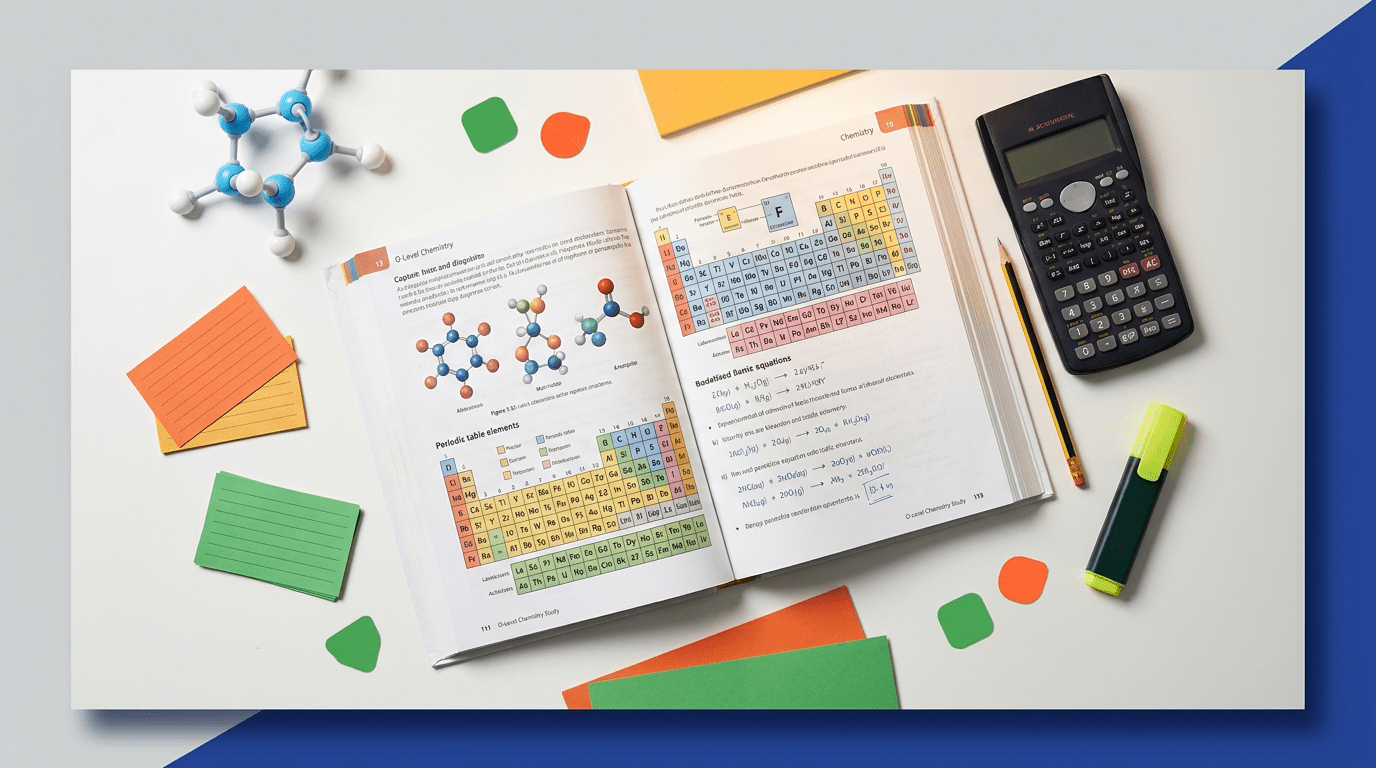
O-Level Chemistry is one of those subjects that can feel overwhelming at first glance — but once you understand how the topics connect, it starts to make a great deal more sense. From balancing equations and understanding atomic structure to exploring organic compounds and reaction rates, the O-Level Chemistry syllabus (as set by the Singapore Examinations and Assessment Board) covers a wide range of concepts that build on one another in a logical way.
Whether you’re just beginning Secondary 3 Chemistry or you’re in the final stretch of exam preparation, having a clear, organised overview of every topic can make a significant difference to your confidence and results. This guide breaks down all the major topics in the O-Level Chemistry syllabus, highlights what to focus on in each area, and offers practical study tips to help you perform at your best. Think of it as your revision roadmap — one topic at a time.
Why O-Level Chemistry Matters
Chemistry is more than just a required subject — it’s a gateway to careers in medicine, engineering, environmental science, pharmacy, and many other fields. For students in Singapore, doing well in O-Level Chemistry opens doors to science-stream courses at the polytechnic and junior college levels. More immediately, a strong grasp of Chemistry concepts helps students connect classroom learning to the real world: understanding why food spoils, how batteries work, and what makes a cleaning agent effective.
The subject is assessed through both written papers and a school-based science practical assessment, which means students need to develop both conceptual understanding and hands-on laboratory skills. Knowing what each topic demands — and where the common pitfalls are — is the first step toward a well-targeted study plan.
Topic 1: Experimental Chemistry
This foundational topic covers laboratory safety, the use of common apparatus, measurement techniques, and the design of experiments. Students learn to identify sources of error, suggest improvements to experimental methods, and interpret data accurately. Many students underestimate this topic, but marks allocated to practical skills and experimental design questions in the written papers add up quickly.
Key focus areas:
- Correct use and reading of measuring cylinders, burettes, and pipettes
- Understanding systematic vs. random errors
- Drawing valid conclusions from experimental data
- Safety precautions and hazard identification
Topic 2: Atomic Structure and the Periodic Table
A solid understanding of atomic structure underpins almost every other Chemistry topic. Students need to know how protons, neutrons, and electrons are arranged, how to use atomic number and mass number, and what isotopes are. The Periodic Table section extends this to trends in properties such as atomic radius, ionisation energy, and reactivity across periods and down groups.
Key focus areas:
- Electron configuration and shells
- Properties of Group I, Group VII, and the Transition Metals
- Trends across Period 3 (sodium to argon)
- Understanding why noble gases are unreactive
Topic 3: Chemical Bonding and Structure
This topic asks students to understand why and how atoms join together, and how the type of bonding determines a substance’s physical properties. The three main types — ionic, covalent, and metallic bonding — each produce distinct structures with characteristic melting points, electrical conductivity, and solubility. Students frequently confuse the properties of giant ionic lattices with those of simple molecular covalent structures, so careful attention to structure-property relationships is essential.
Key focus areas:
- Drawing dot-and-cross diagrams for ionic and covalent compounds
- Comparing giant ionic, giant covalent, simple molecular, and metallic structures
- Predicting physical properties from bonding type
- Examples like diamond, graphite, silicon dioxide, and sodium chloride
Topic 4: Stoichiometry and the Mole Concept
The mole concept is arguably the most calculation-heavy topic in O-Level Chemistry, and it requires both conceptual understanding and consistent practice. Students must be comfortable converting between mass, moles, volume of gas, and concentration of solutions. Reacting mass calculations, limiting reagent problems, and percentage yield questions are all common exam formats.
Key focus areas:
- The mole formula: n = m/Mr and n = cV
- Balancing chemical equations correctly before calculating
- Identifying the limiting reagent in a reaction
- Calculating percentage yield and percentage purity
Regular practice with past-year questions is particularly valuable here. If stoichiometry calculations feel shaky, targeted support through secondary tuition can help consolidate the foundational steps before moving on to more complex problems.
Topic 5: Electrochemistry
Electrochemistry covers electrolysis and the electrochemical series. Students learn how electric current causes chemical change, how to predict products at the electrodes during electrolysis, and how the position of a metal in the electrochemical series determines its reactivity. Industrial applications — such as the extraction of aluminium and the electroplating of metals — are also assessed.
Key focus areas:
- Predicting products at the anode and cathode in aqueous and molten electrolytes
- The role of concentration and the type of electrode
- Electrolysis of copper(II) sulfate solution with copper electrodes
- Differences between electrolytic and simple cells
Topic 6: Energy Changes in Chemical Reactions
This topic introduces students to exothermic and endothermic reactions, energy profile diagrams, and bond energy calculations. Understanding why some reactions release heat while others absorb it connects Chemistry to real-world applications like hand warmers and cold packs. Students should be comfortable sketching energy level diagrams with and without a catalyst.
Key focus areas:
- Distinguishing exothermic from endothermic using temperature change
- Drawing and interpreting energy profile diagrams
- Using bond energies to calculate enthalpy change
- The effect of a catalyst on activation energy
Topic 7: Speed of Reactions
Students explore the factors that affect reaction rate: concentration, temperature, particle size, and catalysts. The collision theory provides the conceptual framework, and students need to be able to explain changes in rate in terms of frequency and energy of collisions. Interpreting graphs showing how rate changes over time is a skill tested regularly in examinations.
Key focus areas:
- Explaining each factor using collision theory
- Interpreting rate-time and volume-time graphs
- Describing experiments to investigate reaction speed
- Understanding how surface area affects the rate in solid reactants
Topic 8: Chemical Equilibria
Reversible reactions and dynamic equilibrium are concepts that many students find abstract at first. The key is understanding that equilibrium is not a static state — both forward and reverse reactions continue, but at equal rates. Le Chatelier’s Principle helps predict how a system responds when conditions such as temperature, pressure, or concentration are changed.
Key focus areas:
- Characteristics of a dynamic equilibrium
- Applying Le Chatelier’s Principle to various scenarios
- The Haber Process for ammonia production as a real-world application
- How catalysts affect equilibrium (they don’t shift it, only speed up attainment)
Topic 9: Redox Chemistry
Redox chemistry ties together oxidation, reduction, oxidising agents, and reducing agents. Students must be able to assign oxidation states to elements in compounds, identify which species is oxidised or reduced, and write half-equations for redox reactions. This topic has strong links to both electrochemistry and the reactivity series, so mastering it pays dividends across multiple areas.
Key focus areas:
- Rules for assigning oxidation numbers
- Identifying oxidation and reduction from changes in oxidation state
- Writing and balancing half-equations
- Common oxidising and reducing agents and their uses
Topic 10: Acids, Bases, and Salts
This is one of the most content-rich topics in the syllabus, covering the properties of acids and bases, neutralisation reactions, the pH scale, and the preparation of salts. Students need to know several methods of salt preparation — including precipitation, direct combination, and titration — and understand when each method is appropriate. This topic is also highly practical, with many questions linked to laboratory procedures.
Key focus areas:
- Properties and reactions of strong vs. weak acids and bases
- Identifying the correct salt preparation method for a given salt
- Calculations involving acid-base titrations
- Tests to identify common ions (e.g., sulfate, carbonate, halide)
Topic 11: Metals and the Reactivity Series
The reactivity series ranks metals by their tendency to react, and students use it to predict outcomes in displacement reactions, reactions with water and acid, and the selection of extraction methods. Industrial processes such as the extraction of iron in the blast furnace and the role of recycling are frequently examined. Understanding corrosion and the methods used to prevent rusting is also key.
Key focus areas:
- Order of metals in the reactivity series (from potassium to gold)
- Predicting displacement reactions using the series
- The blast furnace and the extraction of iron
- Rusting conditions and prevention methods (galvanising, sacrificial protection)
Topic 12: Organic Chemistry
Organic Chemistry introduces students to carbon-based compounds, focusing on the homologous series including alkanes, alkenes, alcohols, and carboxylic acids. Students learn to name compounds using IUPAC nomenclature, draw structural formulas, and describe the characteristic reactions of each functional group. Polymers — both addition and condensation — are also covered, with links to everyday materials like plastics and nylon.
Key focus areas:
- Naming and drawing alkanes, alkenes, alcohols, and carboxylic acids (up to C6)
- Addition reactions of alkenes (with H2, Br2, H2O, and HCl)
- Fermentation and the industrial production of ethanol
- Condensation polymerisation and its difference from addition polymerisation
Smart Study Strategies for O-Level Chemistry
Knowing the topics is only one part of doing well in O-Level Chemistry. How you study matters just as much as how much you study. A focused, well-organised approach will always outperform last-minute cramming, especially for a subject that requires both understanding and application.
Here are some approaches that work particularly well for Chemistry:
- Build concept maps: Connect topics visually. For instance, link redox to electrochemistry to the reactivity series. This helps you see the bigger picture and recall information more effectively during exams.
- Practice calculations regularly: Topics like stoichiometry and titrations require repeated practice. Set aside time each week for calculation-based questions, not just conceptual revision.
- Use past-year papers strategically: Work through SEAB past papers under timed conditions. Analyse your errors — are they due to misunderstood concepts, careless mistakes, or poor time management?
- Master the command words: Exam questions use terms like “explain,” “describe,” “state,” and “suggest” with specific meanings. Understanding what each requires will help you score the marks allocated.
- Revise practical skills: Even if school practicals feel routine, reviewing the theory behind each technique ensures you can answer practical-based questions in the written papers confidently.
For students who need more structured guidance or find certain topics particularly challenging, working with an experienced tutor in a small group setting can make revision far more effective. At EduFirst’s secondary tuition programme, classes are kept small (between 4 and 8 students) so that every student gets the attention they need to work through difficult concepts and build genuine confidence before the examinations.
Putting It All Together
O-Level Chemistry is a broad subject, but it is also a logical one. Each topic lays the groundwork for the next, and students who invest time in understanding the fundamentals — rather than memorising them — find that revision becomes progressively easier. Use this guide as your reference point: revisit it at the start of each new topic and again during your revision period to track how your understanding has grown.
If you find yourself struggling with specific areas or simply want to make sure you’re covering everything thoroughly, structured support can make a real difference. With the right guidance, the right resources, and consistent effort, achieving a strong grade in O-Level Chemistry is absolutely within reach.
Need Support with O-Level Chemistry?
EduFirst Learning Centre offers personalised secondary tuition across 25 locations in Singapore, with small class sizes of just 4–8 students to ensure every learner gets the individual attention they deserve. Whether your child needs help with stoichiometry, organic chemistry, or exam technique, our experienced tutors are here to help.