- May 2, 2026
What Is the Difference Between A-Math and E-Math?
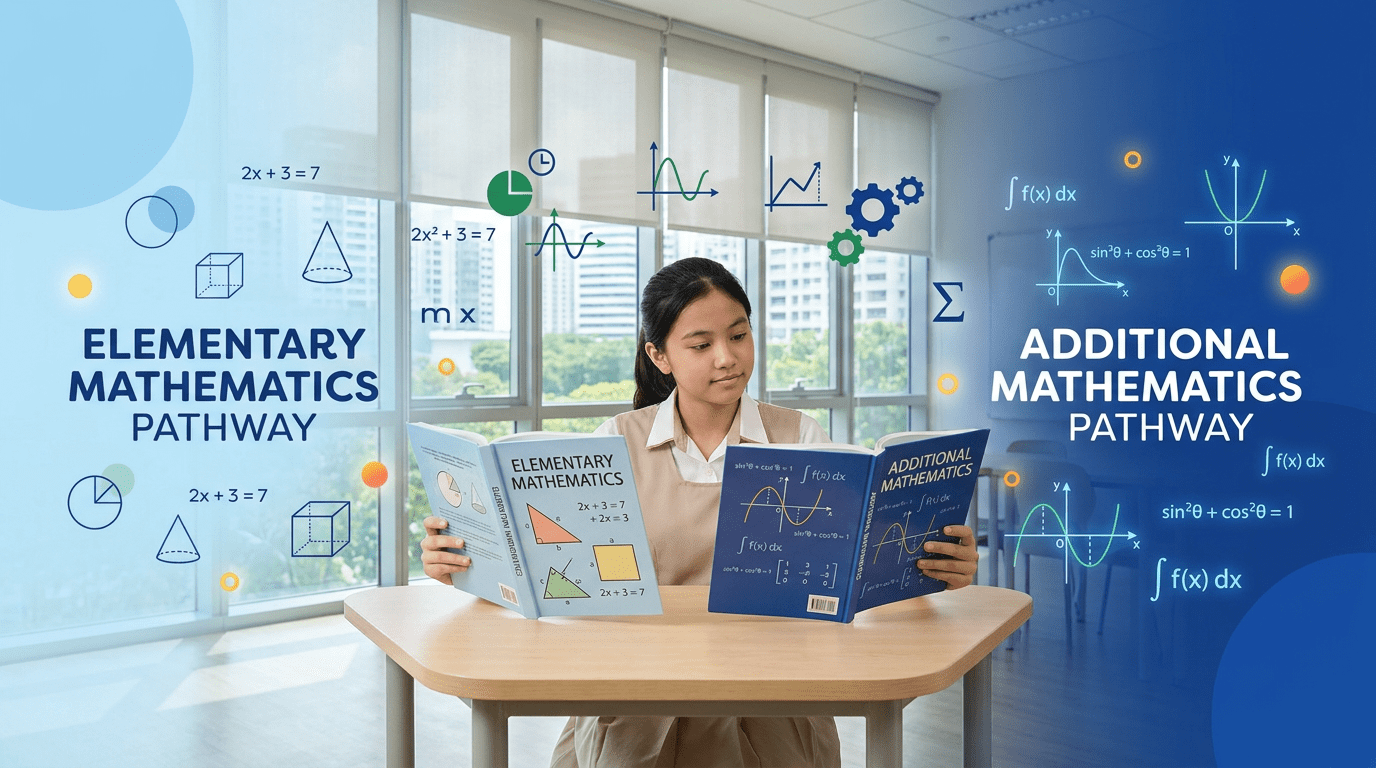
If you have a child entering secondary school in Singapore, you have probably come across two terms that can cause a fair amount of confusion: A-Math and E-Math. Both fall under the Mathematics umbrella, both appear on the O-Level certificate, and both matter enormously for your child’s academic future. Yet they are fundamentally different subjects with different content, different difficulty levels, and different implications for the path ahead.
Understanding the difference between A-Math (Additional Mathematics) and E-Math (Elementary Mathematics) helps parents and students make informed decisions about subject combinations, tertiary education goals, and where to focus study efforts. In this guide, we break down exactly what each subject covers, who is eligible to take A-Math, how the two subjects compare side by side, and what your child can do to excel in either or both.
What Is Elementary Mathematics (E-Math)?
Elementary Mathematics, widely known as E-Math, is a compulsory subject taken by all secondary school students in Singapore, regardless of their stream or subject combination. It is examined at the O-Level and forms the mathematical foundation that every student is expected to master before leaving secondary education. The syllabus is designed to ensure that students develop strong numeracy skills, logical reasoning, and the ability to apply mathematics to real-world scenarios.
The E-Math syllabus covers a broad but accessible range of topics. Students learn to work with numbers and algebra, tackle geometry and trigonometry, interpret statistical data, and solve problems involving mensuration (the calculation of lengths, areas, and volumes). The curriculum is structured so that even students who do not intend to pursue mathematics-heavy courses after O-Levels still leave secondary school with a functional and practical grasp of the subject. Because it is compulsory, E-Math counts towards every student’s L1R4 and L1R5 aggregate scores, making a strong grade here particularly valuable.
The key topics in E-Math include:
- Numbers and their operations
- Ratio, rate, proportion, and percentages
- Algebraic expressions and formulae
- Functions and graphs
- Geometry and trigonometry
- Mensuration and coordinate geometry
- Statistics and probability
E-Math is assessed through two written papers at the O-Level examination, and students are expected to demonstrate both procedural fluency and problem-solving ability. The subject is taught across Secondary 1 to Secondary 4, with complexity building progressively each year.
What Is Additional Mathematics (A-Math)?
Additional Mathematics, or A-Math, is an elective subject offered to secondary school students who demonstrate stronger mathematical ability and have a clear interest or need for advanced mathematical concepts. Unlike E-Math, A-Math is not compulsory. Students typically begin the A-Math syllabus in Secondary 3 and sit for the O-Level examination at the end of Secondary 4. In some schools, exposure to pre-requisite concepts begins as early as Secondary 2.
A-Math goes significantly deeper into abstract mathematics and introduces topics that form the foundation for Junior College (JC) H2 Mathematics. The syllabus is more rigorous and theoretical, demanding a higher level of mathematical maturity and analytical thinking. Students who take A-Math are expected to handle multi-step problems, work with more complex algebraic structures, and apply mathematical reasoning in less straightforward contexts.
The key topics in A-Math include:
- Algebra (including polynomials, surds, and partial fractions)
- Logarithmic and exponential functions
- Trigonometric functions, identities, and equations
- Coordinate geometry in two dimensions
- Calculus (differentiation and integration)
- Proofs in plane geometry
- Binomial theorem
The inclusion of calculus is one of the most significant features of A-Math. Differentiation and integration are topics that do not appear in E-Math at all, and they represent a conceptual leap that many students find both challenging and rewarding. Mastering calculus at this level provides a considerable head start for students who go on to take H2 Mathematics or H2 Physics at the JC level.
Key Differences Between A-Math and E-Math
While both subjects fall under the broad category of mathematics, they differ substantially in terms of content, purpose, and the cognitive demands they place on students. Here is a clear comparison to help you understand where they diverge:
| Feature | E-Math | A-Math |
|---|---|---|
| Full Name | Elementary Mathematics | Additional Mathematics |
| Compulsory? | Yes | No (elective) |
| When Taught | Secondary 1 to 4 | Secondary 3 to 4 |
| Difficulty Level | Foundational to moderate | Moderate to advanced |
| Focus | Practical, real-world application | Abstract, theoretical concepts |
| Includes Calculus? | No | Yes |
| Relevance to JC H2 Math | Low to moderate | High |
In essence, E-Math equips all students with a solid, practical mathematical grounding, while A-Math extends this foundation into more sophisticated territory designed to prepare students for rigorous academic pathways at the JC level and beyond.
Who Should Take A-Math?
Not every student is suited to A-Math, and that is perfectly fine. Taking on an additional and demanding subject without the right aptitude or interest can do more harm than good. Generally, A-Math is recommended for students who consistently perform well in E-Math (typically achieving B3 or better), have a genuine interest in mathematics, and are planning to pursue a course in science, technology, engineering, or mathematics (STEM) fields after secondary school.
Students who intend to apply for JC science streams, particularly those aiming to take H2 Mathematics or H2 Physics, will find that A-Math is practically essential. Many JC teachers assume a working knowledge of calculus and advanced trigonometry from the start of the JC curriculum. Without an A-Math background, students can find themselves struggling to keep up even with diligent effort. If your child is eyeing a course in engineering, medicine, architecture, or computer science at the polytechnic or university level, A-Math provides a meaningful advantage.
On the other hand, students who are more interested in the arts, humanities, or business may not need A-Math at all. A strong grade in E-Math is sufficient for most non-STEM pathways, and it is always better to secure an excellent result in fewer subjects than a mediocre result in more. The decision should be made carefully, ideally in consultation with the school’s mathematics teachers and a trusted tutor who understands your child’s strengths and goals.
How A-Math Affects Your Child’s Future
The decision to take A-Math at the O-Level has downstream consequences that extend well beyond the examination hall. For students who do well, an A-Math distinction or merit opens doors at the JC level that would otherwise remain closed. Most JC science streams require A-Math as a prerequisite, and many competitive polytechnic courses in engineering, information technology, and the sciences also prefer or require it.
From a scoring perspective, A-Math can also play a role in a student’s overall O-Level aggregate. Because it is an elective subject, a strong A-Math result can be included in the computation of the student’s L1R4 or L1R5 score if it improves the aggregate. Conversely, a poor A-Math result does not count against a student in the same way, since the subject is optional. This makes A-Math something of a calculated risk: the potential upside is significant for well-prepared students, but the workload demands genuine commitment.
It is also worth noting that A-Math builds qualities beyond subject knowledge. The discipline of working through complex, multi-step mathematical proofs and problems sharpens analytical thinking, attention to detail, and perseverance — qualities that serve students well in virtually any academic or professional field they eventually pursue.
Tips for Succeeding in Both Subjects
Regardless of whether your child is taking only E-Math or both E-Math and A-Math, consistent effort and the right study strategies make a decisive difference. Mathematics is not a subject where passive reading pays off. Active practice, timely revision, and building genuine conceptual understanding are the pillars of success.
Here are some practical strategies to help your child thrive:
- Practise regularly: Mathematics skills sharpen with repetition. Set aside dedicated practice time each week rather than cramming before examinations.
- Focus on understanding, not memorisation: Students who understand the underlying concepts can adapt to unfamiliar question formats. Rote memorisation of steps without understanding the “why” tends to break down under exam pressure.
- Review mistakes carefully: Every error is a learning opportunity. Encourage your child to go back to wrong answers, identify where the reasoning went astray, and rework the problem correctly.
- Seek help early: Mathematics concepts build on one another. A gap in understanding at the Secondary 3 level can snowball into serious difficulties by Secondary 4. Address weak areas as soon as they appear.
- Use past-year papers strategically: The MOE O-Level past-year papers are invaluable for understanding the format, style, and difficulty of exam questions. Timed practice under exam conditions also builds the stamina and composure needed on the day.
For A-Math specifically, dedicating extra time to calculus and trigonometry — the two areas where students most commonly struggle — pays particularly high dividends. These topics carry significant weightage in the examination and reward students who invest time in mastering them thoroughly.
How EduFirst Can Help
At EduFirst Learning Centre, we understand that every student approaches mathematics differently. Some students thrive when given structured, step-by-step guidance. Others need someone to help them see the big picture before the details fall into place. Our Secondary Tuition programme is designed with exactly this kind of individual variation in mind. With class sizes of just 4 to 8 students, our teachers can give each child the focused attention they need to genuinely understand — not just memorise — both E-Math and A-Math content.
Our experienced tutors are well-versed in the MOE syllabus for both subjects and know precisely where students tend to falter. Whether your child is finding algebra tricky in Secondary 1 or struggling with differentiation in Secondary 4, our team provides targeted support that addresses gaps at the root rather than at the surface. We work to build confidence alongside competence, because a student who believes they can do mathematics is already halfway there.
If you have a younger child who needs a strong foundation before entering secondary school, our Primary Tuition programme ensures they arrive at secondary school with the mathematical skills and habits needed to succeed. We also offer E-Lessons for students who prefer the flexibility of online learning, maintaining the same quality and personalised approach across all our delivery formats.
With 25 locations across Singapore and a track record since 2010, EduFirst has helped thousands of students navigate the challenges of the O-Level mathematics curriculum with confidence. Whether your child is deciding between E-Math alone or adding A-Math to their subject combination, our team can provide the guidance and support to help them make the most of their choice.
Making the Right Mathematics Choice
The difference between A-Math and E-Math comes down to purpose, depth, and ambition. E-Math is the essential, compulsory foundation that all students need, covering practical mathematics with real-world applications. A-Math is the more demanding elective that takes students into abstract and theoretical territory, preparing those who are ready for the rigours of JC-level science and mathematics.
Choosing whether to take A-Math is a decision worth making thoughtfully, with your child’s strengths, interests, and long-term goals at the centre of the conversation. There is no universal right answer, but with the right support, the right guidance, and a clear understanding of what each subject demands, your child can make a choice that genuinely serves their future.
Ready to Give Your Child the Best Start in Mathematics?
Whether your child needs help with E-Math, A-Math, or both, EduFirst Learning Centre’s expert tutors are here to help. With small class sizes, personalised attention, and a proven track record across Singapore, we make a real difference. Get in touch with us today and let us help your child build the confidence and skills to excel.