- May 15, 2026
AEIS Exam Paper: Format, Sections, and How to Practise Effectively
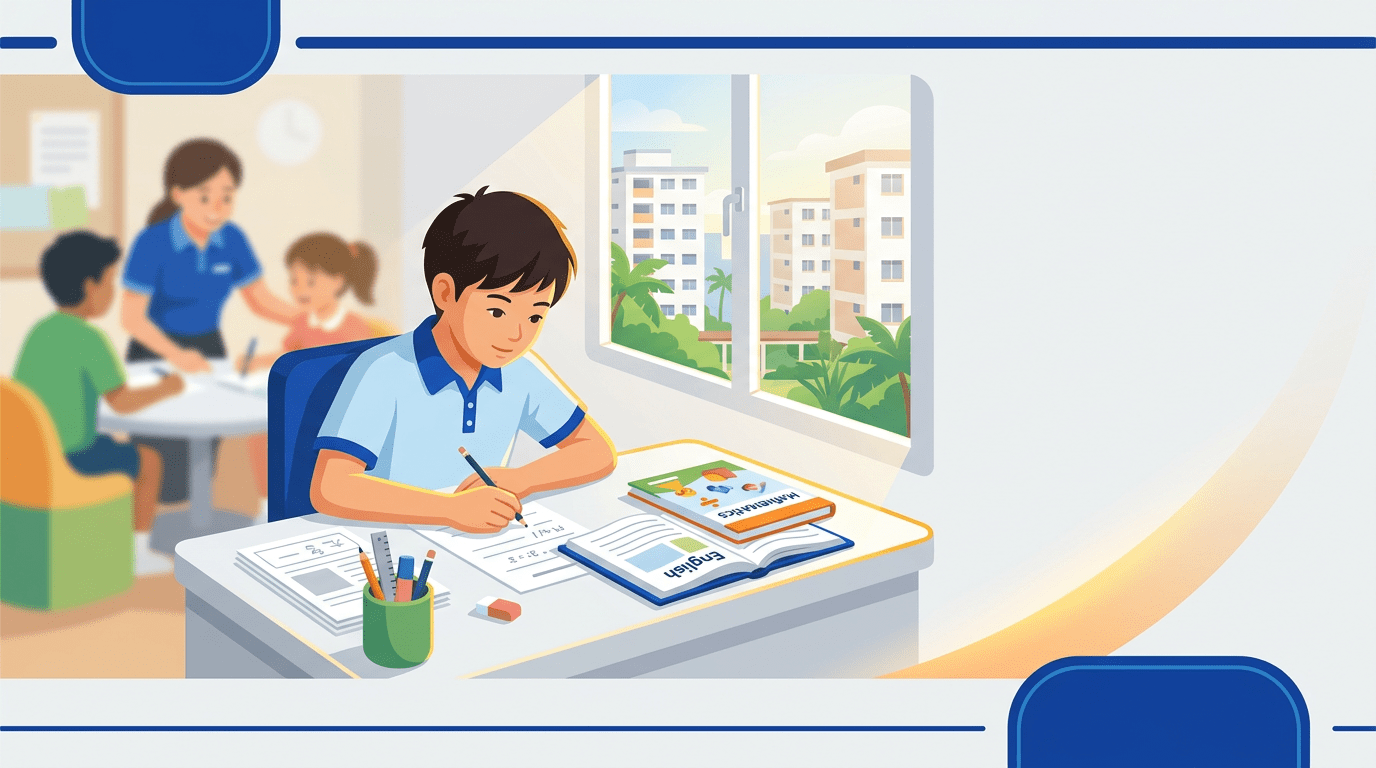
If your family is relocating to Singapore and you hope to enrol your child in a local mainstream government school, the AEIS exam (Admissions Exercise for International Students) is almost certainly the first major hurdle you will need to clear. For many parents, the challenge is not just preparing their child academically — it is understanding exactly what the exam tests, how the paper is structured, and what effective practice actually looks like in the months leading up to the test.
This guide breaks down the AEIS exam paper format section by section, explains what skills are assessed, and offers practical strategies so your child can walk into the examination hall feeling confident and well-prepared. Whether your child is aiming for a Primary 2 placement or a Secondary 1 spot, the information here will give your family a clear starting point.
What Is the AEIS Exam?
The AEIS, or Admissions Exercise for International Students, is an annual exam administered by the Singapore Examinations and Assessment Board (SEAB) on behalf of the Ministry of Education (MOE). It is designed specifically for international students — children who are not Singapore Citizens or Permanent Residents — who wish to join a Singapore government or government-aided mainstream school at the primary or secondary level. The exam is held once a year, typically in September, with results released in November and school placement offers made shortly after.
There is also a supplementary exercise known as the S-AEIS, held in February and March, which caters to students who missed the main sitting or who need a second opportunity to secure a school place. Both exercises test the same subjects and follow the same general structure, so preparation for one applies equally to the other.
Who Should Sit for the AEIS Exam?
The AEIS is open to international students between the ages of 7 and 14 (turning the relevant age in the year of application) who wish to enter Primary 2 through Primary 5 or Secondary 1 through Secondary 3. Students seeking entry into Primary 1 and Primary 6 or Secondary 4 and above are not eligible through this route. Eligibility is also subject to Singapore Citizens and Permanent Residents receiving priority in school placement, so the number of available places for international students can vary from year to year.
It is worth noting that students who have studied in Singapore previously — for example, those who attended an international school here — are still eligible to sit for the AEIS if they meet the age and level criteria. The key requirement is that the student holds a non-Singapore citizenship or PR status at the time of application.
AEIS Exam Paper Format at a Glance
The AEIS exam tests two subjects: English Language and Mathematics. Both papers are taken on the same day, and the level of difficulty is calibrated to the year of entry the student is applying for. This means a student applying for Primary 3 entry will sit a paper pitched at Primary 2 standards, while a student applying for Secondary 2 entry will be assessed at Secondary 1 standards — broadly one year behind the target entry level.
Here is a quick overview of the paper structure:
- Subjects tested: English Language and Mathematics
- Duration: Approximately 1 hour 10 minutes for English and 1 hour for Mathematics (timings may vary slightly by level)
- Format: Multiple-choice questions (MCQ) and short-answer or open-ended questions, depending on the section and level
- Medium of instruction: All questions are in English
- Scoring: Results are not released as raw scores; students receive an indication of whether they have been offered a school place
Because the paper is adapted to each entry level, it is essential that your child’s practice materials are aligned to the correct syllabus year — not simply to their current age or grade overseas.
The English Section: What to Expect
The English paper assesses a range of language skills that reflect the Singapore Ministry of Education English Language syllabus. At the primary level, the paper typically includes components such as grammar and vocabulary, comprehension passages, and situational or continuous writing tasks. At the secondary level, expect more sophisticated comprehension texts drawn from a variety of genres, grammar editing exercises, and writing tasks that require students to construct well-structured essays or formal responses.
Key skills tested in the English section include:
- Grammar and vocabulary: Multiple-choice questions testing tense, subject-verb agreement, word choice, and sentence structure
- Reading comprehension: Passages followed by questions that test literal retrieval, inference, and vocabulary-in-context
- Writing: Situational writing (such as letters or emails at the primary level) and continuous writing (narrative or expository essays at higher levels)
- Editing (secondary level): Identifying and correcting grammatical errors embedded within a passage
One area many international students underestimate is the writing component. Singapore’s English curriculum places significant emphasis on well-organised, cohesive writing with a clear beginning, middle, and end. Students who are used to more informal or loosely structured writing styles may find this component requires deliberate practice to master.
If your child needs structured support to build these skills, our Primary Tuition and Secondary Tuition programmes at EduFirst are designed specifically around the MOE English Language syllabus, giving students targeted practice in each component of the exam.
The Mathematics Section: What to Expect
The Mathematics paper follows the Singapore Mathematics curriculum, which is internationally recognised for its emphasis on conceptual understanding and problem-solving rather than rote calculation. At the primary level, students will encounter questions on whole numbers, fractions, decimals, measurement, geometry, data analysis, and word problems. At the secondary level, the scope expands to include algebra, geometry proofs, statistics, and more complex multi-step problem solving.
The format typically includes:
- Multiple-choice questions (MCQ): Testing straightforward computation and concept application
- Short-answer questions: Requiring students to show working and arrive at a numerical answer
- Long-answer or structured questions: Multi-step problems where marks are awarded for method as well as the final answer
The Singapore Mathematics approach, often called the “Model Method” at the primary level, can be quite different from what international students are used to. Students from curricula that rely heavily on algebraic shortcuts may find that learning to draw bar models or apply the heuristic problem-solving framework takes time. Starting early and working through past-year practice papers aligned to the Singapore syllabus is the most reliable way to close this gap.
How to Practise Effectively for the AEIS Exam
Effective preparation for the AEIS is less about cramming and more about consistent, targeted practice over a period of several months. Here is a structured approach that works well for most students:
1. Start with a Diagnostic Assessment
Before diving into practice papers, identify where your child currently stands relative to the Singapore curriculum. A diagnostic test or initial assessment will highlight specific topic gaps — for example, whether your child is strong in computation but weak in word problems, or fluent in writing but inconsistent in grammar. This prevents wasted time on topics your child has already mastered and focuses effort where it is most needed.
2. Use Singapore-Syllabus Practice Materials
Generic exam practice books from other countries will not align with the AEIS paper. Look for practice papers and assessment books that follow the MOE syllabus for the relevant year level. MOE-published syllabus documents are available on their website and can help you confirm what topics should be covered. EduFirst tutors are familiar with these syllabus requirements and build lesson plans around them directly.
3. Practise Under Timed Conditions
Many students perform well during relaxed practice but struggle to manage time under exam conditions. Introduce timed practice sessions early — not just in the final weeks before the exam. This builds the habit of pacing, helps students learn when to move on from a difficult question, and reduces anxiety on the actual day. Start with slightly more generous time limits and gradually reduce to match the real exam duration.
4. Review Mistakes Actively
Going through wrong answers is just as important as completing the practice paper itself. Encourage your child to understand why an answer was incorrect rather than simply noting the right answer. Was it a careless computational error, a misunderstood question, or a genuine knowledge gap? Each type of error requires a different response — more attention to checking work, reading questions more carefully, or revisiting the underlying concept.
5. Build English Language Habits Daily
For English, daily reading habits make a measurable difference over time. Encourage your child to read a variety of texts — fiction, non-fiction, news articles appropriate for their age — and to pay attention to how sentences are constructed. Practising short writing tasks regularly, such as summarising a passage or writing a short letter, builds fluency in the written expression component of the exam.
Common Mistakes to Avoid When Preparing
Families who are new to Singapore’s education system often make a few predictable missteps when preparing for the AEIS. Being aware of these pitfalls can save significant time and frustration:
- Preparing at the wrong level: Ensure practice materials match the entry level being applied for, not the student’s current overseas grade.
- Focusing only on Mathematics: Many parents assume strong Maths performance alone will secure a place. English is equally weighted and equally important.
- Starting too late: Ideally, preparation should begin at least four to six months before the September sitting. Last-minute cramming is rarely effective for an exam that tests deep understanding.
- Neglecting the writing component: Written expression is a skill that develops gradually. It cannot be improved significantly in a few weeks.
- Using the wrong resources: International exam prep materials (such as those aligned to IB, UK National Curriculum, or US Common Core) will not adequately prepare students for Singapore MOE-aligned questions.
How EduFirst Can Support Your Child’s AEIS Journey
At EduFirst Learning Centre, we have been supporting students across Singapore since 2010, and we understand how daunting the AEIS process can feel for families who are new to the local education system. Our small class sizes of just 4 to 8 students mean that every child receives close attention from their tutor — there is no getting lost in a large group or falling behind without anyone noticing.
Our Primary Tuition programmes cover English Language and Mathematics aligned to the MOE syllabus, giving AEIS candidates the exact foundation they need. For older students applying to secondary school, our Secondary Tuition classes address the more advanced demands of the AEIS secondary-level paper. We also offer E-Lessons for families who prefer or require an online learning option — particularly useful for those who have not yet relocated to Singapore but want to begin preparing early.
With 25 locations islandwide, there is likely an EduFirst centre close to your home or your child’s future school zone. Our tutors are experienced in diagnosing gaps quickly and building structured learning plans that make the most of the time available before the exam.
Final Thoughts
The AEIS exam is a significant milestone for international families hoping to join Singapore’s mainstream school system, but it is far from insurmountable with the right preparation. Understanding the format of each paper — what skills are tested, how questions are structured, and how the difficulty is calibrated to the entry level — is the essential first step. From there, consistent, syllabus-aligned practice with active error review and strong English habits will give your child the best possible chance of success.
Starting early, using the right materials, and seeking experienced guidance where needed can make an enormous difference. If your family is preparing for the AEIS and you would like to understand how EduFirst can help, we would love to hear from you.
Ready to Give Your Child a Head Start on the AEIS?
Contact EduFirst Learning Centre today to find out how our small-group tuition programmes can be tailored to your child’s AEIS preparation needs — whether they are targeting a primary or secondary school placement.