- May 13, 2026
Secondary English Tuition: What Parents Should Know Before Enrolling
If your child has just entered secondary school, you’ve probably noticed that English feels different now. The compositions are longer, the comprehension passages more complex, and the expectations in class seem to have shifted overnight. For many families in Singapore, this is the point where the question of secondary English tuition starts to feel urgent.
But enrolling your child in just any programme isn’t the answer. Before you commit, it helps to understand what secondary English actually demands, why some students struggle even when they did well at PSLE, and what separates a genuinely effective tuition centre from one that simply keeps your child busy for two hours a week. This guide walks you through everything you need to know — so you can make a confident, informed decision.
Why English Is More Than Just Another Subject
In Singapore’s education system, English holds a unique position. It is not only a compulsory subject but also the medium of instruction for every other subject your child studies. A student who struggles with English will often find it harder to process scientific explanations, write coherent humanities essays, or follow complex mathematics word problems. The ripple effect of weak English skills can quietly lower performance across the entire curriculum — which is why addressing gaps early matters far more than most parents initially realise.
The stakes are also very real when it comes to post-secondary pathways. English is the L1 subject in the national examinations, and a poor grade can significantly drag down a student’s aggregate score regardless of how well they perform in other subjects. For students targeting Junior College admission, a strong English result isn’t optional — it’s foundational to their entire post-secondary plan.
The Leap from Primary to Secondary English
One of the most common surprises parents encounter is how sharply English expectations rise once their child moves from primary to secondary school. A student who comfortably scored AL2 or AL3 at PSLE can find themselves suddenly struggling in Sec 1, and this isn’t necessarily a sign of regression. It’s a sign of how significantly the demands change.
At the primary level, English tends to be broken into familiar, smaller components — grammar MCQs, cloze passages, and picture compositions that follow fairly predictable formats. At the secondary level, students are expected to demonstrate deeper inference, construct well-reasoned arguments, analyse texts critically, and produce more sophisticated writing across multiple genres. The comprehension passages are longer and more layered, the oral component becomes more demanding, and the marking criteria reward nuance and precision rather than simply correct grammar. Many students find this transition genuinely difficult, even when they have strong English foundations from primary school.
Warning Signs Your Child May Need Extra Support
It’s worth paying attention to patterns rather than reacting to a single bad result. One disappointing test score doesn’t necessarily mean your child needs tuition — but consistent trends over time are worth taking seriously. Here are some signs that additional structured support could make a real difference:
- Persistently inconsistent marks — especially in comprehension or situational writing, where your child seems to understand the passage but still loses marks on answering technique
- Avoidance behaviours — putting off English homework, showing anxiety before tests, or expressing that they “don’t know where to start” with compositions
- Vocabulary and expression gaps — writing that feels flat or repetitive, relying on simple sentence structures even when they clearly have ideas to express
- Oral communication anxiety — struggling to speak fluently or confidently in structured conversations, which directly affects exam performance in the oral component
- A widening gap between understanding and performance — your child can discuss a topic verbally but cannot translate that understanding into a well-structured written response
It’s also worth noting that tuition isn’t only for students who are falling behind. Many parents enrol their children early as a preventive measure — before small gaps become entrenched habits that are harder to undo closer to the O-Level examinations.
What Secondary English Actually Covers
Understanding the scope of the subject helps you evaluate whether a tuition programme is truly comprehensive or just focusing on one or two components. Secondary English in Singapore spans several distinct assessment areas, each requiring its own set of skills and strategies. A good tuition programme should address all of them, not just the most obvious ones.
- Paper 1 – Writing: Includes situational writing (e.g., letters, emails, reports) and continuous writing (narrative or expository compositions). Students need strong structure, vocabulary, and the ability to sustain an argument or story convincingly.
- Paper 2 – Comprehension: Covers visual text comprehension, narrative comprehension, non-narrative comprehension, and summary writing. This component rewards close reading, precision in answering, and the ability to paraphrase effectively.
- Paper 3 – Listening Comprehension: Tests active listening, note-taking, and the ability to identify main ideas and inferred meanings from audio passages.
- Paper 4 – Oral Communication: Involves reading aloud and a spoken interaction segment, where students are expected to engage thoughtfully with a visual or topic prompt. Fluency, confidence, and the ability to develop ideas spontaneously are all assessed here.
A tuition programme that only drills comprehension passages or only focuses on essay writing is leaving significant marks on the table. The most effective secondary English tuition addresses each paper deliberately, with strategies tailored to how each component is actually marked.
Understanding the Exam Stakes: O-Levels and Beyond
It’s also useful for parents to understand the broader examination landscape their child is navigating. Currently, Secondary 4 students sit for the GCE O-Level examinations — a qualification that directly determines access to Junior Colleges, Polytechnics, and the Institute of Technical Education (ITE). For JC admission, the L1R5 aggregate is used (English as L1 plus the best five relevant subjects), and top JCs typically require an aggregate of around 6 or below after bonus points. A weak English grade doesn’t just affect one subject — it raises the entire aggregate and can close doors to competitive courses.
It’s also worth being aware that Singapore’s secondary education landscape is evolving. Full Subject-Based Banding (Full SBB) has been implemented from 2024, moving away from fixed Express, Normal Academic, and Normal Technical streams. Students are now grouped by posting groups and can take individual subjects at different levels (G1, G2, or G3). From 2027, the GCE O-Level will be replaced by the new Singapore-Cambridge Secondary Education Certificate (SEC), which will consolidate the former exam pathways into a single unified certificate. A good tuition centre should be keeping pace with these changes and updating their curriculum accordingly.
What to Look for When Choosing a Tuition Centre
With so many options available across Singapore, it can feel overwhelming to narrow down the right fit for your child. Rather than making a decision based purely on reputation or price, focus on these factors:
1. Teacher Qualifications and Experience
The quality of the educator is the single biggest determinant of outcomes. Look for tutors with relevant academic credentials, experience teaching at the secondary level, and genuine familiarity with the MOE syllabus. Tutors who have prior school-teaching experience or who have worked as examiners bring valuable insight into how papers are marked — which is different from simply knowing the content well.
2. Class Size
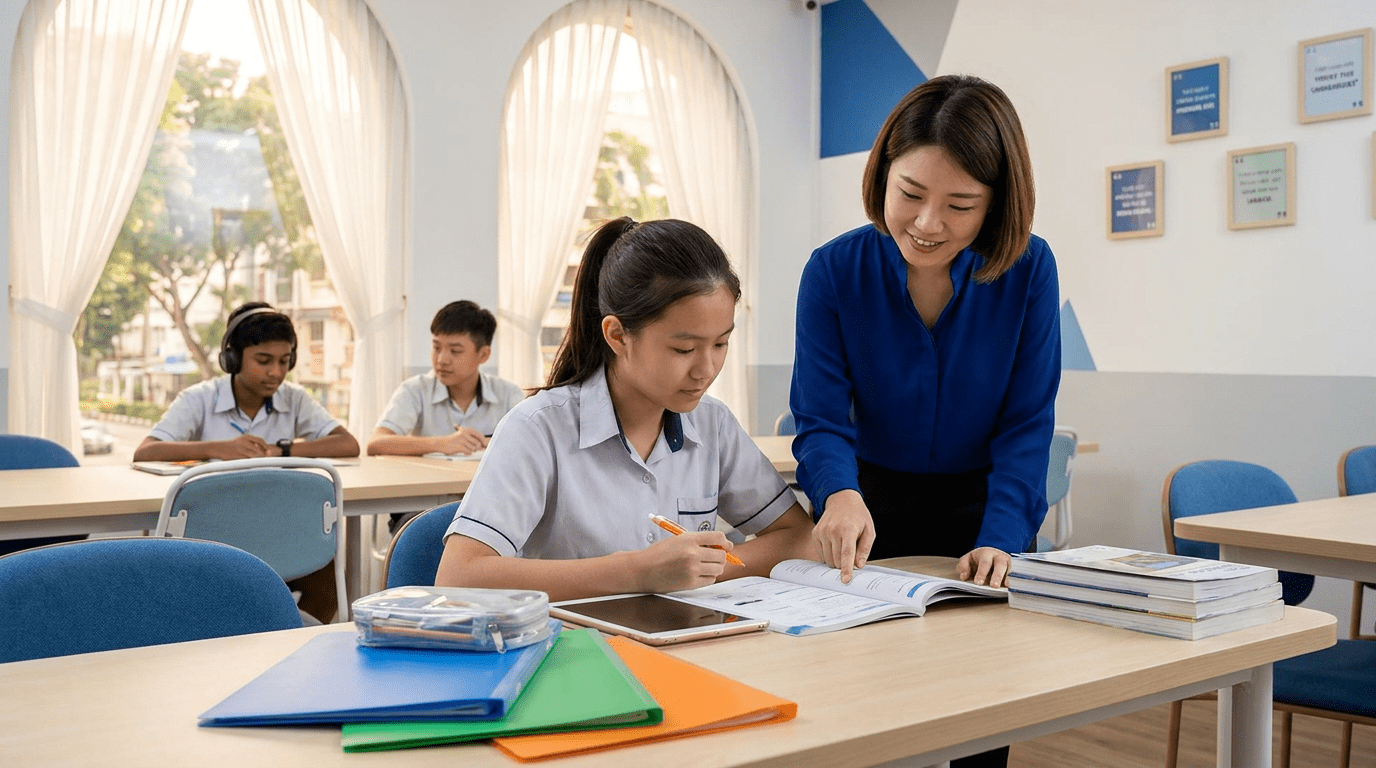
This is one of the most practical indicators of how much individual attention your child will actually receive. Large classes mean less feedback per student and fewer opportunities for a tutor to identify and address each child’s specific weaknesses. Small group tuition — typically around four to eight students — allows the tutor to provide targeted feedback, catch errors in real time, and adapt the lesson to where each student actually needs help.
3. MOE-Aligned Curriculum
The programme should be clearly mapped to the MOE syllabus and updated regularly to reflect any changes in examination formats or marking criteria. Ask specifically how the centre keeps its materials current and whether they cover all four papers, not just writing or comprehension in isolation.
4. Teaching Approach: Strategy Over Drilling
There’s an important difference between a programme that builds genuine language skills and one that simply repeats past-year papers. Effective secondary English tuition teaches students how to approach each question type — how to identify what a comprehension question is really asking, how to structure an argument in an expository essay, how to manage time under exam conditions. Avoid programmes that rely primarily on rote memorisation or endless drilling without explanation of underlying strategies.
5. Progress Tracking and Parent Communication
A reputable centre should have a clear system for monitoring student progress and keeping parents informed. Ask about how assessments are conducted, how often feedback is shared, and whether the centre adjusts its approach based on a student’s evolving needs. Tuition that doesn’t measure progress is difficult to evaluate — and difficult to justify over the long term.
6. Location and Scheduling Flexibility
Practical considerations matter too. A programme that creates excessive travel stress or clashes with CCA commitments is unlikely to be sustainable. Look for a centre with locations convenient to your home or your child’s school, and check whether there is flexibility for make-up lessons if your child misses a session due to school activities or illness.
Questions to Ask Before You Enrol
Before committing to a programme, use these questions as a starting point for your conversations with any tuition centre:
- How is the class structured, and how many students are in each session?
- Does the curriculum cover all four papers of the O-Level English examination?
- How do tutors provide written feedback on compositions and comprehension answers?
- How is student progress tracked, and how often are parents updated?
- What is the centre’s policy on make-up lessons for missed classes?
- Are lessons adapted for students taking subjects at different levels (G1, G2, G3) under Full SBB?
- Is a trial class available before full enrolment?
The answers to these questions will tell you a great deal about how seriously a centre takes its responsibility to each individual student — not just to the class as a whole.
How EduFirst Learning Centre Supports Secondary English Students
At EduFirst Learning Centre, we’ve been supporting students across Singapore since 2010 — and we understand that secondary English is one of the areas where the right kind of support can genuinely change a student’s academic trajectory. Our secondary tuition programmes are built around small class sizes of just 4 to 8 students, ensuring that every child receives meaningful individual attention rather than simply sitting in a room while a tutor teaches to the middle of the group.
Our tutors follow a curriculum closely aligned with the MOE syllabus, covering all components of the secondary English examination — from comprehension and summary writing to oral communication and continuous writing. With 25 locations islandwide, there’s very likely a centre near your home or your child’s school, making it easy to build tuition into an already busy weekly schedule. We also offer e-lessons for families who prefer the flexibility of online learning without compromising on quality or interaction.
Whether your child is just starting out in Sec 1 and you want to build strong habits early, or they’re in Sec 3 or 4 and need focused support in the lead-up to their national examinations, we design our approach around where each student actually is — not where the average student is supposed to be. If you also have a primary school child who could benefit from structured support, you might find our primary tuition programmes equally useful as part of a longer-term academic plan. We also offer pre-school programmes for younger learners who are just starting their English learning journey.
Making the Right Choice for Your Child
Choosing secondary English tuition is not a decision that needs to be rushed, but it’s also not one to defer indefinitely. The secondary school years move quickly, and the habits and skills a student builds in Sec 1 and Sec 2 have a direct bearing on how well-prepared they are when it counts most in Sec 3 and Sec 4. The right tuition centre won’t just improve your child’s grades — it will build the confidence, critical thinking, and communication skills that serve them well beyond any single examination.
Take the time to visit centres, ask the right questions, attend a trial class, and observe how your child responds to a new learning environment. Ultimately, the best programme is the one your child engages with — and that starts with finding a centre that genuinely understands both the subject and the student behind it.
Ready to Find the Right Support for Your Child?
EduFirst Learning Centre has been helping secondary students across Singapore achieve their best in English since 2010. With small classes of 4–8 students, experienced tutors, and 25 convenient locations islandwide, we make quality tuition accessible and effective.