- May 23, 2026
What Happens After the AEIS? Results, Placement, and Next Steps Explained
The AEIS — the Admissions Exercise for International Students — is one of the most significant academic milestones for international families relocating to Singapore. After weeks of preparation and the pressure of sitting the test, many parents find themselves asking the same pressing question: what actually happens after the AEIS? Understanding the results timeline, how school placement decisions are made, and what comes next can make an enormous difference in how smoothly your child transitions into Singapore’s education system.
This guide walks you through every stage that follows the AEIS test — from when results are released and how MOE assigns school placements, to what your options are if your child does not receive a placement, and how to best prepare them for the academic journey ahead. Whether your child sat the September or February test, the steps that follow are critical, and knowing what to expect will help your family navigate the process with confidence.
What Is the AEIS and Why Does Placement Matter?
The AEIS is administered by the Ministry of Education (MOE) Singapore and is the primary route through which international students gain admission to government and government-aided mainstream schools. It is offered twice a year — once in September (for entry into the following year) and once in February via the Supplementary AEIS, commonly known as the S-AEIS (for mid-year entry). The test assesses English and Mathematics, and the results directly determine which school level a student is placed into.
Placement through the AEIS is significant because it determines not just where your child studies, but at what level. A student may be placed in a primary or secondary school depending on their age and test performance. The placement outcome shapes the entire academic trajectory your child will follow in Singapore, making the post-AEIS process just as important as the preparation stage itself.
When Are AEIS Results Released?
For the main AEIS (held in September), results are typically released in November, roughly six to eight weeks after the test date. This gives MOE sufficient time to process results across multiple year levels and coordinate school placements islandwide. For the S-AEIS (held in February), results are generally released within a few weeks, usually by March. It is important for parents to log in to the official AEIS website portal using their registered account to check results, as notifications are sent electronically.
Parents should note that result release dates can vary slightly from year to year. MOE typically announces the exact date on the official AEIS portal and on the MOE website. Keeping your registered email address current and checking the portal regularly around the expected release window is strongly advised to avoid missing critical communications.
How School Placement Works After the AEIS
School placement after the AEIS is handled entirely by MOE and is not something families apply for separately. Once results are processed, MOE matches each successful candidate to a school based on a combination of factors, including the student’s test performance, their age, the year level they qualify for, and school vacancies available at the time of placement.
It is important to understand that families do not get to choose their preferred school during this process. MOE assigns the school, and while parents may indicate preferences through the portal in some cases, the final decision rests entirely with MOE based on available places. Schools are distributed across Singapore, so the assigned school may not necessarily be close to your home — though MOE does make reasonable efforts to consider proximity when vacancies allow.
Students who perform well on the AEIS will be placed in the appropriate year level for their age. However, if a student’s results indicate that they are not yet academically ready for their age-appropriate year level, MOE may place them in a lower year, particularly for primary school students. This is done in the interest of the child’s academic welfare and long-term success in the Singapore system.
Receiving Your School Placement Notification
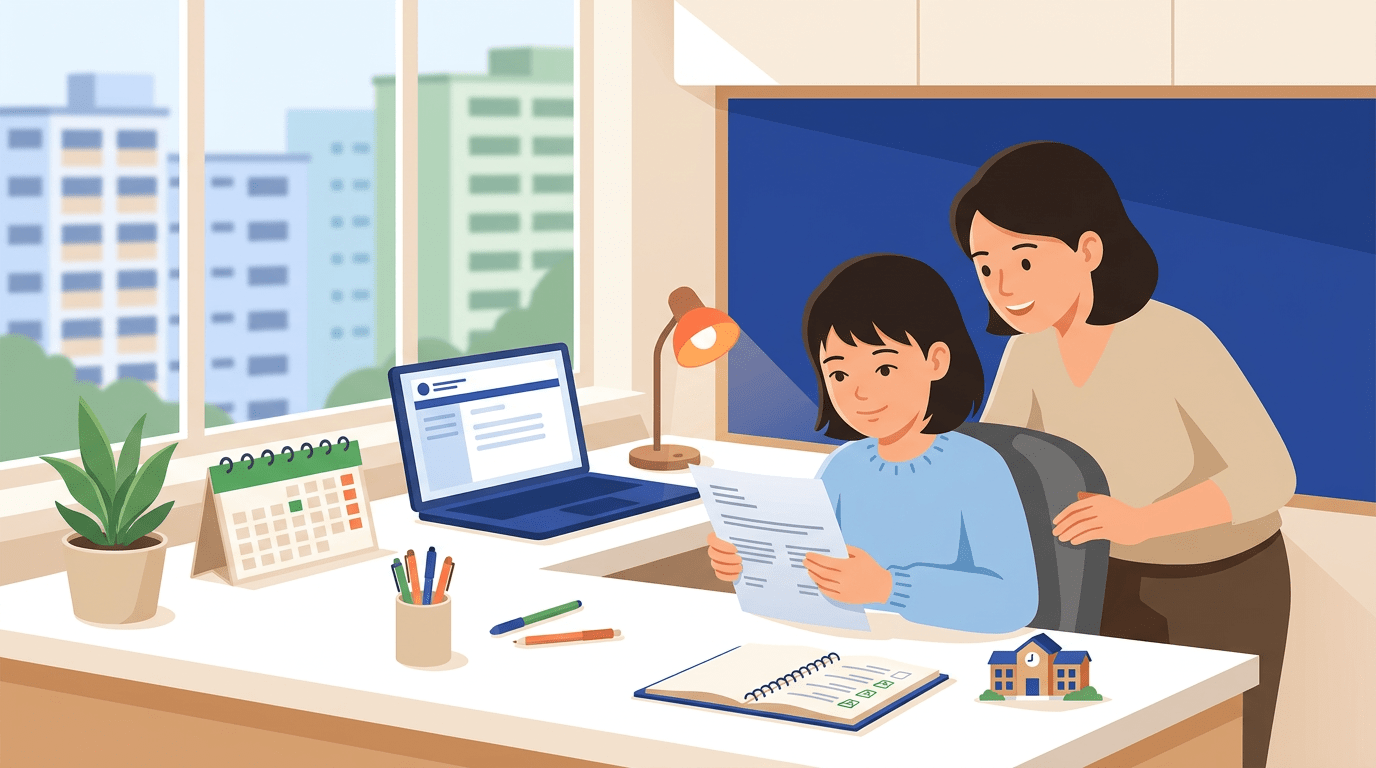
Once MOE has confirmed your child’s school placement, you will receive an official notification through the AEIS online portal. This notification will include the name of the assigned school, the year level your child has been placed in, and instructions on how to proceed with school registration. You will need to report to the assigned school within the stipulated timeframe to complete the enrolment process.
During school registration, you will typically need to bring the following documents:
- Your child’s passport and relevant passes (e.g., Dependant’s Pass, Student’s Pass)
- The official AEIS placement letter or notification
- Your child’s birth certificate
- Recent school reports or academic transcripts from your child’s previous school
- Passport-sized photographs
It is advisable to contact the assigned school directly after receiving the placement notification to confirm the exact documents required and to schedule your registration appointment. Schools may have slightly different administrative procedures, so early communication helps avoid last-minute surprises.
What If Your Child Is Not Placed in a School?
Not every student who sits the AEIS will receive a school placement. A student may not be placed if their test results do not meet the minimum standards required for entry into mainstream government schools, or if there are insufficient vacancies at the appropriate year level. Receiving a non-placement outcome can be disheartening, but it is not the end of the road — there are meaningful options available to families in this situation.
Students who are not placed through the main AEIS in September are eligible to sit the S-AEIS in February, which provides a second opportunity to qualify for placement. In the interim, parents may explore enrolment in private international schools, which operate independently of the MOE placement system and do not require AEIS results for admission. Some families also use the intervening months to invest in intensive academic preparation so their child is better equipped for the S-AEIS.
The S-AEIS: A Second Chance at Placement
The Supplementary AEIS (S-AEIS) is held in February each year and is designed specifically for students who were not placed through the main September AEIS. It follows the same structure and format as the main exercise, testing English and Mathematics. Students who are successful in the S-AEIS are placed in mainstream government schools for the second semester of the academic year, typically beginning in April.
The S-AEIS is a valuable opportunity, and families should treat the months between the main AEIS results and the S-AEIS test date as a focused preparation window. Structured academic support during this period can significantly improve a student’s chances. If your child is preparing for the S-AEIS, working with a dedicated tuition centre that understands the Singapore curriculum and testing style is one of the most effective investments you can make.
Preparing Your Child for Their New School
Once your child has been successfully placed, the real work of settling into Singapore’s education system begins. The local curriculum, especially at the primary and secondary levels, can feel quite different from what international students are accustomed to. Singapore’s education system is academically rigorous, with a strong emphasis on Mathematics, Science, and English — and lessons move at a consistent pace that assumes a certain foundational level of competence.
Beyond academics, there is also the social and cultural adjustment to consider. Starting in a new school where most classmates have studied together for years can be isolating at first. Encouraging your child to participate in co-curricular activities (CCAs), join group projects, and engage with classmates outside of lesson time can accelerate their social integration. Many schools also have pastoral care programmes to support newly admitted international students, and it is worth speaking to the form teacher early on to flag any concerns.
From an academic standpoint, here are some key areas to focus on before and after your child starts school:
- English Language: Singapore’s school English follows the Cambridge framework; exposure to formal written English and comprehension practice is essential
- Mathematics: The Singapore Math curriculum is internationally recognised for its depth; model drawing and problem-solving methods may differ from what your child has learned before
- Science (Secondary level): Secondary students should familiarise themselves with the structured O-Level Science format, particularly if coming from a different examination system
- Mother Tongue Language: Depending on nationality and school policy, some students may be required to take a Mother Tongue Language subject — clarify this with the school early
How Tuition Support Can Help After AEIS Placement
Being placed in a school is just the beginning. Many international students find that even after a successful AEIS placement, the transition into the Singapore curriculum requires additional academic support — particularly in subjects where teaching methodologies differ significantly from their home country. This is where working with an experienced tuition centre can make a tangible difference in your child’s confidence and performance.
At EduFirst Learning Centre, we have been supporting primary and secondary students across Singapore since 2010. With 25 centres islandwide, our small class sizes of just 4 to 8 students ensure that every child receives genuine individual attention — something that is especially valuable for international students who are still finding their footing in a new academic environment. Our educators are experienced in the Singapore curriculum and can quickly identify the specific gaps a newly placed international student may have.
For students entering primary school after the AEIS, our primary tuition programmes offer targeted support in English, Mathematics, and Science — the three core subjects that form the backbone of the PSLE. For older students placed at the secondary level, our secondary tuition programmes are designed to help students navigate the demands of the O-Level and N-Level curriculum with clarity and structure.
We also offer e-lessons for families who prefer the flexibility of online learning — particularly useful during the adjustment period when managing new school schedules, commuting, and extracurricular commitments can feel like a juggling act. Whether your child needs help catching up on foundational concepts or simply wants to stay ahead of the class, EduFirst has a programme that fits.
For younger children who arrived in Singapore before school age, our pre-school programmes offer a nurturing head start in literacy and numeracy that can make the eventual transition into Primary 1 significantly smoother.
Moving Forward After the AEIS
The AEIS is a gateway — and what lies beyond it matters just as much as the test itself. Understanding the results timeline, knowing how school placement works, and having a clear plan for what comes next allows your family to move forward with purpose rather than anxiety. Whether your child has been successfully placed and is preparing to start school, or you are regrouping after a non-placement and planning for the S-AEIS, the most important thing is to take proactive steps early.
Singapore’s education system rewards preparation, consistency, and strong foundational skills. With the right academic support structure in place from the start, international students can not only keep up with their local peers — they can thrive. If your child is navigating this transition, EduFirst Learning Centre is here to help every step of the way.
Ready to Give Your Child the Support They Need?
Whether your child has just been placed through the AEIS or is preparing to sit the S-AEIS, EduFirst Learning Centre offers personalised tuition programmes across 25 locations in Singapore. Our small class sizes and experienced educators ensure your child gets the focused attention they deserve.