- May 22, 2026
AEIS Test Day: What to Bring, What to Expect, and What to Do After the Exam
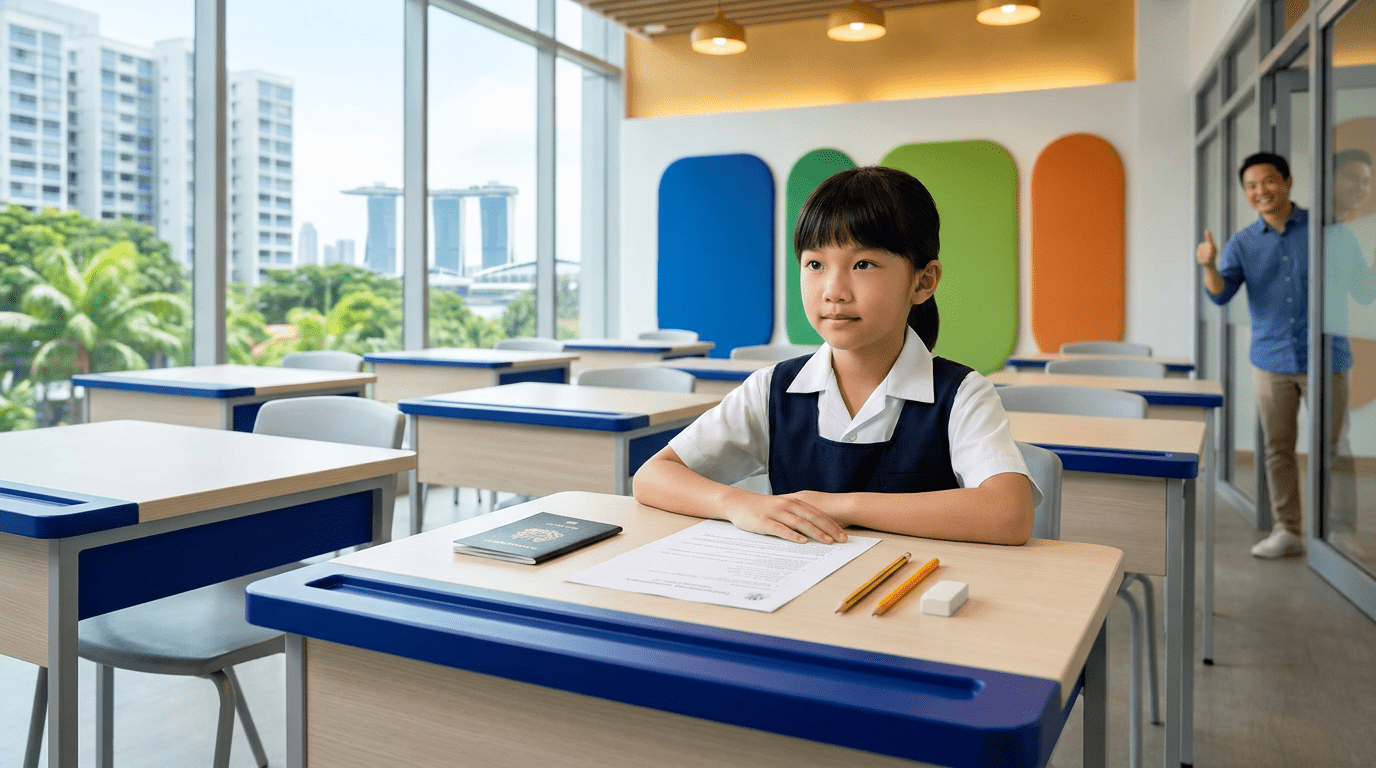
For international families relocating to Singapore, the Admissions Exercise for International Students (AEIS) is more than just an exam — it is the gateway to a place in one of Singapore’s mainstream government schools. Months of preparation, study routines, and practice papers all lead up to a single test day, and knowing exactly what to expect can make an enormous difference to how well your child performs. Anxiety, confusion, or a forgotten document can derail even the best-prepared student, so being thoroughly ready on every front — logistical and emotional — is just as important as academic preparation.
This guide walks you through everything you need to know about AEIS test day: the documents to bring, how the check-in and exam process works, what the papers cover, and the important steps to take once the exam is over. Whether your child is sitting the primary or secondary level test, you’ll find clear, practical guidance to help the whole family approach the day with confidence.
What Is the AEIS and Why Does Test Day Matter?
The AEIS is a centralised admissions exercise conducted annually by Singapore’s Ministry of Education (MOE) and administered by the Singapore Examinations and Assessment Board (SEAB). It is the primary pathway for international students to enter government primary schools at Primary 2 to 5, and secondary schools at Secondary 1 to 3, in the following academic year. Admission is competitive and subject to available vacancies, so every mark counts — and being fully prepared on the day of the test ensures your child can perform to their true potential without unnecessary setbacks.
Understanding the structure of the day goes a long way in reducing pre-exam stress. When both parents and students know what to expect at each stage, from arrival to the final paper, the experience becomes far more manageable. Think of test day preparation as the final piece of your child’s AEIS journey.
Before Exam Day: Final Preparations
The evening before the exam is not the time for last-minute cramming. Instead, focus on logistics. Lay out all required documents, stationery, and clothing the night before so there are no morning rushes. Confirm the test venue and travel route using the details printed on your child’s entry proof — and account for traffic or public transport delays by planning to leave earlier than you think necessary.
Ensure your child gets a full night’s sleep. A well-rested mind retains information better and handles exam pressure more effectively than one that is tired or anxious. A light, nutritious breakfast on the morning of the exam is also worth prioritising. Avoid heavy meals that may cause lethargy, and keep breakfast simple and familiar. This is not the day to try anything new.
What to Bring to the AEIS Test
Getting the documents right is non-negotiable. Based on official MOE and SEAB guidelines, candidates must bring the following on test day:
- A copy of their passport bio-data page — this is the page displaying your child’s personal particulars, photograph, and passport details.
- A copy of their entry proof issued by SEAB — this document is downloaded from the SEAB Candidates Portal (CP) after successful registration and payment, and it contains the test venue, reporting time, and your child’s seat details.
For stationery, students are expected to bring pencils (HB or 2B), an eraser, and a pencil sharpener. Stationery should be kept in a transparent pencil case or a clear plastic bag for easy inspection. Importantly, calculators are not permitted for AEIS Mathematics papers, so students should be well-practised in written workings and mental arithmetic before the day. Mobile phones, smartwatches, and other electronic devices must not be brought into the examination hall.
A small, clear water bottle is generally acceptable, but check the specific instructions on your entry proof, as individual test venues may have their own rules. Leave all unnecessary items at home or with a parent waiting outside.
Arriving at the Venue: Timing and Check-In
The test venue and official reporting time are stated on your child’s entry proof. Plan to arrive comfortably before the reporting time rather than exactly on it. Once at the venue, candidates will go through an identity verification process. This typically involves presenting the entry proof and passport copy, and invigilators may cross-check your child’s photo and details against their registration record.
After verification, students are directed to their pre-assigned seats. Seating is arranged to ensure a fair examination environment, and invigilators will provide instructions about exam conduct before the papers begin. Encourage your child to use any waiting time to settle in calmly — take a few slow breaths, read over any brief notes if they wish, and prepare mentally for the task ahead. Parents are welcome to accompany their children to the venue, but access to the examination hall itself is restricted to candidates only.
What to Expect During the AEIS Exam
The AEIS assesses students in two core subjects: English Language and Mathematics. The English paper covers comprehension, grammar, and writing, while the Mathematics paper assesses number operations, geometry, and problem-solving skills. Exam content is based on Singapore’s mainstream curriculum at the level preceding the one applied for. For example, a student applying for Secondary 3 will be tested on Secondary 2 content. For primary level applicants, familiarity with the Mathematics topics taught at the level below the target entry level is essential.
Each paper typically runs for around one and a half to two hours. Students should read all instructions carefully before beginning, allocate their time across questions wisely, and attempt every section rather than leaving items blank. Invigilators will announce the start and end times clearly. If a student feels unwell or has a question during the exam, they should raise their hand quietly to get an invigilator’s attention — never attempt to speak to another candidate.
One important point to note: no official past papers are released by MOE or SEAB, so preparation through MOE-aligned practice materials and structured tuition is the most effective way to build familiarity with the question style and difficulty level. Students who have completed primary tuition or secondary tuition aligned to Singapore’s curriculum will be far better equipped to handle the range of question types encountered on test day.
Managing Nerves and Staying Focused
It is entirely normal for students — and parents — to feel anxious on AEIS test day. Acknowledging that nervousness is a natural response, rather than trying to eliminate it entirely, is a healthier approach. Teach your child a few simple strategies they can use during the exam itself: slow, controlled breathing when they feel their heart racing; re-reading a question carefully if they feel confused rather than skipping it out of panic; and focusing on one question at a time rather than worrying about how much is left.
Equally important is the mindset you cultivate in the lead-up to the exam. Reassure your child that their preparation has been solid, that they know the material, and that doing their best is all that matters. Avoid loading them with last-minute reminders or pressure on the morning of the test. Positive, calm energy from parents carries over to children — so model the composure you want to see in them.
After the Exam: Results, Placement, and Next Steps
Once the exam concludes, students should collect their belongings and leave the hall quietly. Avoid discussing specific exam questions outside the hall, as this is both distracting and generally discouraged. The focus now shifts to the weeks ahead as you wait for the official results to be released.
AEIS results are typically released in December, viewable through the AEIS Internet System (AEIS-IS) during a specific window of dates announced by MOE. Results are not made public — each family accesses their own child’s outcome by logging in with the child’s passport number or Foreign Identification Number as stated on the entry proof. It is important to check the AEIS-IS during the published viewing window, as the outcome letter is only accessible for a limited period.
If your child receives a school placement, the outcome letter will detail the specific school offered and the reporting instructions. Placement is determined by MOE based on exam performance, available vacancies, and your declared residential area. There is no school choice in the traditional sense, and school posting decisions are final — requests for a different school or transfers will not be entertained at this stage. Successful applicants who do not report to the offered school within the specified reporting period risk having their place offered to another applicant, so adhering strictly to the deadline is critical.
For students who receive a placement but hold a Long-Term Visit Pass (LTVP), Dependant’s Pass (DP), or Immigration Exemption Order (IEO), their school admission can be confirmed immediately upon reporting to the offered school. Students without one of these passes will need to apply for a Student’s Pass (STP) through the Immigration and Checkpoints Authority (ICA) as soon as possible after receiving the school’s STP Registration Acknowledgement Letter, in order to begin school on time in January.
If Your Child Does Not Receive a Placement
Not receiving a placement after the AEIS is disappointing, but it is not the end of the road. MOE does not publish a fixed passing score — placement depends on relative exam performance compared to other candidates and the number of available vacancies that year. A strong result in one intake might not secure a place in a more competitive cohort, which is why ongoing, structured preparation matters so much.
Families in this situation have a clear next step available to them: the Supplementary Admissions Exercise for International Students (S-AEIS), which is typically held in February and March each year. Successful S-AEIS applicants start school in April or May of the same academic year. If neither intake results in a placement, students may apply again in future cycles, provided they still meet the age eligibility requirements for the intended level.
The period between results and the next intake is valuable preparation time. Rather than treating it as a setback, use it to identify the specific areas where your child needs to improve — whether in English comprehension, grammar, mathematical problem-solving, or exam technique — and address those gaps with a structured, consistent study plan. Enrolling in professional tuition designed around Singapore’s curriculum is one of the most effective approaches families take during this time.
AEIS Exam Day Checklist
Use this checklist to make sure your child is fully prepared before leaving home on test day:
| Item | Ready? |
|---|---|
| Copy of passport bio-data page | ☐ |
| Copy of SEAB entry proof (with venue & reporting time) | ☐ |
| HB or 2B pencils (at least 2–3) | ☐ |
| Eraser and pencil sharpener | ☐ |
| Transparent pencil case or clear plastic bag | ☐ |
| Clear water bottle (optional — confirm with your entry proof) | ☐ |
| No mobile phone, calculator, or electronic devices | ☐ |
| Plan to arrive before the reporting time | ☐ |
| Good night’s sleep and nutritious breakfast | ☐ |
How EduFirst Can Help Your Child Prepare
Test day success starts long before the exam itself. At EduFirst Learning Centre, we have been supporting international students and their families in preparing for Singapore’s academic requirements since 2010. With 25 locations islandwide and small classes of just 4 to 8 students, our approach is built around personalised attention — the kind of targeted coaching that helps students genuinely understand concepts rather than simply memorising answers.
Our primary tuition and secondary tuition programmes are closely aligned to the Singapore curriculum that the AEIS is based on, covering both English Language and Mathematics in depth. Students who work through Singapore-style content consistently over time build the familiarity and confidence they need to handle whatever the AEIS papers throw at them. For families not based locally, our e-lessons provide the same quality of instruction online, removing geographical barriers to preparation. For younger learners, our pre-school programmes lay the academic foundations that make the primary years — and eventually the AEIS — far more manageable.
Final Thoughts
AEIS test day can feel like the culmination of months of hard work, and in many ways, it is. But being well-prepared goes beyond knowing the syllabus — it means arriving at the right venue with the right documents, at the right time, with a calm and focused mindset. By understanding exactly what the day involves, from identity checks and seating arrangements to the structure of the English and Maths papers, you can remove much of the uncertainty that fuels pre-exam anxiety.
Equally, knowing what comes after the exam — how results are released, how school placement works, and what options are available if a placement is not offered — allows your family to plan proactively rather than reactively. The AEIS is a significant step, but it is one that, with the right preparation and support, your child is very capable of navigating successfully.
Start Your Child’s AEIS Preparation with EduFirst
Give your child the strongest possible foundation for the AEIS with EduFirst’s personalised tuition programmes. Our experienced educators, small class sizes, and Singapore curriculum-aligned approach have helped hundreds of students succeed. Get in touch with us today to find out how we can support your child’s journey.