- Sep 16, 2026
O-Level Chemistry Notes: A Topic-by-Topic Summary Sheet for Revision
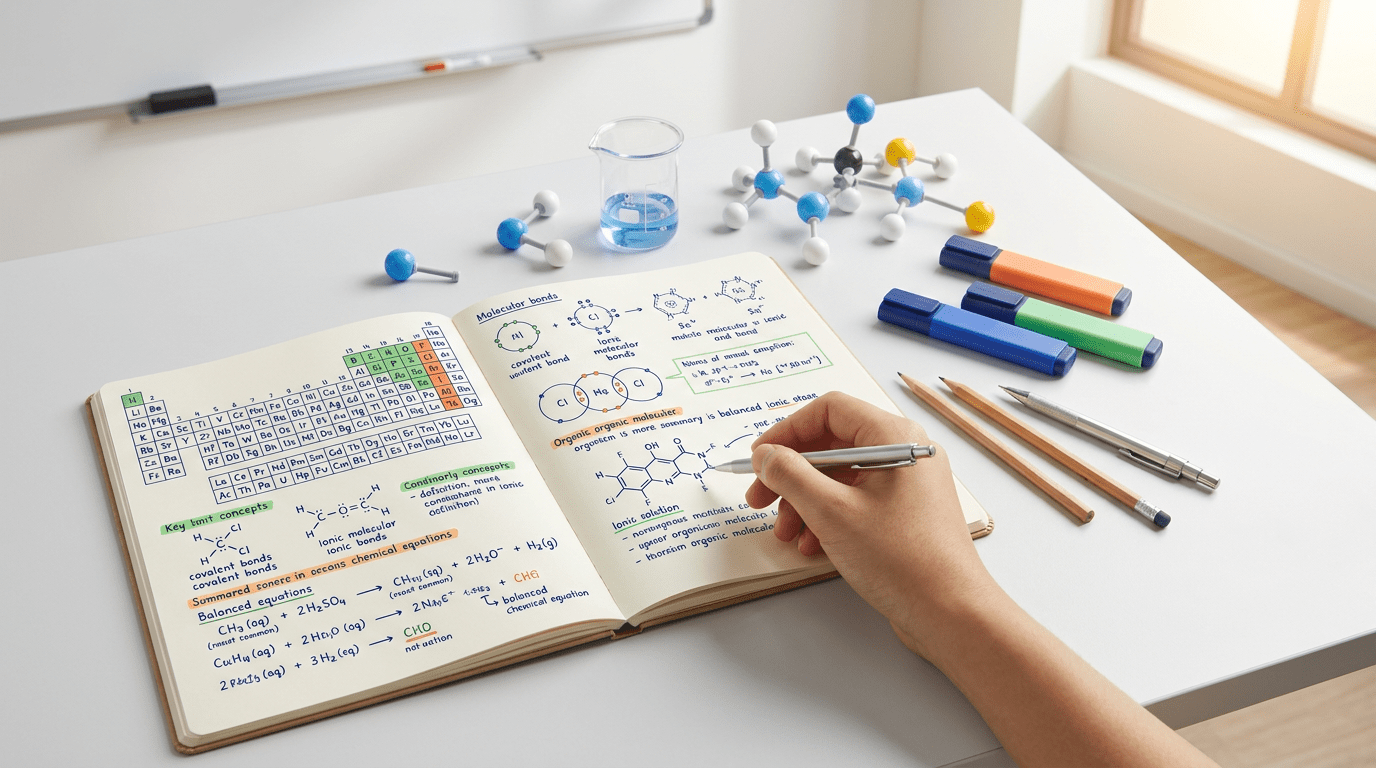
Chemistry is one of those subjects that can feel overwhelming when you look at the full syllabus all at once — but deeply satisfying when you approach it one topic at a time. The O-Level Chemistry syllabus, as set by the Singapore Examinations and Assessment Board (SEAB), covers a wide range of interconnected concepts, from the structure of the atom all the way through to organic chemistry and the impact of gases on our environment. Each topic builds on the one before it, which means that a solid foundation in the earlier chapters makes everything that follows considerably easier to grasp.
This summary sheet is designed to give Secondary 3 and Secondary 4 students a clear, structured overview of every major topic in the O-Level Chemistry syllabus. Whether you are revising ahead of a class test, preparing for your Prelims, or doing a final sweep before the national examinations, this guide gives you the key concepts, essential vocabulary, and exam-ready focus points for every chapter — all in one place. Think of it as your revision roadmap: a reference you return to at the start of each topic and again as the exams approach.
Why a Topic-by-Topic Approach Works for O-Level Chemistry Revision
Many students make the mistake of revising Chemistry by doing practice paper after practice paper without first consolidating their understanding of individual topics. The result is that gaps in foundational knowledge keep resurfacing — and marks keep slipping away on questions that should be manageable. A topic-by-topic revision approach works because it forces you to close those gaps systematically before applying your knowledge under timed conditions. When you know each topic thoroughly, the connections between them become clearer, and exam questions that combine multiple topics become far less daunting.
The O-Level Chemistry syllabus is broadly divided into three strands: the core principles of matter and structure, the behaviour and reactions of chemicals, and the applications of chemistry in the world around us. Organic chemistry sits as a third pillar in the final section. Understanding which strand each topic belongs to helps you see the subject as a coherent whole rather than a disconnected list of things to memorise. Use the summaries below as checkpoints — work through each one, identify where your understanding is strong and where it needs work, and use that information to plan your revision sessions.
Topic 1: Experimental Chemistry
Experimental Chemistry underpins everything else in the syllabus. This topic covers the techniques used in a laboratory setting: methods of separation and purification (filtration, evaporation, distillation, chromatography), safe handling of apparatus, and accurate recording of observations. Students are also expected to understand how to plan simple experiments, identify variables, and present data using appropriate graphs and tables.
For the Paper 3 Practical examination, which contributes 20% of your overall O-Level Chemistry score, precision matters enormously. A common mistake students make is using vague language when recording observations — for example, writing “a solid forms” instead of “a white precipitate is formed.” The marking scheme expects precise, scientific terminology, so practise describing your observations in full and accurate detail throughout your course, not just in the week before the practical exam.
Key Focus Points
- Know the correct apparatus for each separation technique and be able to state the principle behind it
- Understand when to use paper chromatography versus distillation versus crystallisation
- Be familiar with safety procedures: correct disposal of chemicals, handling of glassware, use of eye protection
- Practise writing observations using accepted scientific language (colour changes, precipitate formation, gas evolution)
Topic 2: Particulate Nature of Matter
This topic introduces the kinetic particle theory — the idea that all matter is made up of tiny particles that are in constant motion. Students learn about the three states of matter (solid, liquid, gas), how particles are arranged and how they move in each state, and how changes in temperature and pressure cause substances to change state. Understanding this model is crucial because it explains phenomena that appear across many other topics, including reaction rates, electrolysis, and gas behaviour.
Key concepts to master: the differences in particle arrangement, energy, and movement across the three states; the processes of melting, boiling, condensation, freezing, and sublimation; and how heating curves represent temperature changes during state transitions. Students often confuse the flat portions of a heating curve with “no energy being absorbed” — in fact, energy is still being supplied but is used to overcome intermolecular forces rather than raise temperature.
Topic 3: Atomic Structure
Atomic structure is the cornerstone of O-Level Chemistry. Here, students learn about the three subatomic particles — protons, neutrons, and electrons — their relative masses, charges, and positions within the atom. The concept of atomic number (number of protons) and mass number (protons plus neutrons) allows students to determine the number of particles in any atom or ion. Electronic configuration — the arrangement of electrons in shells, written as 2,8,1 for sodium, for example — determines how atoms bond with one another and explains the trends observed across the Periodic Table.
Students must also understand isotopes (atoms of the same element with different numbers of neutrons) and how to calculate relative atomic mass from isotopic data. The concept of ions follows naturally: atoms gain or lose electrons to form anions (negatively charged) or cations (positively charged), achieving a stable electron configuration in the process. Drawing electronic structures correctly — particularly for common ions — is a skill that appears repeatedly across bonding, electrolysis, and reactions questions.
Topic 4: Chemical Bonding and Structure of Materials
Chemical bonding explains why and how atoms join together to form compounds. The three types of bonding tested at O-Level are ionic bonding (transfer of electrons between metals and non-metals), covalent bonding (sharing of electrons between non-metals), and metallic bonding (a lattice of positive ions in a sea of delocalised electrons). Each type of bonding produces a different type of structure, and each structure has characteristic physical properties — particularly in terms of melting point, electrical conductivity, and solubility.
Students are expected to draw dot-and-cross diagrams for ionic and covalent compounds and to explain the properties of giant ionic lattices, simple molecular structures, giant covalent structures (diamond, graphite, silicon dioxide), and metallic structures. A key point that catches many students out is that graphite conducts electricity despite being a non-metal compound — because it contains delocalised electrons within its layered structure. Understanding the reasoning behind each property, rather than memorising a list, is what separates students who score consistently well from those who struggle with unfamiliar application questions.
Topic 5: Chemical Formulae, Equations and Stoichiometry
Being able to write and balance chemical equations is a skill that runs through every other topic in Chemistry. This section covers how to derive chemical formulae using valencies, how to construct word equations and symbol equations, and the importance of including state symbols (s), (l), (g), and (aq). Ionic equations — which show only the species involved in the reaction — are also required for higher-level questions involving precipitation and neutralisation reactions.
A common source of lost marks is failing to balance equations correctly before using them in stoichiometric calculations. Always check that the number of atoms of each element is equal on both sides of the equation, and that charges are balanced in ionic equations. Writing steps clearly and labelling units at every stage of a calculation reduces careless errors significantly, particularly under exam conditions.
Topic 6: Mole Concept
The mole concept is one of the most calculation-heavy topics in the syllabus and is a common area of difficulty for students. It introduces the idea of the mole as a unit of amount (linked to Avogadro’s constant, 6.02 × 10²³), and builds from there into relative atomic mass, relative molecular mass, empirical formula, molecular formula, and percentage composition by mass. Students are also expected to carry out molar calculations involving gas volumes (at room temperature and pressure, 1 mole of any gas occupies 24 dm³) and solution concentrations in mol/dm³.
The key to doing well in mole concept questions is having a systematic approach. Always identify what is given, what is asked for, and which formula connects the two. Percentage yield and percentage purity calculations appear regularly and require careful interpretation of the question — particularly distinguishing between theoretical yield (calculated from the equation) and actual yield (given in the question). Practising a wide variety of mole concept questions is more effective than re-reading your notes, because the skill is procedural rather than purely factual.
Topic 7: Acids, Bases and Salts
This is one of the most frequently assessed topics in the O-Level Chemistry paper. Students learn the definitions of acids (substances that produce H⁺ ions in water), bases (substances that neutralise acids), and alkalis (soluble bases that produce OH⁻ ions in water). Strong and weak acids are distinguished by their degree of dissociation, and the pH scale (0–14) is used to measure acidity and alkalinity. The reactions of acids with metals, carbonates, metal oxides, and alkalis are all expected knowledge, along with the ability to predict the salt formed in each reaction.
The preparation of salts — both soluble and insoluble — is a practical and theoretical area that students must master. Insoluble salts are prepared by precipitation (mixing two solutions), while soluble salts are prepared by reacting an acid with an excess of the appropriate base, then filtering off the excess and crystallising the product. Knowing the solubility rules (all nitrates are soluble; most chlorides are soluble except lead(II) chloride and silver chloride; most sulphates are soluble except barium sulphate, lead(II) sulphate, and calcium sulphate) is essential and worth committing to memory.
Topic 8: Oxidation and Reduction
Oxidation and reduction (redox) reactions are defined in three progressively more precise ways in the O-Level syllabus: in terms of oxygen gain or loss, in terms of hydrogen gain or loss, and in terms of electron transfer. Understanding all three definitions — and being comfortable switching between them depending on the context — is important for exam success. Oxidising agents accept electrons (and are themselves reduced), while reducing agents donate electrons (and are themselves oxidised).
Students should also be familiar with common oxidising and reducing agents and with tests used to identify them. The concept of oxidation states is introduced at O-Level to help track electron changes, and students are expected to use oxidation state changes to identify which species has been oxidised and which has been reduced in a given reaction. This topic connects directly with electrolysis, metals, and the reactivity series.
Topic 9: Electrolysis
Electrolysis is the process of using electrical energy to drive a non-spontaneous chemical reaction — specifically, the decomposition of an ionic compound in the molten state or in aqueous solution. At the cathode (negative electrode), cations are reduced (gain electrons); at the anode (positive electrode), anions are oxidised (lose electrons). Students must be able to predict the products of electrolysis for a range of substances, including molten ionic compounds, dilute and concentrated aqueous solutions, and the electrolysis of brine (concentrated sodium chloride solution).
A key principle to understand is selective discharge: when a solution contains more than one type of cation or anion, the ion that is discharged preferentially depends on its position in the electrochemical series and on the concentration of ions present. The industrial applications of electrolysis — including the extraction of aluminium, the electroplating of metals, and the purification of copper — are also assessed and are worth revising with specific examples and equations.
Topic 10: Energy Changes
Chemical reactions are accompanied by energy changes. Exothermic reactions release energy to the surroundings (temperature rises; the products have less energy than the reactants), while endothermic reactions absorb energy from the surroundings (temperature falls; the products have more energy than the reactants). Students are expected to draw and interpret energy level diagrams, and to understand the role of activation energy — the minimum energy required for a reaction to occur.
Bond breaking is endothermic (energy is required), while bond forming is exothermic (energy is released). The overall energy change of a reaction depends on the balance between these two processes. In the O-Level practical paper, students may be asked to carry out calorimetry experiments and calculate energy changes from temperature data — accuracy in reading thermometers and recording observations is essential here. Understanding what a catalyst does (lowers activation energy without being consumed) and how this appears on an energy level diagram is another frequently tested concept.
Topic 11: Speed of Reaction
The rate of a chemical reaction is determined by how frequently reactant particles collide with sufficient energy to react. This topic covers the four main factors that affect reaction rate: concentration (more particles per unit volume means more frequent collisions), temperature (higher temperature gives particles more kinetic energy, increasing both the frequency and energy of collisions), particle size or surface area (smaller particles expose more surface area to reactants), and catalysts (provide an alternative reaction pathway with a lower activation energy).
Students should be able to sketch and interpret rate graphs — including graphs showing the total volume of gas produced over time and graphs showing concentration against time. A reaction is complete when the graph plateaus. When comparing experiments with different conditions, a steeper initial gradient indicates a faster reaction, and the final yield remains the same as long as the limiting reagent is unchanged. Being able to explain changes in rate using collision theory, with precise language, is critical for structured-question answers.
Topic 12: The Periodic Table
The Periodic Table organises elements by increasing atomic number into periods (horizontal rows, representing the number of electron shells) and groups (vertical columns, representing the number of valence electrons and shared chemical properties). Understanding periodic trends — both across periods and down groups — allows students to predict the properties and reactions of elements they may not have studied explicitly, which is exactly the kind of application the O-Level examiner rewards.
Focus particularly on Group 1 (Alkali Metals), which become more reactive, less dense, and have lower melting points as you go down the group; Group 17 (Halogens), which become less reactive and have higher melting and boiling points going down the group; and Group 18 (Noble Gases), which are chemically inert due to their full valence shells. Transition metals — found in the central block of the table — are characterised by variable oxidation states, the ability to form coloured compounds, and use as catalysts. Halogen displacement reactions (a more reactive halogen displacing a less reactive one from solution) are a common practical and theory question type.
Topic 13: Metals and the Reactivity Series
The reactivity series ranks metals from most reactive (potassium) to least reactive (gold) based on their tendency to lose electrons and form positive ions. This ranking predicts how vigorously different metals react with cold water, steam, and dilute acids, and which metals will displace others from their compounds in displacement reactions. It also determines the appropriate method of metal extraction: metals above carbon in the reactivity series (such as aluminium) are extracted by electrolysis, while metals below carbon (such as iron) are extracted by reduction with carbon in a blast furnace.
Rusting is a specific and frequently examined application of metal reactivity. Iron rusts when it is exposed to both water and oxygen simultaneously — neither alone is sufficient. Methods of rust prevention include barrier methods (painting, greasing, plastic coating), galvanising (coating with zinc), alloying (mixing with other metals to change properties), and sacrificial protection (attaching a more reactive metal that corrodes preferentially). Understanding the chemistry behind each prevention method — rather than merely listing them — is what earns full marks on exam questions about corrosion.
Topic 14: Air and the Atmosphere
Air is a mixture of gases — approximately 78% nitrogen, 21% oxygen, and small amounts of carbon dioxide, noble gases, and water vapour. This topic explores the properties and uses of these gases, the processes of combustion and oxidation, and the environmental challenges associated with changes in atmospheric composition. Students are expected to explain the causes and effects of acid rain (formed from sulphur dioxide and nitrogen oxides reacting with water), the enhanced greenhouse effect (caused by increased concentrations of carbon dioxide, methane, and water vapour trapping heat), and ozone depletion (caused by chlorofluorocarbons breaking down ozone molecules).
This topic is increasingly relevant to real-world issues and is therefore a topic the examiners tend to frame in unfamiliar, data-based contexts. Practise reading graphs showing changes in atmospheric CO₂ levels or global temperatures, and be prepared to draw evidence-based conclusions rather than simply reciting memorised facts. The ability to connect scientific knowledge to current environmental issues is a skill that is explicitly valued in the revised O-Level Chemistry syllabus.
Topic 15: Introduction to Organic Chemistry
Organic chemistry covers the chemistry of carbon-containing compounds and is the final major content area of the O-Level syllabus. Students study four homologous series — alkanes (saturated hydrocarbons, general formula CₙH₂ₙ₊₂), alkenes (unsaturated hydrocarbons, general formula CₙH₂ₙ), alcohols (containing the –OH group, general formula CₙH₂ₙ₊₁OH), and carboxylic acids (containing the –COOH group). Each series has a characteristic functional group that determines its chemical behaviour, and students must know the key reactions of each series: combustion, substitution (alkanes), addition reactions (alkenes), fermentation and oxidation (alcohols), and esterification (carboxylic acids with alcohols).
The bromine water test (decolourised by alkenes, not by alkanes) is an essential distinguishing test. Beyond functional groups, students also study polymerisation: addition polymerisation (alkene monomers joining to form long chains, as in poly(ethene)) and condensation polymerisation (forming polyesters and polyamides such as nylon). The environmental impact of plastics — including non-biodegradability and the importance of recycling — is an area of growing emphasis in the current syllabus. Organic chemistry accounts for a meaningful portion of exam marks, so it rewards thorough, structured revision.
How to Use These Notes Effectively for Exam Revision
A summary sheet is only as useful as the revision habits you build around it. Here are some practical strategies for getting the most out of your O-Level Chemistry revision:
- Start early and revise in layers. Read through a topic summary, then test yourself on the key concepts without looking at your notes. Return to the topic a few days later and repeat. Spaced repetition strengthens long-term memory far more effectively than single marathon study sessions.
- Prioritise understanding over memorisation. For most topics, understanding the logic behind a concept (why does a more reactive halogen displace a less reactive one? why does a catalyst increase reaction rate?) allows you to reconstruct answers even if you have forgotten the exact wording. Rote memorisation alone tends to break down under exam pressure.
- Use past papers to practise applying your knowledge. Once you have consolidated a topic using your notes, attempt past-paper questions on that topic specifically before moving on. This identifies any remaining gaps more reliably than re-reading the same notes.
- Keep a dedicated errors log. Each time you lose marks on a practice question, note down the exact reason — wrong keyword, missing unit, incomplete equation, incorrect observation language. Reviewing this log regularly is one of the most efficient revision strategies available.
- Do not leave the practical component to chance. Many students underestimate how much Paper 3 requires deliberate preparation. Practise writing observations in correct scientific language, and revise the qualitative analysis tests (flame tests, tests for gases, tests for anions and cations) until they are second nature.
O-Level Chemistry rewards students who approach it systematically and with genuine curiosity. The topics covered in this summary — from atomic structure to organic chemistry — are not just exam content; they are the foundations of how we understand materials, medicines, energy, and the environment around us. Students who take time to understand the reasoning behind each concept, rather than rushing to memorise facts, consistently find that their confidence and results improve together. Use this guide as your starting point, come back to it regularly, and track your progress topic by topic as you move through your revision.
If you are enrolled in EduFirst’s Secondary Tuition programme, your tutors will walk you through each of these topics in a structured, exam-focused way — with small class sizes of just 4 to 8 students ensuring that no question goes unanswered and no gap in understanding goes unaddressed. For students preparing for the O-Level examinations, that kind of personalised support makes a measurable difference.
Your Chemistry Revision Starts Here
The O-Level Chemistry syllabus is broad, but it is also logical and learnable. Every topic in this summary sheet connects to the ones around it, and students who build their understanding systematically — rather than cramming at the last minute — are consistently the ones who walk out of the examination hall with the grades they were aiming for. Bookmark this page as your go-to reference, work through each topic with focus and purpose, and remember that revision is not about how many hours you spend — it is about how intelligently you use the time you have.
At EduFirst Learning Centre, we have been helping Singapore students build genuine chemistry understanding since 2010. Our classes are small by design — between 4 and 8 students — so that every student gets the individual attention needed to work through difficult concepts, correct persistent mistakes, and develop the confidence to tackle even the most challenging exam questions. Whether you are just beginning Secondary 3 or counting down the weeks to your national examinations, we are here to support you every step of the way.
Ready to Strengthen Your Chemistry Results?
EduFirst Learning Centre offers personalised Secondary Tuition across 25 locations islandwide, with small classes of just 4–8 students to ensure every learner gets the attention they deserve. We also offer e-lessons for flexible, online learning from home.
Speak with our friendly team today to find the right programme for your child’s needs and learning style.