- Sep 16, 2026
Sec 3 English: Moving From Lower Secondary to O-Level Standards
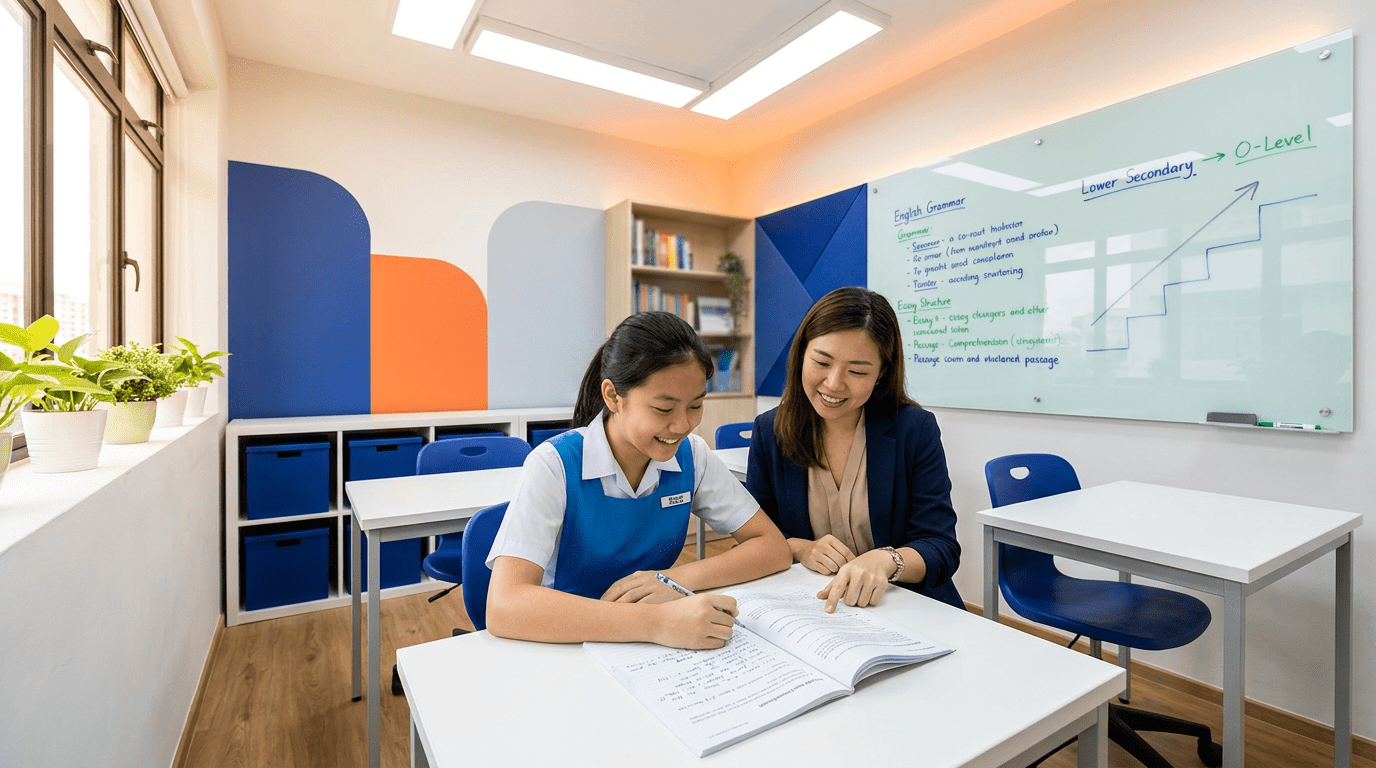
There is a moment many Sec 3 students experience within the first few weeks of upper secondary school: their English marks come back lower than expected, and they are not entirely sure why. They studied. They attempted every question. Yet the results do not reflect the effort they put in. This is not a coincidence, and it is not a reflection of ability. It is the Sec 3 English gap — the space between the habits students bring from lower secondary and the analytical, independent thinking that O-Level standards genuinely demand.
Secondary 3 is the year that bridges the familiar territory of Sec 1 and Sec 2 with the higher-stakes world of national examinations. Students sitting for their GCE O-Level exams (or the incoming SEC from 2027) are assessed not just on grammar and vocabulary, but on how well they can read critically, argue persuasively, and communicate with precision. The good news is that Sec 3 offers just enough runway to close that gap — if students understand what has changed and take deliberate steps to adapt. This article walks you through exactly what shifts in Sec 3 English, what the O-Level exam requires, and what students and parents can do to make this year count.
Why Sec 3 English Feels Different From Day One
Secondary 3 is not simply a harder version of Secondary 2. The expectations change in a fundamental way. In lower secondary, English lessons focus on building foundational competencies — accurate grammar, sentence construction, straightforward comprehension, and narrative writing. These are skills students can develop through practice and repetition. By Sec 3, however, the syllabus pivots. Students are now expected to handle more sophisticated texts, craft argumentative and discursive essays with nuanced perspectives, and demonstrate critical thinking across every component of the exam. The goalposts have shifted, and students who rely on the same strategies they used in Sec 1 and Sec 2 often find themselves struggling without understanding why.
A common pattern seen in tuition centres across Singapore is the student who consistently scored well in lower secondary, only to receive a B4 or C5 in their first Sec 3 examination. This is not necessarily a reflection of effort. It is a mismatch between the skills a student has practised and the new demands of the upper secondary syllabus. The marking becomes stricter, comprehension questions require inference and evaluation rather than direct retrieval, and writing tasks reward depth of thought over grammatical tidiness alone. Recognising this shift early is the single most valuable thing a Sec 3 student can do.
It is also worth noting the broader examination context. Singapore is transitioning from the GCE O-Level to the Singapore-Cambridge Secondary Education Certificate (SEC) from 2027. Students currently in Sec 3 will be among the first cohorts to sit for the SEC, though the academic standards at the G3 level remain closely aligned with the existing O-Level English syllabus. The core skills required — analytical reading, purposeful writing, oral fluency, and listening comprehension — continue to apply in full. If anything, this is additional motivation to build strong English habits now rather than waiting for Sec 4.
What the O-Level English Exam Actually Looks Like
One of the most effective ways to prepare for the transition to upper secondary English is to understand, concretely, what students are working toward. The O-Level English Language exam (Syllabus 1184) is divided into four papers, each targeting a specific set of skills. Papers 1 and 2 together account for 70% of the total grade, making written expression and reading comprehension the two most heavily weighted areas of assessment.
Paper 1 – Writing (35%): This paper tests both editing and composition skills. Section A requires students to identify and correct grammatical errors in a prose passage. Section B is Situational Writing, where students compose a practical text such as an email, report, or blog entry based on a given scenario and visual stimulus. Section C is Continuous Writing, in which students select one topic from four options and write a composition of 350 to 500 words. This section rewards students who can organise ideas, maintain a consistent voice, and engage their audience purposefully.
Paper 2 – Comprehension (35%): The comprehension paper tests students across three text types. Section A features visual texts that require students to analyse language for effect and compare across sources. Section B presents a narrative or descriptive passage, testing vocabulary in context and literary language. Section C contains a non-narrative text, with questions that assess inferential thinking, evaluation of arguments, and a summary-writing task of approximately 80 words. The summary component alone requires students to identify content points, paraphrase them accurately, and synthesise information cohesively — skills that cannot be developed through rushed revision.
Paper 3 – Listening Comprehension (10%): Students listen to a range of audio texts and answer questions testing their ability to understand stated and implied meaning, follow instructions, and take notes from an informational recording heard only once.
Paper 4 – Oral Communication (20%): Under the updated syllabus, Reading Aloud has been replaced by a Planned Response component. Students watch a video clip, prepare a structured response, and then engage in a follow-up discussion with the examiner. This component rewards students who can articulate their opinions confidently, respond to prompts with supporting reasons, and adapt their language to the conversational context.
Understanding this structure matters because it shows students and parents exactly where effort should be directed. Excelling in grammar alone will not produce the results that a balanced, component-by-component approach can deliver.
Lower Secondary vs Upper Secondary: What Really Changes
The most useful way to understand the Sec 3 shift is to look at what lower secondary English rewards versus what O-Level standards actually expect. In lower secondary, a student could perform reasonably well by finding the right sentence in a passage, writing a personal recount with good grammar, and memorising vocabulary lists. These strategies build a useful foundation. But they are no longer sufficient once the difficulty level and analytical depth of upper secondary kicks in.
At O-Level standard, English rewards a different kind of thinking. Rather than identifying what a writer says, students must explain why the writer says it that way and what effect that choice has on the reader. Rather than retelling a story in their own essay, students must construct an argument with a clear position, supporting evidence, and awareness of counterpoints. Rather than selecting a vocabulary word that fits, students must choose language that suits the purpose, audience, and tone of the task. These are not simply harder versions of the same skills. They are qualitatively different expectations.
Here is a practical comparison of what lower secondary habits look like versus what upper secondary expectations require:
- Reading for keywords (lower secondary) vs. understanding the writer’s overall argument (upper secondary) — Students who hunt for matching words in comprehension passages will struggle with inference questions that require connecting ideas across the entire text.
- Copying sentences from the passage vs. paraphrasing and explaining in your own words — Lifted sentences rarely demonstrate genuine understanding; O-Level markers reward students who process and restate information independently.
- Memorising model essays vs. adapting writing to the specific task — A memorised essay that does not fit the question’s purpose, audience, or tone will score poorly regardless of how polished it sounds.
- Focusing mainly on grammar accuracy vs. combining accuracy with critical thinking — Grammar is a baseline expectation, not a differentiator at O-Level standard.
- Writing without planning vs. analysing the task before beginning — Effective upper secondary writing begins before the first sentence is written, with deliberate thought about purpose, audience, and structure.
Students who start making these adjustments in Sec 3 arrive in Sec 4 with a significant advantage. They are not learning how to think about English differently while simultaneously preparing for their national examinations. They are refining skills they have already begun to develop.
Common Habits That Hold Sec 3 Students Back
Most Sec 3 students do not struggle because they are not trying hard enough. They struggle because the strategies that served them well in lower secondary are no longer fit for purpose. These habits can be invisible to students themselves — they feel like they are working, but the marks do not reflect it. Identifying these habits is the first step toward replacing them.
Treating Comprehension as a Search Exercise
The most common comprehension habit carried over from lower secondary is scanning the passage for words that appear in the question and assuming that a nearby sentence contains the answer. This approach works for literal questions at the Sec 1 and Sec 2 level, but it fails consistently at O-Level standard. Upper secondary comprehension questions are designed to test inference, evaluation, and language analysis — types of thinking that require a full understanding of the passage, not just a matching sentence. Students who read for the whole picture, asking what the writer is arguing and how ideas develop across the text, are far better positioned for these questions.
Relying on Memorised Essay Templates
Collecting model essays and memorising impressive phrases is a strategy many students adopt sincerely. Reading strong writing is genuinely useful. But memorising it creates a different problem: students begin forcing prepared content into questions where it does not belong. An essay that sounds polished but fails to address the specific purpose, audience, or argument of the question will not score well, no matter how sophisticated the vocabulary is. The more productive question is not “which memorised essay fits this topic?” but “what is this question actually asking me to do, and how should I structure my response to do that well?”
Mistaking Language Accuracy for Language Quality
Grammatical correctness is important, but it is the baseline expectation at O-Level, not the ceiling. Some students spend the majority of their preparation time on grammar drills and vocabulary lists while neglecting the analytical and evaluative dimensions of the exam. A response that demonstrates clear reasoning, builds a convincing argument, and supports every point with specific evidence from the text will consistently outperform a response that is grammatically immaculate but intellectually thin. The two are not mutually exclusive, but students who focus only on accuracy are leaving significant marks on the table.
Skipping the Planning Stage
Starting to write immediately might feel like good time management, but it regularly produces unfocused essays that drift from the question. Strong upper secondary writing begins with deliberate analysis of the task — identifying the purpose, the intended audience, the required tone, and the specific demands of the question. Students who invest even five to eight minutes in planning before writing typically produce more organised, more relevant, and more convincing responses. The habit of planning is not a luxury for students who have extra time. It is a core skill that separates strong writers from average ones at O-Level standard.
Key Skills Every Student Should Build Before Sec 4
Sec 3 offers something that Sec 4 simply cannot: time to build skills properly rather than under examination pressure. The following are the habits and competencies that students benefit most from developing throughout this year, across all four components of the English exam.
Critical reading: Students should develop the habit of asking questions while reading, not just absorbing information. What argument is the writer making? How is evidence being used to support it? What assumptions does the writer seem to hold? This kind of active engagement with texts directly strengthens both comprehension accuracy and analytical writing.
Paraphrasing and evidence-based explanation: The ability to express ideas from a text in your own words, and to support any claim with relevant evidence, is central to both Paper 2 comprehension and Paper 1 writing. Students who practise this regularly develop stronger analytical instincts and clearer written expression across all components.
Purposeful writing practice: Rather than practising essays generically, students in Sec 3 benefit most from writing to a specific purpose and audience in each session. One essay might be a formal letter of persuasion; the next a reflective personal recount. Varying the task and consciously adapting language, tone, and structure builds genuine versatility that model essay memorisation cannot replicate.
Oral confidence and structured spoken response: With Reading Aloud removed from the updated O-Level oral component, students now need to deliver a planned response to a video stimulus and engage in a sustained discussion. This requires the ability to organise thoughts quickly, articulate a position clearly, and respond to follow-up questions with supporting reasoning. These are skills that improve significantly with regular guided practice.
Summary writing technique: The 80-word summary in Paper 2 is one of the most learnable components of the entire exam, but it demands a systematic approach. Students who practise identifying the key content points in a passage, paraphrasing each concisely, and combining them into a coherent paragraph within the word limit tend to score consistently on this section. Those who attempt it without a clear method routinely lose marks that are genuinely available to them.
These skills take months to develop. A student who begins building them seriously in Sec 3 enters Sec 4 with a set of tools that are already tested and functional. A student who waits until Sec 4 is developing the same tools while simultaneously managing examination deadlines, subject combinations, and school-based assessments. The difference in readiness is significant.
How EduFirst Supports the Sec 3 English Transition
At EduFirst Learning Centre, we understand that the move from lower secondary to upper secondary English is not just about working harder — it is about working differently. Our Secondary 3 English programme is designed to help students make exactly this shift, replacing lower secondary shortcuts with the analytical habits and writing strategies that O-Level standards genuinely reward.
Our classes are kept deliberately small, with just 4 to 8 students per group. This is not an administrative detail. It is what allows our tutors to identify each student’s specific gap — whether that is inference skills in comprehension, essay planning and development, oral fluency, or summary technique — and provide the kind of targeted, individualised feedback that is simply not possible in a larger group setting. We have been supporting primary and secondary students across Singapore since 2010, with programmes available at 25 locations islandwide and through our e-lessons platform for students who prefer to learn from home.
For students who are still completing lower secondary and want to arrive at Sec 3 with stronger foundations, our primary tuition programmes build the reading and writing competencies that make the upper secondary transition smoother. And for parents exploring options early, our pre-school programmes lay the groundwork for strong English literacy from the very beginning.
We believe that Sec 3 is not a year to simply get through. It is one of the most important years in a student’s academic journey — the year where the right habits, built consistently and with proper guidance, can make all the difference when it matters most in Sec 4.
Frequently Asked Questions
Why do students often see their English grades drop in Sec 3?
The Sec 3 English syllabus marks a genuine shift in what is being assessed. Lower secondary English rewards accuracy and basic comprehension, while upper secondary rewards critical analysis, argumentation, and the ability to evaluate a writer’s choices and purpose. Students who carry lower secondary habits — such as scanning for keywords or relying on memorised content — into Sec 3 often find their grades drop, not because their effort has decreased, but because the marking criteria have changed fundamentally.
Is it too late to start improving English in Sec 3?
Not at all. Sec 3 is in many ways the ideal time to address weaknesses and build stronger habits, because students still have a full year before national examination preparation intensifies in Sec 4. Starting earlier is always better, but consistent improvement throughout Sec 3 can make a substantial difference to O-Level readiness.
How does the SEC transition affect Sec 3 students?
Students currently in Sec 3 will sit for the Singapore-Cambridge Secondary Education Certificate (SEC) rather than the GCE O-Level. However, the academic standards at the G3 level — the most rigorous tier — remain aligned with the O-Level English syllabus. The core skills required for strong performance are unchanged: analytical reading, purposeful writing, summary technique, oral fluency, and listening comprehension.
What are the most important English skills to develop in Sec 3?
The skills that deliver the greatest return across all four exam components are: reading critically and inferentially, paraphrasing and supporting answers with evidence, planning essays before writing, practising purposeful situational and continuous writing, and developing structured oral responses. These competencies take time to build properly, making Sec 3 the optimal window to establish them before the demands of Sec 4 set in.
Should students practise with past O-Level English papers in Sec 3?
Exposure to past examination papers is useful for understanding the format and question types, but it is most effective when accompanied by guided feedback. Practising papers without knowing how to approach different question types, or without receiving targeted corrections on essays and comprehension answers, can reinforce weak habits rather than correct them. Structured practice with feedback is significantly more productive than volume alone.
Secondary 3 English is the year when the foundation for national examination success is either built or left incomplete. The shift from lower secondary to O-Level standards is real, and it catches many students by surprise — not because the content has become dramatically harder, but because the type of thinking required has changed entirely. Students who recognise this early, replace ineffective habits with analytical ones, and practise the skills that the exam genuinely rewards are the ones who walk into Sec 4 with genuine confidence rather than catching up under pressure.
Whether your child is just beginning Sec 3 or is midway through the year, the time to act is now. The skills that unlock strong O-Level English performance — critical reading, purposeful writing, evidence-based thinking, and confident oral communication — are built over months, not weeks. Sec 3 provides the time. The right guidance makes the difference.
Ready to Give Your Child a Head Start Before Sec 4?
EduFirst Learning Centre’s Sec 3 English programme provides the personalised, structured guidance students need to make the leap to O-Level standards with confidence. With small classes of just 4 to 8 students across 25 locations islandwide, our tutors can identify exactly where your child needs support and help them build the right habits before it matters most.