- Oct 9, 2026
Early Childhood Education in Singapore: The Structure Explained
For many Singapore parents, the early childhood years feel like a maze of unfamiliar labels — infant care, playgroup, N1, N2, K1, K2, NEL framework, ECDA, MOE Kindergarten. Before you know it, your child’s first day of Primary 1 seems just around the corner, and you are wondering whether the foundation laid in those early years is truly solid.
The good news is that Singapore has one of the most structured and well-supported early childhood education systems in the world. Once you understand how the pieces fit together — the levels, the governing bodies, the curriculum frameworks, and the types of providers — you are in a far better position to make confident decisions for your child. This guide breaks down the full structure of early childhood education in Singapore, explains what each stage covers, and shows you how to connect those early foundations to long-term learning success.
What Is Early Childhood Education in Singapore?
Early childhood education (ECE) refers to the guided learning and development support provided to children from birth through to around age six — the period before they enter Primary 1. In Singapore, this stage is widely recognised as foundational: the social skills, language abilities, emotional habits, and early numeracy concepts children develop during these years have a lasting influence on how they engage with formal schooling later on.
It is important to understand that early childhood education is not simply childcare. While many settings do provide full-day care for working families, the best programmes are deliberately designed around children’s developmental needs. Activities that look like play — building blocks, storytelling, sand play, singing — are purposefully structured by trained educators to build real skills. Singapore’s national education frameworks are built on this understanding, and parents who recognise it are better equipped to evaluate what a quality programme truly looks like.
In Singapore, the term “preschool” is used broadly to cover all education and care settings for children below age seven. This includes infant care centres, childcare centres, and kindergartens. Understanding the distinct levels within this umbrella will help you identify exactly where your child is in the journey and what comes next.
Who Governs Early Childhood Education: ECDA and MOE
Two government bodies shape the early childhood education landscape in Singapore, and both play distinct but complementary roles. Knowing who does what makes it much easier to navigate information, subsidies, and school options.
ECDA (Early Childhood Development Agency) is Singapore’s primary regulatory and developmental authority for the early childhood sector, overseeing all licensed kindergartens and childcare centres for children below age seven. ECDA handles licensing, quality standards, curriculum guidance, and the subsidy schemes that make preschool more affordable for families. Every preschool operating in Singapore — whether a community-based centre or a private international programme — must be licensed under ECDA.
MOE (Ministry of Education) directly operates MOE Kindergartens (MK), which are government-run kindergartens for children aged five and six, typically co-located with primary schools. MOE also develops the Nurturing Early Learners (NEL) Framework, the national curriculum guidance that shapes how preschools across Singapore design programmes for four- to six-year-olds. Together, ECDA and MOE ensure that both the regulatory standards and the educational quality of Singapore’s early childhood sector remain high.
The Singapore Preschool Structure: Levels and Ages Explained
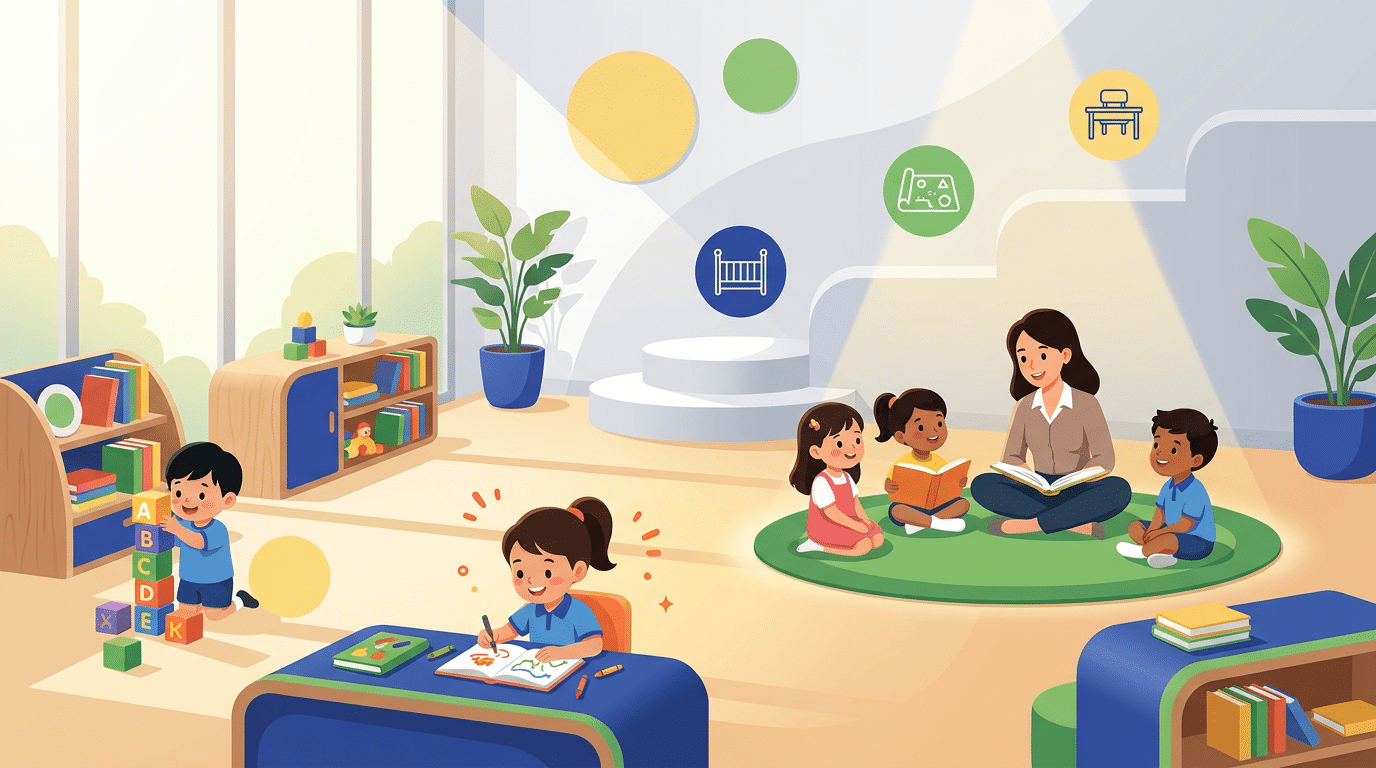
Singapore’s preschool system is divided into clearly defined levels, each matched to a child’s age and stage of development. The structure is consistent across ECDA-licensed providers, which makes it easier to compare programmes and understand where your child fits in. Here is the full breakdown:
- Infant Care — For children from 2 months to 17 months old. Focuses on nurturing, responsive care, sensory stimulation, and secure attachment.
- Playgroup — For children from 18 months to 2 years old. Introduces early socialisation, language exposure, and simple structured activities.
- Pre-Nursery (N1) — For children who turn 3 during the year the class begins. Language development, imaginative play, and early independence skills take centre stage.
- Nursery (N2) — For children who turn 4 during the year. More structured exploration of early literacy and numeracy begins within a play-based framework.
- Kindergarten 1 (K1) — For children who turn 5 during the year. Children engage more directly with pre-reading, pre-writing, and numeracy concepts aligned to the NEL Framework.
- Kindergarten 2 (K2) — For children who turn 6 during the year. This is the final preschool year before Primary 1, with a strong emphasis on school readiness skills.
It is worth noting that preschool attendance in Singapore is not compulsory — Primary 1 at age seven is where compulsory education begins. That said, participation rates are very high: enrolment sits at roughly 88% for children aged three to four, and around 95% for children aged five to six. This reflects how strongly Singaporean families value the early years as preparation for the formal school journey ahead.
The Frameworks That Guide Learning: EYDF and NEL
Singapore’s early childhood sector is guided by two complementary national frameworks. These are not rigid syllabuses that tell teachers exactly what to teach on any given day. Instead, they provide a shared, research-informed foundation that ensures all licensed preschools are working toward the same developmental goals for children, regardless of where a family lives or which centre they choose.
Early Years Development Framework (EYDF) — Birth to 3
The Early Years Development Framework (EYDF) guides educators working with infants and toddlers from birth to three years old. Its emphasis is on child-centred, developmentally appropriate care — particularly the importance of warm, consistent relationships between caregivers and children. The EYDF recognises that secure attachment in the earliest years is the foundation upon which all later learning is built. In strong infant and toddler settings, you will see caregivers responding sensitively to children’s cues, creating safe environments for exploration, and using everyday moments like mealtimes and nappy changes as genuine learning opportunities.
Nurturing Early Learners (NEL) Framework — Ages 4 to 6
For children aged four to six, Singapore’s curriculum guidance is the Nurturing Early Learners (NEL) Framework, developed by MOE and most recently updated in 2022. The NEL Framework covers six learning areas: Aesthetics and Creative Expression, Discovery of the World, Language and Literacy, Motor Skills Development, Numeracy, and Social and Emotional Development. Alongside these learning areas, the framework places strong emphasis on six learning dispositions — perseverance, reflectiveness, appreciation, inventiveness, a sense of wonder and curiosity, and engagement — that shape how children approach challenges throughout their lives.
The NEL Framework is built around six teaching principles captured in the acronym iTeach: Integrated teaching, Teachers as facilitators, Engaging purposeful play, Authentic interactions, Children as constructors of knowledge, and Holistic development. This means that a well-implemented NEL classroom is active, inquiry-oriented, and genuinely child-led — even as educators carefully scaffold each experience toward meaningful learning outcomes. Parents considering pre-school programmes should look for these principles in action during any centre visit.
In 2025, ECDA also implemented SPARK 2.0 — a revised Singapore Preschool Accreditation Framework — giving preschools greater autonomy to develop child-centric programmes while maintaining rigorous quality standards. This update signals a continued commitment by the government to raising the overall quality of early childhood education islandwide.
Types of Preschools in Singapore
One of the most practical decisions parents face is choosing between the different types of preschool providers available. Each has distinct characteristics in terms of fees, curriculum flexibility, and government support. Understanding these differences helps families make an informed choice that matches both their child’s needs and their household budget.
MOE Kindergartens (MK)
MOE Kindergartens are government-operated programmes for Singapore Citizens and Permanent Residents aged five and six. They follow the NEL Framework closely and are typically co-located with primary schools, which offers the added advantage of priority admission and early campus familiarity for children. MOE Kindergartens are widely regarded as high-quality, affordable options for families planning to enter the national primary school system.
Anchor Operator (AOP) and Partner Operator (POP) Preschools
Anchor and Partner Operators are privately-run childcare centres that receive government funding in exchange for keeping fees within regulated caps. As of 2026, full-day childcare at Anchor Operator centres is capped at S$610 per month, while Partner Operator centres are capped at S$650 per month (both excluding GST and before subsidies are applied). Beyond these caps, Singapore Citizen children can access the Basic Subsidy of up to S$300 per month regardless of household income, with additional means-tested subsidies available for qualifying families. Well-known examples of Anchor Operators include PCF Sparkletots and NTUC My First Skool, while Partner Operators include centres like E-Bridge and MindChamps.
Private Preschools
Private preschools operate outside the AOP and POP schemes and set their own fee structures. Monthly fees typically range from around S$1,200 to over S$3,000 for full-day programmes, with premium international preschools sitting at the higher end. While these centres must still be licensed by ECDA, they have greater flexibility in curriculum design — many adopt internationally recognised approaches such as Montessori, Reggio Emilia, or IB-aligned programmes. Private preschools may suit families seeking a specific pedagogical philosophy, smaller class sizes, or bilingual immersion beyond what government-supported centres provide.
What Children Actually Learn in Singapore Preschools
When parents ask what their child is learning at preschool, the answer is often richer than it appears on the surface. A child engaged in sand play is developing fine motor control, spatial reasoning, and creative thinking simultaneously. A group of children negotiating whose turn it is during a board game are building self-regulation, perspective-taking, and communication skills. Quality early childhood education is intentional even when it looks informal, and the six NEL learning areas give us a useful lens for understanding what is being built.
- Language and Literacy: Vocabulary development, phonological awareness, shared reading, storytelling, early writing readiness, and listening skills — all developed through meaningful, conversational contexts rather than isolated drills.
- Numeracy: Counting, number recognition, patterns, shapes, measurement, and basic problem-solving through hands-on exploration with physical objects and real-life situations.
- Discovery of the World: Curiosity-driven exploration of the natural and social world — observing, questioning, experimenting, and making connections across science, culture, and community.
- Aesthetics and Creative Expression: Art, music, movement, and dramatic play that develop imagination, fine and gross motor skills, and the ability to express ideas and emotions.
- Motor Skills Development: Both fine motor skills (drawing, cutting, manipulating small objects) and gross motor skills (running, climbing, balance) that underpin physical health and later writing stamina.
- Social and Emotional Development: Naming and managing emotions, building friendships, resolving conflicts, developing empathy, and gaining the independence needed for school routines.
Across all six areas, the best Singapore preschools consistently embed values and learning dispositions — curiosity, perseverance, and a willingness to try and try again — into everyday experiences. These dispositions matter far more in the long run than any isolated academic skill introduced early.
From Preschool to Primary 1: What Readiness Really Means
The transition from K2 to Primary 1 is the most significant educational milestone of a young child’s life in Singapore. Unlike preschool, where the pace is child-led and highly flexible, Primary 1 introduces a structured curriculum, longer school days, larger class sizes, and an expectation of growing independence. Understanding what genuine school readiness looks like — beyond just knowing how to read — helps parents and children prepare in the most meaningful way.
Research consistently shows that readiness factors like executive function and socio-emotional regulation predict long-term school success more reliably than early academic knowledge alone. In practical terms, this means that a child who can focus on a task for 15 to 20 minutes, follow two- to three-step instructions, manage minor social conflicts, and take care of their own belongings is better prepared for Primary 1 than a child who can recite multiplication tables but struggles to sit in a group or handle frustration.
Academically, a solid foundation entering Primary 1 includes: recognising letters and their sounds, writing one’s name and simple words, counting to 20 confidently, and having been read to extensively at home. Children do not need to read fluently before Primary 1 — but phonemic awareness and a love of books give a meaningful head start. These foundations are exactly what strong K2 programmes are designed to build.
Once children enter primary school, many families find that personalised academic support becomes valuable — particularly as the curriculum deepens and homework expectations increase. EduFirst’s primary tuition programmes, delivered in small classes of just four to eight students, are designed precisely for this transition, ensuring every child receives the individual attention needed to build confidence and keep pace with Singapore’s primary curriculum.
How to Choose the Right Early Childhood Setting
With so many options available — MOE Kindergartens, AOP centres, POP preschools, and private programmes — choosing a preschool can feel overwhelming. Rather than focusing on brand reputation or proximity alone, a more useful approach is to evaluate fit across a few key dimensions. Here are the questions worth asking during any centre visit or admissions call:
- Environment: Are classrooms calm, organised, and accessible to children? Is there space and time for outdoor play every day?
- Teacher interactions: Do educators speak respectfully and at eye level with children? Do they ask open-ended questions rather than testing recall? Do they help children name emotions and work through conflicts?
- Learning design: Is play purposeful and guided toward developmental goals? Are literacy and numeracy introduced through meaningful, hands-on contexts?
- Transition support: How does the centre support children during the settling-in period? What does the home-school communication look like day to day?
- Values alignment: Does the programme reflect a genuine respect for childhood, or does it push formal academics too early in ways that could undermine curiosity and confidence?
A good early childhood setting will welcome these questions warmly — because a centre confident in its quality has nothing to hide. If you walk away from a tour feeling informed and reassured rather than sold to, that is a meaningful signal in itself.
For families thinking beyond preschool toward the full K–12 journey in Singapore, it also helps to explore how supplementary learning programmes — such as e-lessons and structured tuition support — can complement formal schooling at each stage. Building good learning habits early makes the primary and secondary years considerably smoother.
Supporting Your Child’s Early Learning at Home
Preschool is only part of the early childhood picture. The home environment plays an equally significant role in building the capabilities that make later school learning successful. The good news is that the most effective things parents can do at home do not require worksheets or structured lessons — they require time, conversation, and consistency.
Talk frequently and richly. The single greatest predictor of early language development is the volume and variety of conversation children are exposed to at home. Narrate your day, ask open-ended questions, and engage your child in real dialogue about their experiences. “What did you notice today?” is a far richer prompt than “What did you do at school?”
Read together every day. Daily shared reading builds vocabulary, comprehension, print awareness, and a genuine love of learning that pays dividends throughout schooling. Let your child choose books, pause to wonder aloud, and revisit favourite stories — repetition is not boredom for young children; it is how they consolidate meaning.
Build independence through routines. Consistent daily routines — getting dressed, packing a bag, tidying up toys, eating independently — build the self-management skills that Primary 1 teachers value enormously. Resist the urge to do things for your child that they can manage themselves with a little time and encouragement.
Prioritise play and rest. Unstructured play, adequate sleep, and physical activity are not luxuries in early childhood — they are developmental necessities. Children who are well-rested and given space to play freely develop stronger attention regulation, creativity, and social skills than children whose schedules are over-programmed.
As your child progresses through primary school, the academic demands will grow, and having strong learning foundations from the early years makes this transition far less stressful. At that stage, families often find it valuable to supplement classroom learning with targeted support. EduFirst’s primary tuition and secondary tuition programmes are designed to meet students exactly where they are, with small class sizes ensuring every child gets the guidance they need at each level of the Singapore curriculum.
Frequently Asked Questions
What age does early childhood education cover in Singapore?
In Singapore, early childhood education covers children from birth to around age six — spanning infant care (from two months), playgroup, Pre-Nursery (N1), Nursery (N2), Kindergarten 1 (K1), and Kindergarten 2 (K2) before children enter Primary 1 at age seven.
Is preschool compulsory in Singapore?
No, preschool attendance is not compulsory in Singapore. Compulsory education begins at Primary 1. That said, enrolment rates are very high — around 95% for children aged five to six — reflecting the strong value Singaporean families place on early education as preparation for formal schooling.
What is the difference between ECDA and MOE in early childhood?
ECDA is the regulatory and developmental authority for all preschools and childcare centres in Singapore, covering children below age seven. MOE directly operates MOE Kindergartens for five- and six-year-olds and develops the NEL Framework — the national curriculum guidance for preschool-aged children. Both bodies work together to maintain quality across the sector.
What is the NEL Framework?
The Nurturing Early Learners (NEL) Framework is Singapore’s national curriculum guidance for children aged four to six, developed by MOE. It outlines six learning areas, six learning dispositions, and six iTeach teaching principles to guide how quality preschools design and implement their programmes. The framework was most recently updated in 2022.
What is the difference between Anchor Operator and Partner Operator preschools?
Both are privately-run preschool operators that receive government funding in exchange for keeping fees within regulated caps. As of 2026, Anchor Operators cap full-day childcare at S$610 per month and Partner Operators at S$650 per month (before GST and subsidies). The main practical differences are in the fee cap levels and minimum centre sizes required to qualify for each scheme.
How can I support my child’s readiness for Primary 1?
Focus on building independence, language richness, and social-emotional resilience rather than accelerating academics. Reading together daily, maintaining consistent routines, and encouraging your child to problem-solve independently are the most effective home strategies. As your child enters Primary 1, structured tuition support — such as EduFirst’s primary tuition programmes — can help them build confidence and academic foundations in a supportive, small-group setting.
Building Strong Foundations for a Lifetime of Learning
Singapore’s early childhood education system is thoughtfully structured to give every child a strong, holistic start. From the responsive care of infant settings guided by the EYDF, through to the purposeful play-based learning of K1 and K2 shaped by the NEL Framework, each stage is designed to build on the last — preparing children not just for Primary 1, but for a lifetime of confident, curious learning.
Understanding this structure empowers you to ask better questions, make more informed choices, and provide the right support at home and beyond. The early years lay the groundwork, but the learning journey is long. Whether your child is approaching kindergarten, preparing for Primary 1, or navigating the primary or secondary years, having the right educational support in place at every stage makes an enormous difference. EduFirst’s small-class tuition programmes across 25 locations are designed to be that trusted partner — from pre-school through to secondary school — ensuring every child reaches their full potential.
Ready to Give Your Child the Best Start?
Whether you are exploring early learning options or looking for personalised academic support as your child transitions into primary school, EduFirst is here to help. Our educators work in small groups of just 4–8 students, giving every child the individual attention they deserve.