- Apr 21, 2026
How to Write a High-Scoring PSLE Chinese Composition
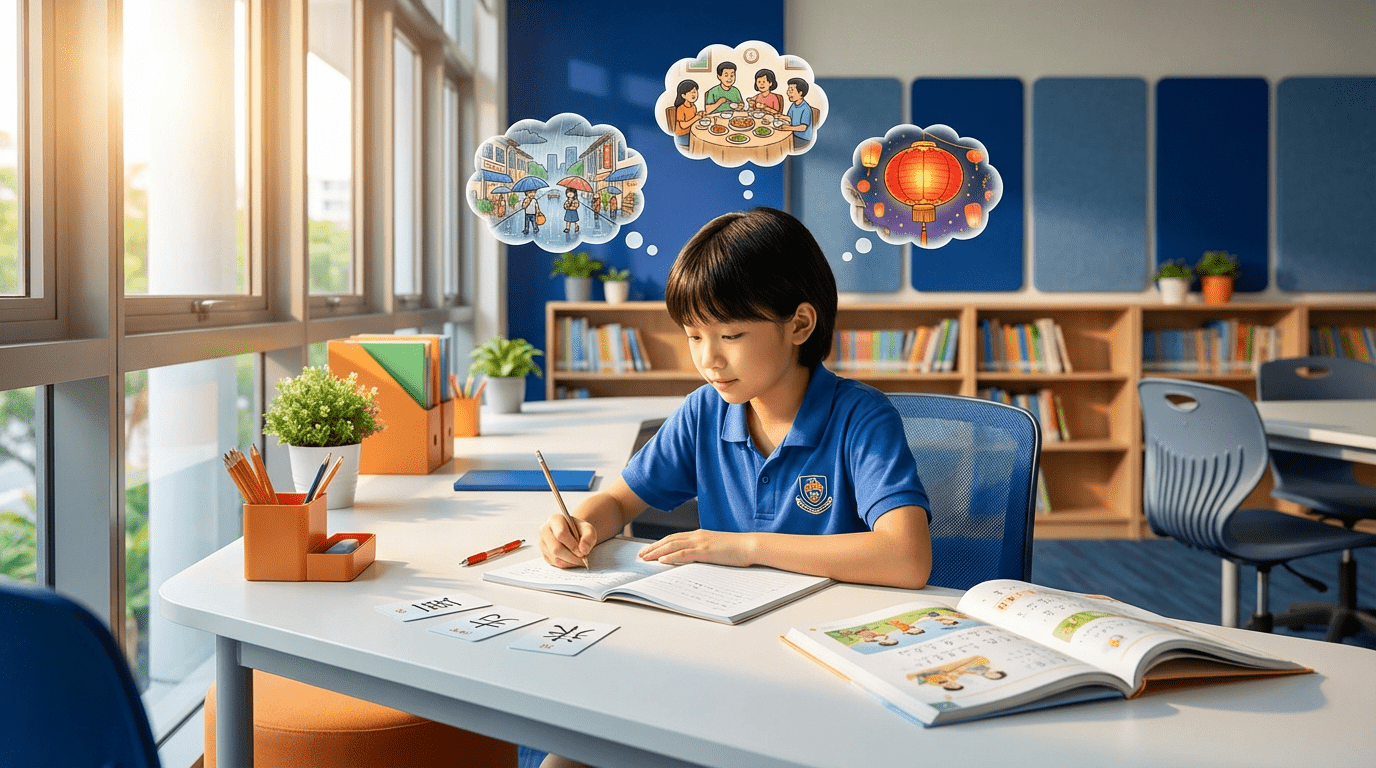
The PSLE Chinese composition is one of the most challenging components of the Mother Tongue paper — and for many students, it’s also the most intimidating. Writing a compelling story in Chinese under timed exam conditions requires more than just knowing the characters; it demands structure, creativity, vocabulary depth, and the ability to convey emotion clearly. The good news is that with the right guidance and practice, writing a high-scoring PSLE Chinese composition is absolutely achievable.
In this guide, we break down everything your child needs to know — from understanding the PSLE Chinese composition format and marking rubric, to practical strategies for crafting stories that impress examiners. Whether your child is just starting to prepare or looking to push from a B to an A, these tips will give them a concrete path forward.
What Is PSLE Chinese Composition?
The PSLE Chinese Language paper (Paper 2) includes a composition component worth 40 marks, making it one of the highest-weighted sections in the entire paper. Students are given a set of four pictures and must choose three consecutive pictures to base their composition on. They are expected to write between 200 and 400 characters in standard Mandarin, crafting a coherent narrative that reflects imagination, language ability, and story structure.
The picture prompts typically depict everyday scenarios — a school event, a community outing, a family activity, or a moment of conflict and resolution. Examiners are not just looking for a retelling of what the pictures show; they want to see students build a story around the images using their own creativity, with a clear beginning, middle, and end. Understanding this expectation is the first step toward doing well.
Understanding the Marking Rubric
Before your child can write a winning composition, they need to understand how it is scored. The PSLE Chinese composition is assessed across three main dimensions:
- Content (内容): This covers the relevance of the story to the picture prompts, the creativity of the narrative, and how well the student develops the plot and characters. It carries the most weight and rewards students who go beyond surface descriptions.
- Language (语言): Examiners assess vocabulary range, sentence variety, and the proper use of grammar. Students who use rich, accurate language — including idioms (成语) and descriptive phrases — score significantly higher here.
- Organisation (组织): This dimension looks at the logical flow of the composition, paragraph structure, and overall coherence. A well-organised story is easy to follow and makes a strong impression.
Understanding these three pillars helps students and parents direct their preparation efforts strategically. Many students lose marks not because their stories are bad, but because they neglect organisation or rely on repetitive, simple vocabulary. Addressing all three areas during practice will have a noticeable impact on results.
Choosing the Right Picture Prompt
One of the most underestimated decisions in the PSLE Chinese composition exam is which set of three pictures to choose. Students have four images to work with, but they only need to use three consecutive ones. This means they have some flexibility in shaping the story’s arc.
Encourage your child to spend the first few minutes of the exam scanning all four pictures carefully before committing. They should ask themselves: Which three pictures give me the best opportunity to write a complete and interesting story? The best choice is usually the one that allows for a clear conflict or challenge, a moment of action or emotion, and a satisfying resolution — not simply the pictures that seem easiest to describe. Choosing wisely at the start can save time later and lead to a much stronger composition overall.
Structuring Your Composition for Maximum Marks
A well-structured composition tells examiners immediately that the student has planned their writing. The most effective structure for a PSLE Chinese composition follows a simple but powerful three-part framework:
1. Opening (开头) — Set the Scene
A strong opening does two things: it establishes the setting and characters, and it hooks the reader’s attention. Avoid starting with a flat, predictable line like “那天是星期六” (It was Saturday). Instead, encourage your child to open with a description of the environment, a piece of dialogue, or a moment of action that draws readers in immediately. For example, describing the hustle of a busy park or the sounds of a school event creates atmosphere and signals to the examiner that the student can write vividly.
2. Development (发展) — Build the Story
The middle section is where the story unfolds, and it should contain the bulk of the composition. This is where students should introduce a challenge, conflict, or turning point — something that creates tension and keeps the reader engaged. Encourage your child to use the pictures as a guide, but not as a script. They should add detail, emotion, and character motivation that the pictures don’t show. What is the main character feeling? What makes this moment memorable? The more specific and human the story, the more it resonates with examiners.
3. Resolution and Reflection (结尾) — End with Meaning
A common weakness in student compositions is a rushed or abrupt ending. The closing paragraph should resolve the story’s central tension and, ideally, include a moment of reflection or lesson learned. This doesn’t need to be heavy-handed — even a simple sentence that shows the character has changed or grown gives the story a satisfying sense of closure. Examiners appreciate endings that feel earned rather than tacked on.
Language and Vocabulary Tips
Language quality is what separates a Band B composition from a Band A one. Students who use a wide range of vocabulary, varied sentence structures, and well-placed idioms consistently score higher. Here are practical ways your child can strengthen their language use:
- Learn and apply 成语 (chéngyǔ): Chinese idioms add sophistication to writing. Encourage your child to memorise a set of 10 to 15 commonly applicable idioms and practise using them naturally in context — not just dropped in awkwardly.
- Use sensory language: Descriptions that appeal to sight, sound, smell, and touch make stories come alive. Instead of “他很害怕” (he was very scared), try something like “他的心跳加速,手心渗出了汗水” (his heart raced, and his palms broke into a cold sweat).
- Vary sentence length: A mix of short, punchy sentences and longer descriptive ones creates rhythm and keeps the reader engaged. Monotonous sentence structures make even interesting stories feel flat.
- Avoid overused phrases: Common student clichés like “突然” (suddenly) used repeatedly or generic expressions like “非常开心” (very happy) weaken the writing. Push for more precise and vivid alternatives.
Building vocabulary takes consistent effort over time. Reading Chinese storybooks, watching age-appropriate Chinese programmes, and keeping a personal vocabulary notebook are all habits that compound significantly over months of preparation. Students enrolled in primary school tuition at EduFirst benefit from structured vocabulary-building exercises as part of their regular lessons.
Common Mistakes to Avoid
Even students who understand the theory of good writing can lose marks due to avoidable errors. Here are the most common pitfalls in PSLE Chinese compositions:
- Describing the pictures literally: Simply narrating what is shown in each image without adding depth or creativity is one of the most frequent content-scoring mistakes.
- Ignoring the character count: Writing fewer than 200 characters is penalised. Students should aim for at least 300 characters to give themselves room to develop the story properly.
- Grammatical errors with particles and measure words: Mistakes with 量词 (measure words) and 助词 (particles) are very common and directly affect the language score.
- Unclear pronoun references: When multiple characters are involved, unclear use of “他” or “她” can confuse the reader. Students should use character names or clear references to avoid ambiguity.
- Weak transitions between paragraphs: Jumping abruptly from one scene to the next without transitional phrases disrupts the flow of the composition and reduces the organisation score.
Building Good Writing Habits Before the Exam
Scoring well in PSLE Chinese composition is not something that happens from last-minute cramming — it is built through consistent, deliberate practice over months. The most effective habits students can develop include writing one composition per week under timed conditions, reviewing teacher feedback carefully, and reading quality Chinese texts regularly to absorb natural language patterns.
Parents can support this process by setting aside a regular writing time at home, discussing stories and their meanings together in Mandarin, and encouraging their child to read Chinese books or comics they genuinely enjoy. When reading and writing feel purposeful rather than purely exam-driven, students tend to make faster and more lasting progress. Small, consistent efforts across Primary 5 and Primary 6 make an enormous difference by the time PSLE arrives.
It also helps to practise with past picture prompts from previous PSLE papers. This familiarises students with the range of scenarios they might encounter and helps them build a mental library of story structures and vocabulary sets they can draw on during the actual exam. For students who need more structured support, primary tuition programmes that focus specifically on Chinese composition can accelerate progress significantly.
How EduFirst Can Help Your Child Excel
At EduFirst Learning Centre, we understand that every child has a different relationship with the Chinese language — and that’s exactly why our approach is never one-size-fits-all. Established in 2010 and operating across 25 locations islandwide, EduFirst offers primary Chinese tuition in small classes of just 4 to 8 students, ensuring that each child receives the individual attention they need to grow as a writer and a communicator.
Our experienced tutors guide students through the full composition process — from picture analysis and story planning, to drafting, vocabulary enrichment, and structured feedback. We don’t just mark compositions; we help students understand why certain choices work and how to consistently apply those skills across different prompts. This targeted, student-centred approach has helped many EduFirst students achieve meaningful improvements in their Chinese Language results ahead of PSLE.
Final Thoughts
Writing a high-scoring PSLE Chinese composition comes down to three things: understanding what examiners are looking for, practising the right skills consistently, and getting quality feedback along the way. With a solid grasp of story structure, a growing vocabulary, and the confidence to express ideas vividly, your child can approach the composition component of the PSLE not with dread, but with readiness.
Start early, practise regularly, and don’t underestimate the power of good guidance. Whether your child needs help building foundational writing skills or refining their technique for the final push, structured support can make all the difference.
Ready to Help Your Child Score Higher in PSLE Chinese?
EduFirst Learning Centre offers personalised Primary Chinese tuition in small classes of 4 to 8 students, with experienced tutors who specialise in composition coaching. With 25 centres across Singapore, expert help is always nearby.