- Oct 8, 2026
Matrices in O-Level Maths: Operations and the Question Types That Use Them
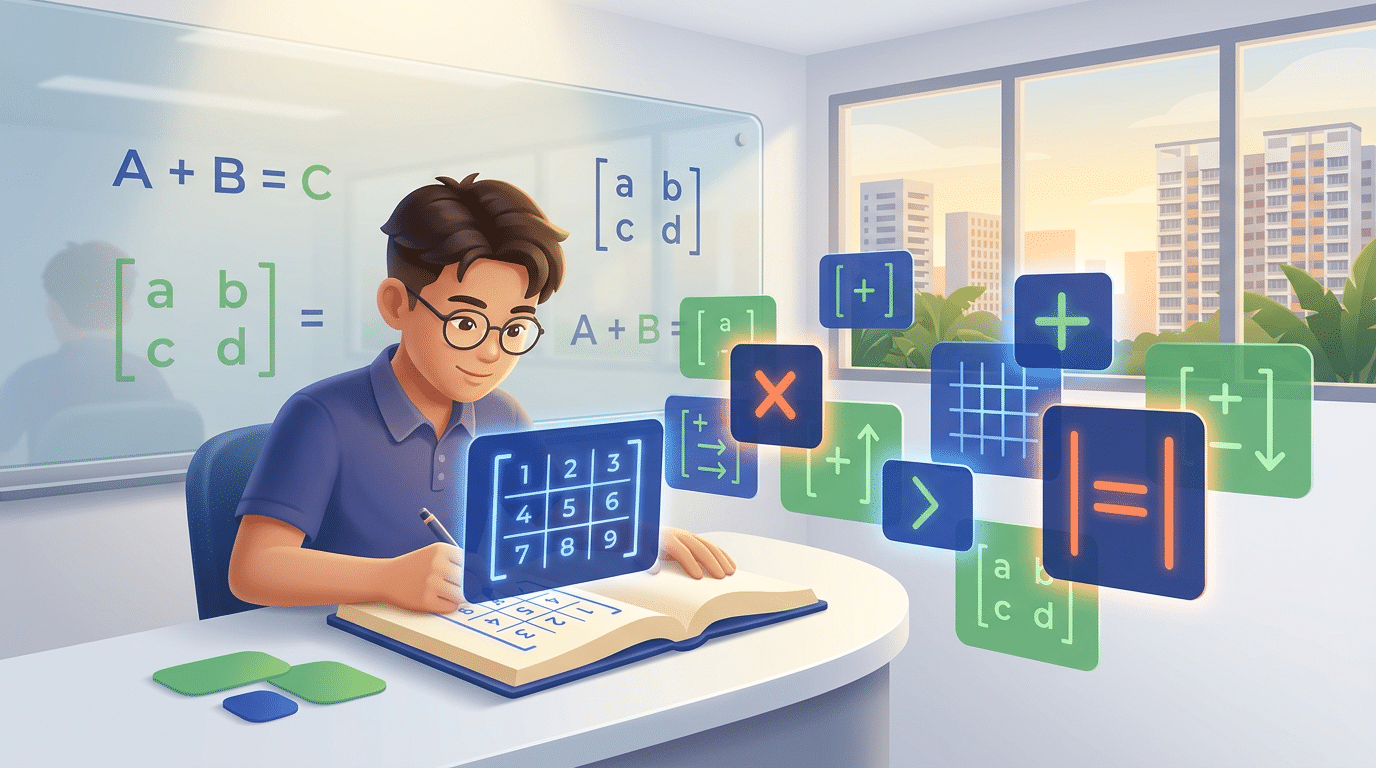
If you are a Secondary 3 or 4 student preparing for the GCE O-Level Elementary Mathematics examination, matrices is one of those topics that can feel deceptively simple at first — until the exam question asks you to combine several operations at once or represent real-world data in matrix form. Matrices sit within the Number and Algebra strand of the O-Level E Maths syllabus, and while the topic may not carry the highest mark weightage, it is entirely learnable and reliably tested. Getting it right can make a meaningful difference to your final score.
This guide breaks down everything you need to know about matrices for O-Level Maths: what they are, how each operation works, and the specific question types that appear in both Paper 1 and Paper 2. Whether you are encountering the topic for the first time or revising ahead of the exam, this article will give you a clear and thorough understanding of what to expect — and how to answer confidently.
Matrices in O-Level Maths
Operations, Question Types & Exam Tips for GCE O-Level Elementary Mathematics
Order Controls Everything
A matrix’s order (m × n) determines which operations are valid and what results look like. Always check dimensions first.
Four Core Operations
Master scalar multiplication, addition, subtraction, and matrix multiplication — each with its own distinct rules.
Multiplication ≠ Commutative
AB ≠ BA in matrix multiplication. Never swap the order of matrices — it’s one of the most costly exam errors.
Real-World Data Questions
Paper 2 tests your ability to encode real-world scenarios (prices, quantities, sales) into matrix form and interpret results.
Methodical = Full Marks
Follow order of operations, show clear working, and always check dimensions before computing for reliable marks.
Scalar Multiplication
Multiply every element by a single number. Order stays the same.
Addition & Subtraction
Same order required. Combine corresponding elements only.
Matrix Multiplication
Columns of A must equal rows of B. Result order is m × p.
Identity Matrix (I)
1s on diagonal, 0s elsewhere. AI = IA = A always.
Direct Computation
Evaluate expressions like 2A + B or AB. Common in Paper 1. Tests scalar multiplication and arithmetic accuracy.
Finding an Unknown Element
Two matrix expressions are equal — solve for x or y by matching corresponding elements and forming equations.
Interpreting Data in Matrix Form
Real-world context (prices, quantities, scores). Multiply or add matrices to extract a meaningful result like total cost.
Setting Up a Matrix Equation
Encode a word problem into matrices, then compute. Tests whether you understand matrix structure, not just arithmetic.
Combined Multi-Step Operations
Higher-mark questions like 3AB − 2C. Requires correct sequencing: multiply first, then scalar, then add/subtract.
Skipping Dimension ChecksAlways verify matrix orders are compatible before starting any operation.
Swapping Multiplication OrderAB ≠ BA — never rearrange matrices in a product without reason.
Partial Scalar ApplicationThe scalar must be applied to every single element, not just the first row or diagonal.
Wrong Order of OperationsAlways complete scalar multiplications before addition or subtraction in mixed expressions.
- Start with 2 × 2 examples to build confidence in each operation before progressing
- Work through past O-Level papers and identify every matrix question type
- Note mark allocation — it tells you how much working to show
- For Paper 2 context questions, always state what your answer means in real terms
- Write each multiplication step clearly to catch arithmetic slips early
- Check dimensions at the start of every question — it takes 5 seconds and saves marks
Need Extra Support for O-Level Maths?
EduFirst Learning Centre · Small classes of 4–8 students · 25 locations across Singapore
What Are Matrices? A Quick Introduction
A matrix is simply a rectangular arrangement of numbers organised into rows and columns, enclosed within square brackets. Think of it as a table of values that you can perform mathematical operations on. In everyday contexts, matrices are used to store and organise data — for example, recording the number of items sold across different products and different stores can be neatly expressed as a matrix. This makes the topic feel very applicable to real life, which is exactly why it appears in the O-Level syllabus.
Each individual number within a matrix is called an element or entry. You refer to any specific element by its position: the row it sits in and the column it occupies. For example, the element in the second row and third column is described as being in position (2, 3). Understanding how to read and interpret matrices is the essential first step before you can work with them algebraically.
Understanding Matrix Notation and Order
Every matrix has an order (also called its dimension), which is expressed as m × n, where m is the number of rows and n is the number of columns. A matrix with 2 rows and 3 columns is a 2 × 3 matrix. This might seem like a small detail, but the order of a matrix controls almost everything — which operations are valid, what the result looks like, and how you set up multiplication. In fact, one of the most common reasons students lose marks in matrices questions is failing to check dimensions before attempting an operation.
The O-Level syllabus, as set out by SEAB for Elementary Mathematics (Syllabus 4052), requires students to be able to display information in the form of a matrix of any order, interpret data from a given matrix, perform scalar multiplication, and solve problems involving the sum and product of two matrices. These four capabilities define the full scope of matrices at this level, so your study plan should address each one systematically.
The Four Core Matrix Operations
Matrix arithmetic differs from ordinary number arithmetic in several important ways. Some familiar rules still apply — others do not. Here is a thorough walkthrough of each operation you need to master for the O-Level exam.
1. Scalar Multiplication
Scalar multiplication is the most straightforward matrix operation. A scalar is simply a single number (as opposed to a matrix). To multiply a matrix by a scalar, you multiply every element inside the matrix by that number. The order of the matrix does not change — a 2 × 2 matrix remains a 2 × 2 matrix after scalar multiplication, just with each entry scaled up or down.
For example, if you multiply the matrix [[3, 1], [0, 4]] by the scalar 2, you get [[6, 2], [0, 8]]. Every single entry is doubled. This operation comes up frequently in exam questions that combine multiple steps — for instance, questions may ask you to evaluate an expression like 3A − 2B, which requires you to perform scalar multiplication on both matrices before subtracting them. Forgetting to apply the scalar to every element, or only applying it to the first row, is a very common error.
2. Matrix Addition and Subtraction
Matrix addition and subtraction follow a simple rule: both matrices must have exactly the same order. You cannot add a 2 × 3 matrix to a 3 × 2 matrix, even though they contain the same number of elements. Once you have confirmed the dimensions match, you simply add or subtract corresponding elements — the element in position (1,1) of one matrix is combined with the element in position (1,1) of the other, and so on throughout the entire matrix.
It is worth knowing that matrix addition is commutative, meaning A + B = B + A, and it is also associative, meaning (A + B) + C = A + (B + C). These properties mirror ordinary number arithmetic and make manipulation easier. Subtraction, on the other hand, is not commutative — the order matters just as it does with numbers. In exam questions that mix scalar multiplication with addition or subtraction, always follow the standard order of operations: handle the scalar multiplications first, then carry out the addition or subtraction.
3. Matrix Multiplication
Matrix multiplication is the most involved operation you will encounter at O-Level, and it works very differently from the other operations. For two matrices to be multiplied, the number of columns in the first matrix must equal the number of rows in the second matrix. So if matrix A has order m × n and matrix B has order n × p, then the product AB exists and will have order m × p. If the inner dimensions do not match, the multiplication is simply not defined.
The method for finding each entry of the product involves multiplying elements row by column: you take a row from the first matrix, pair each element with the corresponding element from a column in the second matrix, multiply the pairs, and then add all the results together. This process is repeated for every combination of rows and columns. At O-Level, you will mostly work with 2 × 2 matrices, but understanding the concept for other dimensions will help you handle any question confidently.
One critical point that catches many students off guard: matrix multiplication is not commutative. This means AB does not generally equal BA — in fact, if AB is defined, BA may not even be defined, depending on the dimensions. However, matrix multiplication is associative: A(BC) = (AB)C. This property is useful when you have a chain of three matrices to multiply, as it lets you choose the most convenient order in which to compute the two-matrix products.
A special matrix worth knowing is the identity matrix, denoted I. It is a square matrix with 1s along the main diagonal and 0s everywhere else. Multiplying any matrix A by the appropriate identity matrix gives A back unchanged: AI = IA = A. Questions sometimes use the identity matrix as part of a proof or a simplification step, and recognising it quickly can save you valuable time in the exam.
Question Types That Use Matrices in O-Level Exams
Once you understand the mechanics of each operation, the next step is recognising the question formats that appear in Paper 1 and Paper 2 of the E Maths exam. Matrices questions in O-Level tend to fall into a few predictable categories, and knowing what to expect makes preparation far more targeted and efficient.
- Direct computation questions: These are the most common type. You are given two or more matrices and asked to evaluate an expression such as 2A + B, A − 3C, or AB. The question tests whether you can correctly apply scalar multiplication, check dimensions, and carry out the operation without arithmetic errors. These often appear as shorter questions in Paper 1.
- Finding an unknown element: Here, you are told that two matrix expressions are equal and you need to solve for an unknown value. For example, a question might tell you that matrix A + B equals a given matrix and ask you to find the value of x or y. This requires you to set up equations from corresponding elements and solve them — combining your algebra skills with your matrix knowledge.
- Interpreting data in matrix form: The O-Level syllabus specifically requires you to interpret information stored in matrices. Questions in this category present data in a real-world context — such as prices of items, quantities sold, or scores in a competition — encoded in two matrices. You are then asked to multiply or add them to extract a meaningful result, such as total cost or combined totals. This type appears frequently in Paper 2 and requires both computational accuracy and the ability to read what the rows and columns represent.
- Setting up a matrix equation: Some questions describe a real-world scenario in words and ask you to represent the information as matrices before performing a calculation. For instance, you might need to set up a matrix to represent sales data across several products and locations, then multiply it by a price matrix to find total revenue. This tests whether you truly understand what the structure of a matrix means, not just how to manipulate numbers.
- Combined operations with order-of-operations challenges: More challenging questions — often worth higher marks — present compound expressions involving multiple operations. For example, you may need to evaluate 3AB − 2C, which requires careful sequencing: matrix multiplication first, then scalar multiplication, then subtraction. These questions reward students who are methodical and who check their steps carefully.
Across both papers, matrices questions can appear as short standalone problems or as part of a multi-part structured question. Because Paper 2 sometimes draws on multiple topics simultaneously in its final real-world scenario question, matrices can appear alongside other algebraic concepts. Practising a range of past-year question types will give you a strong sense of how the examiners frame these problems.
Common Mistakes and How to Avoid Them
Even students who understand the theory well can drop marks due to avoidable errors. Being aware of the most frequent pitfalls — and actively checking for them — is a smart exam strategy.
- Not verifying dimensions before operating: Always check that the orders of the matrices are compatible before you begin. For addition and subtraction, both matrices must have the same order. For multiplication, the number of columns in the first matrix must equal the number of rows in the second. A quick check at the start saves you from wasted working.
- Treating matrix multiplication as commutative: Assuming AB = BA is one of the most common conceptual errors. Always write products in the exact order given in the question and never swap the matrices around.
- Applying scalar multiplication incorrectly: The scalar must be multiplied by every element in the matrix, not just selected rows or the diagonal. Rushing this step often causes partial application errors.
- Ignoring the order of operations: When an expression involves both scalar multiplication and matrix addition or subtraction, complete the scalar multiplications first. Jumping straight into addition without doing this will produce a wrong answer.
- Arithmetic slips in matrix multiplication: Because matrix multiplication involves multiple small products and their sums, it is easy to make a computational mistake mid-calculation. Write each step out clearly, especially when multiplying larger matrices, and double-check by working through the products again.
Study Tips for Mastering Matrices
Matrices is a topic where consistent, structured practice pays off quickly. Because the operations follow fixed rules, working through a variety of questions — from straightforward computations to multi-step word problems — builds both accuracy and speed. Start with simple 2 × 2 examples to build confidence in each operation, then progress to problems that require you to combine operations or interpret data in context.
One particularly effective strategy is to work through past O-Level exam papers and identify every question that involves matrices. Notice the phrasing used, the type of data presented, and the number of marks allocated. This gives you a reliable picture of what examiners expect and helps you pace yourself during the real exam. Pay special attention to real-world context questions in Paper 2, as these require you to understand not just the operation, but what the answer actually means in context.
For students at EduFirst’s Secondary Maths tuition classes, matrices is covered as part of a structured Secondary 3 and 4 programme that ensures every student understands the topic conceptually before tackling exam-style questions. With small class sizes of just 4 to 8 students, tutors can identify exactly where a student is making errors — whether it is a dimensional confusion, a multiplication sequencing mistake, or an arithmetic slip — and address it directly before it becomes a habit.
Building Confidence With Matrices
Matrices is one of those O-Level Maths topics that rewards careful, methodical thinking. The rules are clear and consistent: respect the dimensions, follow the correct procedure for each operation, and never assume matrix multiplication behaves like ordinary multiplication. Once those principles are firmly in place, the full range of question types — from direct computation to real-world data interpretation — becomes very manageable.
The key is not just knowing each operation in isolation but understanding how they connect and how exam questions apply them together. Work through the concepts in the order laid out here, practise with past-year papers, and make a habit of checking your dimensions and your order of operations every time. With the right foundation and consistent effort, matrices can become one of the more reliable mark-earners in your O-Level E Maths paper.
Get Expert Support for O-Level Maths
At EduFirst Learning Centre, our experienced tutors provide personalised guidance for Secondary students across all E Maths topics — including matrices. With small classes of just 4 to 8 students, every child gets the attention they need to understand concepts thoroughly and tackle exam questions with confidence.
We offer Secondary Tuition at 25 locations across Singapore, as well as flexible E-Lessons for students who prefer to learn from home.
Send us an enquiry today to find out how EduFirst can help your child build a strong foundation for the O-Level Maths exam.