- Oct 12, 2026
Phonics in Singapore: How Early Reading Is Taught and Supported at Home
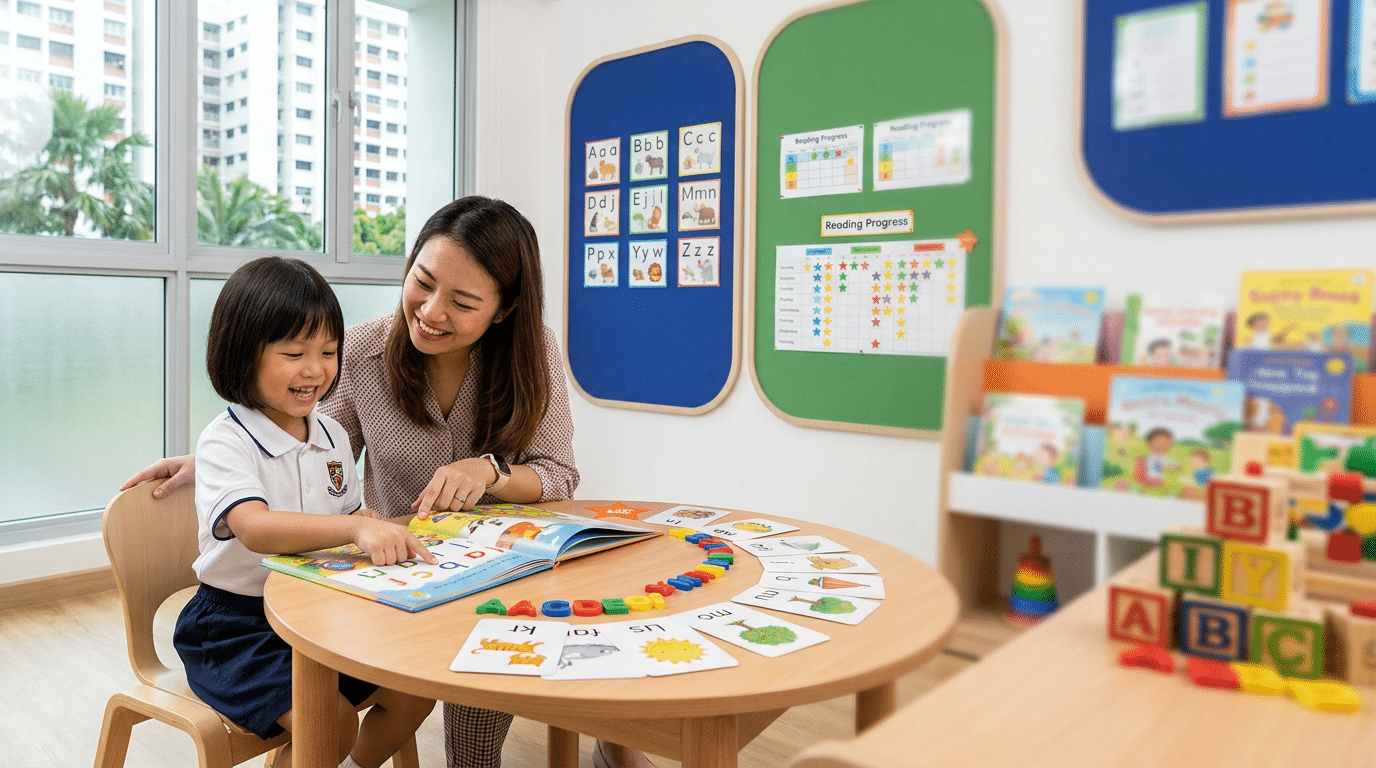
If you have ever watched your child stare blankly at a simple word on a page, you know just how much rides on those earliest reading experiences. For many Singapore parents, the question is not simply when to start phonics — it is how to get it right, and how to make sure what happens in the classroom is being reinforced at home. Phonics is the bridge between spoken language and the written word, and in Singapore’s educational landscape, it plays a central role from the preschool years all the way through Primary 1 and beyond.
This guide walks you through how phonics is taught in Singapore — the national frameworks that shape it, the stages your child will progress through, the different teaching methods used, and the practical ways you can support early reading at home. Whether your child is in kindergarten or has just started primary school, understanding how phonics works gives you the confidence to be an active partner in their literacy journey.
What Is Phonics and Why Does It Matter in Singapore?
Phonics is a method of teaching reading and writing by helping children understand the relationship between letters and the sounds they represent. Rather than asking a child to memorise each word as a whole, phonics equips them with a decoding tool — the ability to look at an unfamiliar word and work out how to say it by sounding out its individual parts. This foundational skill has a profound ripple effect: a child who understands sound-letter relationships can tackle new vocabulary independently, spell more accurately, and read with greater fluency and confidence.
In Singapore, where English is both the medium of instruction and a key language for academic achievement, strong early literacy skills are especially important. Research consistently shows that systematic phonics instruction leads to stronger reading, spelling, and comprehension outcomes, particularly for children between the ages of three and six. The earlier a child builds a solid phonics foundation, the better prepared they will be for the structured academic demands of Singapore’s primary school system.
The Role of Singapore’s NEL Framework in Early Literacy
Singapore’s approach to early childhood education is guided by a nationally developed curriculum framework. The Nurturing Early Learners (NEL) Framework was introduced by the Ministry of Education (MOE) and provides guidelines for quality teaching and learning for children aged four to six — broadly covering the kindergarten years from Nursery 2 through to Kindergarten 2. It is a flexible framework rather than a fixed syllabus, which means preschool centres have room to design their own programmes while still adhering to its overarching learning goals. Language and Literacy is one of the five key learning areas outlined within it.
Phonics sits clearly within this Language and Literacy domain. The NEL Framework guides preschool centres in designing and implementing a quality curriculum, and language development — including early phonics and reading skills — is a central component. This means that while each preschool may approach phonics slightly differently in terms of method or materials, the goal of nurturing early literacy before Primary 1 is shared across the board. Parents can take comfort knowing that most reputable preschools and kindergartens in Singapore are working towards consistent literacy milestones.
The Stages of Phonics Learning: From Preschool to Primary 1
Phonics learning does not happen all at once. It unfolds gradually across several developmental stages, each building on the last. Understanding these stages helps parents know what to expect at each point in their child’s early literacy journey, and where to focus their support.
Stage 1: Phonemic Awareness (Ages 3 to 4)
Before children can connect letters to sounds on a page, they first need to hear and manipulate sounds in spoken language. This early stage, known as phonemic awareness, involves activities like clapping syllables, identifying rhyming words, and isolating the beginning or ending sounds in a spoken word. At this point, the focus is entirely on the ear — no letters or print are required yet. Children who build strong phonemic awareness at this stage find the leap to phonics much more natural when it begins.
Stage 2: Letter Sounds and Basic Blending (Ages 4 to 5)
This is where formal phonics instruction typically begins in Singapore preschools, usually in the Nursery 2 or Kindergarten 1 year. Children learn that letters represent specific sounds — not just names — and start blending those sounds together to form simple three-letter words. A common starting point is a carefully chosen set of letters like S, A, T, P, I, and N, which can be combined into a wide variety of short, readable words like sit, pan, tip, and nap. This early success with real words builds confidence and motivates continued learning.
Stage 3: Word Families, Blends, and Digraphs (Ages 5 to 6)
As children progress through Kindergarten 1 and into Kindergarten 2, they encounter more complex phonics patterns. Word families — groups of words that share a common letter pattern, such as the -at family (cat, hat, mat, bat) — help children recognise that English follows predictable patterns, making new words easier to decode. Consonant blends like bl, st, and tr are introduced, followed by digraphs — two letters that produce a single new sound, such as ch, sh, th, and wh. Digraphs are particularly important because so many everyday English words depend on them, and mastering them significantly expands a child’s reading range.
Stage 4: Phonics into Primary 1
By the time a child enters Primary 1, Singapore’s MOE expects them to be familiar with letter sounds, basic blending, and simple word recognition. Primary 1 English in Singapore follows the MOE STELLAR (Strategies for English Language Learning and Reading) programme, which integrates reading, writing, listening, and speaking through shared reading experiences and structured language activities. Phonics forms the decoding backbone of this programme. Children who arrive at P1 with solid phonemic awareness and basic blending skills are better positioned to participate confidently from day one, even though P1 does teach all of these skills from scratch for those who need it.
Types of Phonics Instruction Used in Singapore
Not all phonics programmes are identical. Different schools, centres, and programmes in Singapore use varying approaches, and understanding these can help you evaluate what your child is being taught and why. Here are the most common methods you will encounter:
- Synthetic Phonics: The most widely used approach in Singapore, synthetic phonics teaches children to convert individual letters or letter groups into sounds and then blend those sounds together to form words. It is systematic, sequential, and highly effective for most learners. Many well-known Singapore phonics programmes, including those using the Jolly Phonics methodology, use this approach.
- Analytic Phonics: Rather than teaching sounds in isolation, analytic phonics asks children to identify patterns within words they already know. For example, from learning the word cat, a child is guided to understand the /c/ sound by analysing it in context. This approach supports cognitive pattern-recognition and works well alongside synthetic methods.
- Multisensory Phonics: This approach integrates visual, auditory, and hands-on kinesthetic learning. Activities might include letter tracing in sand, sound-matching games, or reading words off flashcards combined with movement. Multisensory methods are especially beneficial for children who learn better through physical engagement rather than traditional pen-and-paper exercises.
- Phonemic Awareness Classes: These focus specifically on the sounds of spoken language before introducing written letters. They emphasise a child’s ability to hear, identify, and manipulate individual sounds in words, laying the groundwork for all subsequent phonics learning.
Most high-quality programmes in Singapore do not rely on a single method in isolation. The most effective approach tends to be one that combines systematic progression with multisensory activities, adjusted to match each child’s learning pace and readiness.
How Parents Can Support Phonics Learning at Home
One of the most important things parents in Singapore can do is to treat home as an extension of the learning environment. Children who are learning phonics in school consistently show stronger progress when that learning is reinforced at home — not through pressure or formal lessons, but through short, enjoyable daily interactions that make letters and sounds feel like a natural part of life.
Here are practical, research-informed ways to support your child’s phonics development at home:
1. Build Sound Awareness Before Introducing Letters
Start by sharpening your child’s ear for sounds in everyday conversation. Clap out syllables together in words you encounter during the day. Play simple games like asking your child to find three things in the room that start with the same sound. Slowly stretch out a word — for example, “m-a-p” — and ask them what word that makes. These activities build phonemic awareness, which is the essential pre-reading foundation that makes formal phonics instruction far more effective when it begins.
2. Teach Sounds Rather Than Letter Names
When introducing the alphabet at home, focus on what each letter sounds like rather than its name. The letter “B” makes the sound /b/ as in “ball” — not “bee.” Teaching sounds first, and pairing each letter with a familiar object or image, allows your child to immediately connect the letter to something meaningful and memorable. This is how phonics instruction works in school too, so reinforcing it at home keeps the learning consistent.
3. Read Together Every Day
Even ten focused minutes of shared reading daily can make a meaningful difference to your child’s literacy development. Choose books that match your child’s current level — simple phonics readers with short, decodable words are ideal for early learners. As you read, point to words on the page, emphasise letter sounds, and encourage your child to sound out unfamiliar words rather than guessing from pictures alone. Ask open-ended questions about the story to develop comprehension alongside decoding skills. Rereading favourite books is valuable too, as repetition builds both recognition and confidence.
4. Create a Print-Rich Environment
Label common household objects — the door, chair, fridge, table — with simple word cards. Hang a colourful alphabet chart in your child’s room. Keep a small selection of age-appropriate books within easy reach so that picking up a book feels like a natural, low-pressure choice. This constant visual exposure to letters and words quietly reinforces phonics patterns throughout the day, even outside of dedicated reading time.
5. Make Phonics Playful
Short, playful phonics sessions of around ten minutes are far more effective than long, pressured drills. Games like “I Spy” with phonics clues — for example, “I spy something that starts with the /s/ sound” — combine learning with fun. Nursery rhymes and songs are powerful tools for helping children notice patterns in language. Word sorting games, magnetic letter sets, and simple word-building activities on the kitchen table can all reinforce phonics concepts without your child realising they are “doing schoolwork.”
6. Follow Your Child’s Lead
Every child develops at their own pace, and this is especially true in early literacy. Some children are reading simple sentences confidently by age five; others take until closer to seven and catch up quickly once the phonics click. What matters most is that learning remains a positive experience. Celebrate small milestones — a new word decoded independently, a blend mastered, a sight word recognised on a cereal box — because these small victories build the belief that reading is something they can do.
Signs Your Child May Need Extra Support
While variation in reading pace is normal, there are some indicators that a child may benefit from additional phonics support beyond what the classroom provides. Keep an eye out for the following signs, especially as your child approaches or begins Primary 1:
- Consistent difficulty distinguishing between similar sounds, such as /b/ and /d/, even with practice
- Strong resistance to reading activities or books, beyond ordinary short attention spans
- Inability to identify the beginning sound in a simple spoken word after repeated exposure
- Significant difficulty blending two or three sounds together to form a word by the end of Kindergarten 2
- Trouble recognising common high-frequency sight words that have been practised regularly
- Unclear speech or pronunciation that makes it difficult to isolate individual sounds
Noticing these signs early is not a cause for alarm — it is an opportunity. The earlier a child receives targeted phonics support, the better their chances of building strong literacy skills before the demands of primary school intensify. It is always worth speaking with your child’s preschool teacher first, as they can provide specific observations and recommendations based on classroom performance.
When to Consider Professional Phonics Support
For many families in Singapore, the question of whether to seek external support comes up during the kindergarten years, or shortly after a child begins Primary 1. Structured phonics tuition can be particularly valuable for children who are progressing more slowly than their peers, for those transitioning into P1 who feel underprepared, or for younger children whose parents want to give them a confident head start before formal schooling begins.
At EduFirst Learning Centre, we offer dedicated pre-school programmes designed to nurture early literacy skills — including phonics — in a warm, supportive environment. For children who have already moved into primary school, our primary tuition classes continue to build on phonics foundations, developing reading fluency, comprehension, spelling, and writing skills aligned with the MOE English syllabus. With small class sizes of just four to eight students, every child receives the individual attention they need to progress at their own pace.
For families who prefer the flexibility of learning from home, EduFirst also offers e-lessons that bring the same quality of instruction to your child’s screen — making it easy to maintain consistent learning regardless of schedule or location. Whether your child needs a gentle introduction to phonics before kindergarten, extra reinforcement during the preschool years, or targeted support as they transition into Primary 1 and beyond, structured guidance alongside your home efforts can make a real and lasting difference.
Building Readers, One Sound at a Time
Phonics is not a magic formula — it is a carefully sequenced set of skills that, when taught well and reinforced consistently, gives children the tools to become independent, confident readers. In Singapore, phonics instruction is woven into the early childhood curriculum from the very beginning, guided by frameworks that reflect both local educational priorities and international best practice. As a parent, you do not need to replicate a classroom at home. What you do need is an understanding of the journey your child is on, and the simple, daily habits that keep that journey moving forward.
Whether it is ten minutes of shared reading before bedtime, a game of sound-spotting on the way to school, or choosing a tuition centre that truly understands where your child is developmentally — every small, consistent effort contributes to the reader your child is becoming. For primary students who need ongoing literacy support, explore EduFirst’s secondary tuition options as your child grows, ensuring that strong English foundations carry all the way through their academic journey.
Give Your Child a Strong Start in Reading
EduFirst Learning Centre has been supporting Singapore students since 2010, with over 25 locations islandwide and small class sizes of just 4 to 8 students. Whether your child is just beginning their phonics journey or needs additional support to keep pace in primary school, our experienced educators are here to help — in centre or online.