- Apr 9, 2026
Preventing Careless Errors: Metacognitive Checks Taught in Tuition Classes
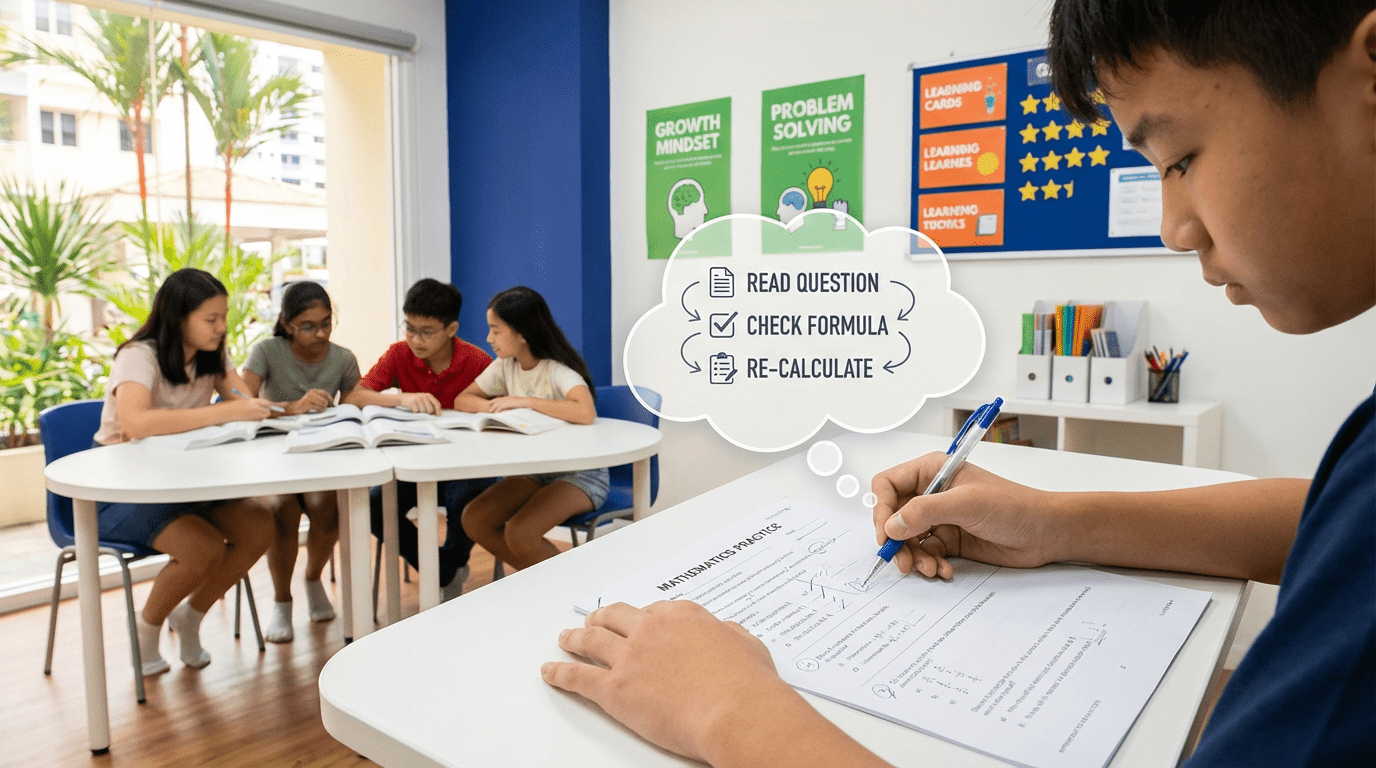
Table Of Contents
- Understanding Careless Errors in Academic Performance
- What Is Metacognition and Why Does It Matter?
- Common Types of Careless Errors Singapore Students Make
- Metacognitive Strategies Taught in Quality Tuition Classes
- How Tuition Classes Implement Metacognitive Checks
- The Role of Small Class Sizes in Developing Metacognitive Skills
- Building Long-Term Metacognitive Habits
Every parent in Singapore has heard it before: “I knew how to do it, but I made a careless mistake.” These words, often uttered after an exam or test, reveal one of the most frustrating challenges in education. Your child understands the concepts, has practiced the problems, yet still loses precious marks to avoidable errors. What many parents don’t realize is that these “careless mistakes” aren’t simply matters of being more careful or trying harder. They stem from gaps in metacognitive awareness, the ability to monitor and regulate one’s own thinking processes.
Quality tuition classes have begun addressing this issue directly by teaching specific metacognitive checking strategies that help students catch errors before submitting their work. These aren’t generic reminders to “check your work” but rather systematic techniques that transform how students approach problem-solving and self-verification. From primary school mathematics to secondary level sciences, metacognitive skills represent the difference between students who consistently perform at their potential and those who perpetually fall short despite understanding the content.
This article explores the metacognitive strategies that effective tuition centers employ to help students prevent careless errors. You’ll discover specific techniques that tutors teach, understand why small class environments facilitate metacognitive development, and learn how these skills create lasting academic improvements that extend far beyond individual subjects.
Understanding Careless Errors in Academic Performance
The term “careless error” often masks the real cognitive processes at play. When students make these mistakes, they’re not being careless in the colloquial sense. Rather, they’re experiencing cognitive load overflow, where working memory becomes overwhelmed by the demands of the task. A Primary 5 student solving a multi-step word problem must simultaneously comprehend the question, identify the relevant operation, perform calculations, and verify the answer makes sense within the problem’s context. Any breakdown in this chain creates opportunities for error.
Research in educational psychology shows that what appears as carelessness is actually a metacognitive monitoring failure. Students lack the internal checking mechanisms that would alert them to inconsistencies or errors in their work. A child might write “48” when they meant “84” because they’re not actively monitoring the output of their pencil against the number held in their mind. They might misread “0.5” as “5” because they haven’t developed the habit of questioning whether their interpretation makes sense in context. These aren’t character flaws but skill gaps that can be systematically addressed.
In Singapore’s high-stakes examination environment, careless errors carry significant consequences. A student can drop an entire grade due to preventable mistakes, affecting school placements and academic confidence. Parents often focus on drilling more practice questions, but without metacognitive strategies, students simply make the same types of errors repeatedly. Quality primary tuition and secondary tuition programs recognize that error prevention requires teaching students how to think about their thinking, not just how to solve more problems.
What Is Metacognition and Why Does It Matter?
Metacognition refers to the awareness and understanding of one’s own thought processes. Often described as “thinking about thinking,” it encompasses two key dimensions: metacognitive knowledge (understanding how you learn and process information) and metacognitive regulation (the ability to plan, monitor, and evaluate your cognitive activities). For students, strong metacognitive skills mean recognizing when they don’t understand something, identifying which strategies work best for different problems, and catching errors through active self-monitoring.
The connection between metacognition and academic performance is well-established in educational research. Students with developed metacognitive skills outperform their peers even when general intelligence is controlled for. This advantage becomes particularly pronounced in complex problem-solving and examination situations where students must work independently without immediate teacher guidance. A student who can internally dialogue with themselves (“Does this answer make sense? Did I address all parts of the question? What mistakes do I typically make in these problems?”) has a significant edge over equally knowledgeable peers who lack this internal monitoring system.
In the Singapore education context, metacognitive skills align perfectly with the Ministry of Education’s emphasis on 21st-century competencies and self-directed learning. These aren’t just test-taking tricks but fundamental cognitive abilities that serve students throughout their educational journey and beyond. When tuition classes explicitly teach metacognitive strategies, they’re not just helping students score better on the next examination; they’re developing transferable skills that improve learning efficiency across all subjects and contexts.
Common Types of Careless Errors Singapore Students Make
Before implementing metacognitive checks, students need to understand the specific error patterns they’re prone to making. Experienced tutors identify several categories of careless errors that repeatedly appear across subjects and levels:
Transcription errors occur when students copy information incorrectly from the question to their working. A number might be transposed (76 becomes 67), a decimal point misplaced, or a negative sign dropped. These errors happen because students’ attention is split between reading the question and writing their response, creating opportunities for information to distort during transfer. In mathematics, transcription errors often cascade through multi-step problems, making correct methodology yield incorrect answers.
Computational mistakes represent another common category, particularly in mathematics and sciences. Students might correctly set up an equation but make basic arithmetic errors during calculation. A child might know that 7 × 8 = 56 in isolation but write 54 when performing the calculation within a larger problem due to divided attention. These errors become more frequent under time pressure or when working memory is taxed by complex problem requirements.
Question misinterpretation errors plague students across all subjects. In comprehension passages, students might answer what they think the question asks rather than what it actually asks. In mathematics, they might solve for x when the question asks for 2x + 3. In science, they might explain a concept when asked to describe a process. These errors reflect insufficient metacognitive checking at the problem comprehension stage, where students don’t pause to confirm their understanding before proceeding to solve.
Units and labeling omissions cost students marks despite correct numerical answers. A perfectly solved physics problem loses marks because the student wrote “5” instead of “5 m/s.” These errors suggest students view problem-solving as complete once they’ve calculated the number, not recognizing that proper communication of the answer is integral to the task. Quality tuition addresses this by building metacognitive awareness that an answer isn’t complete until properly expressed with appropriate units and labels.
Metacognitive Strategies Taught in Quality Tuition Classes
Effective tuition centers don’t just tell students to “check your work” but instead teach specific, actionable metacognitive strategies that become automatic with practice. These techniques transform error-checking from a vague instruction into a systematic process that students can reliably implement.
Self-Questioning Techniques
The foundation of metacognitive checking is strategic self-questioning, where students learn to internally dialogue with themselves at key points during problem-solving. Tutors teach students to ask specific questions rather than simply rereading their work. Before beginning a problem, students learn to ask: “What is this question really asking me to find? What information have I been given? What do I already know about this type of problem?” This pre-problem questioning activates relevant prior knowledge and ensures students understand the task before investing time in solving.
During problem-solving, students practice monitoring questions that keep them metacognitively engaged: “Is this approach working? Does this step make sense? Am I getting closer to answering the actual question?” These questions prevent students from pursuing unproductive solution paths too far before recognizing the need to reconsider their approach. In small class environments typical of quality tuition centers, tutors can model this internal dialogue out loud, demonstrating how expert problem-solvers think through challenges.
After completing a problem, students employ verification questions that catch most careless errors: “Does my answer make sense in the context of the question? Did I include proper units? Did I answer all parts of the question? Is this the type of answer I’d expect for this type of problem?” A student who calculates a person’s age as 150 or a probability greater than 1 should catch these impossible answers through sense-checking, but this only happens when verification questioning becomes habitual.
Systematic Checking Protocols
Beyond questioning, effective tuition classes teach systematic checking protocols that students can apply consistently. One powerful technique is the reverse-checking method, where students verify their answers by working backwards. If a student solved an equation and found x = 7, they substitute 7 back into the original equation to verify it produces a true statement. If they calculated a percentage increase, they apply that increase to the original value to see if it yields the final value stated in the problem. This approach catches computational errors that forward-only checking might miss.
The alternative method check involves solving the same problem using a different approach when time permits. In mathematics, a word problem might be solvable through algebraic equations or through model drawing. Working it both ways provides powerful confirmation when both methods yield the same answer and immediately highlights errors when they don’t. While time-intensive, this strategy proves valuable for important examinations and helps students develop flexibility in problem-solving approaches.
Checklist-based verification provides structure particularly beneficial for younger students still developing metacognitive habits. Tutors work with students to create personalized checklists based on their individual error patterns. A checklist might include items like: “Circle/underline key words in the question,” “Check all calculations with a calculator if permitted,” “Verify units on all numerical answers,” “Confirm I answered the actual question asked.” Initially, students explicitly reference these checklists, but with practice, the checking behaviors become internalized and automatic.
Error Pattern Analysis
One of the most valuable metacognitive skills tutors develop is error pattern awareness. Rather than treating each mistake as an isolated incident, students learn to analyze their errors for patterns. A tutor might help a student recognize they consistently make sign errors in algebra or frequently misread questions that use negative phrasing. This awareness transforms general vigilance (“be more careful”) into targeted attention (“I need to specifically watch for sign changes when expanding brackets”).
Quality tuition centers implement error tracking systems where students maintain error logs across assignments and practices. These logs categorize errors by type (computational, transcription, misinterpretation, etc.) and help students visualize which categories dominate their mistakes. A student who discovers that 60% of their lost marks come from misreading questions can then direct metacognitive energy specifically toward question comprehension and verification, rather than diffusing their attention across all possible error types.
This personalized approach to error prevention proves particularly effective in the small class environments that characterize quality tuition. With class sizes of 4-8 students, tutors can analyze each student’s work individually, identify their specific error patterns, and teach metacognitive strategies tailored to their needs. A student prone to rushing might learn different checking strategies than one who second-guesses themselves excessively, even though both need metacognitive development.
How Tuition Classes Implement Metacognitive Checks
Teaching metacognitive strategies requires more than simply explaining techniques. Effective tuition centers implement these approaches through explicit instruction, guided practice, and gradual release. Tutors begin by making their own thinking visible, talking through their internal metacognitive dialogue as they solve problems. Students hear how an expert thinker approaches uncertainty, catches potential errors, and verifies solutions. This modeling provides the template students need to develop their own internal checking mechanisms.
The next phase involves guided metacognitive practice where students apply checking strategies with tutor support. The tutor might pause students at key points during problem-solving to prompt metacognitive questions: “Before you start calculating, what is this question asking you to find? How will you know if your answer is reasonable?” This scaffolding keeps metacognitive processes at the forefront of students’ awareness until they begin triggering these questions internally without external prompting.
Effective programs also incorporate think-aloud protocols where students verbalize their thinking process while solving problems. Speaking their thoughts aloud makes metacognitive processes explicit and observable, allowing tutors to identify gaps in students’ checking strategies. A tutor might notice a student never verifies whether their answer addresses all parts of a multi-part question, revealing a specific metacognitive blind spot to address. This technique works particularly well in small group settings where students also learn from hearing peers’ thinking processes.
Deliberate practice with immediate feedback accelerates metacognitive development. Rather than assigning large sets of practice problems, tutors might work through fewer problems with intensive metacognitive focus, checking not just whether students reached correct answers but whether they employed effective checking strategies along the way. This quality-over-quantity approach ensures students don’t just practice solving problems but practice solving problems metacognitively.
The Role of Small Class Sizes in Developing Metacognitive Skills
Metacognitive skill development requires the kind of individualized attention and personalized feedback that large classroom environments struggle to provide. This is where small class sizes become crucial to effective metacognitive instruction. In a class of 4-8 students, tutors can observe each child’s problem-solving process, identify their specific metacognitive gaps, and provide targeted guidance that addresses their individual needs.
Small groups enable the interactive dialogue essential for metacognitive development. Tutors can engage students in extended conversations about their thinking: “Walk me through how you approached this problem. What made you choose that method? How did you check your answer?” These conversations rarely happen in larger classes where teachers must maintain pace and cover content. The back-and-forth questioning helps students articulate their thinking processes, which itself strengthens metacognitive awareness.
Additionally, small classes allow for differentiated metacognitive instruction. One student might need strategies for slowing down and checking work more thoroughly, while another needs techniques for deciding when to move on rather than overthinking. A third might struggle specifically with question interpretation, requiring targeted practice in that metacognitive skill. Tutors working with small groups can address these varied needs simultaneously, something impossible in large-class settings where instruction must be one-size-fits-all.
The reduced peer comparison in smaller settings also creates psychological safety for students to admit confusion and ask questions. Metacognitive development requires students to acknowledge what they don’t understand and where they make mistakes. In large classes, many students hide confusion to avoid embarrassment. Small tuition groups foster the trust and comfort necessary for students to be metacognitively honest about their uncertainties and error patterns.
Building Long-Term Metacognitive Habits
The ultimate goal of metacognitive instruction isn’t just reducing careless errors on the next quiz but developing durable metacognitive habits that students carry throughout their education. This transformation from conscious strategy application to automatic metacognitive behavior takes time and consistent practice. Quality tuition centers understand this developmental arc and structure their programs to support habit formation rather than quick fixes.
Habit development requires consistent reinforcement across contexts. Effective tutors don’t confine metacognitive instruction to specific “checking time” but instead weave these practices throughout every lesson and subject. Whether working on mathematics problems, science applications, or comprehension questions, students practice the same core metacognitive skills: understanding the task, monitoring their approach, and verifying their responses. This consistency across contexts helps metacognitive strategies become generalized skills rather than subject-specific techniques.
Parental involvement accelerates metacognitive habit formation when parents understand and reinforce these strategies at home. Rather than simply checking whether homework answers are correct, parents can prompt the same metacognitive questions tutors use: “How do you know your answer is correct? Can you explain your thinking? Did you check your work?” This home reinforcement extends practice beyond tuition hours and helps metacognitive approaches become part of students’ identity as learners.
As metacognitive skills strengthen, students experience a positive feedback loop. Fewer careless errors mean better grades, which builds confidence and motivation. Students begin to see themselves as capable learners whose performance reflects their actual understanding rather than being undermined by preventable mistakes. This shift in self-perception and academic self-efficacy often proves as valuable as the concrete skill development, creating students who approach academic challenges with confidence in their ability to monitor and regulate their own learning.
The investment in metacognitive development pays dividends far beyond individual test scores. These skills transfer across subjects and grade levels, becoming more valuable as academic demands increase. A Primary 4 student who develops strong metacognitive habits carries these skills into PSLE preparation, secondary school, and beyond. In Singapore’s competitive academic environment, this represents not just an advantage but an essential foundation for sustained success.
Preventing careless errors isn’t about trying harder or being more careful. It requires systematic development of metacognitive skills that many students never explicitly learn. Quality tuition classes address this gap by teaching specific self-questioning techniques, systematic checking protocols, and error pattern analysis that transform how students approach academic work. These aren’t quick fixes but fundamental cognitive skills that develop through explicit instruction, guided practice, and consistent reinforcement in small class environments where tutors can provide individualized attention.
The metacognitive strategies taught in effective tuition settings serve students far beyond any single examination or subject. They develop self-aware, strategic learners who can monitor their own understanding, catch their own errors, and continually improve their learning approaches. In Singapore’s demanding academic landscape, these skills often make the difference between students who consistently perform at their potential and those whose grades fail to reflect their true capabilities.
For parents frustrated by their child’s careless errors despite obvious understanding, the solution lies not in more practice problems but in developing the metacognitive foundation that enables students to be their own quality control. When students learn to think about their thinking, careless mistakes diminish not through increased vigilance alone but through systematic cognitive processes that become second nature with proper instruction and practice.
Help Your Child Develop Metacognitive Skills That Last a Lifetime
At EduFirst Learning Centre, our small class sizes (4-8 students) enable the individualized attention necessary for developing strong metacognitive habits. Our experienced tutors don’t just teach content—they teach students how to think about their thinking, catch their own errors, and become self-regulated learners.