- Sep 21, 2026
Sec 2 Science: The Year That Decides Pure vs Combined Science
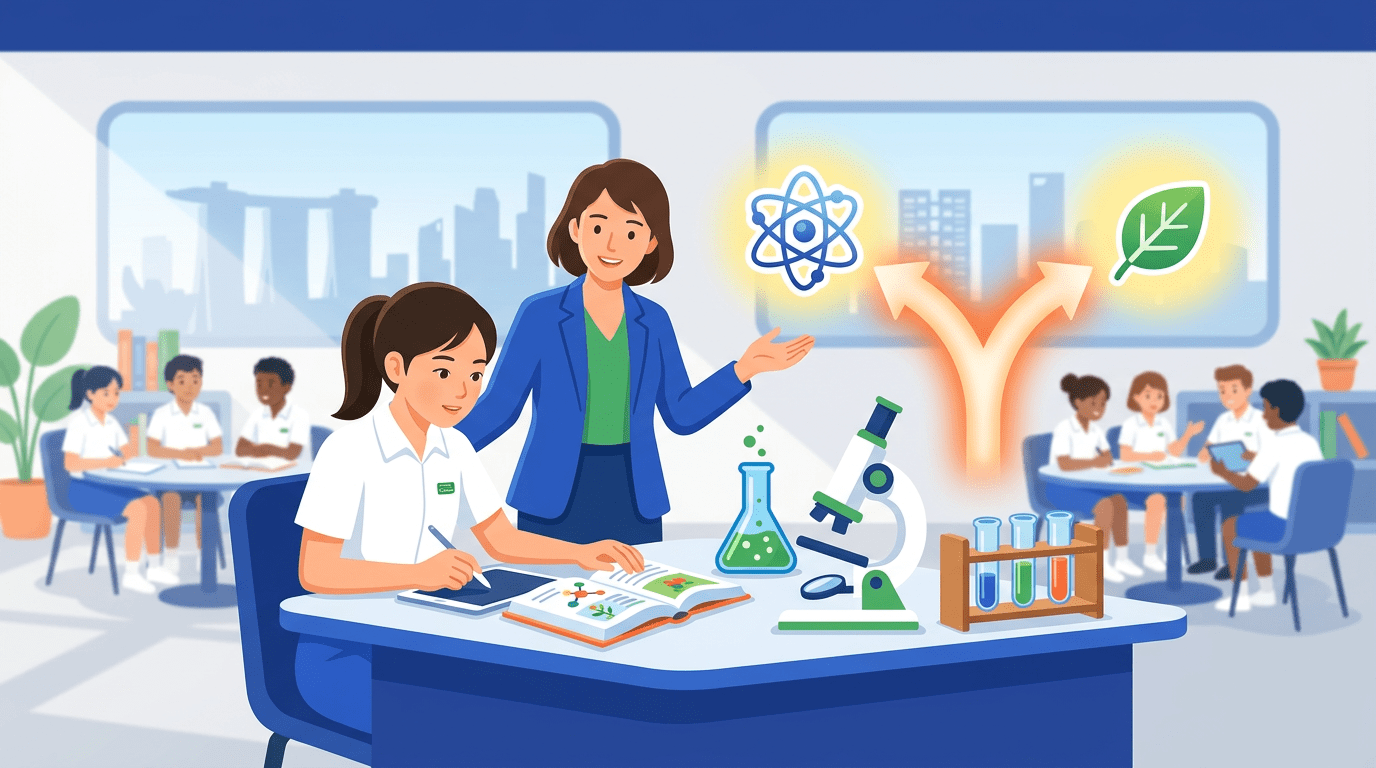
Secondary 2 is, in many ways, a quiet year. Exams are internal, the pressure seems lower than Sec 1, and the O-Levels still feel far away. But beneath that calm sits one of the most consequential academic decisions your child will make in secondary school: whether to take Pure Science or Combined Science in Sec 3 and Sec 4.
This is not just a choice about subjects. It is a choice about pathways. The science option your child selects at the end of Sec 2 will shape their L1R5 or L1R4 aggregate, their eligibility for JC H2 Science subjects, and their access to university courses in medicine, engineering, and the sciences. And unlike most academic decisions, this one is extremely difficult to reverse once made.
This guide is written for Singapore parents and Sec 2 students who want to understand the real differences between Pure and Combined Science, what the new Full Subject-Based Banding (FSBB) and SEC examination framework mean for this decision, and how to assess whether your child is genuinely ready for Pure Science. Whether your child is aiming for JC or polytechnic, this is the year to get the choice right.
Why Sec 2 Is the Science Decision Year
Most schools run their Sec 3 subject combination exercise in Term 3 of Secondary 2. Briefings for students and parents typically happen mid-year, preferences are submitted towards the end of the year, and class allocations are confirmed before Sec 3 begins. This means the window to make an informed decision is surprisingly short, and the groundwork needs to be laid well before the briefing season.
What makes this decision especially weighty is that it is largely permanent. Schools very rarely allow students to switch from Combined Science to Pure Science after Sec 3 begins. By the time exam results reveal that a student could have managed Pure Science, the timetables, class formations, and coursework are already underway. The choice made at the end of Sec 2 is, in practical terms, the choice that goes all the way to the national examination.
There is also a timing factor unique to the current cohort. Students in Sec 2 in 2025 and 2026 will sit for the new Singapore-Cambridge Secondary Education Certificate (SEC) examination, not the traditional O-Level. The SEC reflects the Full Subject-Based Banding (FSBB) system where students take subjects at G1, G2, or G3 levels. This changes how science options are structured and what each path leads to, which makes it even more important for families to understand the landscape before choosing.
Pure Science vs Combined Science: What Is Actually Different
The most important thing to understand is that Pure Science and Combined Science are not the same qualification at different difficulty levels. They are structurally different qualifications that produce different outcomes. Treating Combined Science as simply the “easier version” is one of the most common and costly misunderstandings parents make.
Combined Science
Combined Science pairs two of the three science disciplines into a single subject, producing one O-Level or SEC grade. The three pairings are Physics/Chemistry (the most common), Physics/Biology, and Chemistry/Biology. The syllabus covers selected topics from each discipline at reduced depth. For example, the Chemistry component of Combined Science covers core topics like atomic structure, chemical bonding, and organic chemistry, but omits more advanced content such as electrochemistry, which is fully covered in Pure Chemistry. Because it counts as one subject, it occupies one slot in a student’s timetable and contributes one grade to their post-secondary aggregate.
Pure Science
Pure Physics, Pure Chemistry, and Pure Biology are each standalone subjects with their own full syllabus, separate examination papers, and individual grades. Students typically take two Pure Sciences (most commonly Physics and Chemistry) as part of their Sec 3 and Sec 4 subject combination. The content is substantially deeper. Pure Chemistry alone covers approximately 25 to 30 percent more content than the Chemistry component of Combined Science, including topics like electrochemistry, the Haber process, and transition elements. Each Pure Science subject takes up its own timetable slot and produces its own grade at the national examination.
The practical consequence of this structural difference shows up most directly in post-secondary calculations. A student who takes Pure Physics and Pure Chemistry has two independently graded science subjects available when computing their aggregate. A student who takes Combined Science Physics/Chemistry has one. That single difference in grade count has downstream effects on JC admission eligibility that many families only discover after it is too late to change anything.
Interested in finding the right academic pathway for your child from primary school onward? Our primary tuition programmes build the science and mathematics foundations that make secondary school choices like this one easier to navigate.
FSBB and the SEC: How the New System Shapes Your Child’s Options
Under Full Subject-Based Banding, students no longer follow a single fixed academic stream. Instead, they take each subject at a level that reflects their individual strength in that subject: G3 (the most demanding, equivalent to the former Express standard), G2 (equivalent to Normal Academic), or G1 (equivalent to Normal Technical). This means a student might be taking Mathematics at G3 while taking English at G2, depending on their PSLE results and subsequent school performance.
For science specifically, a student’s G-level in Sec 1 and Sec 2 Science determines which science options are available at the Sec 3 combination stage. Students who are at G3 level in Science can access Pure Science syllabuses. Students at G2 level take Combined Science at the G2 standard. Students can move between G-levels based on their performance in school, so a student who begins at G2 and demonstrates consistently strong results may be offered a move to G3 before the combination exercise.
The SEC examination, which replaces the separate O-Level, N(A)-Level, and N(T)-Level national examinations from 2027, will reflect all of these subject levels on a single unified certificate. This is a significant change from previous cohorts. For Sec 2 students today, the subject combination decision is not just about what to study — it is about what level to study it at, and that level will be recorded on their national certificate and used for all post-secondary admission calculations.
How the Choice Affects L1R5, L1R4, and Post-Secondary Pathways
The L1R5 aggregate is used for JC admission, and it is where the structural difference between Pure and Combined Science has the most direct impact. L1R5 requires English (L1) plus five relevant subjects (R5), with specific requirements around how many Humanities and Mathematics/Science subjects must be included. A student taking Pure Physics and Pure Chemistry has two separate Science grades available to fill R-slots and optimise their aggregate. A student taking Combined Science has only one.
To see why this matters, consider a concrete example. If a student earns A2 in Pure Physics and B3 in Pure Chemistry, those two subjects together contribute 7 points to their aggregate. If a student earns B3 in Combined Science Physics/Chemistry, they contribute 3 points from their science subjects, but they also need an additional subject to fill the sixth slot in L1R5, and that additional subject may carry a weaker grade. The Combined Science student may end up with a higher overall aggregate despite their strong science performance, purely because they have fewer grades to work with. Under the shift to L1R4 from the 2028 Joint Admissions Exercise (JAE), this structural dynamic remains the same — with only five subjects counted instead of six, each grade carries even more weight, making the number of independently graded subjects even more significant.
For polytechnic admission using the ELR2B2 aggregate, Combined Science can fill the science-relevant slot for most science-related diploma courses. However, it occupies only one slot where two Pure Sciences would give a student two separate grades to draw on. Engineering and applied science diplomas often prefer students with Pure Science backgrounds, though Combined Science does not disqualify anyone from applying. The key is to check the specific prerequisites of your target courses before finalising the subject combination.
For JC students aiming at H2 Science subjects, most JCs expect the corresponding Pure Science at O-Level or SEC G3 level. A Combined Science student who wants to take H2 Chemistry in JC will typically need to demonstrate an exceptional grade in their Combined Science subject and may still face a significant content gap on entry — topics like electrochemistry and extended organic chemistry that were not covered at the Combined Science level but are assumed knowledge in JC1.
Our secondary tuition programmes at EduFirst include structured support for both Combined and Pure Science students navigating exactly these pathways across Sec 3 and Sec 4.
Who Should Choose Pure Science, and Who Should Choose Combined
The right choice depends on three intersecting factors: your child’s academic performance in Science so far, their genuine interest in science as a subject, and their post-secondary goals. The mistake most families make is treating this purely as a difficulty question rather than a fit question.
Pure Science is the stronger fit when:
- Your child is consistently scoring B3 or above in Sec 1 and Sec 2 Science. This is the most reliable indicator of readiness. Students who enjoy Science and perform well in it at lower secondary are unlikely to find the deeper Pure Science content overwhelming — they will find it a natural extension of what they already understand.
- Your child is interested in STEM university courses. Medicine requires H2 Chemistry plus H2 Biology or H2 Physics at A-Level. Engineering typically expects H2 Physics. Both of these JC pathways lead back to a foundation in Pure Science at the secondary level.
- Your child wants to keep options open. Choosing Pure Science at Sec 3 does not prevent a student from later pursuing humanities, business, or social sciences. But choosing Combined Science does limit certain STEM pathways. When in doubt, Pure Science preserves more doors.
- Your child is at G3 level in Science under FSBB. G3-level students have both the eligibility and the academic preparation for Pure Science syllabuses. Taking Combined Science at G3 level when Pure Science is accessible and manageable is, in most cases, underutilising your child’s potential.
Combined Science is the stronger fit when:
- Your child’s strengths lie in Humanities, Languages, or the Arts. Students aiming for the JC Arts stream, Law, Social Sciences, or Communications do not need Pure Sciences. Combined Science satisfies the basic science requirement and frees up timetable space for subjects the student performs best in.
- Your child is scoring C5 or below in lower secondary Science. A student who is genuinely struggling with science concepts will not suddenly thrive under the deeper demands of Pure Science. One strong, well-prepared Combined Science grade is strategically better than two weak Pure Science grades that drag down the L1R5 aggregate.
- Polytechnic is the intended pathway and the target diploma courses do not require Pure Science as a prerequisite. Business, IT, media, and design courses at polytechnic have no Pure Science requirement, and Combined Science satisfies their basic science entry criterion.
- Your child’s overall subject load is already heavy. Taking two Pure Sciences plus Additional Mathematics, a Humanities subject, and electives is a demanding combination. Students who are stretched across many subjects may perform better overall by managing their load strategically.
Note that Pure Science is not exclusively for top students, and Combined Science is not a fallback for weaker ones. A diligent mid-range student who genuinely enjoys science can thrive in Pure Science with the right support. And a highly capable student whose interests lie firmly outside STEM may be better served by an excellent Combined Science grade. The subject combination should reflect the student’s actual trajectory, not their parents’ aspirations or their friends’ choices.
A Practical Readiness Checklist for Sec 2 Students
Beyond grades, there are several practical indicators parents and students can use to assess readiness for Pure Science before the combination exercise begins. Use the following checklist as a starting point for an honest conversation at home.
- Grades: Is your child consistently achieving B3 or above in Sec 1 and Sec 2 Science? Not just in one term, but across multiple assessments?
- Enjoyment: Does your child find Science interesting as a subject, or do they treat it as an obligation? Students who enjoy the subject tend to sustain motivation through the deeper Sec 3 and Sec 4 content.
- Independence: Can your child work through unfamiliar science problems using logical reasoning, or do they rely heavily on memorisation alone? Pure Science questions demand application and analysis, not just recall.
- Maths comfort: Science at the Pure level involves more mathematical application, particularly in Physics and Chemistry. A student who is confident in Mathematics is better placed to handle the quantitative demands of Pure Science.
- Future direction: Does your child have any interest (however early-stage) in science-related careers? Even a general leaning toward medicine, engineering, environmental science, or technology is worth factoring in.
- Subject load: How many other demanding electives is your child considering? Two Pure Sciences plus Additional Mathematics is manageable for many students, but not all. Be realistic about the full picture.
If most of these indicators point toward readiness, Pure Science is worth serious consideration. If several indicators give pause, a well-executed Combined Science strategy may genuinely serve your child better. The goal is not to aim higher for its own sake — it is to match the right pathway to the right student.
Common Mistakes Families Make at This Decision Point
After years of supporting secondary students through this transition, these are the patterns we see families fall into most often — and that are worth actively avoiding.
Treating it as a difficulty question, not a fit question
The most common error is framing the choice as “can my child handle Pure Science?” rather than “does Pure Science fit my child’s goals and strengths?” A student who can handle Pure Science but has no use for it in their post-secondary plans is carrying unnecessary load. A student who could manage Pure Science with some support but defaults to Combined Science out of caution may be giving up meaningful options. The question to ask is about fit, not just difficulty.
Following friends instead of making an individual decision
Sec 2 students are significantly influenced by their peers’ choices, and many parents are influenced by what neighbouring families are doing. The subject combination that is right for one student is not automatically right for another, even if both students have similar grades. Each child’s interest profile, post-secondary goals, and subject load are different, and the combination decision should reflect those individual factors.
Assuming the school’s recommendation is final
Schools provide recommendations based on academic performance, but those recommendations are also shaped by operational factors like class sizes, teacher availability, and minimum class numbers for certain subjects. Parents should treat school recommendations as important input, not as a substitute for independent evaluation. If your child’s grades and interest genuinely support Pure Science, it is worth having a direct conversation with the school rather than accepting a Combined Science placement passively.
Leaving preparation too late
Many families begin thinking about the subject combination only when the school’s briefing session arrives, which is typically mid-Sec 2. By that point, the Sec 2 mid-year results are in but there may be limited time to address any gaps before the end-of-year exams that determine eligibility. The preparation for Pure Science — building strong conceptual foundations in all three science areas, developing logical reasoning skills, and strengthening Mathematics — should begin well before Term 3.
How EduFirst Helps Sec 2 Students Prepare for the Right Path
At EduFirst Learning Centre, we have been supporting Singapore students through exactly this kind of decision since 2010. Our secondary science tuition programmes are designed not just to help students score better on their current assessments, but to build the conceptual depth and reasoning skills that make the right Sec 3 choice clear and achievable.
Our classes are kept intentionally small, with 4 to 8 students per group, so that every student receives the kind of personalised attention that makes a genuine difference at this critical stage. A tutor who knows your child’s individual strengths, gaps, and working style is far better placed to advise on Pure vs Combined readiness than a generic school briefing can be. With 25 locations across Singapore, we make it practical for families across the island to access this kind of support.
For Sec 2 students approaching the combination exercise, our structured tuition helps consolidate lower secondary science foundations across all three disciplines, develop the analytical and application skills that Pure Science demands, and build confidence in the mathematical side of Physics and Chemistry. For students who have already decided on Combined Science, we help them approach Sec 3 with the strategic mindset needed to achieve the strong A-grade result that maximises its L1R5 value.
We also offer e-lessons for families who need scheduling flexibility, so your child can access quality science tuition from wherever they are. And for younger children who are building the science foundations that will eventually lead to this very decision, our primary tuition programmes lay the groundwork from early on.
The Sec 2 Science Decision: Get It Right the First Time
The choice between Pure Science and Combined Science is one of the most lasting decisions in your child’s secondary school journey, and Sec 2 is the year when that decision crystallises. Understanding the structural differences, knowing what the FSBB and SEC framework mean for your child’s options, and honestly assessing your child’s readiness across grades, interest, and goals are all part of making a choice you will not need to second-guess.
The good news is that both paths, when chosen well, lead to strong outcomes. A student who genuinely thrives in Science and is heading toward STEM has every reason to take the Pure Science route and build the foundation that JC and university require. A student whose strengths and ambitions lie elsewhere can pursue a strategic, well-supported Combined Science path and achieve excellent results that serve their actual goals. The key is making the choice based on your child’s individual profile, not on assumptions about prestige, peer pressure, or what seemed right for a previous generation of students navigating a very different education system.
Start the conversation now, while there is still time to prepare. And if you want an expert perspective on where your child currently stands and which path makes most sense for them, we are here to help.
Ready to Help Your Child Make the Right Choice?
At EduFirst Learning Centre, our experienced tutors work in small groups of 4 to 8 students to give every Sec 2 student the personalised guidance they need to enter Sec 3 on the right path — whether that is Pure Science, Combined Science, or building the foundations to make that decision with confidence.
With 25 locations across Singapore and flexible e-lesson options, expert support is never far away. Explore our Secondary Tuition programmes or reach out to our team today.