- Sep 24, 2026
Transfer of Thermal Energy: Conduction, Convection and Radiation Made Exam-Ready
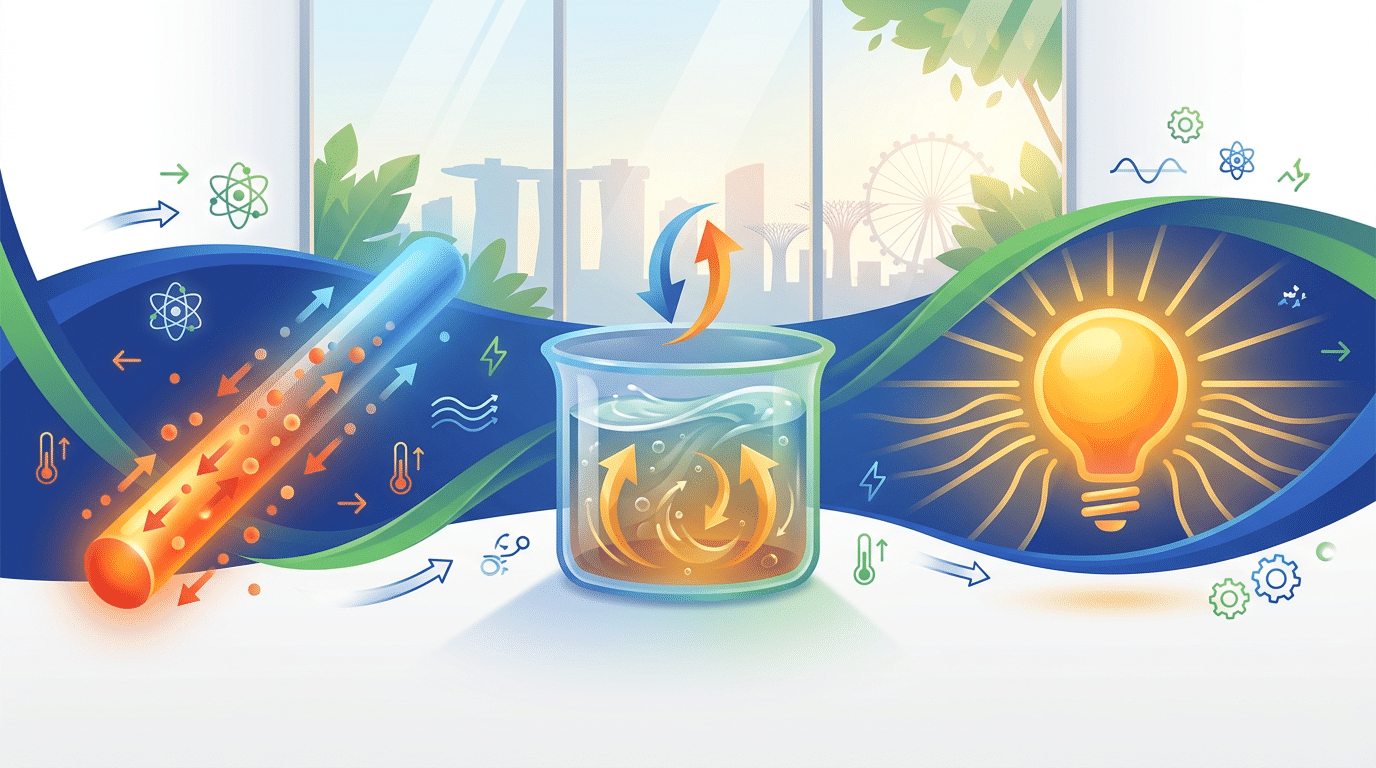
Picture this: you’re sitting in a hawker centre on a blazing afternoon, touching the metal table and flinching because it’s scorching hot, feeling the warm breeze drift past, and sensing the heat radiating from the griddle a few stalls away — all within seconds of each other. Without realising it, you have just experienced all three modes of transfer of thermal energy: conduction, convection, and radiation.
For Secondary 3 and Secondary 4 students preparing for the O-Level or school examinations, this topic is one of the most consistently tested areas in Physics. Understanding it well does not simply mean memorising definitions. It means being able to look at any everyday scenario — a vacuum flask, a coastal breeze, a greenhouse, an astronaut suit — and explaining precisely which mode of heat transfer is at work and why. That level of understanding is what separates an A from a B.
In this guide, we break down each mode of thermal energy transfer from concept to mechanism, walk you through memorable real-life examples, highlight the factors that affect the rate of heat transfer, and give you a practical exam strategy for tackling application questions confidently. Let’s get started.
What Is Transfer of Thermal Energy?
Before diving into the three modes, it is worth clarifying a distinction that trips up many students in MCQ questions: the difference between heat and temperature. Heat (or thermal energy) is energy that flows from a hotter region to a cooler one. Temperature, on the other hand, measures how hot something is — it reflects the average kinetic energy of the particles in a substance. A large pot of warm water can actually contain more thermal energy than a small cup of boiling water, even though the cup reads a higher temperature on a thermometer. Keeping these two ideas separate is the first step to avoiding careless errors.
With that foundation in place: thermal energy always travels from a region of higher temperature to a region of lower temperature, and it can do so in three distinct ways — conduction, convection, and radiation. Each mode operates through a different physical mechanism, occurs in different types of media, and responds to different factors. Understanding all three is essential for the O-Level Physics syllabus.
Conduction: Heat Through Solids
How Conduction Works
Conduction is the transfer of thermal energy through a material by the vibration of its particles, without the particles themselves moving from place to place. Imagine a long line of students sitting in seats, passing a heavy book from the front of the classroom to the back. Each student passes it to the neighbour without leaving their chair — the book moves, but the students stay put. That is essentially what happens during conduction: energy passes from one vibrating particle to the next through direct collisions, without any bulk movement of the material itself.
Conduction occurs primarily in solids because their particles are tightly packed and in constant contact, making energy transfer by collision highly efficient. In metals, the process is even faster because metals contain free electrons that can carry energy rapidly through the structure. This is why metals are described as good conductors of heat, while non-metals such as wood, plastic, and air are poor conductors (also known as insulators). The denser and more tightly packed the medium, the more effective conduction tends to be.
Real-Life Examples of Conduction
Cooking pots and pans: The body of a cooking pot is typically made from aluminium, stainless steel, or cast iron — all metals and therefore good conductors. This allows the heat from the stove to transfer quickly through the base of the pot to the food inside. The handles, however, are coated with plastic or silicone. Since these are poor conductors, they insulate your hand from the metal body, preventing burns while you cook.
Fluffy animal fur and wool: Animals like arctic foxes and sheep stay warm not because fur or wool itself generates heat, but because the fibres trap pockets of air. Air is one of the worst conductors of heat and one of the best natural insulators. The trapped air reduces heat loss from the animal’s body through conduction, keeping the creature warm even in freezing temperatures.
Building insulation (cavity walls): Some buildings use double-wall construction with an air gap in between. Since air conducts heat very poorly, this cavity dramatically reduces the rate at which thermal energy escapes through the walls, keeping interiors cooler in summer and warmer in winter.
Think about it: Why do we place a metal gauze over a Bunsen burner when heating a beaker of water? The metal gauze conducts heat from the flame and spreads it more evenly across the base of the beaker, preventing cracking and ensuring more uniform heating.
Convection: Heat Through Fluids
How Convection Works
Convection is the transfer of thermal energy by the bulk movement of a fluid — that is, a liquid or a gas. Unlike conduction, which relies on particles vibrating in place, convection involves the actual physical movement of particles from one location to another. This movement is driven by changes in density: when a fluid is heated, it expands, becomes less dense, and rises. Cooler, denser fluid then sinks to take its place. This continuous cycle of rising warm fluid and sinking cool fluid is called a convection current.
Because convection requires the free movement of particles, it only occurs in fluids (liquids and gases). It does not occur in solids, since solid particles cannot flow. This distinction is frequently tested in exams, so it is worth committing to memory: conduction works in solids; convection works in fluids.
Real-Life Examples of Convection
Placement of air-conditioning units: Have you noticed that air-conditioners are almost always installed near the ceiling? There is good physics behind this. Cool, denser air from the air-con sinks downward and circulates throughout the room, while warmer, less dense air rises toward the unit to be cooled again. This sets up an efficient convection current. If the air-con were placed near the floor, the cool air would simply pool at the bottom, leaving the upper portion of the room uncomfortably warm. Conversely, in colder countries, heaters are placed near the ground so that warm air rises and heats the entire room from below.
Sea breeze and land breeze: If you have spent time at East Coast Park or Sentosa, you may have noticed that the direction of the breeze changes between day and night. During the day, land heats up faster than the sea, so the warmer air above land rises. Cooler air from the sea flows inland to replace it, creating a sea breeze. At night, the reverse happens — the sea retains heat longer than land, so warm air rises above the sea, and cooler air flows outward from the land, creating a land breeze. This is a classic O-Level convection application question.
Convection rainfall: On a hot, humid Singapore afternoon, warm moist air near the ground rises rapidly into the cooler upper atmosphere. As it rises, the water vapour cools, condenses into clouds, and eventually falls as the heavy afternoon thunderstorms that are a regular feature of life here. This convection rainfall cycle is a perfect example of a large-scale convection current in action.
Radiation: Heat Without a Medium
How Radiation Works
Radiation is the transfer of thermal energy as electromagnetic waves — specifically, infrared radiation. What makes radiation fundamentally different from conduction and convection is that it does not require any medium at all. It can travel through a complete vacuum, which is exactly how the Sun’s energy crosses 150 million kilometres of empty space to reach Earth and warm our planet. Every object with a temperature above absolute zero emits infrared radiation, and the hotter the object, the more radiation it emits.
For exam purposes, two key properties of surfaces govern how well they absorb and emit radiation. First, colour: dark or black surfaces are good absorbers and good emitters of radiation, while white or light-coloured surfaces are poor absorbers and poor emitters (they reflect radiation instead). Second, texture: dull or rough surfaces absorb and emit radiation more effectively, while smooth, polished, or shiny surfaces reflect radiation and are therefore poor emitters and poor absorbers. Crucially, a good emitter is also a good absorber — this is a fundamental principle that frequently appears in exam questions.
Real-Life Examples of Radiation
The vacuum flask: A well-designed vacuum flask keeps hot drinks hot for hours by combining all three modes of heat transfer in its design. The vacuum between the double glass walls eliminates heat loss by conduction and convection, since there are no particles in a vacuum to carry energy. The inner walls are coated with a shiny, silvered finish, which reduces heat loss by radiation because shiny surfaces are poor emitters. This is an excellent example of an O-Level question that requires students to discuss all three modes together.
Wrapping food with aluminium foil: Aluminium foil has one shiny side and one dull side, and which way you wrap your food actually matters. For keeping food warm, the shiny side should face inward, as it reflects radiation back toward the food and reduces heat loss. The dull outer surface, meanwhile, helps emit any escaping heat. For cooking (such as wrapping food in a hot oven), you want the dull side facing out so it absorbs radiation from the oven more efficiently, cooking the food faster.
Greenhouses: A greenhouse traps heat by allowing shorter-wavelength radiation from sunlight to pass through the glass roof into the interior, while blocking the longer-wavelength infrared radiation emitted by the warm plants and soil inside from escaping. This creates a warm, stable environment ideal for growing plants in otherwise cold climates.
Think about it: Why are astronaut suits white? Because white surfaces are poor absorbers of radiation, which protects astronauts from the intense solar radiation in outer space. The suits reflect radiation rather than absorbing it, preventing dangerous overheating.
Factors Affecting the Rate of Heat Transfer
A solid grasp of what influences the rate of heat transfer — not just whether transfer occurs, but how quickly — is essential for answering higher-order exam questions. Here is a concise summary organized by mode:
Conduction:
- Material: Metals conduct heat faster than non-metals. Among metals, some (like copper) conduct better than others (like steel).
- Temperature difference: A greater difference in temperature between the hot and cold ends increases the rate of conduction.
- Thickness and cross-sectional area: Thinner materials and those with a larger cross-sectional area conduct heat more rapidly.
Convection:
- Temperature difference: A larger temperature difference between the hot and cold regions of a fluid creates stronger, faster convection currents.
- Type of fluid: Fluids with lower viscosity allow particles to circulate more freely, enabling more vigorous convection.
Radiation:
- Surface colour: Black or dark surfaces emit and absorb radiation faster; white or light surfaces do so more slowly.
- Surface texture: Dull, rough surfaces are better emitters and absorbers; smooth, shiny surfaces are poor emitters and absorbers (good reflectors).
- Surface temperature: The hotter the surface, the greater the rate of radiation emitted.
- Surface area: A larger surface area results in more radiation being emitted per unit time.
When Two or More Modes Work Together
Some of the most challenging — and most rewarding — exam questions involve real-world objects where two or even all three modes of heat transfer operate simultaneously. Recognising this and being able to discuss each mode accurately earns full marks in structured questions.
The vacuum flask is a prime example, as described above. Another is the car radiator, which dissipates engine heat through a combination of conduction (heat moves from the engine through metal parts to the radiator fins), convection (hot coolant fluid circulates through the radiator system), and radiation (the hot metal surface radiates infrared energy). Similarly, a wood-burning fireplace warms a room through convection (hot air rising and circulating), radiation (infrared heat radiating outward), and some conduction through the surrounding brickwork.
When you encounter these multi-mode scenarios in exams, take a moment to identify each mode separately, explain the mechanism for each, and connect it clearly to the specific design feature or material in the question. This structured approach will help you earn every available mark.
Common Mistakes Students Make in Exams
Even students who have studied this topic thoroughly can drop marks due to avoidable errors. Here are the most frequent pitfalls to watch out for:
- Confusing heat with temperature: Describing a material as having “more heat” when you mean “higher temperature” (or vice versa) will cost you marks. Always use precise language: thermal energy is transferred as heat; temperature describes how hot the object is.
- Saying radiation requires a medium: Radiation is the only mode that can travel through a vacuum. Do not state or imply it needs particles — that is conduction and convection.
- Forgetting that good emitters are also good absorbers: This is a direct exam checkpoint. A black, dull surface absorbs radiation well AND emits radiation well. Students often remember one property but forget the symmetry.
- Applying conduction logic to fluids: When asked about heat transfer in water or air, the primary mechanism is convection (and radiation for air), not conduction. Conduction in liquids and gases is generally very slow and inefficient.
- Incomplete explanations in structured questions: Writing “hot air rises” is not enough. A complete answer would say: “The air near the heater is heated, expands, becomes less dense, and rises. Cooler, denser air sinks to take its place, setting up a convection current that distributes heat throughout the room.”
Exam Strategy: How to Decode Thermal Energy Questions
Application questions in this topic can look very different from one another, but they almost always contain keyword clues that point you toward the right mode of heat transfer. Training yourself to spot these clues quickly is one of the most effective exam strategies you can develop.
- Keywords pointing to Conduction: mentions of solid materials, metals vs. non-metals, direct contact, handles, insulation, trapped air, double-glazed windows.
- Keywords pointing to Convection: fluid (liquid or gas), rising and sinking, circulation, air-con placement, heater placement, sea breeze, boiling, atmospheric patterns.
- Keywords pointing to Radiation: colour (black, white, silver, dull, shiny), vacuum, no medium, infrared, surface area, greenhouse, space, the Sun.
When writing a structured answer, always follow this three-part framework: (1) Identify the mode of heat transfer; (2) Explain the mechanism in terms of particle behaviour or electromagnetic waves; (3) Link the mechanism to the specific feature, material, or design described in the question. This approach ensures your answer is complete, precise, and aligned with what examiners are looking for.
If you find yourself consistently unsure which mode applies in novel scenarios, it is a signal that you need to practise with a wider variety of application questions — and ideally, review them with guidance from a tutor who can walk you through the reasoning in real time. At EduFirst Learning Centre, our small-group Secondary Tuition classes (just 4 to 8 students) give every student the chance to ask questions, work through exam scenarios together, and receive personalised feedback that builds this kind of analytical instinct.
Putting It All Together
Transfer of thermal energy is one of those Physics topics that rewards genuine understanding far more than rote memorisation. Once you truly grasp why conduction relies on particle-to-particle vibration, why convection currents form due to density differences in fluids, and why radiation needs no medium at all, the real-life examples stop feeling like isolated facts you need to memorise. They start to make intuitive sense — and that intuition is exactly what you need to handle novel application questions confidently in an exam setting.
Use the keyword spotting tips, the three-part answer framework, and the common mistake checklist in this guide as your regular revision checkpoints. The more scenarios you work through, the sharper your ability to identify the relevant mode and construct a complete, mark-winning explanation becomes. Good luck with your revision!
Need Extra Help with Physics? EduFirst Has You Covered.
At EduFirst Learning Centre, our experienced tutors have helped hundreds of secondary students in Singapore master challenging topics like thermal energy transfer — and turn that understanding into real exam results. With small classes of just 4 to 8 students across 25 locations islandwide, every student receives the personalised attention they need to progress with confidence.
Whether you are looking for structured Secondary Tuition, foundational support through Primary Tuition, early childhood programmes via our Pre-School, or the flexibility of E-Lessons from home, EduFirst has a programme tailored to your child’s needs.