- Oct 17, 2026
P5 Science: Topics, Themes, and the Jump in Answering Demands

If your child sailed through Primary 4 Science and is now finding Primary 5 unexpectedly tough, you are not imagining things — and neither is your child. P5 Science represents one of the most significant curriculum transitions in Singapore primary school, and it catches many families off guard. The topics become more complex, the questions demand deeper reasoning, and the marking criteria expect a level of written precision that students have simply never needed before.
This article covers everything you need to understand about P5 Science: the key topics and MOE themes that form the syllabus, the important updates introduced in the revised curriculum, and — crucially — why the answering demands jump so sharply between P4 and P5. Whether you are a parent trying to support your child at home or looking for the right support programme, this guide will give you a clear picture of what Primary 5 Science truly requires.
Why P5 Science Feels Different from P4
Many parents are surprised when a child who did well in Primary 4 suddenly starts struggling in Primary 5. The marks drop, confidence dips, and the question “Why is Science suddenly so hard?” surfaces at the dinner table. This experience is incredibly common across Singapore schools, and it does not reflect a child’s ability. It simply reflects how much P5 Science raises expectations compared to everything that came before.
In Primary 3 and 4, Science focuses on building a basic understanding. Questions tend to be direct, and answers often come from recalling facts taught in class — naming parts of a plant, identifying materials, describing life cycles. From Primary 5 onwards, the subject shifts decisively towards application and reasoning. Students are no longer just learning what something is. They must explain how it works, predict what will happen under changed conditions, and link cause to effect in writing — often within the span of two to three sentences.
The examination format itself reflects this shift. The PSLE Science paper comprises Booklet A (multiple-choice questions) and Booklet B (open-ended questions worth 44 marks), and the open-ended section in particular demands structured, precise written responses. A child who understands concepts when spoken to may still lose marks because their written explanation is incomplete, vague, or missing a key scientific link. P5 is where this gap between “knowing” and “expressing” first becomes visible — and where it needs to be addressed before PSLE year.
The Five MOE Themes That Shape P5 Science
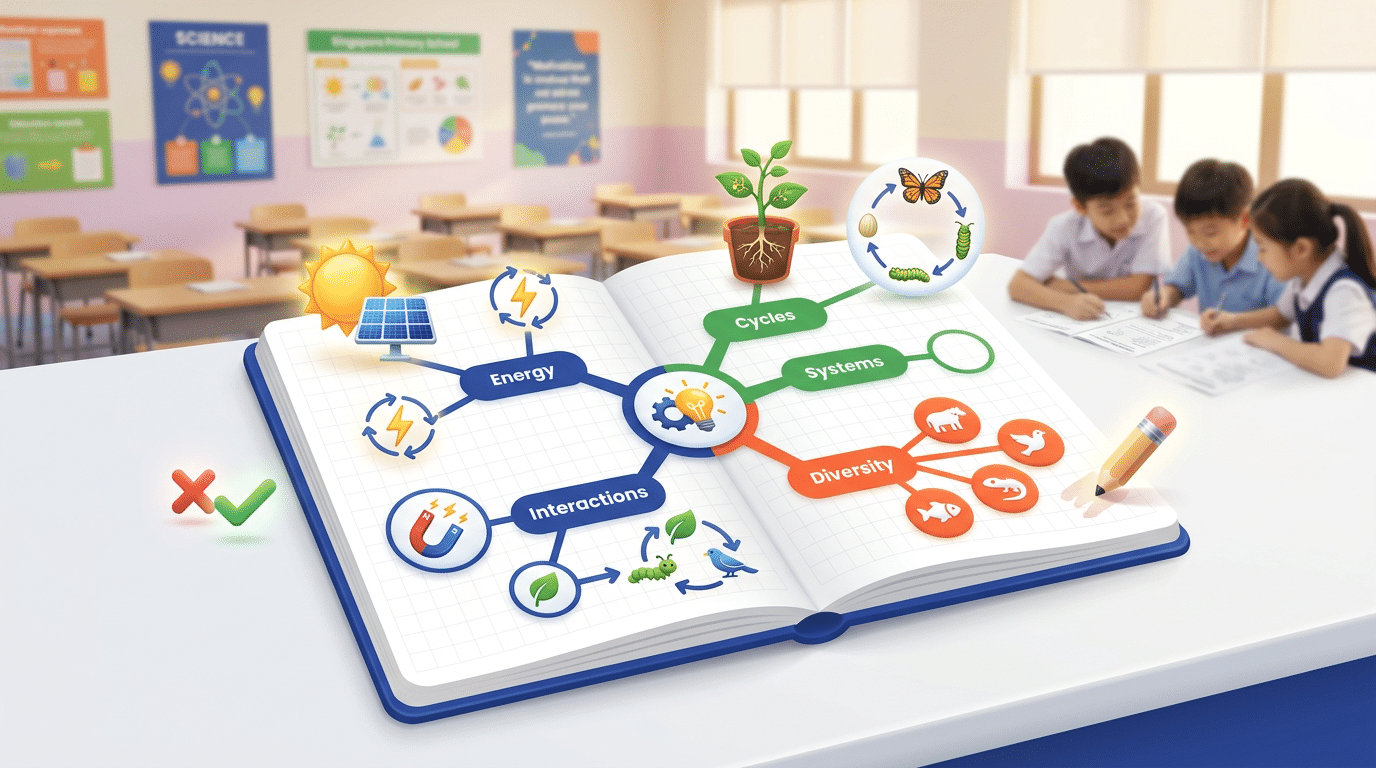
The MOE Primary Science syllabus is built around five overarching themes: Diversity, Cycles, Systems, Energy, and Interactions. These themes are not simply organisational labels — they represent the core ideas that connect all Science topics from P3 to P6. The aim is to help students appreciate how different topics are linked, allowing them to integrate scientific ideas rather than treat each topic in isolation.
At Primary 5, three of these themes become especially prominent. Cycles underpins the topics of Reproduction (in plants and animals) and the Water Cycle. Systems is the lens through which students study the Plant Transport System, the Human Respiratory System, the Human Circulatory System, and Electrical Systems. Energy connects to how circuits function and how living organisms use energy to carry out life processes. Understanding which theme a question draws from helps students select the right scientific framework before they begin writing their answer — a skill that becomes essential by PSLE.
A Topic-by-Topic Breakdown of P5 Science
P5 Science introduces six major topics spread across all four school terms. Each topic introduces systems or processes that are more abstract than anything covered in the lower primary years. Here is what your child will be studying and what makes each topic demanding.
Reproduction in Plants and Animals
This topic sits under the Cycles theme and covers pollination, fertilisation, seed dispersal, germination, and the basic concept of reproduction in animals. Students must understand the full sequence from pollination through to germination for flowering plants, and grasp how different structures (such as wing-like or hair-like seed features) adapt to their method of dispersal. A key skill here is sequencing — being able to describe what happens at each stage and in what order. Students who try to memorise individual facts without understanding the process tend to lose marks on questions that shuffle the sequence or introduce an unfamiliar plant scenario.
Cycles in Water
The Water Cycle topic has been updated in the revised syllabus to include temperature graphs that illustrate changes in the state of water during processes like melting and freezing. Students now need to interpret these graphs and understand that during a change of state (for example, from liquid water to ice during freezing), temperature remains constant even as the state changes. This is a conceptually subtle point that trips up many students. The topic also covers water pollution, including the effect of algae growth, and touches on the importance of water conservation — though the detailed methods of conservation are no longer required under the new syllabus.
Plant Transport System
Under the Systems theme, students learn how water and mineral salts are transported from the roots to all parts of a plant via water-carrying tubes, and how food made during photosynthesis is transported through food-carrying tubes. The technical terms xylem and phloem are not required under the updated syllabus — students should use “water-carrying tubes” and “food-carrying tubes” respectively. A common challenge here is explaining what happens when part of the transport system is disrupted: for example, what occurs when a ring of bark is removed. Students must connect structure to function and express why a change in one part of the system affects the whole plant.
Human Respiratory and Circulatory Systems
This is widely regarded as one of the most difficult P5 topics because it requires students to understand two separate systems — the respiratory system and the circulatory system — and then explain how they work together. The revised syllabus uses the terms “inhaled air” and “exhaled air” and introduces pie charts showing the composition of both. Students also need to understand the concept of oxygen-rich and carbon dioxide-rich blood. The key challenge is writing multi-step explanations that trace the journey of oxygen from the lungs into the bloodstream and out to the rest of the body — a type of process-based question that requires clear sequencing and accurate use of terminology.
Electrical Systems
Electrical Systems is introduced in P5 for the first time and sits under the Interactions strand. Students learn about open and closed circuits, series and parallel configurations, conductors and insulators, and the roles of each standard circuit component. The updated syllabus uses the term “current” rather than “electrical current,” and “bulb fuses” instead of “bulb blows.” This topic is notable for requiring both conceptual understanding and the ability to interpret and draw circuit diagrams. Questions in this topic often describe a change to a circuit — a switch is opened, a component is removed — and students must explain the effect on the remaining bulbs and why it occurs.
Key Syllabus Updates Parents Should Know
The updated Primary Science syllabus introduced several important changes designed to make learning more focused and age-appropriate. For parents supporting their children at home, understanding what has changed helps avoid confusion when comparing older resources with current school materials.
- Removal of the Cells topic: The standalone topic of Cells has been removed from the P5 syllabus. Terms like “cytoplasm” and “nucleus” are no longer formally assessed. A basic concept of cells is now introduced lightly within the Reproduction in Animals topic instead.
- Temperature graphs in the Water Cycle: Students now work with graphs showing constant temperature during phase changes such as melting and freezing, adding a graphical data interpretation element that was not previously required.
- Updated terminology in Plant Transport: “Mineral salts” replaces “minerals,” and food is described as being “stored above the cut” rather than “accumulated” when there is a ring cut in the stem.
- Respiratory System language updates: “Inhaled air” and “exhaled air” are now the standard terms. The composition of these is shown using pie charts rather than a single atmospheric air chart.
- Electrical Systems terminology: “Current” replaces “electrical current,” and “bulb fuses” replaces “bulb blows.”
- Reproduction in Plants simplification: Terms such as “self-pollination,” “cross-pollination,” xylem, and phloem are not required. “Feathery structure” is replaced with “hair-like structures” for seed dispersal descriptions.
If your child is using older practice books or worksheets, it is worth checking whether the terminology aligns with these updates. Using outdated phrasing in exam answers can cost marks even when the underlying understanding is correct.
The Jump in Answering Demands: From Recall to Application
Perhaps the most significant — and least discussed — aspect of the P5 transition is not the content itself, but the type of thinking the exam expects. In P3 and P4, many Science questions ask students to identify, name, or describe. From P5, questions increasingly ask students to explain why something happens, predict outcomes under changed conditions, and evaluate experimental methods. This is not just a harder version of the same task. It is a fundamentally different type of cognitive demand.
Consider a simple example. A P4 question might ask: “Name the organ that pumps blood around the body.” A P5 question on the same subject might read: “Explain what would happen to the cells in the body if the heart stopped pumping blood. Use the terms oxygen and carbon dioxide in your answer.” The student now needs to understand the role of blood in transporting gases, link that to what cells need in order to survive, and express the cause-and-effect relationship in precise scientific language — all within two to three sentences.
This is why many families notice what feels like a strange gap: a child can explain a concept clearly when asked aloud, but the same idea on paper earns partial marks or none at all. The issue is rarely that the child does not understand. More often, it is that they have not yet learned how to structure a written scientific explanation to the standard examiners are looking for. Addressing this gap in Primary 5 — before PSLE year — makes an enormous difference to outcomes in Primary 6.
Answering Techniques That Actually Earn Marks
Strong P5 Science answers are built on a few consistent habits. Once students internalise these habits, they apply across all topics and question types — making revision far more efficient than trying to memorise model answers for every possible scenario.
Read the command word first. Before reading the rest of the question, students should identify the instruction: “State,” “Describe,” “Explain,” “Compare,” or “Predict.” Each command word signals a different type of response. “State” requires a direct answer with no elaboration. “Explain” requires cause and effect. “Compare” requires both items to be mentioned with a clear similarity or difference. Students who ignore the command word often write the wrong type of answer — correct in content but incomplete in structure, which costs marks.
Use cause-and-effect connectors. Open-ended questions almost always reward answers that explain not just what happens, but why it happens. The clearest structure is: state the outcome, explain the cause, and link both using connectors such as “because,” “therefore,” or “as a result.” Simple sentence starters like “This is because…” and “As a result…” go a long way in making answers coherent and mark-worthy. A student who writes “The plant wilted” earns little. A student who writes “The plant wilted because the water-carrying tubes were blocked, so water could not be transported from the roots to the leaves” earns full marks.
Use precise science vocabulary. One of the most common pitfalls in open-ended responses is imprecise language. Instead of saying “plants make food,” students should write “plants carry out photosynthesis.” Instead of “the bulb goes off,” they should write “the bulb does not light up because the circuit is open and current cannot flow.” Using correct scientific terms consistently signals to examiners that the student understands the concept — not just the general idea. It is also worth noting that P5 students should use the updated MOE terminology (“current” not “electrical current,” “inhaled air” not “air breathed in,” etc.).
Anchor every answer to the question’s context. A scientifically correct answer that ignores the specific scenario in the question is not a full answer. If the question describes a particular experimental setup, the explanation must refer to those specific conditions — the material used, the variable changed, the observation made — rather than offering a generic textbook response. PSLE Science rewards application, and the habit of grounding answers in the given context is one of the clearest markers between an average answer and a full-marks one.
How to Help Your Child Prepare for P5 Science
Building strong P5 Science foundations is not about doing more practice papers — it is about doing them in the right way. Here are the approaches that make the most difference at this stage.
- Review wrong answers with your child rather than just marking them. Ask your child to explain their original thinking and then work through what the correct reasoning should look like. This develops the habit of cause-and-effect thinking more effectively than simply reading the model answer.
- Encourage active recall over re-reading. Closing the textbook and explaining a process from memory — “Tell me how blood moves through the heart and lungs” — is far more effective than re-reading notes. It forces the brain to retrieve and organise information in the same way an exam does.
- Check terminology against the updated syllabus. If your child is using older assessment books, make sure the vocabulary aligns with the current MOE terms. Outdated phrasing can result in lost marks even when the concept is understood correctly.
- Address gaps from P3 and P4 early. The MOE syllabus uses a spiral approach — P5 topics build on P3 and P4 foundations without re-teaching them. A child who is unclear on heat and temperature from P4 will find the Water Cycle’s graph questions harder than necessary. Filling these gaps early prevents compounding difficulty later.
- Focus on answering technique as a separate skill. Many students need explicit coaching in how to structure written scientific explanations, not just more content revision. Technique gaps caught in P5 are far easier to correct than the same gaps in P6, when time pressure is far greater.
If your child is struggling to bridge the gap between understanding concepts and expressing them clearly in writing, a structured learning environment with small class sizes and personalised feedback can make a significant difference. At EduFirst Learning Centre, our Primary Tuition programme is designed specifically for this transition — our classes of 4 to 8 students allow teachers to identify exactly where each child’s reasoning breaks down and provide targeted, immediate guidance. This level of individual attention is difficult to replicate in larger classroom settings, and it is precisely what P5 Science demands.
The Bottom Line for P5 Science
P5 Science is genuinely more demanding than what came before — not because the content is impossibly difficult, but because it requires a whole new mode of thinking and expressing. Students must move from recalling facts to applying concepts, from identifying parts to explaining systems, and from speaking ideas aloud to writing them precisely on paper. The topics themselves — Reproduction, the Water Cycle, Plant Transport, the Respiratory and Circulatory Systems, and Electrical Systems — all require this higher order of engagement, and the updated MOE syllabus has refined the terminology and focus areas accordingly.
The good news is that the skills required in P5 Science are learnable. With the right understanding of the topics, awareness of the updated syllabus expectations, and deliberate practice of answering techniques, most students can bridge the gap between what they know and what they can express on paper. The key is to start building these habits in P5 — not to wait until P6 when PSLE preparation leaves less time for foundational repair. Understanding what P5 Science truly demands is the first step, and this guide has aimed to give you exactly that foundation.
Give Your Child the P5 Science Support They Deserve
At EduFirst Learning Centre, we have been helping Singapore primary students navigate the P4-to-P5 transition since 2010. Our small class sizes of just 4 to 8 students mean your child receives genuine individual attention — and our teachers are trained to identify and address gaps in both content knowledge and answering technique before they affect results.
We offer Primary Tuition across 25 locations islandwide, as well as flexible E-Lessons for families who prefer online learning. Whether your child needs to strengthen their understanding of P5 topics or build stronger exam answering skills, we have a programme that fits.