- Oct 18, 2026
P6 Science Full Topic Map and Where Marks Are Lost
By the time your child reaches Primary 6, they have already spent three years building a foundation in Science. They know about matter, light, heat, life cycles, plant systems, electricity, and the human body. P6 does not start from scratch — it adds the final layer of new topics and then asks your child to use everything together under exam conditions.
That combination is exactly where most marks are lost. A child who knows each topic individually but cannot connect them, or who understands a concept but cannot write it in the format the examiner expects, will consistently leave marks on the table. Understanding the full P6 Science topic map — and recognising the precise points where students slip up — is the clearest starting point for targeted, effective revision.
This guide covers every topic cluster in the P6 Science syllabus, organised by MOE theme, and explains where marks are most commonly dropped in each area. It also walks through the three most frequent open-ended question mistakes and closes with a practical revision sequence your child can act on right away.
How PSLE Science Is Built: The Five MOE Themes
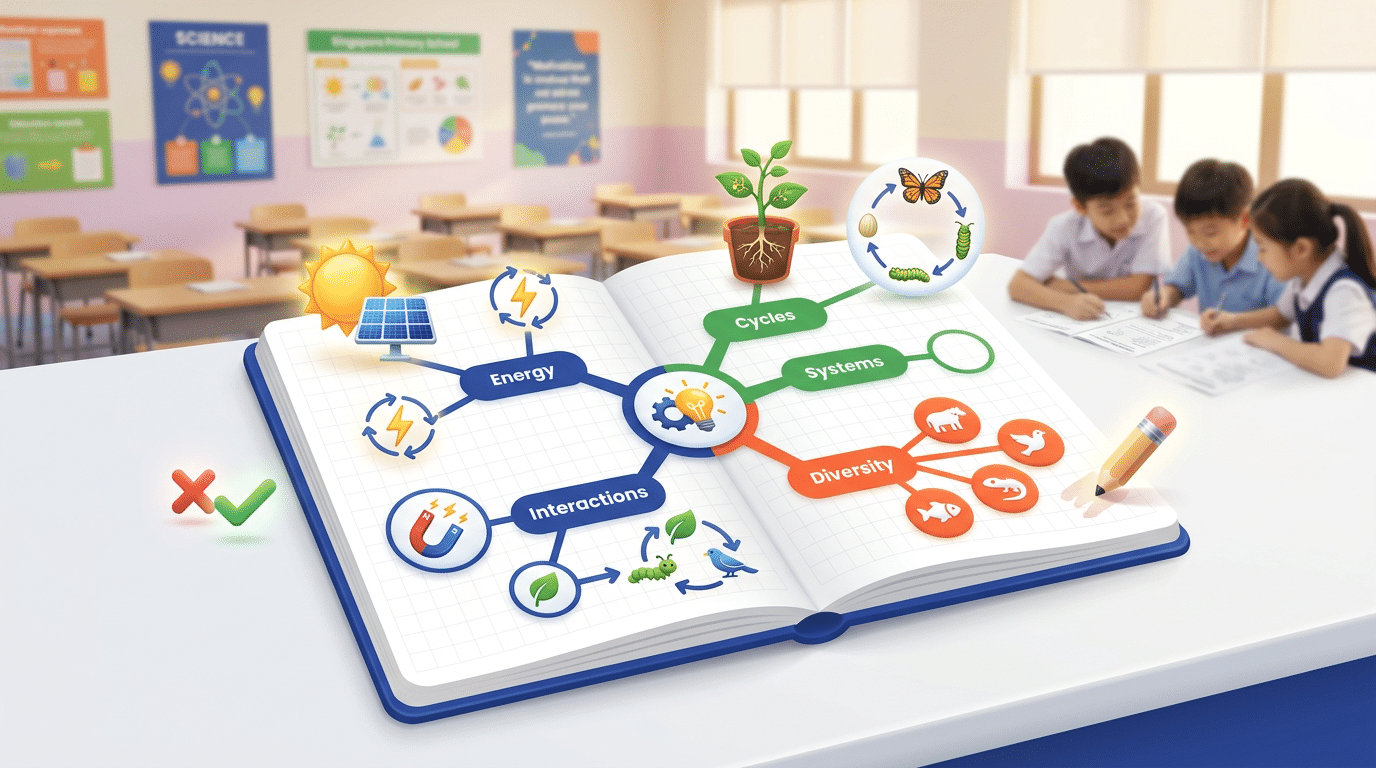
The Singapore MOE primary Science syllabus is organised around five core themes: Diversity, Cycles, Systems, Interactions, and Energy. Every question in both Booklet A (MCQ) and Booklet B (open-ended) comes from within these five themes. This framework matters because it tells you that Science is not a collection of disconnected facts — it is a web of ideas that the syllabus has been deliberately building since Primary 3.
Understanding which theme a question belongs to helps your child identify the right concept quickly and structure their answer around it. A child who can mentally file each question under its theme is far less likely to panic when the context looks unfamiliar. The five themes also explain why P3 and P4 content still shows up in the P6 exam: the earlier levels provide the foundational ideas that upper-primary questions build on.
The Full P6 Science Topic Map
The four topic groups introduced at Primary 6 sit within two themes: Energy and Interactions. Each group adds new content while connecting back to concepts already taught. The table below is a complete map of what your child is expected to know by the time they sit the PSLE.
| MOE Theme | P6 Topic | Key Concepts Covered | Connects Back To |
|---|---|---|---|
| Energy | Photosynthesis | How plants use light, water, and carbon dioxide to produce sugar and oxygen; factors affecting rate of photosynthesis; role of chlorophyll | P4 plant parts and functions; P5 transport in plants |
| Energy | Energy Conversion (Standard Science) | Tracking energy from one form to another; gravitational potential energy to kinetic energy; conservation of energy; forms of energy | P5 forms and uses of energy; P5 electrical systems |
| Interactions | Forces | Gravitational force and weight; frictional force; magnetic force; elastic spring force (Standard Science); effects of forces on motion and shape | P3 magnets; P4 and P5 matter and movement |
| Interactions | Interactions Within the Environment | Food chains and food webs; populations and communities; adaptations; human impact on the environment; habitats | P3 diversity of living things; P5 reproduction; P5 water cycle |
On top of these four P6-specific topic groups, the PSLE paper draws from every level of the primary Science syllabus. That means your child also needs to be fluent in the P3 to P5 topics that sit beneath them: heat and temperature, matter, electrical systems, life cycles, the water cycle, body systems, and plant systems. The P5 topics alone have historically accounted for around a third of total marks in the exam.
If your child is currently in primary school tuition at EduFirst, lessons at P6 are structured to cover both the new topics and systematic revision of earlier content — so nothing falls through the gaps.
Where Marks Are Lost: A Topic-by-Topic Breakdown
Knowing the topic map is only the first step. The more useful question is: within each topic, at which exact point do students stop scoring? The patterns below are consistent across school assessments, preliminary exams, and the PSLE itself.
Photosynthesis and Energy in Living Things
Photosynthesis is a topic that most students can describe in a sentence — plants use light, water, and carbon dioxide to make sugar and oxygen. The marks, however, are rarely lost at that definitional level. They are lost when questions ask your child to apply the concept to an experiment or compare two plants under different conditions.
The most common mark-losing pattern in photosynthesis questions is identifying the wrong variable in an experimental setup. A question might describe two plant setups that differ in light availability and ask your child to explain the result. Students who skim the setup description often answer about the wrong variable — concluding something about water when the experiment changed light intensity. Reading every detail of the setup before writing a single word is non-negotiable in this topic.
A second frequent error is confusing photosynthesis with respiration, especially in questions that involve both processes. Plants carry out both, but the conditions differ. Photosynthesis requires light and only happens in cells containing chlorophyll. Respiration happens in all living cells at all times. When a question asks what happens to a plant at night, your child needs to be clear that photosynthesis stops but respiration continues.
- Mark-loss pattern 1: Misidentifying the variable being tested in a photosynthesis experiment
- Mark-loss pattern 2: Mixing up photosynthesis and respiration in questions involving both
- Mark-loss pattern 3: Forgetting that only green parts of a plant (containing chlorophyll) carry out photosynthesis
Energy Conversion
Energy conversion questions require your child to trace the path from one energy form to another, usually across multiple steps. The most common mistake is skipping a step. A ball rolled off a table converts gravitational potential energy to kinetic energy — but a student who writes “potential energy to sound energy” when the ball hits the floor has jumped a step and will lose the mark. Each conversion step needs to be identified individually and in the correct order.
A related mistake involves the direction of reasoning. Energy conversion questions sometimes describe a scenario and ask students to explain what happened to the energy. Students who have only memorised direction-specific conversions (for example, always writing from chemical to electrical) can be thrown when the question works backwards or presents an unusual sequence. Practising with varied conversion chains — not just the standard textbook examples — is what builds the flexibility needed to handle these questions reliably.
- Mark-loss pattern 1: Skipping a step in the conversion chain (e.g., missing kinetic energy between potential and sound)
- Mark-loss pattern 2: Using vague language like “energy is used up” instead of correctly naming the energy forms involved
- Mark-loss pattern 3: Ignoring the specific scenario details and giving a generic textbook answer
Forces
Forces questions test whether your child can identify the correct force, state its direction, and explain its effect on the object. These three components — force type, direction, effect — are the consistent marking framework, and answers that leave out any one of them are incomplete. A student who writes “friction acts on the block” scores less than one who writes “friction acts on the block in the direction opposite to its motion, slowing it down.”
Gravitational potential energy and gravitational force are also frequently confused in this topic. Gravitational force is the pull exerted by the Earth on an object. Gravitational potential energy is the stored energy an object has because of its position above the ground. Mixing up these two ideas — especially when a question asks specifically about one of them — is a consistent mark-loser in both MCQ and open-ended sections.
- Mark-loss pattern 1: Incomplete force descriptions — naming the force without stating direction and effect
- Mark-loss pattern 2: Confusing gravitational force with gravitational potential energy
- Mark-loss pattern 3: Ignoring condition constraints in multi-part questions (for example, answering “drop from a greater height” when the question specifies height cannot be changed)
Interactions Within the Environment
Food web questions are one of the most consistently mishandled topic areas in the PSLE. The most widespread mistake is tracing only a single food chain when a question involves a web. If a question asks what happens to the eagle population when the rabbit population decreases, your child needs to consider all the organisms connected to both eagles and rabbits across the entire web — not just the single chain from grass to rabbit to eagle. Tracing one chain leads to an incomplete answer and costs marks.
Adaptations questions are another area where marks slip away. These questions place an organism in a new or unusual environment and ask whether it would survive, or ask your child to explain a structural feature. The mark comes from explicitly linking the adaptation to the specific environmental condition mentioned in the question. Writing that a camel has a hump is not enough; the answer needs to explain how the stored fat provides energy when food is scarce in a desert environment.
- Mark-loss pattern 1: Tracing only one food chain when the question requires full food web reasoning
- Mark-loss pattern 2: Describing an adaptation without linking it to the specific environmental condition in the question
- Mark-loss pattern 3: Missing the knock-on effects when a population changes — for example, not following the increase in a prey species when its predator decreases
P3 to P5 Topics That Still Appear in P6 Papers
Because the PSLE draws from all four years of primary Science, P3 to P5 content regularly appears — and many students underestimate how much these earlier topics still contribute to the overall mark. Heat and temperature, matter and volume, electrical systems, the water cycle, and body systems each appear across multiple questions in most exam sittings.
Heat and temperature questions lose marks most often through vague direction-of-transfer answers. Stating that “the object heats up” is not enough; your child needs to clearly identify which object transferred heat to which, and whether the material involved is a good or poor conductor. Matter and volume questions (particularly those involving floating objects and water displacement) lose marks when students apply the standard displacement method without adjusting for the fact that the object floats. Electrical systems questions most often trip up students who have not checked whether a circuit is open or closed before predicting brightness or current.
- Heat and Temperature: Vague direction of heat transfer; confusing good and poor conductors
- Matter and Volume: Applying the standard displacement method when the object floats
- Electrical Systems: Not checking whether the circuit is complete before answering
- Water Cycle / Evaporation and Condensation: Using everyday language (“water disappears”) instead of correct scientific terms (“water evaporates”)
- Experimental Questions: Incomplete fair-test answers that name the changed variable but fail to list what was kept constant and why
The Three Biggest Open-Ended Question Mistakes
Booklet B open-ended questions account for 44 marks in the PSLE Science paper, and they are where the gap between knowing a concept and being able to express it precisely becomes visible. Many students who score well on MCQs still lose significant marks here — not because they lack knowledge, but because of how they write their answers.
Mistake 1 — Stopping at the observation instead of explaining the cause. A student who writes “the plant wilted” has described what happened. An examiner cannot award a mark for that. The answer needs to trace back to the underlying reason: the plant did not receive enough water, so it could not maintain the pressure in its cells, causing it to wilt. Every open-ended answer should use a cause-and-effect structure — either explicitly with words like “because” and “therefore,” or through a clearly logical sequence of reasoning.
Mistake 2 — Using everyday language instead of scientific terms. “The water disappeared” costs marks. “The water evaporated” earns them. “The plant makes food” is vague. “The plant photosynthesises to produce glucose and oxygen” is precise. Markers work from a mark scheme that uses specific scientific vocabulary, and vague descriptions do not earn credit no matter how correct the underlying understanding may be. Building the habit of replacing everyday phrases with their scientific equivalents is one of the most straightforward improvements a P6 student can make.
Mistake 3 — Giving incomplete comparisons. When a question asks your child to compare two setups or explain why one result differed from another, both sides of the comparison need to appear in the answer. Writing only “Plant A grew taller” when the question involves both Plant A and Plant B is incomplete. The full answer addresses both: Plant A grew taller than Plant B because it received more light for photosynthesis, allowing it to produce more food for growth. This sounds simple in principle, but under exam pressure, students frequently drop one side and lose the mark.
These three mistakes are, importantly, correctable with focused practice. The key is not to do more papers — it is to review each answer against the mark scheme, identify which of these patterns is causing the mark loss, and rewrite the answer correctly. Doing ten practice papers with the same unchecked habits will not improve the score. Reviewing five papers properly will.
A Practical Revision Sequence for PSLE Science
With four years of content to cover, knowing where to start is half the battle. The most efficient revision sequence follows the mark distribution — not the order topics were taught. Upper primary content (P5 and P6) consistently carries around two-thirds of the total marks in the PSLE Science paper, so these topics should receive the bulk of your child’s revision time.
A workable sequence looks like this:
- Start with the highest-weightage P6 topics — Photosynthesis and Energy in Living Things, Forces, Energy Conversion, and Interactions Within the Environment. These are the newest topics and the ones most likely to have conceptual gaps that need addressing.
- Move to the highest-weightage P5 topics — Electrical Systems, the Water Cycle, Reproduction, Body Systems, and Forms and Uses of Energy. These appear in almost every exam paper and sit directly beneath the P6 concepts in terms of connections.
- Consolidate P3 and P4 topics — Heat and Temperature, Matter, Light, Magnets, and Life Cycles. These carry fewer marks but should not be skipped. Gaps here surface in multi-concept questions that blend earlier and later content.
- Practice experimental questions separately — Fair test design, control setups, identifying variables, and writing conclusions are skills that apply across all topics. They need to be drilled as a distinct skill set, not just encountered occasionally within topic revision.
- End each revision block with a timed past paper — Apply the answering techniques above to every open-ended question, check each answer against the mark scheme, and categorise every lost mark as either a knowledge gap or a technique gap. Address technique gaps immediately, before they become habits.
The goal of all of this is not just to recall facts on demand — it is to build the habit of connecting ideas across topics, reading questions carefully, and applying the right scientific language consistently. That combination is what earns marks in the PSLE Science paper, and it is the same combination that strong teaching in small groups helps your child develop most efficiently. EduFirst’s primary school tuition programme uses small class sizes of just 4 to 8 students to ensure every child gets the individual attention they need to close both knowledge and technique gaps — across every topic on the P6 Science map.
Turning the Topic Map into a Better Score
The P6 Science topic map is not overwhelming once it is laid out clearly. There are four new topic groups introduced at Primary 6 — Photosynthesis, Energy Conversion, Forces, and Interactions Within the Environment — and they sit on top of everything your child has already learned since Primary 3. The marks that go missing are rarely lost because students do not know the content. They are lost because of incomplete cause-and-effect explanations, imprecise scientific language, or misreading the conditions stated in the question.
Fixing those patterns takes structured, guided practice — and it takes someone who can identify exactly which pattern is causing the mark loss for each individual child. That level of specificity is what small-group tuition makes possible. At EduFirst, every student is seen, every answer is reviewed, and every technique gap is addressed directly rather than left to repeat itself across the next practice paper.
Ready to Help Your Child Master P6 Science?
EduFirst Learning Centre has been helping primary and secondary students across Singapore succeed since 2010. With small classes of just 4 to 8 students across 25 locations islandwide, your child gets focused, personalised attention on the exact topics and techniques that make the difference in PSLE Science.
We also offer e-lessons for families who prefer online learning.