- Oct 21, 2026
How to Choose Creative Writing Classes for Your Child in Singapore
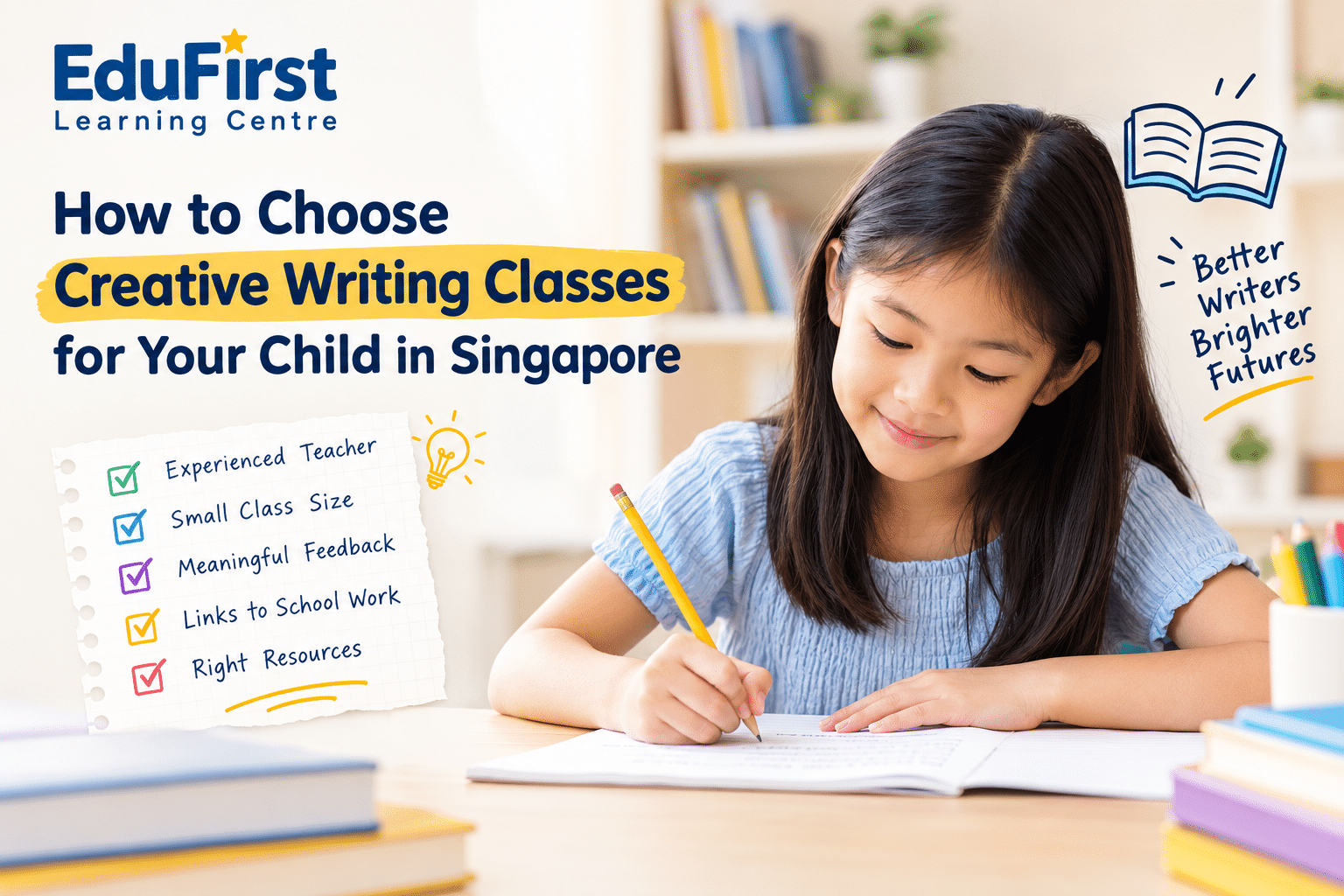
To choose creative writing classes for your child in Singapore, start with the teacher and the class size. Then check how feedback is given and whether lessons connect to school composition. Price and location matter, but they come later. A good class has your child writing every week and getting specific comments they can act on. If a programme can’t show you that, keep looking.
Parents at our centres ask us about this a lot. So here’s the checklist we’d use ourselves.
Why Parents Sign Up for Creative Writing Classes
Most parents come to us after a composition comes home with a low mark and a comment like “lacks development” or “weak vocabulary.” Others just notice their child freezes in front of a blank page.
The benefits of creative writing classes for kids go well past exam marks:
- Ideas come faster. Kids learn to plan a story in minutes instead of staring at the question.
- A wider vocabulary they actually use. Not memorised phrases, but words they pick for a reason.
- Clearer thinking. Writing a story makes a child put events in order and explain cause and effect.
- Children who write often stop fearing the composition paper.
- Better reading habits. Good writers read, and good classes push both.
Those gains don’t come from any class, though. They come from the right one.
How to Choose Creative Writing Classes: A Practical Checklist
Look at the teacher, not the brand
The person in the room matters more than the logo on the door. Ask who’ll teach your child and how long they’ve taught English at primary level. Ask if the same teacher stays with the class through the year. Kids open up to a teacher they know. Constant swaps undo that.
Check the class size
Writing needs one-to-one time. A teacher with 20 students can’t read every draft closely. Smaller groups mean your child’s work gets read properly, and they get space to ask questions without feeling shy. For writing, we’d treat anything above 10 as a warning sign.
Ask how feedback works
This is the one most parents skip. And it’s the one that matters most.
Good feedback is specific. “Good effort” doesn’t help anyone. “Your opening gives away the ending. Try starting in the middle of the action” does. Ask to see a marked script from a current student, with the name hidden. If the comments are vague, or there’s just a mark at the bottom, that’s your answer.
Make sure it connects to school work
Creative writing classes can be fun and still be useful. In Singapore, your child will face situational writing and continuous writing in PSLE English Paper 1. A class that ignores this format leaves your child to make the jump alone. The best classes teach imaginative storytelling, then show kids how to fit it into the paper’s word limits and time pressure.
See what they write with
Ask about materials. Are there themed booklets, picture prompts, model compositions? Model answers help, but only if the teacher breaks them down. Classes that hand out “golden phrases” to memorise tend to produce compositions that all sound the same. Markers notice.
Questions to Ask at a Trial Class
A trial lesson tells you more than any brochure. Go in with these:
| Question | A good answer | Red flag |
| How many students per class? | A clear, small number | “It depends,” with no cap |
| How often will my child write a full piece? | Every week or two | Mostly worksheets, rarely full stories |
| How is writing marked? | Written comments plus a talk-through | A mark only |
| How do you track progress? | Regular updates to parents | No clear answer |
| Can we switch classes if it isn’t working? | Yes, with a simple process | Locked into a long term |
Watch your child, too. Did they speak up? Did they walk out with something they wrote? That’s a better test than anything the centre says.
Red Flags Worth Walking Away From
- Promises of guaranteed AL1 or AL2 results. Nobody can honestly promise that.
- Heavy reliance on memorised phrases and “model stories.”
- No sample of marked work you can look at.
- A big upfront payment with no trial.
- Teachers who can’t explain why a piece scored the way it did.
How We Teach Writing at EduFirst Learning Centre
At EduFirst, composition sits inside our Primary English programme, so writing isn’t a separate add-on. Our classes are small, usually 4 to 8 students. That means teachers read every draft and talk it through with each child.
We cover creative and situational writing, with structured strategies for PSLE composition. Children practise brainstorming, plan their paragraphs and build descriptive language step by step. Lessons use past-year papers and themed reading booklets so reading and writing grow together. As a tuition centre in Singapore with branches across the island, we’re usually close to home or school.
We also offer a free trial class. Bring your child, see how they respond, and ask us the questions in the table above. We’d rather you choose with your eyes open.
FAQs
At what age should my child start creative writing classes?
Many children start around Primary 2 or 3, when school writing tasks get longer. Starting earlier is fine if your child enjoys it. Regular practice matters more than an early start.
How long before I see improvement in my child’s compositions?
Most children show clearer structure within a term. Vocabulary and style take longer, often a few terms of steady writing and feedback.
Are creative writing classes different from English tuition?
Some centres run them separately. Others, like us, build composition into English tuition so grammar, comprehension and writing support each other.
Should creative writing classes follow the PSLE format?
They should at least prepare for it. Imaginative writing builds skills, but your child still needs practice within the word limits and timing of the real paper.
What should my child bring to a trial class?
A pencil and, if you have one, a recent school composition. It shows the teacher where your child is right now.