- Sep 9, 2026
The O-Level Periodic Table Explained: Groups, Periods and the Trends You Are Tested On
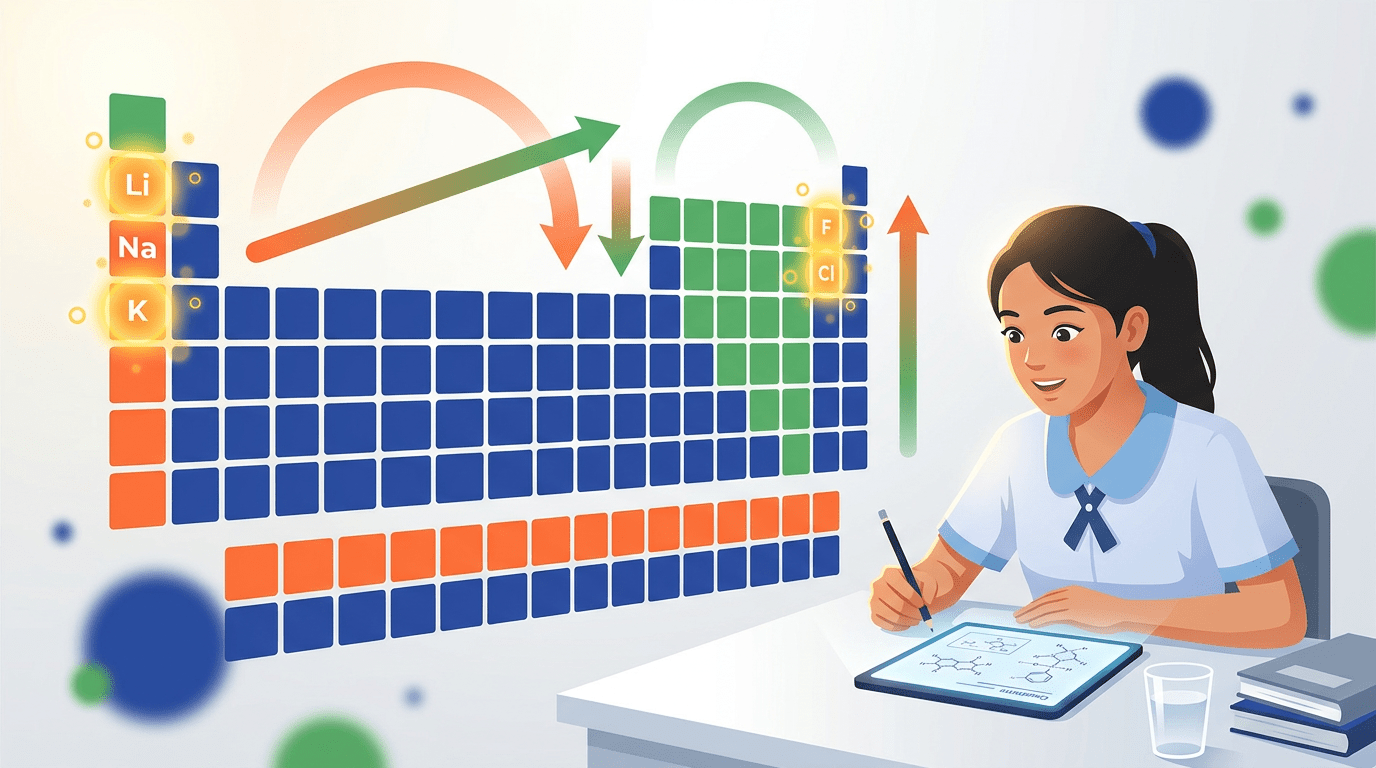
Open any O-Level Chemistry paper and you will find the periodic table printed right there for you to use. That might sound reassuring, but many students lose marks on this topic precisely because they assume that having the table means they do not need to understand it. The truth is that the O-Level Periodic Table is far more than a reference chart. It is a prediction tool, and the examiners expect you to use it as one.
This guide covers everything tested in the Singapore O-Level Chemistry syllabus (6092) on the periodic table: how groups and periods are organised, the trends you need to explain, the four key groups that dominate exam questions, and practical strategies for scoring marks on unfamiliar elements. Whether you are approaching this topic for the first time or doing a focused revision sweep, reading through this article carefully will give you a structured, exam-ready understanding of one of Chemistry’s most powerful tools.
What Is the Periodic Table and Why Does It Matter for O-Levels?
The periodic table is a systematic arrangement of all known elements in order of increasing proton (atomic) number. Every element has its own box showing its symbol, proton number, and relative atomic mass. What makes the table genuinely useful — and what the O-Level examiners test — is that an element’s position in the table tells you a great deal about its properties. Once you understand the patterns, you can predict how an element you have never studied will behave, simply by knowing where it sits.
For the Singapore O-Level Chemistry syllabus, the periodic table connects directly to topics across the entire course: atomic structure, ionic and covalent bonding, reactivity series, redox chemistry, electrolysis, and qualitative analysis. Students who understand periodic trends make fewer errors across multiple question types because they are applying a system rather than trying to recall disconnected facts. The table is provided during the examination, but as the syllabus makes clear, knowing how to extract and apply information from it is what earns marks.
Understanding Groups and Periods
The periodic table is organised into two key directions. Groups are the vertical columns, numbered 1 to 7 (and Group 0 for the noble gases) in the O-Level system. Elements in the same group share the same number of outer-shell (valence) electrons, which is why they display similar chemical properties. The group number directly tells you the number of valence electrons for Groups 1 to 7. Periods are the horizontal rows, numbered 1 to 7. Every element in a given period has the same number of electron shells, with that number equalling the period number. Sodium, for example, is in Period 3 and has three electron shells.
Understanding this two-directional structure lets you decode the electron configuration of the first 20 elements quickly. Take potassium (K): its proton number is 19, it sits in Period 4 (four shells) and Group 1 (one valence electron), giving an electron configuration of 2,8,8,1. Mastering this shortcut is essential for answering configuration questions efficiently under timed conditions, and it underpins everything else in this topic.
Trends Across a Period
Moving from left to right across a period, the number of protons and electrons increases while the number of electron shells stays the same. This produces a clear shift in character: elements on the left of each period are metals, while elements on the right are non-metals. Across Period 3, for instance, you move from sodium and magnesium (metals) through aluminium (a metalloid boundary element) to silicon, phosphorus, sulfur, and chlorine (non-metals). This is a tested trend at O-Level, and it is especially visible in the behaviour of oxides.
The nature of the oxide changes predictably across a period. Metal oxides on the left are basic, forming alkaline solutions when dissolved in water. As you move right, aluminium oxide is amphoteric (it reacts with both acids and bases), and the non-metal oxides further right — such as those of sulfur and phosphorus — are acidic. Exam questions frequently ask students to identify or explain this shift from basic to amphoteric to acidic oxides across a period, so it is worth committing to memory.
Group 1: The Alkali Metals
Group 1 contains lithium (Li), sodium (Na), potassium (K), and their heavier relatives. These elements all have one valence electron, which makes them highly reactive and gives them a remarkably consistent set of properties. They are soft, shiny metals with low densities — sodium and potassium both float on water — and they must be stored in oil to prevent reaction with moisture and oxygen in the air.
The reaction of alkali metals with water is one of the two key reactions in this entire chapter. The general equation is: alkali metal + water → metal hydroxide + hydrogen gas. The metal hydroxide produced is soluble and alkaline, which explains the group’s name. The vigour of this reaction increases down the group: lithium reacts steadily, sodium reacts vigorously, and potassium reacts so violently that the hydrogen produced ignites. This escalating reactivity is the central trend examiners test.
The reason reactivity increases down Group 1 comes down to atomic structure. As you move down the group, each element has an additional electron shell, so the outer electron is further from the nucleus and less strongly attracted to it. This makes the outer electron easier to lose, increasing reactivity. This explanation — linking atomic size to ease of electron loss — is exactly the kind of reasoning that earns marks in Paper 2 structured questions.
Key trends to know going down Group 1:
- Reactivity increases (outer electron lost more easily)
- Melting and boiling points decrease
- Relative atomic mass increases
- Density generally increases
Group 7: The Halogens
Group 7 contains fluorine (F), chlorine (Cl), bromine (Br), and iodine (I). Unlike the alkali metals, these are non-metals with seven valence electrons — just one short of a full outer shell. This means halogens are highly reactive and tend to gain an electron to form a -1 ion. They exist as diatomic molecules (F₂, Cl₂, Br₂, I₂), and their physical states at room temperature change visibly down the group: fluorine is a pale yellow gas, chlorine is a yellow-green gas, bromine is a red-brown liquid, and iodine is a dark grey solid that produces a purple vapour when heated.
The reactivity trend in Group 7 is the opposite of Group 1: reactivity decreases going down the group. Fluorine is the most reactive halogen and chlorine is more reactive than bromine, which in turn is more reactive than iodine. The reasoning mirrors that of Group 1 but in reverse: as atoms get larger down the group, the outer shell is further from the nucleus and the attraction to incoming electrons weakens. This makes it harder for larger halogen atoms to gain an electron, reducing their reactivity.
The second key reaction in this chapter is the halogen displacement reaction. A more reactive halogen will displace a less reactive halogen from an aqueous solution of its salt. For example, when chlorine water is added to potassium bromide solution, chlorine displaces bromide ions because chlorine is more reactive than bromine. The solution turns from colourless to orange-brown as bromine is released. These colour changes are observable and frequently tested in both MCQ and structured questions, as well as in Paper 3 practicals.
Key trends to know going down Group 7:
- Reactivity decreases (harder to gain an electron as atomic size increases)
- Melting and boiling points increase
- Colour deepens (from pale yellow to dark grey/solid)
- Physical state changes from gas to liquid to solid at room temperature
Group 0 / Group 18: The Noble Gases
Group 0 (also written as Group 18) contains helium, neon, argon, krypton, and xenon. These elements are monatomic — they exist as individual atoms rather than molecules — and they are extremely unreactive. The reason is straightforward: noble gases already have a full outer electron shell (helium has 2 electrons; the rest have 8), so they have no tendency to gain or lose electrons in ordinary chemical reactions. This stable configuration is what all other elements are effectively working towards when they bond.
While noble gases might seem like a quiet corner of the syllabus, they have real-world applications that sometimes appear in exam questions. Helium is used in balloons because it is light and non-flammable. Neon glows with a characteristic light when electrically excited, making it useful in advertising displays. Argon is used in light bulbs and welding to create an inert atmosphere that prevents reactions. Understanding why noble gases are used in these contexts — their lack of reactivity — is the core exam point.
Transition Elements
The transition elements occupy the central block of the periodic table, sitting between Groups 2 and 13. They are all metals, and they share a distinctive set of properties that set them apart from the main-group metals. Common examples tested in the O-Level syllabus include iron (Fe), copper (Cu), zinc (Zn), and nickel (Ni). These elements are denser, harder, and have higher melting points than the alkali metals in Group 1.
Three characteristics of transition elements are consistently tested. First, they can form variable oxidation states: iron, for example, can exist as Fe²⁺ (iron II) or Fe³⁺ (iron III) ions. Second, they form coloured compounds and ions: copper sulphate solution is distinctively blue, and iron(III) chloride solution is yellow-brown. Third, transition elements and their compounds are widely used as catalysts. Iron is the catalyst in the Haber process for making ammonia; vanadium(V) oxide catalyses the Contact process for making sulfuric acid. These applications connect the periodic table to industrial chemistry questions that appear frequently in Paper 2.
Exam Strategy: How to Use the Periodic Table Effectively
One of the most valuable question types in this topic asks students to predict the properties of an element they have not studied, such as rubidium (Group 1) or astatine (Group 7). The approach is always the same: identify the group, identify where the element sits relative to known elements, and apply the trend. If potassium reacts vigorously with water, rubidium — which sits below potassium — will react even more vigorously. If bromine is a red-brown liquid at room temperature, iodine — below bromine — will be a solid with a higher melting point. This logic is reliable across every question type and is the core skill this chapter builds.
When working through exam questions on the periodic table, keep these strategies in mind:
- Use the period number to determine the number of electron shells quickly.
- Use the group number to determine the number of valence electrons and predict ion charge.
- Apply trends directionally: Group 1 reactivity increases down; Group 7 reactivity decreases down.
- Always justify trends with atomic structure reasoning — marks in structured questions come from the explanation, not just the answer.
- For displacement reactions, identify which halogen is more reactive before stating the outcome and describing the colour change.
If you find it helpful to practise these skills alongside a structured programme, EduFirst’s Secondary Tuition classes cover the full O-Level Chemistry syllabus in small groups of 4 to 8 students, giving every student the individual attention needed to master topics like this. For those who prefer to study from home, E-Lessons are also available to support flexible revision schedules.
Common Mistakes Students Make
Even well-prepared students can lose marks on the periodic table topic through a handful of recurring errors. Being aware of these in advance is one of the most efficient ways to protect your grade.
- Mixing up reactivity trends. Group 1 reactivity increases going down; Group 7 reactivity decreases going down. These are opposite trends and confusing them is one of the most common errors in this chapter.
- Forgetting to explain the trend. Stating that potassium is more reactive than sodium is worth one mark. Explaining that potassium has an additional electron shell so the outer electron is further from the nucleus and more easily lost is worth the full marks.
- Misidentifying states of halogens. Chlorine is a gas, bromine is a liquid, and iodine is a solid at room temperature. Mixing these up costs marks in both MCQ and structured questions.
- Applying displacement rules in the wrong direction. Only a more reactive halogen can displace a less reactive one. Bromine cannot displace chloride ions from solution because bromine is less reactive than chlorine.
- Ignoring helium’s electron configuration. Helium has only 2 electrons but still has a full outer shell (the first shell holds a maximum of 2). Do not write helium’s configuration as incomplete.
Putting It All Together
The O-Level Periodic Table chapter rewards students who take the time to understand the reasons behind each trend rather than simply memorising the outcomes. When you know that reactivity increases down Group 1 because the outer electron is progressively further from the nucleus and easier to lose, you can answer any question about alkali metals — including ones about elements you have never encountered. The same logical framework applies to Group 7, noble gases, and transition elements. Knowing the patterns and being able to explain them in terms of atomic structure is the skill that separates good answers from great ones.
Keep in mind that the four tested groups (Group 1, Group 7, Group 0, and the transition elements) each have a distinct identity: alkali metals are reactive and form alkaline solutions with water; halogens are reactive non-metals that undergo displacement reactions; noble gases are stable and unreactive because their outer shells are full; and transition elements are dense, catalytically active metals that form coloured compounds and variable-charge ions. Getting comfortable with all four, and practising prediction questions regularly, will leave you well-prepared for whatever the examiners put in front of you.
Need Extra Support With O-Level Chemistry?
At EduFirst Learning Centre, our experienced tutors guide Secondary students through every chapter of the O-Level Chemistry syllabus in small classes of just 4 to 8 students. Every student gets the focused attention they need to understand tricky topics like the periodic table — and to apply that understanding confidently on exam day.