- Sep 18, 2026
Work-Study Diplomas in Singapore: How They Work and Who They Suit

Every year, thousands of Singapore students complete their secondary education and face a pivotal question: what comes next? For ITE graduates who have earned their Higher NITEC, a relatively new pathway has been gaining serious traction — the Work-Study Diploma (WSDip). It is a programme that offers something genuinely different: a nationally recognised diploma, full-time employment, and a salary, all at the same time.
But what exactly is a Work-Study Diploma, how does it compare to a conventional polytechnic diploma, and is it the right fit for your child or for you as a student weighing your options? This guide breaks down everything you need to know — from eligibility and structure to salary figures, career pathways, and the type of learner who genuinely thrives in this format. Whether you are a parent researching post-secondary options or a student trying to make a smart decision, read on for a clear, practical picture.
What Is a Work-Study Diploma in Singapore?
The Work-Study Diploma, commonly known as the WSDip, is a government-supported, apprenticeship-based diploma programme administered by the Institute of Technical Education (ITE) under the SkillsFuture Singapore framework. Unlike a traditional full-time diploma where students spend three years primarily in classrooms, the WSDip places graduates in actual companies from day one, combining structured on-the-job training with scheduled academic instruction. The result is a qualification that is earned through doing, not just studying.
The programme was introduced in 2018 and has expanded steadily since then. In 2025, five new courses were added across growth sectors, reflecting the government’s commitment to expanding vocational excellence as a legitimate and respected career pathway. Today, the WSDip stands as a credible alternative to the polytechnic route for ITE graduates who are ready to enter the workforce sooner rather than later.
How the Work-Study Diploma Works
The structure of the WSDip sets it apart from almost every other education pathway in Singapore. The programme runs for approximately 2.5 years, during which trainees are not students in the traditional sense — they are full-time employees of a partner company. This means they receive a salary, enjoy employee benefits, and are subject to the responsibilities of a working professional, all while working toward an academic qualification.
The curriculum is split between two modes of learning. The majority of the time, roughly 70% to 80%, is spent on On-the-Job Training (OJT) at the workplace. The remaining 20% to 30% involves Off-the-Job Training (Off-JT) conducted at ITE, where participants attend lessons with ITE lecturers covering the theoretical and technical dimensions of their field. This blend ensures that trainees are not just accumulating work hours but are building a genuine, structured knowledge base.
The curriculum is also deliberately designed in collaboration with industry partners, which means what is taught in the classroom directly mirrors what is needed at the workplace. This alignment gives WSDip graduates a meaningful advantage when they complete the programme, because the skills they hold are precisely the ones their employers — and the broader industry — are looking for.
Who Can Apply: Eligibility and Requirements
The WSDip has clear eligibility criteria, and understanding them helps students and parents plan ahead. The primary entry route is through an ITE qualification, but there is also a pathway for working adults who have accumulated relevant industry experience.
For ITE Graduates
Applicants must be Singapore Citizens, Permanent Residents, or Long-Term Visit Pass Plus (LTVP+) holders who have attained a relevant Higher NITEC, or a NITEC with a Grade Point Average (GPA) of at least 2.0 from a relevant course. Meeting the academic threshold is only the first step — applicants also need to secure employment with an ITE partner company before or during the application process. Shortlisted candidates typically attend interviews with partner employers, and the employer’s offer is what formally enables enrolment.
For Working Adults
The WSDip is also open to working adults who hold equivalent qualifications such as a Workplace Literacy and Numeracy (WPLN) Level 5 certification, provided they are at least 18 years old and have a minimum of two years of relevant full-time work experience. This route acknowledges that career changers and adult learners also benefit from this structured earn-and-learn format.
The Application Process
Applications are submitted through the ITE’s online portal, and candidates can typically select up to five course preferences. Shortlisted applicants attend interviews with partner employers — because securing a job offer is a prerequisite for programme entry. For male applicants who are ITE graduates, National Service (NS) deferment may be available for those who secure a WSDip placement, which is a meaningful practical consideration for eligible students.
Available Fields and Course Options
One of the WSDip’s strengths is that it spans a broad range of industries, reflecting Singapore’s diverse economy. Courses are not generic — each is tied to a specific employer vacancy and is designed around the competencies that sector actually demands. Current fields of study include:
- Engineering and Technology — covering areas such as precision engineering, electronics, and mechatronics
- Infocomm Technology — including cybersecurity, software development, and digital infrastructure
- Business and Services — spanning logistics, retail management, and financial services operations
- Healthcare and Nursing — providing a hands-on route into allied health roles
- Hospitality and Culinary Arts — placing trainees in hotels, F&B operations, and event management
- New 2025 courses — including digital supply chain management and sustainable facilities management
Beyond the ITE-administered WSDip, it is worth noting that Singapore Polytechnic (SP) also offers a Work-Study Programme (WSP) for ITE and polytechnic graduates, structured as a 12 to 18-month programme leading to a Diploma, Specialist Diploma, or Advanced Diploma. This means the earn-while-you-study model is available at multiple levels of the education system, not just through ITE.
Salary and Financial Incentives
For many students and families, the financial dimension of the WSDip is one of its most compelling selling points. Because trainees are full-time employees from the start of the programme, they earn a real salary throughout their studies — a significant contrast to the polytechnic route, where students typically rely on parental support or part-time work for three years of full-time study.
According to figures cited by the Ministry of Education, WSDip graduates earn a median monthly salary of approximately $2,850 upon completion of the programme — a figure that is comparable to that of polytechnic diploma holders. For context, the 2024 Graduate Employment Survey indicated that the median monthly salary for polytechnic graduates broadly sat at around $2,900, suggesting the WSDip closes the gap considerably for ITE graduates who take this route.
On top of the salary earned during training, eligible participants can access meaningful financial incentives:
- $5,000 SkillsFuture Sign-On Incentive — disbursed in two equal tranches of $2,500. The first is paid six months after commencement; the second upon graduation.
- $10,000 CPF Ordinary Account Top-Up — available to eligible WSDip graduates through the ITE Progression Award, boosting long-term savings for housing or retirement.
- Course fee sponsorship — employers typically cover or subsidise training fees, meaning trainees are not taking on educational debt while they study.
These combined incentives make the WSDip not just an educational choice, but a financially strategic one for students who need to start building their savings and CPF contributions early.
WSDip vs. Polytechnic Diploma: Which Is Better?
This is the question most students and parents ask when they first encounter the WSDip. The honest answer is that neither option is universally better — the right choice depends on the individual’s priorities, learning style, and career goals. Here is how they compare across the dimensions that matter most:
| Factor | WSDip (ITE) | Polytechnic Diploma |
|---|---|---|
| Duration | 2.5 years (with full-time work) | 3 years (full-time study) |
| Income during study | Yes — full salary from day one | No (part-time work possible) |
| Entry requirement | Higher NITEC or relevant NITEC (GPA ≥ 2.0) | O-Level or N(A)-Level results |
| Subject breadth | Focused on one industry/employer | Broader academic curriculum |
| University pathway | Possible (may require bridging) | Clearer direct-entry pathway |
| Recognition | Nationally recognised diploma | Nationally recognised diploma |
| Work experience gained | 2.5 years full-time employment | Short internships only |
For a student who is work-ready, financially motivated, and clear about their career direction, the WSDip offers a compelling head start. For a student who values academic exploration, is considering multiple degree options later, or benefits most from the structured learning environment of a polytechnic, the traditional diploma route may serve them better. Both paths are legitimate, and both can lead to a degree — the timelines and trade-offs just differ.
Further Study Pathways After a WSDip
A common misconception about the WSDip is that it leads to a dead end academically. This is not accurate. Upon fulfilling specific admission requirements, WSDip graduates are eligible to apply for full-time or part-time degree programmes at several of Singapore’s autonomous universities, including the National University of Singapore (NUS), Nanyang Technological University (NTU), Singapore Institute of Technology (SIT), Singapore University of Social Sciences (SUSS), Singapore University of Technology and Design (SUTD), and the University of the Arts Singapore (UAS). Graduates may also pursue Post-Diploma programmes at all five local polytechnics.
It is worth noting that NUS explicitly lists the ITE Work-Study Diploma as a recognised qualification for undergraduate admission — placing WSDip holders in the same applicant pool as polytechnic diploma graduates for relevant programmes. That said, some degree programmes may still require bridging modules or additional prerequisites, so students should check specific course requirements before assuming direct entry is guaranteed.
For those who complete the WSDip and want to continue deepening their skills without committing immediately to a degree, the Work-Study Post-Diploma (WSPostDip) programmes offered by polytechnics such as Nanyang Polytechnic (NYP) provide another structured earn-and-learn step up, combining employment with advanced training in a 12 to 18-month format.
Who Is the Work-Study Diploma Best Suited For?
The WSDip is a genuinely strong option for a specific type of learner, but it is not the right fit for everyone. Understanding this distinction can save students and families from making a decision that does not align with long-term goals.
The WSDip is likely a good fit if your child:
- Has completed Higher NITEC or a relevant NITEC and is not planning to go directly to a polytechnic
- Is self-motivated and ready for the responsibilities of full-time employment alongside studying
- Wants to start earning and contributing to CPF and savings earlier than peers on traditional education pathways
- Has a clear interest in a specific industry and is happy to commit to that sector for the duration of the programme
- Learns better through hands-on, practical experiences rather than primarily classroom-based instruction
- Is financially motivated and wants to reduce dependence on family support during their diploma years
The WSDip may not be the best fit if your child:
- Is still exploring different career interests and needs breadth of study to find their direction
- Is aiming directly at a specific university degree programme that requires a polytechnic diploma as a prerequisite
- Thrives in structured academic environments with more flexibility for subject choice and electives
- Would struggle with the dual demands of full-time employment and academic coursework simultaneously
Ultimately, the WSDip rewards students who are self-aware, career-focused, and ready to grow up fast. It is not an easier path — it is a different path, one that demands maturity and commitment in exchange for early financial independence and real-world skills.
Why Secondary School Performance Still Matters
It is tempting to view the Work-Study Diploma as a conversation that only becomes relevant once a student is already at ITE. In reality, the groundwork is laid much earlier — specifically during secondary school. A student’s O-Level or N-Level results determine whether they enter a polytechnic directly or take the ITE route first. And even within ITE, the Higher NITEC GPA that qualifies a student for WSDip admission is shaped by the academic habits and subject knowledge built during secondary school years.
This is why investing in strong academic foundations at the secondary level is so important. Students who receive the right support during their secondary education are better placed to meet polytechnic entry requirements outright, or to perform well enough in their NITEC and Higher NITEC studies to qualify for competitive WSDip courses. Either way, secondary school performance is the foundation on which all post-secondary options are built.
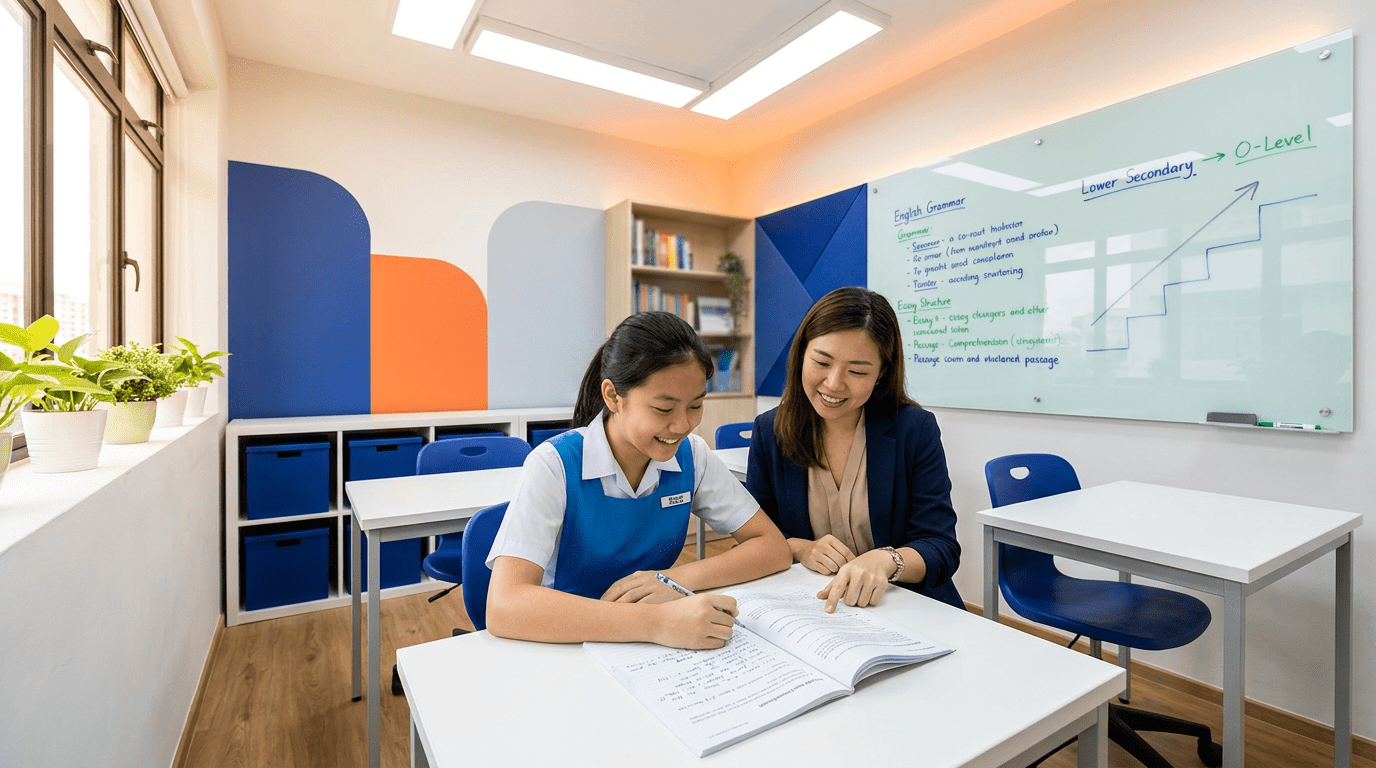
At EduFirst Learning Centre, our Secondary Tuition programmes are designed with exactly this in mind. With small class sizes of just 4 to 8 students, our teachers can identify each student’s gaps, build their confidence, and help them achieve the grades they need to keep all their options open after secondary school. And for younger students who need a strong head start, our Primary Tuition programmes lay the literacy and numeracy foundations that carry students through PSLE and into secondary school with momentum.
The decisions students face at 17 or 18 — polytechnic or ITE, WSDip or full-time diploma, work or study — are shaped by the habits, knowledge, and grades they built years earlier. Early investment in quality education support is one of the most practical things a parent can do to ensure their child has genuine choices when the time comes.
Final Thoughts
The Work-Study Diploma is one of Singapore’s most innovative education pathways — a programme that challenges the idea that earning and learning must happen at separate stages of life. For the right student, it offers a compelling combination of financial independence, industry experience, and a nationally recognised qualification. For families trying to make the best decision, the key is to understand the trade-offs honestly: the WSDip offers a faster income but a less flexible academic journey than the polytechnic route.
What remains constant, regardless of which post-secondary path a student ultimately takes, is that stronger academic foundations at the primary and secondary levels always expand the choices available later. Students who enter secondary school well-prepared, and who receive the right support throughout their O- or N-Level journey, are the ones who arrive at the post-secondary crossroads with the most options on the table.
Help Your Child Keep Every Option Open
Whether your child is in primary school building core foundations or navigating the demands of secondary school before the post-secondary crossroads, EduFirst Learning Centre is here to help. With personalised small-group tuition across Primary and Secondary levels, we make sure every student gets the individual attention they need to succeed — in exams and beyond.
Send us an enquiry today and let our experienced educators help your child achieve their full potential.